Category Archives: Church Planting
“There is no command in the Bible to go into all the world and plant churches”
Great reminders from J.D. Payne. Read the whole article here. A few excerpts of note:
Then why is there so much talk about church planting if there is no scriptural mandate?
The Church is to make disciples of all nations (literally, “peoples,” not nation-states). The best way to fulfill this mandate of evangelizing, baptizing, and teaching obedience is through the planting of contextualized churches among the various people groups and population segments of the world.
Biblical church planting is evangelism that results in new churches. But, churches can be planted with little to no evangelism being done.
But it’s not about church planting…it is out of a disciple making movement that churches are birthed (e.g., Acts 13-14).
Unfortunately, most church planters in North America are more involved in gathering together long-term Kingdom citizens than doing evangelism that results in new churches.
Today, we plant the church first, and then (hopefully) lead the church to do evangelism.
But planting churches is cool! It is cool to quickly start a worship gathering with high quality music and preaching. It is cool to quickly develop church programs for kids, families, outreach, missions, etc.
But it’s not about planting churches.
Our mandate is about evangelism, baptisms, and teaching those new believers how to be the local church in their context. It is about teaching those new believers how to gather for worship. It is about teaching those new believers how to preach, how to pastor, how to lead children, families. It is about teaching those new believers how to do missions. There is not much that others can see, feel, and hear in the early days of a church recently birthed from the harvest. . .
Planting churches is cool. . . making disciples from out of the harvest that will become local churches is not.
But it’s not about planting churches, is it?
Meeting the Challenge of Population Growth and Church Decline
A recent study of the Northshore communities in SE Louisiana revealed that less than 4% of the popoulation attends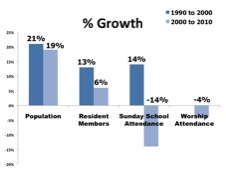 Southern Baptist Churches on any given weekend (11,000 attenders to 343,000 in population). Consultation with other evangelical groups revealed that less than 10% attend evangelical churches of any kind (approximately 25,000 attenders per weekend).
Over the next ten years the Northshore is projected to continue to grow at a rate of 22%, which would bring our population to over 419,000 people. 22% growth for Northshore Baptist churches would mean adding 5,296 new members in ten years. The real challenge is to increase the percentage of people attending worship gatherings and Bible Studies. Currently 3.3% of the population attends worship in Northshore Baptist churches. If we wanted to double that to 6.6% of the population in worship attendance over the next ten it would mean adding 16,434 worshipers. Currently, only 1.9% of the population attends Bible Study in NSBA churches. If we wanted to double that to 3.8% over the next ten years it would mean adding 9,304 people to our Bible Study rolls. Daunting numbers. How could we do this? And is it even possible?
Four suggestions to meet the challenge: First, we need some of our churches to breakout. Second, we need healthier and riskier church planting. Third, we need to partner to help churches in need of and willing to engage in revitalization. Fourth, we need a discipleship revolution.
Breakout Churches. A breakout church is defined by Thom Rainer in his book by that title as a church that reaches at least one person for Christ every two weeks or 26 persons per year, has a conversion ratio of 20:1 or 1 conversion for every 20 members per year, has tenured and consistent leadership, and the church makes a clear and positive impact on its community.[1] In our area, FBC Covington would be an example of a breakout church. In 1980, FBC had 322 in Sunday School and baptized 32. Dr. Waylon Bailey became pastor in 1989 and from 1990 to 2000, Sunday School attendance grew from 417 to 1,137. From 2000 to 2010, FBC relocated into a new facility, sponsored a new church on the Northshore which added 100+ members in its first five years, and today FBC has over 1,700 worshippers each week. And, since 1990, 1,745 people have been baptized through the ministry of FBC Covington. Bedico Baptist is another church that has broken out with tenured leadership. Leo Miller became Pastor in 1994. In 1995, Sunday School averaged 76 weekly attendees at Bedico. In 2000, that was up to 141, 2005 to 232, and Bedico has recently broken the 400 barrier. And since 1994, 537 have been baptized at Bedico. Others are poised to breakout across the Northshore. The momentum of growing churches breaking out will help us catch up with population growth and move past a season of decline.
Healthier and Riskier Church Planting. Healthier church planting means church planting that is led by churches with a heart to multiply and reproduce themselves for the sake of kingdom expansion. So, what’s needed for healthier church planting is healthy mother churches with a heart to reproduce. As Bob Roberts says in his great book The Multiplying Church, “The future of faith in America (and anywhere in the world, for that matter) is not tied to planting more churches, but in raising up of mother congregations of every tribe, tongue, denomination, and network that are reproducing… The hope is in pregnant mother churches.”[2]
Riskier church planting would be multiplication that targets hard to reach areas and unchurched pockets of our population. Missiologist Alan Hirsch suggests that current church models are reaching out to smaller and smaller segments of the population, with possibly as much as 60% of America untargeted by our evangelistic and outreach efforts.[3] Our study identified multi-housing residents as one potential segment that is underserved. Others may be those in their early 20’s with very little understanding of religion in any form. We need some church plants that go beyond planting a worship service that looks similar to others in the community, but will ask the question “Where is the church not?” and go there with the gospel. We need some church plants that have different scorecards and different expectations, but will faithfully deliver the message of Christ to unchurched people.
Partners in Revitalization. Church revitalization is needed to turn momentum around for congregations that are not effectively reaching their communities. This is already happening in a variety of ways on the Northshore, with Grace Memorial Baptist Church in Slidell becoming the sponsor of Covenant Baptist Church, which was in steep decline and in danger of shutting the doors. Also, with Woodland Park Baptist Church merging and taking on the assets and liabilities of New Life Church in Hammond, which was in steep decline, and now they are looking to plant a new church on the site. And FBC Hammond working through a self-assessment with the NSBA Staff to begin a process toward revitalization. Churches are needed who are willing to adopt or sponsor or merge with existing congregations for the glory of God. And churches are needed who are willing to admit there in need of coming under the wing of a benevolent parent church or work with a church wanting to help then in a revitalization effort.
A Discipleship Revolution. Call it revival, lay renewal, or awakening, what we need is a revolution of discipleship that will lead Northshore Christians to multiply themselves spreading the Gospel like a sneeze to their neighbors, classmates, coworkers, and beyond. In his book Church 3.0, Neil Cole observes, “we have lowered the bar of what it means to be a Christian, such that simply showing up to the weekly one-hour event with some regularity and a checkbook is all it takes.”[4] We must refocus on making disciples who will reproduce themselves by telling others, inviting others, and discipling others. Discipleship should lead to disciple makers on mission for others.
[1] Rainer, Tom. Breakout Churches. Grand Rapids, Michigan: Zondervan, 2005.
[2] Roberts, Bob. The Multiplying Church. Grand Rapids, Michigan: Zondervan, 2008.
[3] http://www.christianpost.com/news/alan-hirsch-church-model-reaching-only-40-percent-of-americans-47500/
[4] Cole, Neil. Church 3.0: Upgrades for the Future of the Church. San Francisco, CA: Jossey-Bass, 2010.
Church Multiplication
A few convictions and random ideas:
- If we’re going to reach the world the church must learn to multiply. On and off campus.
- Church planting and multiplication must be done with greater simplicity, regularity, and more organically.
- As a church leader I must practice “catch and release”, “low control-high accountability”, “sending the whole church” in order to maximize multiplication and disciple making.
- Christianity started out as a movement driven by a message passed on by ordinary people across their relational networks. Christianity will spread faster as a movement than as an institution.
- Jesus regularly sent people out before they were “ready.” People are more ready than I want to admit most of the time.
- You’re never “ready” to plant a church, so that means you’re always ready to plant a church. Just do it.
- If a church doesn’t plant another church in its first three years it likely never will.
- Starting a worship service is different from planting a church or making disciples.
- Discipleship should result in disciple makers. Disciple makers will spark multiplication.
- Discipleship leads to mission. Want a missional, outwardly focused church? Teach people the ways of Jesus.
- God won’t call us to something we can’t handle. Wrong. God always calls us to impossible tasks. Church multiplication is impossible without the Holy Spirit.
A few Church Planting dates for the Fall
- 8.24 – Partners in Church Planting Luncheon, 10:30am-1pm @ FBC Mandeville. For pastors and churches interested in getting involved with Church Multiplication. Ask questions, hear about opportunities and needs, plan and strategize with other multiplication minded leaders on the Northshore.
- 8.29 – Monthly Church Multiplication Network Meeting, 11:30am @ Cafe Nola in Ponchatoula. Network meetings are for planters, planting teams, future planters, planting enthusiasts, multiplication minded church leaders. Great time to fellowship, collaborate, encourage one another. And this fall we’ll add an optional Afternoon coffee training module/learning cluster after lunch. CP Networks are vital.
- 9.8-10 – Basic Training for Church Planters, 8:30am-4:30pm each day, @ Woodland Park Baptist Church in Hammond. For anyone planting or prepping to plant a church. Also, would be good for revitalization of a church. Pre-register here.
- 9.26 – Monthly Church Multiplication Network Meeting, 11:30am @ Northshore Church in Slidell.
- 10.21-22 – Greenhouse: Organic Church Planting w/Neil Cole @ New Orleans Baptist Theological Seminary. http://www.nobts.edu for more info. I read everything Neil Cole writes. Looking forward to learning from him at NOBTS this fall.
- 10.24 – Monthly Church Multiplication Network Meeting, 11:30am, @ TBA
- 11.28 – Monthly Church Multiplication Network Meeting, 11:30am, @ TBA
More than Maps
How many sub-groups, sub-cultures, people groups, neighborhoods, cracks, and crevices are there in your city or region? The homogenous suburban mass is breaking up and many cracks and crevices are left that only relational outreach can fill. So, mission strategy must look at the cracks and crevices, not just the maps. A block party Saturday in a local neighborhood turned out families from China, Virginia, and New York City. All had moved here in the last year. We have a new Jerusalem (Acts 1:8). Just planting worship services with a “ya’ll come” cannot be counted as a sole strategy that births regional transformation with more cracks and crevices developing around language, digital tribes, generational shifts, economic pressure, and information/activity overload.
Reading through the Missional Community Field Guide this summer, which proposes “in addition to using maps to determine our course of action we also implement cracks as a way of becoming the church.” Empowering people to see “the Gospel come to life and incarnated in whatever crack and crevice of society they find themselves in.”
“Reaching the world requires us to release the church to penetrate society, rather than simply offering more centralized services. Such a church, gradually infiltrating subversively through all the networks of society, will birth genuine city transformation.”
Some natural cracks and crevices that are common across our culture: Multi-housing complexes, restaurant workers, language groups, the first responder community. Are there others?
Check out Launching Missional Communities: A Field Guide by Mike Breen and Alex Absalom. Also, Mike Breen’s blog.
Why Plant New Churches?
I was recently asked to provide some info on why we need to plant new churches. Thought the links were worth sharing:
- Why Plant Churches by Tim Keller. “Nothing else–not crusades, outreach programs, para-church ministries, growing mega-churches, congregational consulting, nor church renewal processes–will have the consistent impact of dynamic, extensive church planting.”
- Why We Don’t Plant Church by Ed Stetzer.”new churches are the ultimate evangelistic tool because they begin with no other purpose than reaching unbelievers.”
- Assessing the Need for New Churches. “Many Pastors, me included, tend to think about a new ministry or church through the lens of what it may cost us. What if we thought about it in terms of the great cost to those who may never hear the Gospel.”
- Why Every Church Must Plant – info graphic from the North American Mission Board.
- Do We Really Need More Churches? by Ron Sylvia, excerpt from his book Starting High Definition Churches made available at http://www.churchplantingvillage.net.
- Why Start A Church? from Spin-Off Churches by Tom Cheyney, Rodney Harrison, and Don Overstreet.
- Northshore PROBE Results – If you’re asking the Why question in Southeast Louisiana, check out this research that points us to the fact that less than 10% of our population are attending evangelical churches.
Overheard, as a North American Church Planter
One of the #1 topics of conversation that I share with would be church planters is about expectations. And rightly so. 10 years ago my wife and I loaded all our possessions into a 24′ U-Haul and drove from Fort Worth, TX to Covington, LA to start a church on the Northshore of Lake Ponchartrain. We had no idea what to expect and were full of faith and a great deal of naivity as we began the journey. My wife and I have often unpacked our journey by thinking through the things we’ve overheard in 10 years of church planting. Here’s a few of those that may give you some hints about expectations:
“We’ll try to have someone there to help you unpack.” Expect to be alone.
If you’re a church planter, you’re the initiator. Don’t expect others to prioritize your vision or values. If they do, you must communicate well to them. Proverbs 13:2 says, “from the words of his mouth, a man will enjoy good things.” If you don’t communicate, you’ll travel alone. And until you communicate, you will travel alone.
For us, we arrived in Covington and hoped for help never showed up. Around 11pm the first day, Heather and I threw our mattress on the floor and crashed having unpacked 75% of our belongings alone. It would be two more days before we would meet someone from our partnering churches. The next morning, our neighbor came over and helped us unload the heaviest of our furniture. And we were able to begin casting a vision to them. Two months later, a Bible study started in our neighborhood, and neighbors began putting their faith in Christ. But those first few nights would be our first lessons on the loneliness of starting something new. The loneliness of shepherding and entrepeneurial ministry can be stifling. Get a coach or mentor, join a network, talk through the frustrations and expectation malfunctions. It is not good for man to be alone on this journey.
“I think we can handle that area on our own.” Expect to be misunderstood.
If your going to plant a church in North America, don’t expect every colleague to be receptive of the idea and of you. Unfortunately, us pastors often see church planting as unnecessary or a necessary evil, because we see it through the lens of how it will effect me and my church instead of a path toward more people coming to Christ. I was at first dismayed by this attitude, but began to see it as another objective in the process – to bring more people on board with God’s mission to multiply His church.
I also believe that part of this mindset is a result of a severe lack of vision on our part, especially with churches in the south. A church plant or mission church for many is a small red brick building that our men built last summer in a poor community for a struggling congregation. And that’s how it should be and that’s how we like it. They are there to make us feel good about our church, as a place to give our used Sunday school material, and not necessarily as a serious partner in the Great Commission cause. I felt hemmed in by this lack of vision at times in our journey. Especially when I was asked at one point, “do we need another ‘little’ church in that area.” Don’t get hemmed in by wrong headed or low expectations. Learn to ask the right questions about your community and let the fruit of your labor and God’s story of His work through you lead others to see the necessity of church multiplication.
“I didn’t know churches helped people.” Expect to find opportunities
I hate to admit it, but at one point, I began believing that maybe we didn’t need to multiply and the whole thing was a lost cause, but then I began getting out and meeting people and I saw the divide between the opinions of the Sunday morning faithful and the other 80% of the people in the community. One particular conversation I had with a leader in our community drives the nail home for anyone trying to answer the question, “Why do we need new churches?” I gave him my short spill about planting a new church in the area and asked him my standard question for community leaders, “How could a church help you?”
His honest reply has been foundational for me over the last 10 years. He said in all seriousness, “I didn’t know churches helped people.”
Personally, He had been deeply offended and hurt by churches. Professionally, he had reached out to churches for help with community events only to get turned down again and again. Over time, he had lost confidence that the Church was on his side. That conversation led to a personal friendship that grew very deep and led to open doors into the community including our new church’s first meeting place along with countless opportunities to show Christ to people in our area.
Almost every church planter I’ve talked with can point to one relationship or one event or one big break that opened the door for movement to begin. It’s like the Apostle Paul finding the prayer group by the river led by Lydia, or Phillip happening upon the Ethiopian eunech reading the scriptures, or Peter looking up and seeing the doors of the prison cell are wide open. If God calls you to reach a community, you can expect Him to open doors into and already be working in that community. The work of the church planter is to be intentional, look for those open doors, and prepare to be used in tremendous ways.
“Here’s my deal – $270,000.” Expect God to provide.
For 54 months our new church met in the bay of an un-airconditioned Fire Station. We had prayed and sought for land and space in the area where our denomination had asked us to plant. Then in May of 2005, my phone rings and a local business owner whom we had befriended and served on a number of occasions said abruptly, “$270,000.” She owned a business on the busiest highway, in the very center of our community. As we investigated her offer, we learned the property was worth at least twice as much and she’d been offered three times as much, but for some odd reason, she wanted us to have it. We worked with partners to purchase the property and began preparing the building for a place of worship and we held our first worship gathering there on July 26th, 2005. That date is significant to everyone in SE Louisiana, because on August 29th, 2005, Hurricane Katrina devastated our entire area. The day before the storm I realized how God had provided. Our new building had a 125K Diesel Powered Generator, a full commercial kitchen with 1,000 gallon propane tank, and it was in one of the highest areas of the community. I think we were the only church in our parish that was able to have worship gatherings IN AIR CONDITIONING every Sunday after Katrina. Many meals were served, volunteer groups were housed, and people were saved. And that Fire Station was rendered completely inoperable by the Hurricane. A good friend of mine says, “God gives you what you need, when you need it.” Church Planter, you can expect Him to do the same for you.
“I think you dropped the ball.” Expect to be criticized.
One of the toughest seasons of the journey for me personally, was when body life began to be solidified and difficult decisions had to be made. Purchases that not everyone agreed with, lifestyle issues that led to church discipline, relational issues in the body that threatened division. If you’re a leader, you can’t avoid having fingers pointed at you during these seasons of body life. And as a church planter, you may suffer sleepless nights, because you gave someone influence and they weren’t ready and now they’re turning on you or others or they’re overwhelmed and burning out. Or because someone got mad and left the church, but kept the directory, and now is having dinner parties in your dis-honor. Or because you have to ask someone to leave for reasons that shouldn’t be aired in public. Or because someone comes to you and announces they’re leaving the church right before you supposed to get up and preach a sermon on unity. You could run from all of this and just sink into a people pleasing mode, trying to make everyone happy, and keep as many butts in the seats as possible. Or you can learn, grow, admit mistakes, confront divisiveness, correct sinfulness, forgive those who trespass against you, and count on Christ to grow his body in his way. I’ve still got some learning to do on this one.
“If it hadn’t been for Hope Church…” Expect to make a difference.
For me as a church planter, these five words bring chills and tears – “If it hadn’t been for…” Why? Because I can remember when there was no Hope Church or Bridge Church. And I can remember how many times I wanted to say no and I wanted to give up and I lay awake at night asking God why we’re not making headway. In his book Failing Forward, John Maxwell says, there is no such things as failure, only those who quit too soon. Don’t give up. God’s called you for a reason. There are those in your community who are waiting on you to bring Good News to them. Keep fighting, keep praying, keep planting seeds. You can and will make a difference.
10 Years Ago Today,
Heather and I were unloading our U-Haul in Covington, LA to begin a Church Planting journey. We’ve added 20 lbs (that’s me, not Heather), a few gray hairs, 2 more Corley’s, lots of great friendships and changed lives, not a few sleepless nights and lessons learned. And now I’m more convinced than ever that:
- God is a great provider and is sufficient for any and every situation.
- God is a sender. And sometime he sends us into uncertainty and high water.
- Experience in church planting just means you know how difficult its going to be.
- New churches are needed to reach the 60% of people who are not being sought by current ministry models.
- Church must become more reproducible and easily multiplied if we’re going to reach the world for Christ.
- A good wife is more valuable than a seminary degree. Or anything else I can think of for that matter.
- Church Planters have more fun.
I’ve kept a journal of things I’ve overheard and noted over the past 10 years. Sharing some of that later.
“If you want to build a ship, don’t summon people to buy wood, prepare tools, distribute jobs, and organize the work – rather, teach people the yearning for the wide boundless ocean”
– Antoine de Saint-Exupery
“Could we change the world by starting 1,000 mega churches over the next 10 years?” #exponential Notes 2011
Question ask by Matt Carter during one of the Main Sessions led by he and Ed Stetzer at Exponential Conference in Orlando, April 26-29, 2011. Here’s a few notes:
Matt Carter:
- Could we change the world by starting 1,000 mega churches over the next 10 years? Answer: We actually just did that. Over the last 10 years 1200 mega churches were started and interestingly enough less people are attending church today than ever before. No 1,200 mega churches wouldn’t hurt and would be welcome, but we cannot be a one weapon army.
- There is a restlessness among laity today that’s not existed in a long time. People are asking, “why is what we see in the New Testament so different from today’s Christianity?”
- If we build more and reach more in one place, what changes in our cities? Sending people as missionaries into the cities will bring real transformation.
- Change the scorecard for the church to MISSION together. No better way to foster community than be on mission together. Aim at community get nothing. Aim at mission get community thrown in.
- Train church members to be missionaries, to feed themselves, and to reproduce.
- Raise the bar for engagement. The sky is the limit. People with the power of the resurrection inside of them are passing out bulletin in our churches. People are capable of so much more than we are asking and allowing. We must release them.


 Lane Corley