Faith in Action Weekend: Where is the Church Not?
In 2008, we were assessing the need for a potential new church in West St. Tammany Parish. One of my favorite questions in assessing the need for a new church is, “Where is the church not?” Meaning, is there places in this community where the Gospel & the body of Christ are not represented to a population segment or people group? And then, can sustainable ministry be developed through an existing or new church?
 As part of this assessment, we came across Oak Villa Mobile Home Park in Covington. 150 lots, 450 people living there, 75-100 under the age of 18, 25% of the households are elderly, many with no local family, many in transition – lost job, recently divorced, just got out of jail. This became the first place of engagement for a Bible Study group that was meeting to form Bridge Church. We started by building a relationship with the management & meeting the immediate needs that she recognized, which was six households that needed food assistance. That led to ministering to one of those households in another practical way. A bed ridden elderly man was overrun with cock roaches. So our Bible Study group made the very spiritual decision to purchase him a year’s worth of pest control.
Since those first projects we’ve built porches, steps, handicap ramps, conducted regular kids activities, block parties, How to seminars, pressure washed trailers, etc. We’ve also served as Shepard to a shepard-less group of people – conducting funerals, counseling, benevolence, etc.
 Then in 2010, with the help of Fairview Baptist Church, Coushatta, LA & the Louisiana Baptist Convention we were able to get our own Mobile Home in the park where today we have a Food Pantry, weekly Bible Studies, & we can call ourselves neighbors to the largest multi-housing community in West St. Tammany.
This weekend will be Bridge Church’s Faith in Action Sunday, where instead of gathering we scatter & serve our community in a variety of ways. We’ll be focusing on the needs of Oak Villa MHP. Projects will include building a couple of wheelchair ramps for elderly residents, trimming trees in the park that could damage trailers if we have a high wind event, activities & Bible stories for kids, Outdoor Worship & we’ll close out with the Big Kahuna water slide. We’ll also be baptizing several residents of the park who are ready to follow Christ.
Faith in Action Sunday is about going where the church is not. Less than 2% of multi-housing residents attend church & in low income areas like Oak Villa, many of them cannot due to lack of transportation. This is an opportunity for us to take church to them & show them the body of Christ in our area cares. And ongoing ministry demonstrates we love them because we care enough to come back.
Ask, “where is the church not?” about your community. Is there ministry that you, your small group, your church could do? You can also join Bridge Church for Faith in Action Sunday, June 30th, 9:30am at Oak Villa Mobile Home Park, 15455 Ronald Reagan Hwy., Covington.
Click here for a few shovel ready Multi-Housing Ministry Ideas. Click here for some info about starting Faith In Action as a ministry in your community.
Do We Need a Church Revitalization Plan?
 Diagnosing the need for church revitalization is often the hardest step. And in my experience as a strategist, most seem to wait till it’s an emergency, stage four kind of diagnosis to make the call & begin to plan. I’ve mentioned a few great tools to use in diagnosis before (Here & Here). Like all health issues, the sooner you make the call & begin to address the problems, the better off you’ll be.
Here’s another great list for diagnosis to go over with a leadership team:
4 Types of Churches in Relation to Life:
1. Declining – Struggling to make budget, recruit leaders, & influence the community. Leaders are tired, frustrated, struggling to believe & dream.
2. Existing – Stable, Making Budget, celebrating each others milestones, harvesting low hanging fruit. Little passion for the lost & little knowledge of the church in the community.
3. Adding – Slight growth each year, a few passionate & fruitful leaders on a pedestal in the church & community. Growth rate probably below population growth rates. Inviting friends to church is easy. Some new people being reached, but transfer growth still a much greater %. Momentum is up and down with the calendar.
4. Multiplying – Growth at multiple levels – inside church & in the harvest fields, influence growing in the community, new leaders each year. A belief that something great is happening permeates the leadership. New people being reached in the community. New ministries springing up. Momentum makes work seem like play.
Questions:
- Which describes us?
- Which will describe us in 5 years?
- Where do we want to be?
- How can we get there?
DoWeNeedChurchRevi – PDF Download
_________________________________
If 80% of churches are declining, 98% probably are included in declining, existing, & adding. Few are multiplying.
In our Association, only 3.3% of the population attend a Southern Baptist Church, around 7% an evangelical church of any kind. We found that if we wanted to double that to 6.6% over the next 10 years, we would need to add over 16,000 worshippers to our current 11,000. Truly Multiplying churches are needed! But so few of us have ever seen it. We’re very content to add.
One of my fav books on this is Bob Roberts The Multiplying Church (My Summary Here).
“The highest demonstration of maturity for a local church is when it multiplies. Only something alive can reproduce, and it will do so only if it is healthy.” ~ Bob Roberts
Fatherhood Through Their Eyes
A few years ago my oldest son defined what Fatherhood looked like to him after 7 years with me:
- Fun
- Awesome
- Tall
- Holy
- Eats Alot
- Really Stinky
- Smart
He knows me pretty good! And I’m trying to live up to most of this list. But being aware of what’s seen through their eyes is so important as a Dad. They learn so much from what they see, and smell I guess. My to do list for my boys: Be intentional, listen, point them to God’s Word, accumulate experience & memories. And remember, he/she may be Just Like You.
How would your son or daughter define Fatherhood by what she sees in you?

147 Million Orphans Minus One
Excited to be a part of Evan & Angie McGinty’s adoption journey. Get one of these great t-shirts HERE. Follow the story at their ADOPTION BLOG. Other fundraising efforts HERE. Also, Bridge Church will be doing a BBQ luncheon on August 4th to raise money for them. More info soon. A baby boy from Ethiopia will be graced with an incredible family some time soon.


On Finding Friends
I went out to find a friend
but could not find one there;
I went out to be a friend
and friends were everywhere.
– Author Unknown
Dale Carnegie in How to Win Friends & Influence People:
“You can make more friends in two months by becoming interested in other people, than you can in two years by trying to get other people interested in you.”
The path to great relationships is to love others in obedience to God. To focus on the needs of others & not your own.
“A friend loves at all times…” Proverbs 17:17
Tools for Revitalization: Church Systems Analysis
I like this line of thinking. Just like the human body stays healthy because of healthy systems – respiratory, nervous, digestive, skeletal, etc., a church needs healthy systems to stay healthy. Here’s an Assessment tool we’ve developed to help a church leadership team assess its systems. Get Nelson Searcy’s book on systems here. 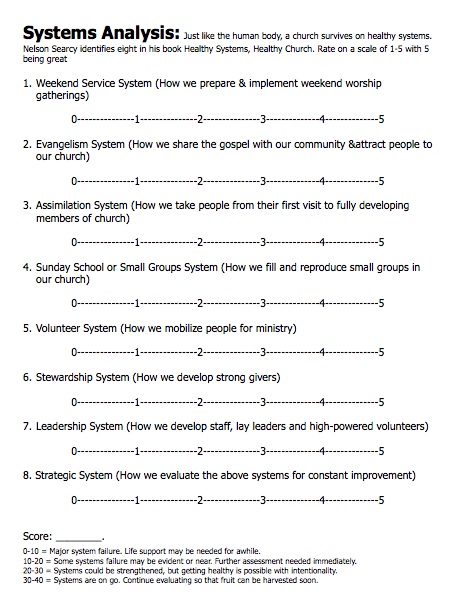
ChurchSystemsAnalysis – PDF Download
Remembering D-Day: Personal Pics from the WWII Memorial in D.C.
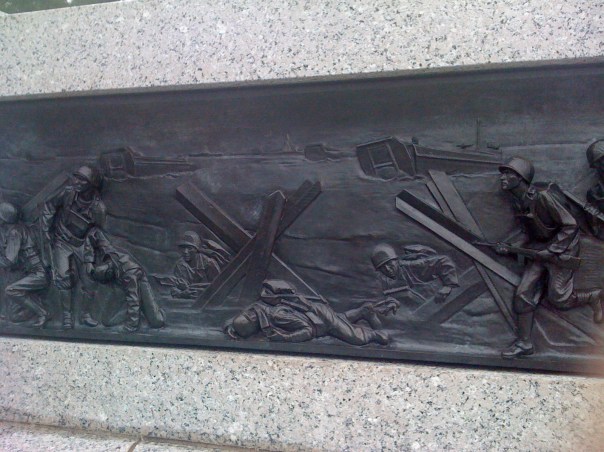


“You will bring about the destruction of the German war machine, the elimination of Nazi tyranny over the oppressed peoples of Europe, and security for ourselves in a free world. Your task will not be an easy one. Your enemy is well trained, well equipped, and battle-hardened. He will fight savagely….The free men of the world are marching together to victory. I have full confidence in your courage, devotion to duty, and skill in battle. We will accept nothing less than full victory. Good luck, and let us all beseech the blessings of Almighty God upon this great and noble undertaking.” ~General Dwight D. Eisenhower giving the D-Day order on June 6, 1944.
How Does a Pastor Create Sending Capacity?
“The greatness of a church is not in her seating capacity, but in her sending capacity” ~Rick Warren.
I’ve heard this saying over & over again for the past 15 years or so from Pastors and church leaders from all different perspectives of ministry. But I haven’t seen much about how to expand the SENDING capacity of a local church or a real change in strategy to developing SENDING capacity. Many pastors are frustrated because of the inability of the church to penetrate the lost culture. Cycles of transfer growth are disheartening to many, both OUT (people leaving one church to join another church that has more or different) and IN (the only growth being people coming from other churches).
Let me suggest we must add a SENDING mindset to our idea about church life. Recently I got calls from two churches that are large & “successful” asking what church I knew that could do ______ ministry, because they didn’t have anybody that could do it. I thought, you’ve got more people than 99% of the churches in the area and you don’t have anybody that can be sent into the community to meet a need? The answer: Yes they do! Now, I know every church can’t meet every need. That’s why we network & affiliate. And I know that some pastors are trying to send, but the season the church is in may make it difficult. But the challenge is, do we see the church as a body to be sent? Do we see mission as a necessary component to spiritual & church growth? Do we see sending capacity as a measure of success? Do we see the people of the church as ambassadors of Christ to bless the community? Do we see our role as an equipper of the saints to do the work of the ministry? It’s a mindset.
Here’s a simple mindset exercise that I was taught by mentor & friend Jim Gerlach that helps me remember my role as a sender/equipper. In preparation, am I thinking:
They’re coming, how do I get ready? or They’re not coming, how do I get ready?
In the first question, we’re thinking inwardly, how do I communicate the message to these people I know, how to meet their needs best, my presentation, what people will think of ______, making sure everything’s perfect, how do I shield criticism, etc. Necessary & not bad stuff. But the second statement pushes me to recognize the reality: there’s a world out there that is unreached, so how do I get the message to them? This helps me shift my thinking from meeting these people’s needs, to sending these people on mission / equipping these people for mission in our world. How can I get the message out creatively to different population segments? etc. Balancing these two questions is the work of the leader that desires to create sending capacity as seating capacity grows.
And in most of our communities unfortunately the second statement is coming true. They’re not coming. In my community, less than 10% attend an evangelical church. Most pastors are shocked at that stat. I was too, because I was so focused on getting ready for those that are coming. We must change our mindset if we will continue to push back darkness in our world.
How do you create sending capacity? What other questions should we be asking?
“caring for orphans AND widows in their distress”
Much attention is being given to the orphan crisis in the world and rightfully so, with 147 million orphans worldwide. I’m excited that our family is participating in several fundraising projects for orphan causes currently. But let’s not neglect the second part of the admonition in James 1:27, “Pure and genuine religion in the sight of God the Father means caring for orphans AND WIDOWS in their distress” (NLT).
In my community we recently found out about a widow that has been without refrigeration or hot water for 7 months. There are widows whose yards are overgrown because they can’t afford lawn care and have no nearby family. Our church is helping a widow who’s still displaced from her home due to hurricane damage with no flood insurance or government help to make repairs. And it’s a global crisis, just like with orphans. A church in Zimbabwe that we’ve partnered with hosts a regular widows meetings with over 400 in attendance that lack the ability to care for themselves. The stories of grief, loss, and suffering from these meetings are shocking and heartbreaking.
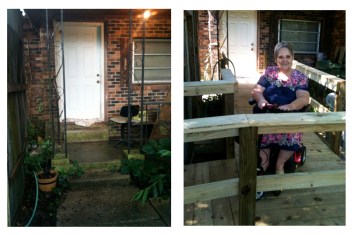
Before & after a ramp was installed for an elderly widow in my community.

Over 400 widow gather for prayer in Mbare, Zimbabwe.
God’s heart in James 1:27 is that we take care of those who can’t take care of themselves. In every community there are opportunities. Here’s some ways to get started:
- Open your eyes to those around you that may be home bound, unable to care for themselves, or whose properties are showing signs of neglect. Don’t do like some in my community, who recently called the Parish reporting code violations at area shut ins homes, leading them to extra unneeded stress as they faced fines until getting it cleaned up.
- Ask your church secretary for a list of homebound, shut-ins, widows & challenge your small group or Sunday School class to get involved in some way.
- Contact the local Council on Aging and ask about needs of widows and disadvantaged elderly. Partnership with our local COA has opened doors for different kinds of light construction projects for the men in our churches, connecting the elderly with community resources they did not know existed, and they have assisted with purchases of needed appliances for widows like the one mentioned above.
- Go by the local nursing home and ask if there are any residents with no family locally. Their walls will be bare and simple things to help them maintain physical and emotional health are not available. Love them.
- I heard of one church that does a widow’s banquet around Valentine’s Day, serving a meal for widows in the community and making a list of how the church can help around their properties.
- Cook a hot meal. If you’re cooking a big pot of something. Make sure you have enough for the elderly widow or couple in your neighborhood.
- Partner with those in your small group or church to spend a few days per year helping the elderly with yard work, food needs, etc.
A Small Group with Bridge Church recently took a Sunday afternoon to pressure wash & spruce up the homes of two elderly neighbors.

There’s no earthly glamor in widow ministry. Their needs persist. They don’t have much to contribute to you or your church. But if we want to be God-like and we want our churches to fight God’s battles in our community, we will be about this important work.
“Father of the fatherless and protector of widows is God in his holy habitation” Psalm 68:5 ESV.
What are other ways to minister to widows? What other groups “in distress” can we serve as ambassadors for Christ?
If you’re in West St. Tammany Parish and looking for opportunities or have one to suggest. Please let me know.
You Might Be Wise If…
Started a summer study through the book of Proverbs at Bridge Church yesterday. I love Proverbs because it covers every issue we face in life through the lens of God’s inspiration. And because I love hard candy that takes a while to digest. Many of the Proverbs are like that. But spend time on them and you will grow wiser and follow them and your life will be different. What does the wise life look like? Here’s a little checklist:
According to Proverbs, you might be wise if…
- You choose your friends wisely.
- You listen to others.
- You can receive correction from others.
- You fear the Lord.
- You discipline your children effectively.
- You are generous with your wealth.
- You treat the poor with care & concern.
- You are careful with your words.
- You refuse gossip & slander.
- Your words mean a lot to others.
- You save sex for marriage.
- You love your spouse enthusiastically.
- You can control your temper.
- You understand the dangers of abusing alcohol.
- You are not afraid of hard work.
- You are honest in your business dealings.
- You can be trusted as a friend.
- You can be kind to your foes.
- You rely on God’s word.
- You trust God for salvation & provision.
- You are not easily led into evil by others.
- You do not lie.
- You are humble instead of prideful.
- You stay away from flirtation & the flirtatious.
- You hate evil.
- You are more concerned about who you are that what you have.
- You can define riches without talking about money.
- You have a truly meaningful life.
- You have a good reputation with others.
- You trust God instead of yourself & others.
Wise up with us Sunday’s, 10:30am at the Lake Pontchartrain Basin Maritime Museum in Madisonville.