Scenarios for Church Revitalization: Restructure or Re-Start
With over 70-80% of churches plateaued and declining, church revitalization must be a major topic of conversation for church leaders and strategists. In the last two posts (Diagnosis and Refocuse & Re-Energize), I’ve shared our developing strategy with the Northshore Baptist Association. 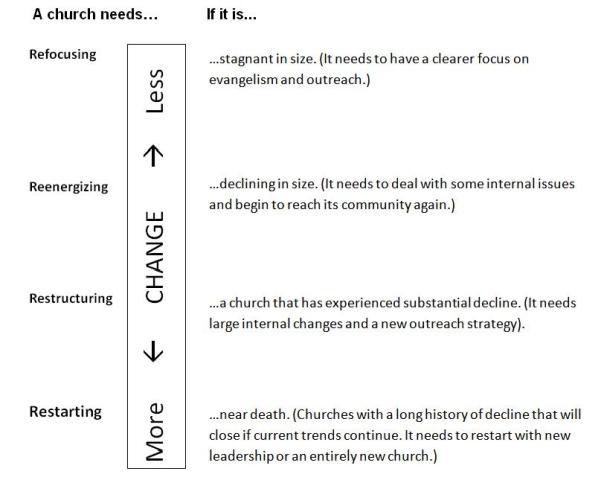
So how do we Restructure or Re-Start?
If a church is diagnosed with needing restructuring or restarting, there are really only two next steps:
Step #1: Decision. The congregation must decide if large internal changes are possible or is it time to close the doors & allow something new to be born. All living things are born, they live, & they die. No New Testament Church still exists today. But even if a church continues it must die to its current way of thinking, so that a new vision can develop. Living things experience death as they age & mature & adapt to changing environments. Every growing church has had to die to various ideas, paradigms, and programs in order to grow. A final death that doesn’t lead to growth as the church exists may happen when we are unable to continue to adapt & grow through challenges faced.
Questions:
- Can we afford the large internal changes that are needed?
- Do we have the resources, energy, & determination to dream a new dream for our community?
- From where we are, can we adapt to the changes of our current environment?
Step #2: Death. Once the decision to die has been made there are two options:
1) Adaption by Re-Structuring. Deciding to adapt/re-structure & grow means dying to the current model of ministry & mission. Scenarios for adaptation:
- Reverting to Mission Status & submitting to the authority of another congregation that can assist in dreaming a new dream.
- If resources are available, working with the local association to develop a plan to Assess, Align, & Advance the mission of the church.
2) Closure to Re-Start. Deciding to close/re-start means laying to rest the current church so that a brand new ministry can be started in its place. Scenarios for closure:
- Formally decide to close the church, giving the assets & liabilities to the local association so that a new church can be planted or ministry developed.
- Formally decide to close the church, giving the assets & liabilities to another local church with ties to the local community.
Next week I’ll share some of our local success stories and lessons learned.
Scenarios for Church Revitalization: Refocus and Re-Energize
When a church is stagnant or declining in size, diagnosis is that refocusing and re-energizing is needed. How do we refocus & re-energize? Three steps to revitalization: Assessment, Alignment, Advancement.
Step #1: ASSESSMENT.
- Discover needs of community and potential new ministries.
- Assess Leadership capability and needs.
- Identify Church Systems in need of restoration. Nelson Searcy of Church Leader Insights identifies Eight Systems of a Healthy Church:
- The Weekend Service System,
- The Outreach/Evangelism System,
- The Assimilation System,
- The Small Groups System,
- The Ministry Mobilization System,
- The Stewardship System,
- The Leadership Development System,
- The Strategy Planning System
- Research legal documents and history. History and legal documents need to be researched in order to identify potential threats to growth.
Step #2: ALIGNMENT.
- Recover Faith Factors. In Chapter Three of the book Comeback Churches, Ed Stetzer identifies three faith factors that are essential to church revitalization: 1) A renewed belief in Jesus Christ and the Mission of the Church, 2) A renewed attitude for servanthood, 3) Strategic Prayer Efforts.
- Discover/Recover the unique, God given Mission, Vision, Values. The revi team should participate in Church Planter Basic Training & take advantage of coaching networks & suggested reading lists to help discover a vision for the community.
- Make necessary identity changes. Name? Signs? Location? What identity changes may be necessary to birth new vision & energy in the church?
- Restore needed Church Systems for life and health. See above comment about Church Systems. What systems will need new energy & attention going forward?
Step #3: ADVANCEMENT.
- Vision Renewal Launch Service. Plan for a Vision Renewal Celebration as the church moves into a period of advancement and growth.
- Plant, water, and bring in the harvest. The church should experience some growth as systems are slowly restored and outreach, assimilation, small groups move people to Christ and spiritual maturity.
- Multiply disciples, leaders, and ministries. A new generation of leaders will begin to emerge that will carry the Church into the future.
- Partner in Acts 1:8 Missions. The Church will be capable of taking on missions endeavors beyond its Jerusalem and potentially assist other churches with revitalization/renewal.
Download the paper, Steps to Revitalization.
Scenarios for Church Revitalization: Diagnosis
With over 70-80% of churches plateaued and declining, church revitalization must be a major topic of conversation for church leaders and strategists. In the next few posts, I’ll share the strategy we are working on with the Northshore Baptist Association. Everyone working on revitalization should be indebted to Ed Stetzer and Mike Dodson for their great book Comeback Churches. One of my top gleanings from the book is the diagnostic tool for assessing a congregations needs:
This image gets even those most entrenched in the attitude “we’re fine the way we are” thinking about the need to change. Great tool to help churches diagnose their need for revitalization.
The next question is – How? How do we refocus? re-energize? Restructure? Restart?
Got Our Redneck Wedding On this Weekend
Got to officiate my first real Redneck Wedding this Weekend. Barn, Hay, Rubber Boots, Bride riding in on a Landmaster. It was awesome! Congrats to Louis & Amy Bankston! And yes the groom got a brand new pair of rubber boots for the occasion.





What if Jesus Were Normal?
Yesterday, I took a look at a few halmarks of “NORMAL CHRISTIANITY” or what normal has become for many of us western Christians. Some  questions I’m asking of my faith journey is would a first century believer that moved to my neighborhood from Ephesus or Antioch or Jerusalem recognize anything of the way (Acts 9:2) in my normal Christianity? and…
What if Jesus were our standard for Normal? What might Christianity look like? A few thoughts:
- Taking Risk for the Good of Others. Philippians 2:3-8, outlines how Christ’s death was a series of sacrifices for the good of others. From coming to this world in the form of man to dying on a cross, he put others ahead of himself. And we are commanded to do the same, “You must have the same attitude that Christ Jesus had…” Philippians 2:5 NLT. Following Christ means putting others first even at great risk to yourself.
- I adjust my life to WHATEVER God says. Prior to being crucified for a non-crime, Jesus ask the Father if there was any other way, but qualified his prayer with “Not my will but thine be done.” Normal Christianity seems to believe the chief qualifier is our happiness and pleasure, not God’s will and the good of others. What’s the qualifier for your obedience? Your desire or His?
- Responsiveness to the Needs of Others. One of the key words in the book of Mark is IMMEDIATELY. It’s used many times to describe how Jesus responded to the needs of others. Matthew 9:35, says that he saw the crowds and felt compassion, then responded by sending out disciples to meet their needs. What happens in your heart when you see the needs of others? or hear about a need?
- Upside Down Relationships. You want your faith to stand out? Try following Jesus’ instructions on relationships. Love your enemies. Don’t Judge. When you lend, don’t expect it returned. If someone has something against you, take the initiative to get it right. If someone ask you for a favor, do it times two. I’m convinced that if Christians would make Christ’s relational principles the norm, the world would be shaken.
- Going / Sending. Two of my favorite words in the story of Jesus are “Jesus went.” Speaks of his responsiveness and his desire to take the good news. I’ve said, I’d love for that to be on my grave stone, should I have one. “He went.” Along with those two words we see “Jesus sent.” He didn’t hold on to his followers and see the reasons they weren’t ready. He sent them out, allowing them the opportunity to experience the power of God and be used to expand the kingdom. Am I going? and as a leader, am I releasing and sending? The popular statement among leaders, “the church shouldn’t be known for its seating capacity, but its sending capacity” fits the Christ life and should be the norm. See my post on Creating Sending Capacity.
What else would you add to a list of Jesus norms?
Normal Christianity is Weird
If you talk to new comers to Christianity, you have to admit with them that Christians do some weird things. Jon Acuff has made us all laugh as he has chronicled these with his Stuff Christians Like blog and book. But it seems that normal and weird change over time and what is normal to us would probably look weird to a New Testament Christian church.
Thinking of conversations I’ve had with “normal” Christians over the last ten years along with assessing my own views, here’s what it appears NORMAL has come to look like for Christianity in America:
- It’s about me and my comfort. How can we read the New Testament and come away with statements like, “My Church doesn’t meet my needs” or “I’m just not getting fed.” The New Testament compels us to a faith filled with personal sacrifice, going deep with God, and others centered living (Philippians 2:3-4, Colossians 3:1-2). Jesus said what comes out of our mouth is in our hearts. Are your words saying, “It’s all about me” in relation to your Christian faith?
- Jesus informs my decisions. The bumper sticker is true for Western Christians, “Jesus is my Co-Pilot.” And we’ll refer to him if needed, but otherwise, I’ve got it under control for now. Instead of knowing Jesus as Lord, who directs and guides, commands and leads, we know him as one option on our reference shelf for life’s directions.
- Intention = Actions. Intentions matter a lot to us. And the right intentions are important, but intentions deceive us into thinking we’re something we’re not. The New Testament test of faith is action (Matthew 12:15, Ephesians 2:10, James 2:14-17). Not in order to get God’s favor, but that shows we have God’s favor. What’s inside will come out if it’s real. Just like the plants in my garden. They will tell me the label on the pack of seeds was correct when they bear their fruit.
- Karma – I must be ok with God if everything is going so well. I’ve got a nice job with a raise coming this year, great house, my kids are doing well in sports, so God must be pleased with me. This is believing that we’re saved by the American dream instead of by Christ. And the god of nice job, nice house, upwardly mobile kids will eventually betray us. Our need for God is not based upon how well things are going, it’s based upon the universal need for an answer to our sin problem. This attitude is essentially animism. In the jungles of south Mexico when things go wrong, they make sacrifices to appease the gods. In America, when things go wrong, we get the family to church for a few weeks in a row.
- Fellowship = friendship with people like me. As a church planter I know the reality of the leadership law, “You attract who you are, not who you want.” But I also know the great need for us to take the gospel to people, cultures, parts of town, not like us. One of the miracles of early Christianity that we miss in our homogeneous culture is that racial, social, economic, cultural, religious boundaries were destroyed by the power of the Gospel. Even among Jesus’ disciples was a tax collector who was seen as an enemy of Israel and a Jewish zealot who would have been committed to oppose him with terrorist like tactics. Roman soldiers and Jewish rabbis would have been together around the communion table. The gospel leads us into a dismissal of us vs. them. We see that in Christ, it’s just us.
- You can change. Jesus might can help with that. Pop psychology says, “You can change, let’s talk tactics and possible options.” Unfortunately, sounds like some sermons I’ve preached and heard. The power of the gospel for salvation (Romans 1:16-17) has become one of many tactics or plans to get to the good life as the American dream defines it.
- I’m ok if I keep most of the rules. “I’m a good person” or “My plus column is higher than my minus column” or “I go to church as often as I can.” Many are just grinning and bearing it as they check off a list of religious deeds on our way to a good time. Problem is, rules don’t have power to give life and rules don’t have power to give eternal life. Only a relationship with Christ does that. Jesus gave us a new rule: “I am the way, the truth, and the life.” The rule is now, connect in relationship to Christ. And let Christ define normal for you.
What would you add to my list?
Tomorrow we’ll explore what NORMAL should look like, if we follow Christ.
Northshore PROBE Two Years Later
In April of 2011, our Association did an exhaustive study of our region which covers from Holden to Slidell, along Interstate 12 in Southeast Louisiana. You can see the full reports here, and my comments here and here. This month, I compared our 2010 church health numbers with the 2012 stats for churches. Here’s a few big takeaways:
- Stats taken from each zip code where there is a Northshore Baptist church showed only a slight uptick of .4% in population growth (from 343,794 to 345,225).
- Baptisms continued to slide in Northshore churches, down 11% to 812. Down 25% from 1990’s all time high of 1,077. Ten Northshore Baptist churches reported zero baptisms. Seventeen more reported five or less.
- Sunday School/Bible Study attendance increased 2%. 6,786 attended a Bible Study on any given weekend which is equal to 2% of the population.
- Worship attendance increased 1% to 11,312 individuals attending a worship service in a Northshore Baptist Church on any given weekend. That still equals to only 3.3% of the population.
- Receipts increased by 10% while missions giving decreased 15%. Possibly caused by belt tightening going on due to the poor economy over the last few years. Also, the “Institutional Internalization” noted as a national trend by Dr. Randy Stone in 2011, as churches “preserve their institution rather than pursue the mission.”
Download the Statistical Summaries of the Northshore PROBE Two Years Later for yourself:
- Entire Northshore – NSBA Probe – 2012
- Tangi-Livingston Area – NSBA Probe:Tangi-Livingston – 2012
- West St. Tammany – NSBA Probe:WST – 2012
- East St. Tammany – NSBA Probe:EST – 2012
How do we move forward? In 2011, we outlined four keys and they are still true and still our focus.
Breakout Churches
A breakout church is defined by Thom Rainer in his book by that title as a church that reaches at least one person for Christ every two weeks or 26 persons per year, has a conversion ratio of 20:1 or 1 conversion for every 20 members per year, has tenured and consistent leadership, and the church makes a clear and positive impact on its community.[1] The momentum of growing churches breaking out will help us catch up with population growth and move past a season of decline.
Healthier and Riskier Church Planting
Healthier church planting means church planting that is led by churches with a heart to multiply and reproduce themselves for the sake of kingdom expansion. So, what’s needed for healthier church planting is healthy mother churches with a heart to reproduce. As Bob Roberts says in his great book The Multiplying Church, “The future of faith in America (and anywhere in the world, for that matter) is not tied to planting more churches, but in raising up of mother congregations of every tribe, tongue, denomination, and network that are reproducing… The hope is in pregnant mother churches.”[2]
Riskier church planting would be multiplication that targets hard to reach areas and unchurched pockets of our population. Missiologist Alan Hirsch suggests that current church models are reaching out to smaller and smaller segment of the population, with possibly as much as 60% of America untargeted by our evangelistic and outreach efforts.[3] Our probe identified multi-housing residents as one potential segment that is underserved. Others may be those in their early 20’s with very little understanding of religion in any form. We need some church plants that go beyond planting a worship service that looks similar to others in the community, but will ask the question “Where is the church not?” and go there with the gospel. We need some church plants that have different scorecards and different expectations, but will faithfully deliver the message of Christ to unchurched people.
Partners in Revitalization
Church revitalization is needed to turn momentum around for congregations that are not effectively reaching their communities. Churches are needed who are willing to adopt or sponsor or merge with existing congregations for the glory of God. And churches are needed who are willing to admit there in need of coming under the wing of a benevolent parent church or work with a church wanting to help then in a revitalization effort.
A Discipleship Revolution
Call it revival, lay renewal, or awakening, what we need is a revolution of discipleship that will lead Northshore Christians to multiply themselves spreading the Gospel like a sneeze to their neighbors, classmates, coworkers, and beyond. In his book Church 3.0, Neil Cole observes, “we have lowered the bar of what it means to be a Christian, such that simply showing up to the weekly one-hour event with some regularity and a checkbook is all it takes.”[4] We must refocus on making disciples who will reproduce themselves by telling others, inviting others, and discipling others.
I’m Made Alive Forever
Made Alive by Citizens (buy on Itunes)
I once was dead in sin
Alone and hopeless,
A child of wrath I walked
Condemned in darkness,
But your mercy brought new life
And in your love and kindness,
Raised me up with Christ
And made me righteous.
You have bought me back
With the riches of,
Your amazing grace
And relentless love.
I’m made alive forever,
With you, life forever
By your grace I’m saved,
By your grace I’m saved.
Lord, you are the light,
That broke the darkness.
You satisfy my soul,
When I am heartless.
If ever I forget
My true identity,
Show me who I am,
And help me to believe.
You have bought me back,
With the riches of,
Your amazing grace
And relentless love.
I’m made alive forever,
With yoy, life forever,
By your grace I’m saved,
By your grace I’m saved.
My sin has been erased,
I’ll never be the same.
My sin has been erased,
I’ll never be the same.
You have bought me back,
With the riches of.
Your amazing grace,
And relentless love.
I’m made alive forever,
With you life forever,
By your grace I’m saved.
You have bought me back,
With the riches of.
Your amazing grace,
And relentless love.
I’m made alive forever,
With you, life forever,
By your grace I’m saved,
By your grace I’m saved.
Sending the Whole Church
“He has filled him with the Spirit of God, in wisdom, in understanding and in knowledge and in all craftsmanship” Exodus 35:31 NASB.
We know God gives power to preachers, worship leaders, teachers, and missionaries. BUT do the people in the church know that their skill, whatever it may be, can be used to fulfill God’s purpose. Bezelel was a carpenter/craftsman and filled with the spirit to craft instruments for God’s glory.
“I never knew my skills could help the church” said one craftsman we utilize to build wheelchair ramps for the handicapped in our community.
How does you church make a way for those God has filled with his spirit for craftsmanship, carpentry, sewing, scrapbooking, flooring, arts, trimming trees  (like in the picture of tree surgeon Mark Johnson taking trees off the house of an elderly widow during a recent Faith in Action weekend with our church), landscaping, etc. etc.? Sending and equipping the whole church means realizing the Spirit empowers for all kinds of ministry.

Creating More SENDING Capacity
“The greatness of a church is not in her seating capacity, but in her sending capacity” ~Rick Warren.
Seating & sending capacity are necessary for growth and Acts 1:8 kingdom expansion. And in a day of declining attendance and loss of Christian influence we desperately need both. More seems to be made by example and information of “The How” related to seating capacity than sending capacity. In a previous post about sending capacity, I talked about why? And here’s a bit of my personal exploration of the How behind SENDING.
The HOW is really found in the practices of Jesus & the early church & the truths of the Gospel:
1. Share the Gospel – Ephesians 2:8-10, Titus 3:5-7
Going/Sending/Serving/Obeying is an affect of people being transformed & regenerated by the gospel. The Bible says that Christians who are transformed are created “for good works” (Ephesians 2:10) and that one of the purposes of the Gospel was that God would have a people who were “eager to do good works” (Titus 2:14). The Holy Spirit gives power to serve and share the message to those transformed by the Gospel.
So if we’re sharing the Gospel & people are being saved then we will always have capacity to send these people who are being shaped by God and the Gospel to obediently Go in His power.
2. Listen to God – Acts 13:1-5
In Acts 13, the church was fasting, praying, and listening to God and guess what He said? “Go/Send.” Actually, he said, “set apart for me Barnabas & Saul for the work that I have called them” (Acts 13:2). This made since to the believers because the Lord had already told them to “Go into all the world…” Mt 28:19 and that they were to be His witnesses to the ends of the earth (Acts 1:8). His instructions for the church haven’t changed. If we listen to God the call to obey, go, send will still be heard within every church. This call will make sense to believers who are listening.
3. EQUIP the Saints – Ephesians 4:11-12
In Ephesians 4, Paul the Apostle, teaches us that God gives to the church apostles, prophets, evangelists, shepherds, teachers and their job is “to EQUIP God’s people to do His work” (NLT). So two separate roles develop: Equippers and Ministers. Several attitudes in today’s church hinder these roles:
- A “hire it done” mentality. Sending for us, means hiring a new staff member, so I can send him/her to the hospital or to the lost, etc.
- A Mere Volunteer. Some leaders hinder sending by downplaying the power of God’s people doing his work. They are mere volunteers, that can’t really be depended on or trusted. To that I say, maybe that’s all you’ve equipped them to be.
- Fear of Releasing. Sending is not desired by some leaders, because their end goal is to have more people this Sunday than last Sunday at any costs and to give opportunities for people to be sent may require people being elsewhere some or most Sunday’s.
Dennis Watson of Celebration Church says for a church to grow, the people have to give the leadership to the Pastor(s) and the Pastor(s) have to give the ministry to the people. For multiplication to happen, we must not fear equipping, releasing, sending people to fulfill their God given roles.
4. Lead like Jesus – Sending was part of his strategy – Matthew 9:35-10:5
“They’re just not ready yet.” This is a common refrain that I’ve heard and said about people in churches. But if you observe Jesus’ ministry, you’ll see him sending the “not yet ready” at a steady clip. Sending was part of his strategy to grow people and grow the kingdom. They weren’t ready, they made mistakes, but they learned, they developed faith, they were ready at the right time to multiply the church exponentially. If we wait until we’re ready, we’ll be stuck in a holding pattern while the world’s population passes us by. Is that where we are today?
What is your ministries sending capacity? How are you intentionally releasing people to ministry? Does your attitude about ministry or people hinder sending capacity for your church?