Things Pastors of Evangelistic Churches Say
This week, I had the opportunity to facilitate a Breakout at the Louisiana Baptists Evangelism Conference with three men that lead churches with great Evangelistic culture in Louisiana. Jacob Crawford – Life Point Mansura, Willis Easley – Christ’s Community Denham Springs, & Checkerz Williams – Celebration LaPlace. (See my previous post for a bit of bio on them & their churches). These churches are responsible for 100’s of baptisms each year. We threw out several questions designed to just get them talking, so that we could glean insights & be inspired. These men had never met each other before this conference, but it was interesting to hear how many of the same things came out of their mouths related to creating an evangelistic culture. Here’s some things they said over & over that have stuck with me:
“It’s about casting vision.”
Checkerz Williams said he uses the statement “Can you imagine what our community would be like if…?” to get people to see the possibilities.
“We teach people, ‘It’s not about you.'”
Willis Easley said at least monthly they tell people to turn to the person next to you & say “It’s not about you.” And interestingly enough the other two churches do the same thing!
“Our church looks like our community.”
Life Point is 60% white, 40% African-American, which matches the demographics of the community it is in. Celebration LaPlace is 55% African-American, 35% white, 10% Hispanic, which matches the demographics of the community it is in. Each of these churches are diverse, multi-ethnic churches. A lot of people talk about diversity & multi-ethnic ministry, but what I’m learning is that diversity & multi-ethnic church development is a product of an evangelistic culture.
“We share the Gospel at every gathering.”
Each church makes the gospel an important part of every service. Jacob Crawford said, “Never assume that everyone believes. Assume the opposite & share the gospel.” And these leaders go out of the way to share the gospel in ways that are reproducible & easily picked up by others. Willis Easley says, He uses the Roman Road EVERY time he shares the gospel from the Pulpit, because it’s easily picked up by others.
“We love people to Christ.”
Service & outreach to the community is of course a major part of the ministries of each of these churches. Christ’s Community & Celebration Church both sponsor a big day of service at least annually, where everyone takes on outreach & evangelism projects together.
“We started an additional service to reach more people.”
Each of these churches have started multiple services to add capacity for reaching new people for Christ.
“We encourage people to pray for friends that are not believers.”
Each of these churches have a system in place for people to identify people in their relational network who are without Christ & pray for them. For Celebration it’s the FRAN list – Friends, Relatives, Associates, Neighbors. For Christ’s Church it’s called the High 5’s.
“We network with community leaders.”
Being involved in the community is important to each of these churches. “Building bridges not barriers” – Checkerz Williams.
“We baptize people that become believers quickly.”
Baptisms are down across the Southern Baptist Convention, so I was very curious as to what the process these churches have for baptism. Each said they baptize people very soon after they make a decision. Checkerz Williams says their baptistry at Celebration LaPlace is ALWAYS full & ready. Ushers at Life Point show up early & ask every Sunday, “How many do we have today?” in reference to baptisms. Their is an attitude of expectancy in these churches that people will be getting saved, so lets get ready to baptize them.
“We equip & train members of the church to do the work of evangelism.”
It was clear that for these men, their role is to equip the people & groups to do evangelism. So, from modeling, to training, to keying on reproducible processes, the desire is for the entire church to own evangelism of the lost community.
Great conversation. What do you need to add to your vocabulary this year related to your church’s culture? These sayings will be a great start.
Here’s a few other great quotes from our session:
- Willis Easley – “When I saw that we had only baptized 5 or 6 in a year, I got alone with God, & said, ‘Lord, we’re not doing what you called us to do.'”
- Jacob Crawford – “We cast a vision for community transformation. Avoyelles Parish’s suicide rate is similar to North Korea. We teach people that only Jesus can fix this.”
- Checkerz Williams – “Our Baptistry stays full. We talk about it every Sunday. Once per year we do a Baptism emphasis. You’ve got to keep it in front of people.”
- Willis Easley – “If you’re not sharing the gospel with lost people, you won’t be baptizing many people.”
- Willis Easley – “Southern Baptist have been trying to harvest in fields in which we haven’t sown.”
- Jacob Crawford – “The biggest obstacle to evangelism in our church was ME, the Pastor. I had to get out of the way & equip the members to do the work of the ministry.”
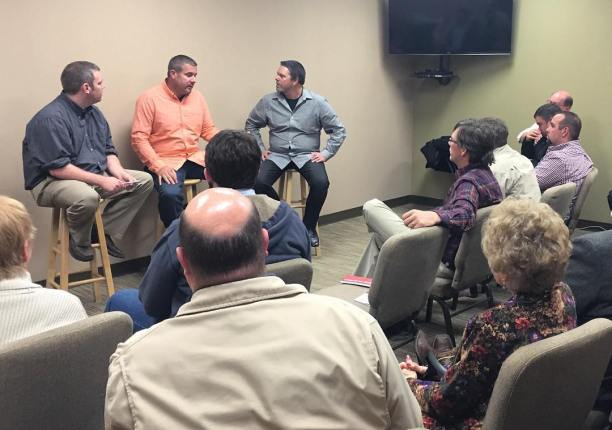
Left to Right: Jacob Crawford, Checkerz Williams, Willis Easley.

Creating an Evangelistic Culture in Your Church
 Looking forward to ECon – the Louisiana Baptists Annual Evangelism Conference on Monday & Tuesday, January 25-26 at FBC Lafayette. Featured speakers will be Josh McDowell, Steve Gaines, Alvin Reid & others. (Live Stream located here). I’m very excited to be facilitating a breakout on Tuesday afternoon called Creating an Evangelistic Culture in Your Church. This will be a forum featuring pastors from three of the fastest growing, most evangelistic churches in Louisiana in 2015. If you’re curious about what growing churches in Louisiana are doing, find this breakout!
Jacob Crawford from Life Point Church, Mansura. Life Point had an incredible year, baptizing 105 & starting four new churches! And they did this in one of the most impoverished, hardest to reach areas of Louisiana.
Willis Easley from Christ’s Community Church in Denham Springs. CCC was recently featured in Outreach Magazine. They baptized 135 last year & have done an incredible job designing ministry for the unchurched community. Located just south of a major new on ramp to I-12 at Juban Rd. in Livingston Parish.
Checkerz Williams from Celebration LaPlace. Celebration Church leads Louisiana in baptisms almost every year. They’ve multiplied to six campuses & expecting to add more in the near future. Checkerz leads the River Parishes campuses which has grown exponentially over the last few years in a traditionally hard to reach area for evangelicals.
Grateful for these men & looking forward to learning some tips & tricks born out of real experience of reaching people in Louisiana.


On Failed Church Plants: How Many Are There? and Why?
Fifteen. That’s the number of “failed” church plants we’ve recorded in Louisiana since 2010. 15 out of 124 churches planted. I tracked this number down, because it’s one of the regular remarks I hear from people wanting to question or disparage the role of church planting in the ministry of the church.
- “Don’t most church plants not make it anyway?”
- “History tells us that most church plants won’t be around in 10 years.”
- “I’ve heard 80% of church plants fail.” (Don’t know where this number came from, but it has to have joined the ranks of most quoted bad stats).
So that means we have an 88% “success” rate in church planting in Louisiana since 2010. The North American Mission Board has reported a 68% success rate across North America. (not an 80% failure rate! Please quit saying 80% of church plants fail!)
As a church planter, I hate using these words – “failed” & “success.” Here’s why?
- You can’t fail in attempting something great for God. If you’re sharing the gospel, you might not get immediate results, but you plant seeds for the future. The word of God never returns void. In the context of church planting, that might mean you run out of time on financial sustainability, but you can look back & see seeds planted, people that were lifted, & deep lessons learned that led to spiritual growth & character development in the life of a planter & team. I don’t think God would call that a failure.
- Defining success in church planting can be muddy waters. Successful Church Planting is evangelism that leads to the birth of a new congregation. Is it success, then, if a church plant stays open, but reaches very few new people through evangelism? Is it success, if a church plant grows at the expense of other churches in town? Is it success, if a church plant doesn’t impact the community around it through evangelism & people in the immediate area don’t even know it exists? Questions like these lead me to look back at my list of 15 & see a few churches that made the tough decision to close, but may have been more “successful” than some of the 109 that are still open. Self-sustainability is an important factor in church planting, but evangelism & reaching new people, should ultimately define our true success.
Why do Church Plants Fail?
Looking back at our list of 15, & a factoring in a few others that I’ve been involved with prior to 2010, here are the reasons for their failures:
- Character & Calling issues. 4 out of the 15 I mention closed because of moral failure or a deficiency in character in the church planter.
- Wrong Context & Culture. Another 4 in our list, can be chalked up to the church’s strategy & focus or the church planter himself not being a good fit for the context & culture.
- Ran out of Time. The other 7 just simply ran out of time before achieving critical mass or financial sustainability. Lots of factors could go with this one, including work ethic issues of the church planter (which may go back to character & calling), lack of partner development, lack of evangelism & team building, difficulty of the soil in the area (which may go back to context), etc.
These are all things that we can counter with good solid assessments of planters & partner churches on the front end, good equipping & networking opportunities for planters & their teams, & by building great partnerships to come around each new plant.
In Louisiana, we offer these opportunities as part of our Church Planting Networks. Connect with our Facebook Group to keep up with opportunities. Our Greenhouse Training coming up this Spring is specifically designed to help a church planter in Louisiana design systems & strategy to get to self-sustaining status in 5 years.
Church Planting is a risky thing. Not failing every now & then may be a sign that we’re not pushing into the absolute hardest to reach areas. The great axiom is “Failure is never final, it’s only feedback.” If a church plant doesn’t make it, it usually leaves behind some changed people & we can say it’s cultivated the ground for something in the future.
Check out these resources to help you or your church to get started on your church planting journey:
- 5 Things You MUST do Before You Start a Church
- 5 Things You MUST do During the First Year of a New Church
- 10 Biblical & Practical Ways to Get Involved in Church Planting
- Every Church Can Encourage Church Planting and Multiplication
- Every Church Can Be a Church Planting Partner
- Your Church Can Be a Parent to a New Church or Campus
 God wants you to grow in 2016.
Am I a Church Planter? Some Essential Characteristics
When we think about the question “Am I a Church Planter?” One of the best list of criteria that has been developed is Charles Ridley’s 13 Essentials. These formed the basis of Church Planter Assessments for years & though more recent list may look a little different, Ridley’s work provides the foundation for much of everything done in assessment today. The axiom that Assessments are built upon is “Past behavior is the best predictor is of future practice.” So the way potential candidates & assessors should look at this list is, “Are these qualities present in my life / the life of the candidate?”
These are also good benchmarks for us who are actively seeking to multiply churches. This list has served challenges & tools for personal review for me along my church planting journey.
Here are Ridley’s 13:
- Has visionizing capacity: Generates visions, initiates plans, builds significant projects from the ground floor up.
- Intrinsic motivation: Demonstrates the ability to be a self‐starter who works with diligence and excellence.
- Empowers others to lead: Passes on the baton of ministry so that others can continue the race.
- Reaches the unchurched: Consistently reaches out and influences people toward a relationship with Christ and the church.
- Has spousal cooperation: If married, has a spouse that is committed to collaborating in marriage and in ministry.
- Effectively builds relationships: Evidences the ability to meet new people and engage them in relationships.
- Committed to church growth: Embraces growing the church, numerically and spiritually, and implements church growth principles effectively.
- Responsive to the community: Understands local communities and implements culturally responsive ministries.
- Utilizes the giftedness of others: Assesses, develops, and releases others to serve in their area of giftedness.
- Flexible and adaptable: Negotiates change successfully while staying centered on the overall vision.
- Builds cohesive groups: Orchestrates widely differing people to function as a unified body.
- Resilient: Stays the course in the face of major setbacks, disappointments, and opposition.
- Exercises faith: Evidences a strong, vital relationship with God and willingly takes significant faith risks.
Also see my post “You Might Be A Church Planter If…”
If you’re considering church planting in Louisiana, you can get started with an assessment by filling out our Initial Info Form. Or contact me & I’ll be glad to point you toward some next steps to start your church planting journey.
Also, consider attending our upcoming training called Greenhouse: Creating the Right Conditions for Church Multiplication in Walker on Feb 22-23.

Life Change Common Place at Christ’s Community Church
“When I first came to the church… I looked like something out of Sons of Anarchy… and this church just opened their arms to me.”
 Christ’s Community Church of Denham Springs, Pastor Willis D. Easley, was profiled this month on OutreachMagazine.com. CCC baptized 135 people in 2015! And they’ve grown exponentially from 50 to 500+ in 5 years.
Check out the full story HERE.
Willis will be part of our breakout on “Creating an Evangelistic Culture in your Church” at the LBC Evangelism Conference at FBC Lafayette, Jan 25-26 (https://louisianabaptists.org/econ2016). Along with Checkerz Williams from Celebration Church & Jacob Crawford from Life Point Mansura. Hope you’ll come by & get to know Willis.

On Ramps to Spiritual Growth: Personal Devotional Habits
God wants a RELATIONSHIP with us, so he can shape our IDENTITY, & prepare us for ETERNITY. This relationship is possible through Christ sacrificial death, which reconciles us to God by wiping away sin, which broke that relationship. God invites us into this relationship through His REVELATION of Himself. He reveals Himself to us through the beauty & order of creation, through the person & work of Jesus Christ, through His activity in our lives as we seek Him through prayer, through His Word, & through His work in & through other believers. We grow in this relationship by the habits we form. These habits will include Personal Worship (John 4:24), Private Prayer (Matthew 6:16-18), & Bible Reading & Devotion (Joshua 1:8). Devotional habits serve as On Ramps to Spiritual Growth & Transformation.
 God didn’t spell out the perfect formulas for our devotional habits. It never says in the Bible, “Spend 15 minutes a day reading the Bible, pray for 10 minutes, read a daily devotional published by reputable publisher, then listen to a worship song or two before you go to work.” He’s left that up to each of us individually to determine the best ways to develop our relationship. When my devotional life is dry, sometimes it helps me to ask a few growing Christians what they do to connect with God. So, in hopes that it will be helpful to someone, here’s my current pattern or habit that takes 45 minutes to 1 hour each day. I hope you’ll share yours as well.
- Wake up early. I’m a morning person, so I enjoy the early AM hours. It all goes down hill after 8am to me. Ha.
- Journaling. I start my day with writing prayers & commitments of devotion to God. (see my post Morning Prayers).
- Reading Scripture. I follow the One Year Bible Plan on Youversion.com. It’s a simple plan that allows you to read the Bible through in a year & the Psalms twice in a year. (See my post How to Get a Grip on the Bible for answers to questions about the Bible & a how to get started reading the Bible).
- Journaling. As I’m reading I write down the verses that jump out at me. When I’m done reading I read back through those verses & write down any Observations, Applications, or Prayers. (See the SOAP method). (Also, check out my post Allowing the Teachings of Jesus to Go Deep, for a plan to Journal through the sermon on the mount. Serves as a great introduction to journaling through the scriptures).
- Devotional Reading. I usually read a devotional of some kind each day as well. This year I’m reading A Year with C. S. Lewis: Daily Readings from His Classic Works. Others that I’ve enjoyed have been My Utmost for His Highest by Oswald Chambers, Experiencing God Day by Day by Henry Blackaby, 21 Most Powerful Minutes in a Leaders Day by John Maxwell.
- Daily News feed. I also use Feedly.com to follow a lot of authors, pastors, networks, & news sites that inspire & inform me.
- Sharing. As I’m reading, I’m asking is there anything that I’d like to share with friends or family, with my church, or with my social media networks. As well as tagging & filing anything that may be helpful for my upcoming speaking & preaching schedule.
- Intercession. I keep a list of people & situations that I want to pray for everyday. It includes my family, the leaders of my church, the team I work with, & others. I’m committed to make time to pray for them. Sometimes that happens in the mornings during my devotions. Sometimes its later in the day. Like at 10:02am when my alarm goes off reminding me to pray for laborers (see Luke 10:2).
Roll with the punches. I wish I could say this all happens everyday. Work, sickness, oversleeping, my poor time management happens, so I plan on rolling with the punches. Some tools we have to help with that:
- Technology. When I don’t have time to read in the mornings. I can listen to my Bible plan using the Bible App during my commute. My newsfeed & devotional is also on Kindle, so I can read it during spare moments of the day.
- Grace. Remember that my salvation is not based upon my ability to read the Bible everyday. Only Jesus saves. Devotional habits are tools for our growth in grace. Don’t give up. The life we have is ETERNAL, so missing a day every now & then does not mean losing.
- Presence. God is not with me only when I’m reading the Bible & praying. God is with me all the time. I can stay connected with him through prayer all day long.
- Tomorrow. One of my favorite sayings is, “YESTERDAY ENDED LAST NIGHT.” The bible says, “God’s mercies are new every morning” Lamentations 3:23-24. If you miss a day of devotional habits, put it behind you, celebrate the grace & presence that you did experience that day, & let that build anticipation for tomorrow or when you can restore your habits.
Jesus said, “Man cannot live on bread alone, but on every word that comes from the mouth of God.” Matthew 4:4. Devotional habits are as important to the Christian as food & drink. They are one of the primary On Ramps in our Spiritual Growth & Maturity. Work out a plan that works for you, figure out how to do it everyday, commit to it for life, & roll with the punches.
What are some tools that you use in your devotional life? What is your daily pattern?


The Call to Preach is not just for Preachers
 Grateful for Tim Keller’s latest book Preaching: Communicating Faith in an Age of Skepticism, in which he writes that the New Testament call to preach goes beyond just pulpit ministry. Keller argues that there are three levels of preaching.
Level 1 would be through everyday Christian conversation. “Paul calls all believers to ‘let the message of Christ dwell among you richly’ & ‘teach & admonish one another in all wisdom’ (Colossians 3:16).”
Level 2 would be through things like “writing, blogging, teaching classes & small groups, mentoring, moderating open discussion groups on issues of faith, & so on.”
Level 3 would be preaching as we typically define it today – “the public preaching & exposition of the Bible to assembled gatherings.”
I appreciate these distinctions, because I’ve run into people that say they are called to preach, but then when you suggest they come along to the jail or start a small group or teach a sunday school class, they are unenthused. Biblical preaching seldom included a pulpit because such a thing didn’t yet exist. And sometimes we seem to think that vocational preaching is the highest rung on the ladder & everybody else is just a mere volunteer. Praying we recover Levels 1 & 2, without neglecting Level 3 & that we see all our conversation as preaching instead of preaching as just a possible career.
A few other favorite quotes from Tim Keller in Preaching:
- Every Christian needs to understand the message of the Bible well enough to explain and apply it to other Christians and to his neighbors in informal and personal settings.
- It is dangerous, then, to fall into the unbiblical belief that the ministry of the Word is simply preaching.
- No church should expect that all the life transformation that comes from the Word of God comes strictly through preaching.
- We must beware of thinking the Sunday sermon can carry all the freight of any church’s ministry of the Word.
- a church’s gospel ministry should be “pulpit-centered, but no pulpit-restricted.”
- while the difference between a bad sermon and a good sermon is mainly the responsibility of the preacher, the difference between good preaching and great preaching lies mainly in the work of the Holy Spirit in the heart of the listener as well as the preacher.
- Every time you expound a Bible text, you are not finished unless you demonstrate how it shows us that we cannot save ourselves and that only Jesus can.
- we are loved sinners in Christ – so loved that we don’t have to despair when we do wrong, so sinful that we have no right to be puffed up when we do right
- the temptation will be to let the pulpit drive you to the word, but instead you must let the Word drive you to the pulpit.
Keller’s book is also VERY insightful, as always, on preaching in our modern cultural context. Highly recommend adding this book to your library if you haven’t already.

You are… You Have…
Dear Church Member,
You are…
- God’s plan to display his glory to the nations.
- God’s plan to show your kids how to follow Christ.
- God’s plan to reach your neighbors & show them what it means to know Christ.
- God’s plan to expand his kingdom in your town, city, state.
- God’s plan to show His wisdom to the world through pooling your gifts with other believers in a local church.
- Loved. Chosen. Favored. Saved. Filled. Forgiven. And so much more.
You have…
- God’s power within to help you overcome the daily & the deadly.
- God’s word to guide you in the way to believe & behave.
- God’s gifts to build others up & help grow his kingdom.
- God’s resources to be managed in a way that honors him & shows others that He is better than this world.
- God’s promise that He will be with you & he will use you & he will empower you.
- God’s people around you to encourage & build you up.
- Power. Wisdom. Grace. Eternal Life. Peace. And so much more.
YOU ARE, much more than just a volunteer. YOU ARE a leader in God’s kingdom & YOU HAVE everything you need to make a difference. No excuses. No delay. No looking at others. Be who YOU ARE meant to be. Use what YOU HAVE.
What’s stopping you? “I’m not…” or “I don’t have…” or “I can’t…” Really?