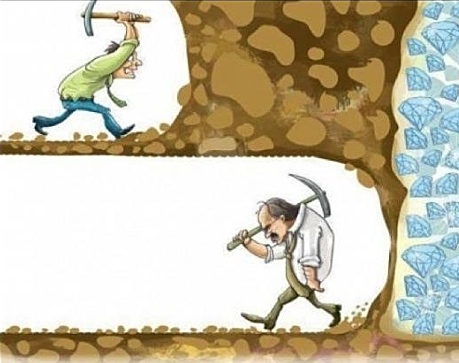
KEEP BELIEVING!

“The work of God is this: to believe in the one he has sent” Jesus, John 6:29 NIV.

Spiritual leadership requires taking care of a lot of details. Big & small. It’s all demanding. Relationships are hard & messy. Weekends are long. If you’re in vocational ministry, money is tight, vacations are short. But you can make it, if you can KEEP BELIEVING.

The greatest battle in life & leadership often rest in my ability to believe.

  • Will I believe that God can use me?
  • Will I believe that Jesus is Lord & has “all authority in heaven & earth” Matthew 28:18 & is willing to direct that authority toward me & my church?
  • Will I believe that Jesus is with me & desires to work through me?
  • Will I believe that life is short & heaven & hell beg us for urgency?
  • Will I believe that “with God everything is possible” Matthew 19:26?
  • Will I believe that this mission is possible?

And will I keep believing:

  • When attendance is low?
  • When volunteers don’t show up?
  • When criticism comes my way?
  • When people don’t respond to my ideas?
  • When other ministries grow faster than mine?
  • When I’m discouraged?
  • When I’m tired?
  • When I’m lonely?
  • When I’m afraid?
  • When circumstances seem to be arrayed against me?

What does God want me to do? Believe Him!

“No one else can save us, redeem us, create a new life in us!” #Sunday #letsworship

From the top of the playlist this week…

Only Jesus Can

Jon Guerra

Can He breathe in to the dust?
Can He make sons out of us?
Life is in His mighty hands
Life is in almighty hands

He can do it, yes, He can
He will prove it, our God can
No one else can save us, redeem us, create a new life in us
Only Jesus can

Can He love His enemies?
Can He make them family?
Life is in His mighty hands
Life is in almighty hands

Can He heal the leper’s limb?
Can He cleanse us from within?
Can we drink from living streams?
Can we ever be redeemed?
He has healed the leper’s limb
He has cleansed us from within
We have drunk from living streams
Surely, we have been redeemed

5 Things You MUST Do the FIRST YEAR of a Church Plant

There are different strategies & philosophies that go in to what you do in the Pre-Launch phase of a church plant. My purpose is not to give you another in this post, but to tell you what MUST happen along with the strategy you adopt so as not to derail success. I mentioned 5 Things you MUST do before you Plant a church here. Here’s my list of 5 Things for the Pre-Launch first phase of a church plant.

1. Build Your Network.

Ended here last time, start here this time. Your support network is your lifeline. As a entrepreneurial leader you should ALWAYS be building your network. But in the first year of a church plant your network must expand into the community. Meet with community political leaders, other pastors, school administrators, apartment complex managers, fire & police departments, business owners. Talk to as many people as possible to gather info, share about the church plant, find opportunities to serve & share the gospel. So many sound bites that instilled vision into our church plants came from these types of conversations in our first year.

2. Gather a __________.

Small Group? Yes! Core Group? Yes! Launch Team? Yes! I don’t care how many or what you call it, but GATHER! Somebody said there three keys to church planting: 1) GATHER, 2) GATHER, 3) GATHER. Whatever the strategy or philosophy, it must include gathering people together around the word of God & the mission of God. We started with two gatherings in each of our church plants. A Discovery Bible Study for seekers & pre-Christians & a Leadership Development Group that went through studies like Experiencing God & The Barnabas Factors. The two groups multiplied & played off of each other culminating in the launch of the new church. If you struggle with gathering people, then get somebody that doesn’t on your team, or expect slow growth, or consider a different role. Gatherings is essential!

3. Make it Sticky.

Our first church plant was in a community with hard soil. Gathering was difficult & slow. I had no experience or coach to help me read success or failure, so I invited a friend with experience planting in pioneer areas to come to a gathering. Afterward I ask him if I should quit & go do something else. He said, “If you quit it will be the stupidest decision you every make, because you can’t get people to sit down & shut up so that you can start & you can’t get people to quit talking & leave afterward so that you can lock up.” He was helping me see the relational stickiness of our gathered group. Several things that I’ve observed that help make new churches sticky:

  • The Gospel. One of the great miracles of New Testament Christianity was the different people groups that were brought together & unified to make up the body of Christ. It’s still a miracle today. Gather around the Gospel & you can expect supernatural glue.
  • Relationships. I love Ed Stetzer’s quip, “People are not looking for a friendly church, they’re looking for friends.” Don’t get organized & programatic too quickly (or at all if you can help it). Build in lots of time for getting to know people, being vulnerable, & caring for each others needs.
  • Mission & Ministry. Tackle a huge project that everyone can get involved in. Get messy if possible. Celebrate what you did together that you could have not done separately. Mission & ministry create a story.

4. Establish clear lines of communication.

“Without communication, you travel alone” John Maxwell. You must develop a plan for how you’re going to communicate to at least six different groups of people: (1) Support network – including sponsor churches, denominational entities if applicable; (2) Prayer partners; (3) Core Group / Leadership Team; (4) the Unchurched Community; (5) Community Leaders; (6) Disciples in the making.

There has never been better tools available for communication than there are today. Some that I’ve found helpful:

  • Mailchimp, Constant Contact, or Vertical Respons
  • Facebook Groups – open & closed
  • Facebook Page for the church
  • Email – don’t neglect regular email b/c people are more apt to reply & create conversation
  • Snail mail – never been easier & more affordable to do direct mail than it is today
  • Personal notes – get some personalized stationary. The more personal the touch, the more personal the follow-up response should be
  • Texting – many Church Management tools will have mass texting tools available

The cliches about communication are true! “You can’t over communicate!” “People are down on what they’re not up on.” And you’ve got a great story to tell, so plan on communicating with intentionality.

5. Start with Integrity.

Don’t wait to establish a framework for integrity in financial, personnel, & other matters of integrity. Don’t mix personal & church finances. Get a partnering church involved in oversight. Seek accountability. Establish job descriptions. In matters of integrity you can’t hope so. You must do all that you can to protect yourself & others from temptation & accusation. To get started:

  • Open a separate checking account. A partner church might can do this for you at first, but get a separate place from which money can be received & spent.
  • Use a Counting Sheet for donations. Helps keep track of cash & checks & records gifts for year end contribution statements.
  • Get a Cloud based Church Management System. Popular ones are Fellowship One, The City, ACS, Church Community Builder. These are costly but worth it. You sponsor church may allow you to use theirs for awhile. Starting out from scratch they may be overkill. Our new church has used ChurchOfficeOnline.com. Designed with smaller churches in mind. Very functional. And not near as expensive or training intensive.

Design a strategy to reach your community & DON’T NEGLECT these 5 things. What else would you add to this list?

5 Things You MUST do BEFORE You Plant a Church

“I think I want to start a church one day, where do I start or what should I be doing now?” I get this question a couple of times of month & it’s awesome that so many are interested in church planting these days. Here’s my typical response:

1. Confirm Your Calling.

You can’t just “think” you want to start a church, you need to KNOW that this is what you’re called & cut out by the Holy Spirit to do. The best way to confirm calling is to let others do it with you & for you. There are a variety of sources that offer Church Planting Assessments that start online & move to an interview where experienced church planters can help you confirm your make up & call to plant. Being disgruntled about the church(es) you’re currently attending can be part of a calling, BUT should not be the only part. Planters are shaped by God. Check out my post “You Might Be A Church Planter if…” to see some typical innate qualities of those who plant.

2. Confirm Your Spouse’s Calling.

Your spouse will not be the church planter, but she needs to have a sense of calling none the less, b/c so much of the early years of planting a church will encompass your home life. And your call to MARRIAGE, if you are a husband, will ALWAYS supersede your call to plant a church. If your wife is not on board, wait!

3. Deal with the Cracks in Your Character.

Church Planting can be like a pressure cooker. The stress & heat of the moments in the beginning of a new church will bring out whatever is in you, good & bad. So, if you’re struggling with addiction, anger, insecurity; church planting will most likely not help you in this struggle. Have a plan that includes accountability, rest, closeness to God, & emergency response by others as you feel pressure rising.

4. Get Equipped.

Read, attend church planting conferences, & seek out at least one good school of church planting or Basic Training. Listening to the podcast of a famous church planter is good, but it’s not the training you need to plant a church in a particular context. That planter is successful because of systems that are in place that you’ll never see just simply by listening to a podcast. Find a workshop type training in your area that will help you plan for evangelizing & discipleship in your context.

5. Build Your Network.

There are very few “self-made” church planters. To be successful you will need others. Start by seeking out Prayer Partners & do this as soon as possible. Start an E-Newsletter or send personal emails to everyone you know who MIGHT pray for you & be interested in what God’s doing in your life. Let them know what you’re praying about & seek their partnership in prayer. You’ll also need financial partners, on mission partners to be part of your core team, & a network of other planters/coaches/mentors who will advise you along the way.

So, you think you want to start a church?
  • Are you called by God? or by disgruntlement? Desire for fame? or something else?
  • Who is helping you confirm your calling?
  • Is your spouse & family on board?
  • Have you dealt with cracks in your character?
  • Do you have a network?
  • How many prayer partners do you have?

And one BIG honorable mention:

  • Consider being part of a church planting team. Nothing prepares you for planting like experiencing it first hand as a team member. If you’re able, find a new church to become a member of for a year & get to know real life church planting. You can use this time to work on the 5 MUST’S. And maybe that church plant will be a big part of your growing network!

What would you add to this list?

Message me at Lane.Corley@LouisianaBaptists.org to get specific about confirming your calling or working on other parts of the MUST’s.

Worth Reading: Missional Essentials

MissionalEssentialsThis past summer I worked through a 12 lesson study by Brad Brisco & Lance Ford called Missional Essentials. This is a great primer for discovering life on mission right where you are and understanding basic missiology. It would be great for small groups, discipleship groups, or personal use. Deals with issues like the nature of God & the church, consumerism & mission, rest & time management, biblical hospitality, & more. Check it out here:

A few of my favorite quotes:

  • in the church, we have focused almost exclusively on the idea of sending rather than being sent. We think primarily of sending and supporting missionaries in faraway places rather than seeing ourselves, both individually and collectively as being sent.
  • We should be sending people in the church out among people of the world rather than attempting to attract people of the world in among the people of the church.
  • We in the church often wrongly assume that the primary activity of God is in the church, rather than recognizing that God’s primary activity is in the world, and the church is God’s instrument sent into the world to participate in his redemptive mission.
  • Instead of thinking of the church as an entity that simply sends missionaries, we should instead view the church as the missionary.
  • God has sent you on assignment as a participant in his mission to the world. Your locale is no accident.
  • Hospitality involves living life in a way that places a higher value on relationships and community than on consumption and productivity.
  • Our families and our homes should be places where people experience a foretaste of heaven.
  • LIGHT: Listen to the Holy Spirit, Invite others to share a meal, Give a Blessing, Hear from the Gospels, Take Inventory of the day.

Gathering Strategy: “Draw them with love” #churchplanting #spurgeon

“Compassion magnetizes a man… A big heart is one of the main essentials to great usefulness… You may collect people for a time by some extraneous means, but unless they perceive that you love them, and that your heart goes out with desires for their good, they will soon weary of you.”

From a sermon by Charles Spurgeon entitled “Compassion On The Ignorant.” Check out the entire clip HERE

Outreach FAQ: “What if we’ve tried that already?”

When it comes to outreach a lot of Christians & churches usually quit too soon. Why? Two reasons:

  1. We’ve been trained to think that if we don’t “close the deal” & get “decisions” or have a big crowd every time we reach out & share the gospel, then we’ve failed. It was the great evangelist Billy Graham who once said, “it takes 20 people to lead someone to Christ. The first person thinks they had nothing to do with it. The last person thinks it was all him.” You never know if you’re #1 or #20. Be faithful, leave the results to God.
  2. We don’t account for the need for cultivation. Outreach & Evangelism are like farming. Everything tends to happen in seasons. There’s a season for cultivating the ground, a season for planting seeds, & a season for harvesting. Knowing which season you’re in is the key to success. And in today’s cultural climate with Biblical literacy at all time lows & culture rot firmly entrenched, you must be prepared for hard ground & cultivation wherever you are.

So, if you’re church or group or family is planning an outreach event, use these rules of thumb:

  • Pray & ask God to help you imagine what kind of outreach will best reach your target population.
  • Plan for at least two events. My answer to people that say: “We’ve already tried that” is usually, if you’ve done it once, that doesn’t count as “tried.” Keep going!
  • Make adjustments, don’t quit. You’re plan may need tweaking, but if God has moved you to do something, don’t give up. “We tried that once” will seem like a small, weak excuse when we stand before him responsible for the souls of those around us.

I like the quip, “There’s no such thing as failures, only those that quit too soon.” Cultivate, plant, harvest. Don’t give up. All heaven is behind you! Go! (Matthew 28:18-20).

Jesus “was not seduced… He didn’t leverage” #leadlikeJesus

the key for the future of the Western Church is simple, but both profound and hard. The key is a powerful return to Jesus’ heart for making disciples, and multiplying them into missional leaders.

Think about how Jesus did his ministry. He preached God’s word to the multitudes, but was not seduced by the size and success of the crowds. He demonstrated the power of the Spirit through a miraculous ministry, yet he didn’t leverage it for his popularity. He moved on when he could have stayed and built momentum, and he continually prioritized his time, resources, teaching, and attention to a small group of leaders to whom he would one day hand the keys…

Jon Tyson, Multiplying Missional Leaders

Does My Community Need a New Church? The Right Questions & Key Indicators

A common question I’m asked as a church planter and strategist: “Why do we need new churches when we have so many already?”


Stated in other, more direct ways:

  • “We’ve got that area covered already, there’s no need for a new church.”
  • “Planting a new church will make Pastors in the area feel unappreciated or like they’re not doing their job.”
  • “Why plant a new church when my church needs so much help?”
  • “Do we really need another ‘little’ church in this area?”
  • “Won’t a new church just take resources from other churches.”

These can be legitimate concerns, when brought with a kingdom mind set, and these concerns should be addressed by strategists and planters in the planning process. I’d really like to work through each of these concerns individually at some point but now I’m asking, what are the right questions and the key indicators of the need for new churches or ministries?

  1. Is the community being transformed for the good or bad? Instead of starting by looking at ourselves (i.e. the existing churches in the community), maybe we should take a look at what’s happening in the lives of people in the area. Church planting should start with a desire to see the community transformed by the gospel. Is it happening as we need it to? Are we willing to admit that the task of transforming our community may be more than one church can handle? Are we committed to life change at all costs?
  2. Are there places where the Church is not? Flowing out of the first question, what do we find when we look at spheres of influence and places of engagement in the community? Are churches able and willing to engage the local schools, multi-housing complexes, business communities, correctional facilities, chat rooms, neighborhood associations, etc.?
  3. Are there population segments or people groups that are not being touched by the Gospel? Next, are there language, socioeconomic, or lifestyle groups, that are not being touched adequately by a consistent Gospel witness?
  4. What is God stirring up in and for this community? God is in the world reconciling people to Himself (2 Corinthians 5:17-21). What is He doing in this community in that regard? When our Father’s work includes stirring the heart of a church to multiply and send out its own to start a new church or launch a new campus or reach out to a population segment, we should not oppose what He is stirring. We can assess if this is a genuine call from God or a call to disgruntlement or if it is born out of divisiveness. We can also hold our planting teams accountable to be agents of transformation not division, focusing on where the church is not, and reaching out to unreached peoples.

Many Pastors, me included, tend to think about a new ministry or church through the lens of what it may cost us. What if we thought about it in terms of the great cost to those who may never hear the Gospel, or those who are going through life without the joy of a relationship with Christ, or those who are going through life’s challenges without a family of believers who can love and provide for them along the way? Can we look honestly at our communities and see the need and God’s activity if it’s there and then partner together to plant for God’s glory and the good of our communities?

Check out the Louisiana Engage Map to research demographic info, locations of current churches, church plants, & targets for new churches for communities across Louisiana. 

“The good Lord was watching out for you” – Bunkie, LA

My aging pickup left me stranded in Bunkie, LA this week. Wasn’t that bad at all. Good people there. And everyone – tow truck driver, mechanic, 2nd mechanic after the first couldn’t fix it, 1st mechanic again – told me something I needed to hear. “The good Lord was watching out for you!” I only had the chance to talk to one of these individuals about their relationship with God, but when you’re going through a trial, no matter how small, assurance of God’s presence, no matter where it comes from, is like a sip of cold water on a hot day.

Hope to pass on that reminder to someone today and everyday as well.
.

IMG_2505.JPG