
The Impact of Churches Under 100
61% of Louisiana Baptist churches that reported attendance in 2015, reported 100 or below (that’s 984 out of 1,624 churches). I hope every church grows larger this year, but I appreciated Dan Reiland’s recent article on The Great Value of Churches Under 100.
1) Large churches don’t appeal to everyone.
2) Some towns and cities can’t support a big church.
3) Small churches can move and respond quickly.
4) Small churches can have a big impact from specialized ministries.
5) Small churches can offer a personalized touch.
This got me thinking about the impact these churches have as a group, so I looked up some numbers for 2015 (2016 data is still being collected).
The 984 Southern Baptist churches in Louisiana that reported between 1 and 100 in worship attendance in 2015:
- Represent 48,059 Worshippers
- Baptized 3,403 souls
- Gave $3.7 million to the Cooperative Program
- Gave $1.7 million to their local Baptist Associations
- Gave $1.5 million to SBC Special Missions Offerings ($639k to Lottie Moon, $468k to Annie Armstrong, $420k to Georgia Barnette).
Not insignificant numbers. And this is not just in Louisiana. 82% of churches across the country are less than 125.
Take Aways:
- Don’t be satisfied with 100, but celebrate what the small church can offer to the community.
- Don’t just communicate about resources that are helpful to big churches. Let’s remember the big church tends to be the exception across America.

Disaster Relief Readiness Opportunities
During the 2016 Louisiana floods, I took a lot of calls from young pastors looking for answers on how to respond. I would ask them, “Are you SBC DR Certified?” They’d usually say, “I don’t know.” After talking through various opportunities for the SBC DR Certified churches and volunteers and those that weren’t, the question would be, often times with frustration, “Well, how do I get my church SBC DR Certified?!!??” I’d usually say, “The answer most likely lies in your deleted email folder.” Throughout the year, SBC DR trainings take place around the country. Directors of Missions and State Conventions email and mail invites. They’re well attended, but mostly by older congregations and already trained volunteers. We could talk about why younger pastors and congregations are deleting these invites and seeing them as irrelevant to them:
- No cool factor because the source is associations and state conventions maybe
- Associations and state conventions haven’t learned the communication handles and tactics for this generation maybe
Whatever the case, these meetings are the place to get your Southern Baptist Disaster Relief Certifications and Credentials. I’ve been to them. I always enjoy them. Great people. Great info. Don’t delete. Get registered. Get ready to respond. In this fallen world, disasters will happen. It’s not if, but when. SBC DR certification can expand your opportunities for ministry when and wherever disaster strikes.
Get Info and Register for our first Disaster Relief Roundtable and Training in Louisiana, February 3-4 in Hammond HERE. Training for Feeding Units, Shower/Laundry Trailer, Assessment, Mud Out, Chainsaw Crews. Check with your State Convention or local Baptist Associations to find out when training is happening.

The Art of Neighboring
This weekend, our church talked about living out life In Christ in our Neighborhood’s and with those in close proximity. Get the message audio and follow up guide HERE.
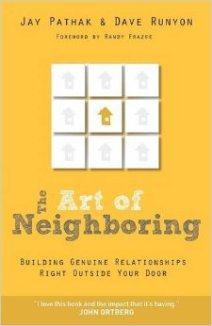 A couple of years ago I read one of the most challenging and informative books on this subject called The Art of Neighboring: Building Genuine Relationships Right Outside Your Door. Here’s a few great quotes from the book that should get you thinking about how to live out your faith in your neighborhood:
- “The majority of the issues that our community is facing would be eliminated or drastically reduced if we could just figure out a way to become a community of great neighbors.” – local small town mayor
- We are often moving too fast to notice that those who are right around us need a good neighbor.
- To love someone, it helps to actually know their name.
- It’s vital to take a step back and ask ourselves if we live at a pace that allows us to be available to those who live around us.
- In this life, we can only do a few things really well; I think it’s a good idea to make certain that one of those things is what Jesus says is most important.
- Love and hurry are fundamentally incompatible. Love always takes time, and time is the one thing hurried people don’t have.
- If you don’t set your priorities, others will do it for you.
- God is already working in your neighborhood. Being a good neighbor simply means slowing down and being aware of what he is designing.
- Jesus didn’t tell us to become acquaintances with our neighbors; he called us to love them, and that means we need to have an actual relationship with them.
- We don’t love our neighbors to convert them; we love our neighbors because we’re converted.
- If we live out the Great Commandment, an environment is created where the Great Commission can be effectively obeyed.
- Good neighboring – you walk alongside those in need and help them find their way.
- Behind every door is a story.
Questions:
- What would happen if every Christ-follower made it a point to know and befriend their literal neighbors?
- Do I live at a pace that allows me to be available to those around me? And if not, are all of those things I’m doing more important than taking the Great Commandment literally?
- What are the activities you most enjoy doing, and how might they become tools for building relationships with your neighbors?
- Which of your neighbors do you feel God calling you to spend more time with?
Find some great resources that go with the book at ArtofNeighboring.com.


“When you pray… When you fast…” ~ Jesus
 Jesus seemed to assume that prayer and fasting would be a part of the lives of his followers. He didn’t say “if” but “when.” With his assumptions we see again that spiritual disciplines were not just meant for the clergy, but for everyone. In January, our church typically participates in a 21-Day Prayer & Fasting plan. With that in mind, here’s some basics on fasting from a few of my favorite books on the subject of prayer.
From Celebration of Discipline by Richard Foster:
- Fasting refers to abstaining from food for spiritual purposes. It’s not a hunger strike or a form of dieting. Biblical fasting always centers on spiritual purposes.
- Fasting must forever center on God. It must be God-initiated and God-ordained.
- More than any other discipline, fasting reveals the things that controls us. We cover up what is inside us with food and other good things, but in fasting these things surface.
- In Scripture the normal means of fasting involves abstaining from all food, solid or liquid, but not from water (Luke 4:2).
- Sometimes a partial fast is described. Like Daniel, “I ate no delicacies, no meat or wine entered my mouth” (Daniel 10:3).
Isaiah 58 is one of the best resources on fasting in the Bible. Tom Eliff in his great book, A Passion for Prayer shares an outline with us on improper and proper motivations for and the promised benefits of fasting:
Four Improper Reasons for Fasting:
- Fasting to get God’s attention (Isaiah 58:3a).
- Fasting w/o focusing on the Lord (Isaiah 58:3b).
- Fasting w/o humility of heart (Isaiah 58:4).
- Fasting for a brief external show of piety (Isaiah 58:5). Jesus spoke against this as well in Matthew 6:16-18.
Proper motivations for fasting (Isaiah 58:6-7):
- To bring spiritual liberation and freedom.
- To relieve heavy burdens.
- To increase our awareness of the needs of others.
God’s promised benefits for those who fast sincerely and seriously:
- Insight and understanding (v. 8)
- Physical well-being (v. 8)
- A deep sense of what is right (v.8)
- God’s presence to protect and provide (v. 8)
- A sense of immediate access to God (v. 9)
- Release from spiritual oppression (v. 10)
- Real-time guidance from God (v. 11)
- Satisfaction and joy during difficult times (v. 11)
- Increased strength to accomplish the Lord’s work (v. 11)
- Fruitfulness (v. 11)
- Recovering and restoring culture (v. 12)
- Rebuilding what was destroyed (v. 12)
Some Options for introducing fasting into your life:
As you consider fasting, before conducting an extended, lengthy complete or total fast from all food, consider your past health and conditioning and some of you may want to consult a doctor. Consider your work. If your work is rigorous then you need food for energy to give your best to your employer. A complete fast may not be for you at this point. Here are a few other options:
- One meal each day—The fast is not about only giving up food, but also includes praying during mealtime. Jesus said, “Could you not watch with me one hour?” (Matthew 26:40). It takes about an hour to prepare a meal or travel to a restaurant or get ready to eat. So this time is a perfect opportunity to pray. Those who work in hot exhausting jobs cannot fast completely because they need their strength and stamina for physical exertion. However, they can sacrifice one meal a day for the Lord.
- Two meals each day—Some people can pray for two hours each day, sacrificing two meals to the Lord.
- Eat only veggies—The Daniel Fast involves giving up meats, desserts and snacks, eating only the food that Daniel most likely ate. While the fast doesn’t give extra time to pray, it is a commitment of the heart that when joined with prayer, moves the heart of God.
- Give up television—Secular people might laugh at “fasting television” or “sacrificing television” but it is a commitment to God to place loyalty to Christ first above all else. This is a spiritual choice in response to Christ, who promises, “Seek first the kingdom of God and His righteousness, and all these things shall be added unto you” (Matthew 6:33).
- Give up sports—Giving up bowling league, golfing, fishing, jogging or other activity for a season (such as 40 days) to pray during that time is a choice. It places spiritual exercise above physical exercise.“Bodily exercise profits little, but godliness is profitable for all things” (1Timothy 4:8).
- Give up pleasure reading—Beyond what you must read for your work or preparing for teaching the Word of God, pleasure reading could be turned into prayer time. You could consider laying aside reading the daily newspaper too.
- Restrict mobile phone use and text messaging—While some of these communication devices are necessary, they are serious time robbers that could be placed aside for praying.
- Facebook and other social media—These activities can consume huge chunks of time. Part of a fast could be to cease social media and use the time for prayer and intercession.
- Other—There may be something that the Holy Spirit brings to mind that you could place aside for a season while you focus on more prayer.
The Daniel Food Fast
Also check out www.ultimatedanielfast.com & www.danielplan.com/ for info, recipes, & more.
The Daniel Food Fast is a very healthy way to eat. So health professionals will support this eating plan but might suggest a few modifications if you have health issues that need special attention. For example, pregnant and nursing mothers might get instructions to add fish, chicken and cheese into the Daniel Food Fast but otherwise stay the course. Diabetics may need to add more carbohydrates or include chicken and fish. Also, those who are especially active either through sports, bodybuilding or vocation may need to slightly alter the eating plan. I encourage you to check with your doctor . . . and by the way, being addicted to Snickers and Coke don’t count as a special need!
What is the Daniel Food Fast?
The Daniel Food Fast is a biblically based partial fast. It is a method of fasting that men, women and young people all over the world are using as they enter into the spiritual discipline of prayer and fasting.
There are two anchoring scriptures for the Daniel Food Fast. In Daniel 1, the Prophet ate only vegetables (that would have included fruits) and drank only water. So from these scriptures we get two of the guidelines for the fast:
1. Only fruits and vegetables
2. Only water for a beverage
Then in Daniel 10, we read that the Prophet ate no meat nor any precious breads or foods and he drank no wine for 21 days. So from this scripture, we get a third guideline:
3. No sweeteners and no breads
Another important guideline is drawn from Jewish fasting principles, where no leaven is used during the fast. So that’s why yeast, baking powder and the like are not allowed on the Daniel Food Fast.
Check out www.danielplan.com & www.ultimatedanielfast.com for more info, including recipes.
Other resources for your 21 Day’s of Prayer & Fasting:

Worship is…
 The Christmas story says a lot about the nature of true worship. We can say that God sent Christ into the world so that we could have unfettered opportunity to worship Him. However, worship is misunderstood today as a place and time (“the Worship Service starts at…”) or an experience or element of a gathering (“the worship was great today”). We find a great definition of true worship in Mary’s song in Luke 1:46-55.
Worship is humble surrender born out of knowledge of God.
Mary’s worship demonstrated three things:
1. Humility – “It’s not about me.”
Real Worship starts with the reality that life is about HIS value, and then wonder that I can be accepted, cared for, given to, by such an incredible God. Mary says, “my soul magnifies the Lord, and my spirit rejoices in God my Savior, for he has looked on the humble estate of his servant” Luke 1:46-47. Mary demonstrates for us that the proper attitude in worship and in life is, “It’s not about me. It’s about Him.” And “who me? I get to be part of this?”
2. Surrender – “Lord, my life is Yours.”
Mary was a true worshiper because her heart was surrendered. In Luke 1:38 she said, “I am the servant of the Lord; let it be to me according to Your Word.” In Luke 1:48, she again calls herself “His Servant.” The word here is literally bond-slave denoting one that has intentionally surrendered themselves to be in servitude to another. To surrender is to make your whole self available to God for whatever He desires. It’s to say to God, “Your way is best. I’m listening. I’m ready to respond with yes.” The opposite of surrender is to resist, to fight, to struggle, to run away, to make our way best and essentially ourselves god, which is idolatry. Mary’s worshiped with a heart that was without resistance.
3. Knowledge of God – “He has done great things for me, and holy is His name” Luke 1:49.
In this song, Mary shows us that she knows God’s word, has a deep understanding of God’s purposes, she knows His work in history, and that she’s internalized His promises to be for her and all that have led her to worship Him.
What has God done for you? How has God worked in your life? You can’t worship what you don’t know. Humility and surrender will open your life to know and experience God, which will lead you to a life of worshiping Him.
So, is life all about you? is there resistance in your heart when it comes to the will of God? can you point to God’s work in your life? If not, during this Christmas season, humble yourself, surrender your heart and will, and get to know His story. Worship Him.
Toward Better News Sources
I’m not interested in just hearing what famous people tweeted overnight or what celebrities have had for breakfast recently. I like to hear my news through two lenses: Global perspective and Christian values. Two places I’ve found that deliver on these. 
- The World and Everything In It Podcast – 20 minute update on news and special interest stories from a Christian perspective.
- The BBC World News Podcast – 20 minute update from around the world. Not necessarily a Christian perspective, but Western and Global.
I listen to World everyday and BBC if I have time during the day, or if something big has happened around the world. I feel I’ve gotten a better handle on the big picture with these two daily doses. I liked Denzel Washington’s recent quote about news sources,
“If you don’t read the newspaper, you’re uninformed. If you do read it, you’re misinformed.”
What are you favorite news sources to help you stay informed?

Celebrating Small Group Life
Round tabled with our Bridge Church Small Group Leaders this week for a seasonal troubleshooting and celebrating session. Proud moment for the church planter, when you realize that what started as one small group in 2011, has now grown to 10 groups! We celebrated new groups and first time group engagements. We trouble shot consistency, communication, pastoral care issues. A few of the highlights and developing strategies from our journey to effective group ministry:
- Seasonal Rhythm. We’ve adopted three seasons as opportunities to start new groups, for groups to take natural breaks, and to emphasize new connections. This includes a Small Group Leader round table, one month prior to each new seasons kickoff. A rhythm is a system that can give natural start and stops for groups.
- Geaux Projects for Groups. Each group is encouraged to organize around the strategy Gather-Grow-Geaux. How are we going to gather this season (where, how often, how long, etc.)? How are we going to grow this season (track with sermon series, marriage study, financial study, etc.)? How are we going to geaux this season (how will we serve and make a difference in our community together)? This seasons Geaux Projects have included projects for local widows, helping flood victims, serving local children’s home, shared date nights for couples, neighborhood block parties, etc.
- Putting our Money Where our Mouth Is. A few years ago it hit me that we talk about how important groups are but our budget doesn’t back that up. So now, each group gets $1,000 per year to make magic happen with group life. This is turned into incredible impact through the opportunity for groups to be responsive to the needs around them and creatively serve one another and their communities. This year, we were able to do that twice. Love hearing the stories of how this money is spent.
Capacity for making disciples is best expanded at the group level. Churches that grow must find ways to multiply gatherings (rows), groups (circles), and teams (strengths).
If you go to a church, but are not involved in a group, get involved ASAP. We like to say,
“Life change happens best in circles, not rows.”
Getting involved in a group that forms in a circle is different than sitting in a church with rows.
– In a circle you look someone in the face.
– In a circle there is dialogue & conversation.
– In a circle, you let down your defenses & engage.
These are critical elements of the kinds of relationships that bring life change.
If you’re in West St. Tammany Parish, and want to connect with one of our Bridge groups, sign up here.


Rules of Thumb & Questions for Church Calendar Planning
- “God is looking for people through whom he can do the impossible – what a pity that we plan only the things that we can do by ourselves.” – A.W. Tozer
- The end result of every event should be people moving closer to Christ.Everything must be filtered through the Great Commission of Making Disciples.
- Define how each thing we do CULTIVATES, PLANTS Seeds, or Brings in a HARVEST. Everything must be filtered through the urgency of evangelism.
- Are there any events that we need to kill?
- Are there any events from the past that we wish we hadn’t killed?
- Are there any events that need to be moved?
- Is there an opportunity we’re missing on our calendar? (Have you said, “Aw man, we should have done _____!)
- Rule: Only one Special Event (all church) per month
- Special Events should include every demographic in our church at least once per year – Men, Women, Teens, Kids, Married Couples, Singles, Older adults
What rules and questions guide your churches calendar planning?

3 Questions to Get Leadership Development Started
Sustained leadership development requires intentionality. Churches stall many times because they lack an intentional plan to continue reproducing leaders beyond the core group development phase, if they do it then. Here are three questions to get leadership development started.
1. How many leadership roles have we developed?
You won’t expand the capacity of your church without a growing number of leaders. You won’t develop leaders if you don’t see a need for them. Expanding the capacity of your church requires enlarging the organization through leadership roles. Our current church plant has basically followed the Acts 6 moments in our history to start new ministry teams and thus creating new leadership roles. When we had a need arise, like in Acts 6 with the need for widows to be served fairly, we’ve created a new team. Or when we saw God giving us leaders of a certain gifting, we took the opportunity to create opportunities in that area. In 7 years, we’ve gone from one launch team, to now eight ministry teams, with leaders multiplying to fill roles required by the needs of the church and community.
Is your church setup to expand capacity through new leaders and expanding roles for leaders? If not, start with obvious needs in the church and community, and begin to cast vision for a new ministry or team or individual to fulfill that ministry.
2. How many leadership training opportunities have we promoted?
Leadership training for the church is more than just seminary training. Every church can offer an array of training opportunities and in so doing, develop a culture of leadership development. Here are a few opportunities available to all of us:
- Online training options like Ministry Grid. Training can be shared on Facebook Groups or by email. You can even do your own video training very easily these days through Youtube.com or Right Now Media.
- Invite other church leaders in your region that are killing it in a particular area of ministry that you hope to develop. Put on a luncheon after church and pay their mileage and most will jump at the chance to serve your church.
- If you’re close to a seminary, invite a professor for a day of training with your church in a particular area.
- Denominations and local Associations of churches offer trainings throughout the year that are usually free and close by.
- National conferences can be more expensive when you factor in travel, but can still be powerful events to train, equip, and inspire your leaders and potential leaders.
Plan 4-6 opportunities next year. Watching who shows up for these and takes them seriously will help you see who your leaders and potential leaders are.
3. How many small steps up the leadership ladder have we developed?
 Each year I update a spreadsheet for our church called “Who Does What?” It lists everything required to pull off what our church does every week. Dozens of task go on that list. As a church planter, many of them have been done by me or by staff. But our work is to get more and more of that list, especially the leadership roles, done by the people in the church. BUT PAY CAREFUL ATTENTION TO THIS: It’s not about getting stuff done! It’s about getting people done! Giving people responsibility in the overall mission of the kingdom is a way to help them develop as disciples. Watch for obedience and faithfulness, coach and encourage, and watch many of them climb up the ladder to fruitful ministry in the church, neighborhood, and beyond. You should see even making the coffee as a sacred role that invites someone to a life on mission.
Does your church have small steps of responsibility and life on mission for new disciples and potential leaders to take this week?
Developing leaders is about offering opportunities to lead, to learn, to take small steps along the path to maturity.


 Lane Corley