Blog Archives
Crawfish and Spiritual Life
Crawfish season in Louisiana brings joy, celebration, and community. But did you know that crawfish also offer us a powerful picture of spiritual life? In the Bible, crawfish (and other shellfish) were forbidden for the people of Israel under ceremonial law (Leviticus 11:12; Deuteronomy 14:9-10). While strange to modern ears, these dietary rules served as symbolic boundaries that set God’s people apart.
But thankfully, the story doesn’t end there.
From Forbidden to Free
Hebrews 10:1 explains that ceremonial laws were “a shadow of the good things to come.” In Acts 10:15, Peter receives a vision in which God declares, “What God has made clean, do not call impure.” Through Christ’s death and resurrection, we are no longer bound to food laws and regulations. We are invited into a new kind of holiness, not based on what we eat but on our relationship with God through faith in Jesus.
So yes—praise God—you can enjoy that crawfish boil with gratitude and freedom! But here’s where it gets personal…
Crawfishing as a Metaphor
Crawfish don’t just taste great—they walk backward when threatened. Sadly, many people do the same thing spiritually. When confronted with hardship, responsibility, or change, we tend to crawfish—retreating, avoiding, and disengaging.
Here are a few ways this shows up in life:
- Avoiding spiritual conversations out of fear or comfort.
- Withdrawing from community when accountability challenges your choices.
- Returning to old habits rather than walking in newness of life.
- Living a roller-coaster faith, based on emotions or circumstances.
This is the story of Peter after Jesus’ arrest and crucifixion. He denied even knowing Jesus (Luke 22:54-62). Then, disoriented and ashamed, he told the others, “I’m going fishing” (John 21:3)—essentially saying, “I’m done.”
A God Who Restores
But the story doesn’t end with Peter’s failure. In Mark 16:7, the angel at the tomb gives this powerful instruction: “Go tell the disciples—and Peter…” Even in his shame, Peter was not forgotten.
In John 21, Jesus finds Peter and gently restores him:
“Do you love me? Feed my sheep.”
Peter isn’t sent back to the fishing boat—he’s called forward into leadership, purpose, and grace.
Jesus doesn’t shame backsliders—He restores them. If you’ve crawfished spiritually, God is not finished with you. There is mercy, forgiveness, and a new mission waiting.
When Do We Backslide?
We tend to crawfish when:
- Our faith is tested (Mark 14:27)
- Life’s worries cloud our priorities
- Fear of people outweighs fear of God
- Sin overtakes us and we stop fighting (Galatians 6:1)
But God’s invitation is clear:
“The one who perseveres to the end will be saved.” – Matthew 24:13
“We are not those who draw back and are destroyed, but those who have faith and are saved.” – Hebrews 10:39
Moving Forward
Jesus is the Good Shepherd. If you’ve crawfished—He’s calling you back.
You’re not alone. You’re not too far gone.
There’s a seat at the table—and maybe even a sack of crawfish waiting—as a symbol of the joy and freedom we’ve been given in Christ.
15 Skills of Effective Disciple Makers
Disciple-making is an art that requires specific skills. Skills modeled and taught by Jesus. And it’s a lost art. Only 10% of Christians seek to be active witnesses and disciple-makers in their sphere of influence. Are we giving them the skills they need?
Here are 15 skills that we’ve identified and are seeking to pass on to our church through our Equip Luncheons in 2025:
Being a Disciple
- Abiding in Christ – Identifying with Christ through faith and baptism. Then, developing a daily relationship with Christ through prayer, his word, and walking in the Holy Spirit.
- Knowing the Word -The Word of God is our master tool for disciple-making. Developing a knowledge of the word of God is an essential skill for disciple-makers.
- Listening to God – God is working to reconcile people to himself (2 Corinthians 5:18-20). He will direct the willing and ready heart to join him in his work. Through our abiding relationship with him, he will guide us to the people and opportunities for fruitfulness in disciple-making.
Building Relationships
- Love and Compassion for the Lost – Effective disciple-makers know what’s at stake for those who don’t know Christ. We are compelled by His love (2 Corinthians 5:15) to do all that we can to share the gospel and get other people on this disciple-making mission.
- Listening to Others – Being heard and loved are two sides of the same coin today. Knowing the broken beliefs of others so that we can share the hope of the gospel with them is essential to evangelism today. The challenge here is making time in disciple-making to listen to others. Jesus spent three years of daily life with his disciples.
- Building Trust – Disciple-making is relational. Being trustworthy as a friend lays the foundation for someone to consider your message and want to follow in your footsteps, which is the goal of disciple-making. Mark 3:13-15; 1 Corinthians 11:1
- Hospitality—Being welcoming, likable, and someone that others want to be around is a great skill to have if you desire to influence others. Jesus welcomed all kinds of people. You get the idea that they liked being around him, and he also enjoyed being around them. We must break relationships at some point, but we should lead with hospitality.
- Consistent Intercession – Knowing people, loving them, listening to them, building trust with them, welcoming them, and then diligently praying for their salvation and spiritual development. As Epaphras wrestled in prayer for his disciples in Colossae, Hierarpolis, and Laodicea (Colossians 4:12-13), we must develop rhythms of intercession for those we want to lead to faith and disciple-making.
Personal Evangelism – Multiplying Gospel Conversations
- Turning a Conversation toward Spiritual Things – This may be one of the most difficult things to do. Learning a few Evangelism Scripts and developing your personal rhythm of doing this is essential. Check out the 3 Circles Evangelism tool and the book Turning Everyday Conversations into a Gospel Conversations.
- Sharing the Gospel with Clarity – Being clear on the gospel and how to present it clearly to people at different points of need. Tons of books on this. Check out Evangelism in a Skeptical World by Sam Chan.
- Leading people to a response – It takes boldness to persuade people to respond to the Gospel. But persuasion was part of gospel presentations in the book of Acts and it should be for us. Pray for boldness. Develop a persuasive call to respond to the people you are witnessing to. The above books can help with that too.
Disciple-Making
- Teaching the Bible – Helping a new or growing disciple start the journey of a lifetime by teaching them how to abide in Christ and become disciple-makers.
- Patience and Perseverance—This road will have many ups and downs. People will reject you, fall away, and hurt you. Jesus taught in the parable of the sower that only one out of four would be fruitful. Patience with people and perseverance through the ups and downs are essential to the journey of disciple-making.
- Worship and Gratitude – All the glory for this work goes to God. Worship and gratitude keeps our eyes on him and off the difficulties and off of ourselves.
- Reproducing Yourself – The ultimate goal is the one we disciple, discipling someone else. Being able to lead them in such a way that they don’t develop dependence on us or on the church, but are able to lead their sphere of influence to Christ and disciple them. 2 Timothy 2:2 – “what you’ve heard from me in the presence of many witnesses, entrust to faithful men, who will be able to teach others also.”
What other skills would you add to this list?
Here’s a quick course on getting started with disciple-making – LINK.

A Daily Walk
Colossians 2:6: “So then, just as you have received Christ Jesus as Lord, continue to walk in him.”
Kicking off this year at our church in Colossians 2, lifting a few commitments to make at the beginning of a new year from verses 6-7.
- Jesus is Lord – Beginning with the overarching confession of the believer’s life: Jesus is Lord!
- A Daily Walk
If the soul is awakened with the confession that Jesus is Lord, the soul is sustained by walking daily in a relationship with Jesus. We walk with Jesus through developing a personal devotional habit and daily practice. We have the promise of his constant presence with us through the person of the Holy Spirit. We have his words, which guide us and show us how to walk in his steps. We have the example of his abiding relationship with the Father through prayer and responsiveness to the needs of others. And we know that he wants a personal relationship with each of us.
God didn’t spell out the perfect formulas for our devotional habits. It never says in the Bible, “Spend 15 minutes a day reading the Bible, pray for 10 minutes, read a daily devotional published by a reputable publisher, then listen to a worship song or two before you go to work.” He’s left that up to us individually to determine the best ways to develop our relationship. And I’m reminded that a checklist of base touches does not produce a deep relationship with anyone and most likely will not with God.
Over 25 years of figuring out how to walk with God myself, here are the rhythms that have worked for me to this point:
- Wake up early. I’m a morning person, so I enjoy the early AM hours. It all goes downhill after 8am to me.
- Journaling. I start my day by writing prayers and commitments of devotion to God. (see my post, Morning Prayers).
- Reading Scripture. I follow one of the Bible in a Year Plans in the Bible App, which leads you through the Old Testament and New Testament in a systematic way (See my post How to Get a Grip on the Bible for answers to questions about the Bible & how to get started reading the Bible).
- Journaling. As I read, I write down the verses that jump at me. When I’m done reading, I read back through those verses and write down any Observations, Applications, or Prayers. (See the SOAP method). (Also, check out my post Allowing the Teachings of Jesus to Go Deep, for a plan to Journal through the sermon on the mount. Serves as a great introduction to journaling through the scriptures).
- Bible Memory. I also utilize the Bible Memory App to commit verses that jump out at me to memory. Reviewing memorized verses throughout the day helps me to stay in tune and meditate on God’s word all day long (see Psalm 1, Joshua 1:8). (See my posts on the Habit of Scripture Memory HERE).
- Devotional Reading. Sometimes, I read something extra. A few favorites: A Year with C. S. Lewis: Daily Readings from His Classic Works, My Utmost for His Highest by Oswald Chambers, Experiencing God Day by Day by Henry Blackaby, 21 Most Powerful Minutes in a Leaders Day by John Maxwell. Lots of great devotionals are available.
- Daily News feed. I also use Feedly.com to follow many authors, pastors, networks, and news sites that inspire and inform me.
- Sharing. As I’m reading, I’m asking if there is anything that I’d like to share with friends or family, with my church, or with my social media networks. I will also tag and file anything that may be helpful for my upcoming speaking and preaching schedule.
- Intercession. I keep a list of people and situations that I want to pray for every day. It includes my family, my church leaders, the team I work with, and others. I’m committed to making time to pray for them. Sometimes, that happens in the mornings during my devotions. Sometimes, it’s later in the day.
Roll with the punches. I wish I could say that this happens every day. Work, sickness, oversleeping, and poor time management happen, so I plan on rolling with the punches. Some tools we have to help with that:
- Technology. When I don’t have time to read in the mornings. I can listen to my Bible plan using the Bible App during my commute. My newsfeed and devotional are also on Kindle, so I can read them during my spare moments.
- Grace. Remember that my salvation is not based upon my ability to read the Bible every day. Only Jesus saves. Devotional habits are tools for our growth in grace. Don’t give up. Our life is ETERNAL, so missing a day occasionally does not mean losing.
- Presence. God is not with me only when reading the Bible and praying. God is with me all the time. I can stay connected with him through prayer all day long.
- Tomorrow. One of my favorite sayings is, “YESTERDAY ENDED LAST NIGHT.” The Bible says, “God’s mercies are new every morning” Lamentations 3:23-24. If you miss a day of devotional habits, put it behind you, celebrate the grace and presence you experienced that day, and let that build anticipation for tomorrow or when you can restore your habits.
Jesus said, “Man cannot live on bread alone, but on every word that comes from the mouth of God.” Matthew 4:4. Devotional habits are as crucial to the Christian as food and drink. Work out a plan that works for you, figure out how to do it every day, commit to it for life, and roll with the punches.
Christ Jesus as Lord
Colossians 2:6 “So then, just as you have received Christ Jesus as Lord”
Kicking off this year at our church in Colossians 2, lifting a few commitments to make at the beginning of a new year from verses 6-7. Beginning with the overarching confession of the believers life: Jesus is Lord!
The Christian life begins with the confession “Jesus Christ is Lord” (Romans 10:9). This confession serves as the soul awakening by God (Matthew 16:18; 1 Corinthians 12:3) and the outset of the new birth and new life in the believer. This confession should also serve as our way of life and motto. To live under his Lordship and authority, allowing him to rule and reign in all our thoughts and actions. Living out Jesus as Lord means forsaking all other rulers, authorities, and priorities, intending that every day will be lived for his glory and pleasure.
Here are a few daily prayers to pray to surrender to his Lordship daily:
- Father in heaven, I exalt you as Lord, master, and King of my life, placing all that I am at your complete 100% disposal.
- Lord, whatever you ask of me today, my answer is yes.
- Lord, use me, teach me, change me according to your perfect will.
- Lord, rule and reign in all my thoughts and actions today.

Memorize One, Get Five for Free
This verse is repeated six times in the Old Testament and is great to memorize and meditate on during November.
1 Chronicles 16:34 – “Give thanks to the Lord, for He is good, his faithful love endures forever.”
(Also found at Psalm 106:1; 107:1; 118:1; 118:29; 136:1).
So you can memorize one and say you memorized six! Lol!
Thanksgiving Memory Verses
Join me in memorizing 30 Thanksgiving verses on the Bible Memory App this month: LINK.
I’ve used the Bible Memory App daily for over six years now. It’s been a great devotional tool. It helps me hide the word in my heart. And it’s only 100% better than scrolling Facebook/Twitter/Snapchat/TikTok, or whatever. Start a new habit with the Bible Memory App.
- Get Started with the Bible Memory App – LINK
- Cultivating the Habit of Scripture Memory – LINK
- Why and How to Memorize Scripture – LINK
- Develop a New Habit: Scripture Memory – LINK
- How to Get a Grip on the Bible – LINK


A Healthy Soul
Our church is wrapping up a Fall study of the New Testament book of 1 Peter. We tackled the book through the lens of Soul Care, exploring what is a healthy soul. Here’s a list of statements gleaned from the series defining a healthy soul.
- A healthy soul doesn’t get too attached to this world. 1 Peter 1:1-2
- A healthy soul has experienced the new birth. 1 Peter 1:3-12
- A healthy soul is fixated on God’s grace. 1 Peter 1:13-25
- A healthy soul grows healthier by feeding on God’s Word. 1 Peter 2:1-10
- A healthy soul trusts Christ to deal with sin. 1 Peter 2:11-25
- A healthy soul is a ready witness of God’s goodness. 1 Peter 3:1-17
- A healthy soul is friends with God. 1 Peter 3:18-22
- A healthy soul serves others through the power of God. 1 Peter 4:1-11
- A healthy soul trusts God to deal with the injustice of Christian suffering. 1 Peter 4:12-19
- A healthy soul is a gracious, humble soul. 1 Peter 5:1-7
- A healthy soul overcomes this world. 1 Peter 5:8-14
I’m grateful for our Preaching and Teaching Collaborative at Bridge Church, which works together to deliver messages to our congregation: Adam Bourne, Chris Guillott, Larry Johnson, Evan McGinty, and myself. We’ve been using a team approach for a few years now, and I love it, especially with a bi-vocational staff. You can listen to these sermons at Bridge Northshore on iTunes or here.


Understanding Proverbs
Our church started a summer study of the book of Proverbs this week. It’s one of my favorite books of the Bible. I read it every day. This book is worth a lifetime of study and reading. It’s a lot like hard candy. Takes a while to digest. Many people have suggested reading one chapter a day. With 31 chapters, you can finish the book in one month. Billy Graham suggested reading five chapters of Psalms and one chapter of Proverbs daily. He said Psalms will help you prepare to relate with God. Proverbs will help you prepare to relate to man.
Three things I love about Proverbs:
1) Wisdom Literature
Proverbs is part of a genre in scripture we call Wisdom Literature. The books of the Bible in this category are Job, Psalms, Proverbs, Ecclesiastes, and Song of Songs. These books call us to righteousness, justice, godliness, and true worship of God, and give us tons of wise sayings to live by.
A proverb is defined as a general observation about how things are or how to live in God’s will. Wisdom literature and especially the book of Proverbs are full of wise, memorable sayings. They are worth memorizing and meditating on every day.
2) A Letter from Dad
Two words started jumping off the pages at me when reading Proverbs as an adult – “My son…” This book is a letter from a Dad to his sons. Knowing this makes it a very personal book. It can serve as an important tool in the toolbox for any parents seeking to raise wise and godly children.
3) Listening to the Wisest Wealthiest Man Who Ever Lived
What would you get if you crossed a Saudi Arabian prince, the President of the United States, Socrates, and Mickey Mouse? The wealthiest, most politically powerful, wisest, and most famous person in the world. That describes King Solomon. Proverbs and Ecclesiastes allow us to listen to this God-given wisdom as he seeks to guide his future generations and share lessons learned from a life building the greatest kingdom on earth in his time.
Unfortunately, Solomon didn’t always live wisely. He pursued pleasure, treasure, selfishness, and other things. His life serves as a parable as well as provides the wisdom of Proverbs. Get to know Solomon through 1 and 2 Kings, 1 and 2 Chronicles, Proverbs, and Ecclesiastes.
Follow along with Bridge Church’s trek through Proverbs this summer HERE.


Report: Baptisms Rebound in Louisiana
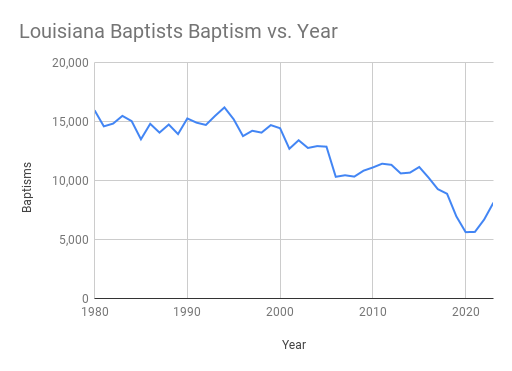
Last week Lifeway Research released a report on Baptisms and other stats across the Southern Baptist Convention. Find it HERE. How does Louisiana’s data fit into that picture?
Louisiana Baptist churches reported 8,120 baptisms in 2022. That’s a 21% increase from 2021 to 2022. And a 44% increase from 2020 to 2022. Up from 5,637. Still a long way from a high of 16,187 in 1994. A steep drop started in 2016, the last year above 10,000 baptisms in our reported history.

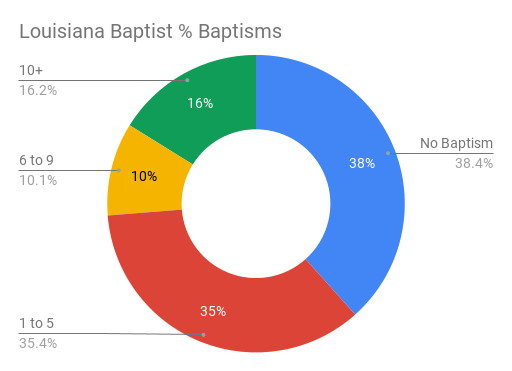
38% of Louisiana Baptist churches that reported in 2022 had zero baptisms. 35% baptized 1-5 people, while 10% saw six to nine baptisms. 16% reported at least 10 baptisms.

Newer churches are not as evangelistic as they once were. This is something I’ve written about before HERE. Church’s founded before 2000, averaged 7.5 baptisms per church. Those founded between 1950 and 1999, baptized 8.3 per church. Those founded from 1900 to 1949 baptized 9.2 per church. And those founded pre-1900 averaged 5.3 baptisms per church.

If you’re concerned, you can do something about low baptism numbers today! SHARE THE GOSPEL. Here is three questions and a to do list for increasing baptisms in short order:
Question: Do we have a list of potential candidates?
1. Look over our church directory and circle the names of people that I know have not been baptized or that I’m not sure have been baptized.
2. Make appointments with at least one of these each day, until everyone circled has been challenged to consider where they are in their journey toward Christ.
3. Plan a sermon on Baptism where everyone will be challenged to follow and obey Christ with the opportunity to respond.
Question: Are we making Evangelistic Contacts?
4. Pray for open doors to share the gospel.
5. Plan a time today and at least three times each week, to intentionally interact with people that are far from God.
6. Put at least three outreach events on the calendar between now and the end of the year that are sure to engage people who are far from God. Get names, pray, follow up.
Question: Are we developing an Evangelistic Culture in our Church?
7. Plan at least one evangelism training for the entire church between now and the end of the year.
8. Put on the calendar at least one monthly special prayer time for lost and unchurched people in our community.
9. Challenge our church leaders by email and in person to right down the names of five people that they know who need Christ. If they don’t know five people, challenge them to get to know five people who need Christ.
What if Jesus Were Normal?
Yesterday, I took a look at a few halmarks of “NORMAL CHRISTIANITY” or what normal has become for many of us western Christians. Some  questions I’m asking of my faith journey is would a first century believer that moved to my neighborhood from Ephesus or Antioch or Jerusalem recognize anything of the way (Acts 9:2) in my normal Christianity? and…
What if Jesus were our standard for Normal? What might Christianity look like? A few thoughts:
- Taking Risk for the Good of Others. Philippians 2:3-8, outlines how Christ’s death was a series of sacrifices for the good of others. From coming to this world in the form of man to dying on a cross, he put others ahead of himself. And we are commanded to do the same, “You must have the same attitude that Christ Jesus had…” Philippians 2:5 NLT. Following Christ means putting others first even at great risk to yourself.
- I adjust my life to WHATEVER God says. Prior to being crucified for a non-crime, Jesus ask the Father if there was any other way, but qualified his prayer with “Not my will but thine be done.” Normal Christianity seems to believe the chief qualifier is our happiness and pleasure, not God’s will and the good of others. What’s the qualifier for your obedience? Your desire or His?
- Responsiveness to the Needs of Others. One of the key words in the book of Mark is IMMEDIATELY. It’s used many times to describe how Jesus responded to the needs of others. Matthew 9:35, says that he saw the crowds and felt compassion, then responded by sending out disciples to meet their needs. What happens in your heart when you see the needs of others? or hear about a need?
- Upside Down Relationships. You want your faith to stand out? Try following Jesus’ instructions on relationships. Love your enemies. Don’t Judge. When you lend, don’t expect it returned. If someone has something against you, take the initiative to get it right. If someone ask you for a favor, do it times two. I’m convinced that if Christians would make Christ’s relational principles the norm, the world would be shaken.
- Going / Sending. Two of my favorite words in the story of Jesus are “Jesus went.” Speaks of his responsiveness and his desire to take the good news. I’ve said, I’d love for that to be on my grave stone, should I have one. “He went.” Along with those two words we see “Jesus sent.” He didn’t hold on to his followers and see the reasons they weren’t ready. He sent them out, allowing them the opportunity to experience the power of God and be used to expand the kingdom. Am I going? and as a leader, am I releasing and sending? The popular statement among leaders, “the church shouldn’t be known for its seating capacity, but its sending capacity” fits the Christ life and should be the norm. See my post on Creating Sending Capacity.
What else would you add to a list of Jesus norms?
Loving People to the Very End #HolyWeek
“Mom, I love you Four hundred-million-thousand!” My oldest son did this numbers game when he was younger. He tried to come up with the largest numbers his brain could imagine to describe the height, depth, breadth of his love for mom. (When asked about love for Dad, it was usually just a plain 100 or so. But I’m not bitter). Finally, one day he gave up trying to come up with larger and larger numbers and just proclaimed, “Mom, I love you to the very end!”
That reminded me of the Holy Week story in John 13. The Bible says about Jesus, “He had loved his disciples during his ministry on earth, and now he loved them to the very end” John 13:1 NLT. So what did He do? He “wrapped a towel around his waste, and poured water into a basin. Then he began to wash the disciples’ feet…” John 13:4-5 NLT.
This was just the beginning of a 24-36 hour period of loving them to the end that culminated with his brutal bloody death on the cross. How did Jesus demonstrate how to love to the end? Deep humility and serving others with no boundaries. Jesus’ love said, “I’ll do whatever it takes, without limitation or hesitation, because of my love for you.”
“Yea, that’s Jesus. He’s awesome!” Yes He is, but Jesus called us to this same kind of life. What!
John 13:14-15,
“since I, your Lord and Teacher, have washed your feet, you ought to wash each other’s feet. I have given you an example to follow. Do as I have done to you.”
Philippians 2:5-8 ups the stakes even more:
“You must have the same attitude that Christ Jesus had.
Though he was God,
he did not think of equality with God
as something to cling to.
Instead, he gave up his divine privileges;
he took the humble position of a slave
and was born as a human being.
When he appeared in human form,
he humbled himself in obedience to God
and died a criminal’s death on a cross.”
God desires for us to live with an attitude of “I’ll do whatever it takes” in our relationships with Him and others. Letting go of perks, privileges, social norms, entitlements, and appearances. The opposite is to draw the line. “I’ll not go that far.” Jesus erased his line for us, and calls us to do the same.
Some questions I’m reflecting on:
- Where do I draw the line when it comes to humility, transparency, and serving others? Why?
- Do I allow real or imagined perks, privileges, social norms get in the way of loving people?
- Can I say my attitude toward others is Christ-like with this standard?
- Does my love for God and others have limitations? or is it to the very end?


 Lane Corley