Blog Archives
Thanksgiving Memory Verses
This verse is repeated six times in the Old Testament and is excellent to memorize and meditate on during November.
1 Chronicles 16:34 – “Give thanks to the Lord, for He is good, his faithful love endures forever.”
(Also found at Psalm 106:1; 107:1; 118:1; 118:29; 136:1).
So you can memorize one and say you memorized six! Lol!
Thanksgiving Memory Verses
Join me in memorizing 35 Thanksgiving verses on the Bible Memory App this month: LINK.
I’ve used the Bible Memory App daily for over seven years now. It’s been a great devotional tool. It helps me hide the word in my heart. And it’s only 100% better than scrolling Facebook/Twitter/Snapchat/TikTok, or whatever. Start a new habit with the Bible Memory App.
15 Skills of Effective Disciple Makers
Disciple-making is an art that requires specific skills. Skills modeled and taught by Jesus. And it’s a lost art. Only 10% of Christians seek to be active witnesses and disciple-makers in their sphere of influence. Are we giving them the skills they need?
Here are 15 skills that we’ve identified and are seeking to pass on to our church through our Equip Luncheons in 2025:
Being a Disciple
- Abiding in Christ – Identifying with Christ through faith and baptism. Then, developing a daily relationship with Christ through prayer, his word, and walking in the Holy Spirit.
- Knowing the Word -The Word of God is our master tool for disciple-making. Developing a knowledge of the word of God is an essential skill for disciple-makers.
- Listening to God – God is working to reconcile people to himself (2 Corinthians 5:18-20). He will direct the willing and ready heart to join him in his work. Through our abiding relationship with him, he will guide us to the people and opportunities for fruitfulness in disciple-making.
Building Relationships
- Love and Compassion for the Lost – Effective disciple-makers know what’s at stake for those who don’t know Christ. We are compelled by His love (2 Corinthians 5:15) to do all that we can to share the gospel and get other people on this disciple-making mission.
- Listening to Others – Being heard and loved are two sides of the same coin today. Knowing the broken beliefs of others so that we can share the hope of the gospel with them is essential to evangelism today. The challenge here is making time in disciple-making to listen to others. Jesus spent three years of daily life with his disciples.
- Building Trust – Disciple-making is relational. Being trustworthy as a friend lays the foundation for someone to consider your message and want to follow in your footsteps, which is the goal of disciple-making. Mark 3:13-15; 1 Corinthians 11:1
- Hospitality—Being welcoming, likable, and someone that others want to be around is a great skill to have if you desire to influence others. Jesus welcomed all kinds of people. You get the idea that they liked being around him, and he also enjoyed being around them. We must break relationships at some point, but we should lead with hospitality.
- Consistent Intercession – Knowing people, loving them, listening to them, building trust with them, welcoming them, and then diligently praying for their salvation and spiritual development. As Epaphras wrestled in prayer for his disciples in Colossae, Hierarpolis, and Laodicea (Colossians 4:12-13), we must develop rhythms of intercession for those we want to lead to faith and disciple-making.
Personal Evangelism – Multiplying Gospel Conversations
- Turning a Conversation toward Spiritual Things – This may be one of the most difficult things to do. Learning a few Evangelism Scripts and developing your personal rhythm of doing this is essential. Check out the 3 Circles Evangelism tool and the book Turning Everyday Conversations into a Gospel Conversations.
- Sharing the Gospel with Clarity – Being clear on the gospel and how to present it clearly to people at different points of need. Tons of books on this. Check out Evangelism in a Skeptical World by Sam Chan.
- Leading people to a response – It takes boldness to persuade people to respond to the Gospel. But persuasion was part of gospel presentations in the book of Acts and it should be for us. Pray for boldness. Develop a persuasive call to respond to the people you are witnessing to. The above books can help with that too.
Disciple-Making
- Teaching the Bible – Helping a new or growing disciple start the journey of a lifetime by teaching them how to abide in Christ and become disciple-makers.
- Patience and Perseverance—This road will have many ups and downs. People will reject you, fall away, and hurt you. Jesus taught in the parable of the sower that only one out of four would be fruitful. Patience with people and perseverance through the ups and downs are essential to the journey of disciple-making.
- Worship and Gratitude – All the glory for this work goes to God. Worship and gratitude keeps our eyes on him and off the difficulties and off of ourselves.
- Reproducing Yourself – The ultimate goal is the one we disciple, discipling someone else. Being able to lead them in such a way that they don’t develop dependence on us or on the church, but are able to lead their sphere of influence to Christ and disciple them. 2 Timothy 2:2 – “what you’ve heard from me in the presence of many witnesses, entrust to faithful men, who will be able to teach others also.”
What other skills would you add to this list?
Here’s a quick course on getting started with disciple-making – LINK.
A Disciple is…
According to the Book of Acts, a disciple is an individual who has placed his faith and trust in Jesus Christ and is following Jesus Christ’s teachings and direction for his life. A disciple is connected with other disciples through the church and participates in Jesus’ mission to spread the good news to the ends of the earth.
A disciple is an individual. While Acts points us to the church’s work as a gathered group of disciples, we do not escape the spiritual reality that God deals with us as individuals. Each person is responsible for their sin, as in the case of Ananias and Sapphira in Acts 5, and individuals are invited to call on the name of the Lord and be saved (Acts 2:21).
A disciple is an individual who has placed his faith and trust in Jesus Christ. What makes one a disciple is a personal and individual decision to follow Jesus by faith. Peter, who gave the first post-ascension proclamation of the good news about Jesus, had responded in faith to Jesus in Matthew 4:19-20, when Jesus said, “Follow me, and I will make you a fisher of men.”
A disciple is following the teaching of Jesus Christ. Disciples are seen in the book of Acts, acting in obedience to the words of Jesus Christ. They obey his words and pray in an upper room in Jerusalem, waiting on his promise (Acts 1:12-14). They obeyed his words and witnessed about him across the known world (Acts 1:8, Acts 8:1-4). Paul obeyed his words even at significant cost to his reputation, physical body, and life. Disciples are always responsive to the words of Jesus.
A disciple is following the direction of Christ through his Holy Spirit. Not only do we observe the disciples obeying the teaching and commands of Christ, but we also see them being responsive to Christ’s leadership through the Holy Spirit. Cornelius responded when directed to go and seek out Paul after his Damascus Road experience with Jesus. Paul and Barnabas responded when the Holy Spirit directed them not to go in a particular direction on their missionary journey. Disciples listen and obey both the words of Jesus and the direction of his Spirit.
A disciple is connected with other disciples. There are few instances in the Book of Acts of disciples acting alone. Jesus modeled and commissioned his disciples to serve and share the gospel in groups of two or more. Jesus sent his disciples out in pairs. Jesus prayed for a unified mission force in John 17. The only ministry interaction in the Book of Acts that is not done as a team is Phillip’s remarkable evangelistic exchange with the Ethiopian Eunuch. From the beginning of the ministry of Jesus, through the book of Acts, we see that disciples are meant to relate to other disciples in fellowship and in pursuit of Jesus’ mission.
A disciple participates in Jesus’ mission of spreading the good news to the ends of the earth. Throughout the book of Acts we see disciples walking in obedience to Jesus’ commission to be witnesses of him. Peter proclaimed the Gospel everywhere he went, beginning in Jerusalem. Phillip shared the gospel cross-culturally with the Ethiopian Eunuch. Paul proclaimed the gospel everywhere he went and taught others to spread the gospel throughout his three missionary journeys. The most remarkable statement in Acts 19 is that all of Asia heard the word of the Lord. A disciple is obedient and responsive to the words of Jesus and the promptings of the Spirit, and those words and promptings throughout the book of Acts guided them toward gospel proclamation. Disciples will find a way to participate in Jesus’ mission to spread the good news of his death, burial, and resurrection to the ends of the earth.

Six Years with the Bible Memory App
I’ll celebrate six years of daily engagement with the Bible Memory App this week. This App has been a great spiritual growth companion. Desiring to be more devoted to scripture memory, I downloaded several apps and the Bible Memory App stuck with me. I begin each day and end each day by reviewing 5-7 verses. I also add new verses and review memorized verses from my daily devotional reading each morning. Then, throughout the day, as I have occasion (waiting in line, etc.) I jump on and review a few verses.
In six years, this App has helped me master over 2,000 verses. I’ve also utilized the app to take on the challenge of memorizing large chunks of scripture including the Sermon on the Mount and the book of 1 John and several entire chapters. This habit has also helped me as a witness and a preacher as verses are more readily recalled and I’m always ready when asked to share without a lot of opportunity to prep.
Why invest time in Bible Memory?
- Jesus Did. He quoted scripture in response to temptation and his teachings are full of obvious Old Testament references.
- The Disciples Did. As a matter of fact, part of the duty of a called disciple was to memorize their teacher’s teachings. They did and thus we have the Gospels and the New Testament letters.
- The Bible Tells Us To. We are commanded to meditate and to hide the word in our hearts.
- The Word of God is Power. It never returns void. It has the power to save souls. It’s sharper than any sword. And it will endure for all eternity.
- It’s better than any alternative. What else would you do with that 15-35 minutes per day? Doom scroll on social media? TV? Consider the comparative impact on your soul with any other use of time.
So, if you’re a disciple of Christ, and have not yet developed a rhythm of Bible Memory, try out the Bible Memory App. Here are a few articles I’ve written over the last six years about how and why to get started:
- Cultivating the Habit of Scripture Memory – Link
- Why and How to Memorize Scripture – Link
- Getting Started with the Bible Memory App – Link
This App will not click with everyone. That’s ok. Find another way to develop this soul-sustaining habit of scripture memory. Bible memory is a great adventure that you’ll never regret.
The PRO version of the Bible Memory App is only $9.99. Get 20% or a couple bucks off with this link – PRO.

Mid-Year Spiritual Checkup
This year is now halfway gone! Unbelievable! Here’s a list of questions I journal through annually for a Mid-Year Spiritual Checkup:
- Has my devotional life been consistent?
- Has my prayer closet or private room seen me regularly?
- Have I gathered and prayed with other believers regularly?
- What Bible reading plan have I followed or completed? Do I need to restart or start fresh in Bible intake this week?
- What verses or truths have been especially meaningful so far this year?
- What books or articles have been especially helpful so far this year?
- What personal growth or victory can you thank God for?
- What victory or challenge do I need to seek God for?
- Who have I sought out for wise counsel? Have I ignored or heeded the counsel of others so far this year?
- How many times have I shared the Gospel?
- How many lost people am I currently praying for?
- How many new relationships have I built with potential new disciples?
- Who am I currently discipling and training into godliness and disciple making?
- Who am I encouraging through difficulty and affliction?
- What have I given away? Have I been faithfully generous with money? Time? Possessions? Words? Wisdom?
- What is working? What is exciting? What has momentum? What is bearing fruit?
- What is not working? What does it seem like I am pushing up a steep hill? What do I need to give up on? What is robbing me of energy?
- What have I neglected? What have I ignored? What am I hoping will just disappear on its own? (But I know it won’t)
- What is worth doing, but I’m out of my league? What do I need more power, prayer, people to help with?
- Check screen time on my phone. What does it say about my heart and priorities? What does my internet history say about my heart and priorities?
What questions would you add to this list?
What if we dropped a “1” in front or a “0” at the end?
“If God be your partner, make your plans large.” – D.L. Moody
One fun exercise to enlarge your plans is to ask, “What would we do if we wanted to drop a 1 in front or a zero on the end?”
A new church has 35 adults attending small groups. “What would we do if we wanted to put a 1 in front of that and make it 135?” or “What would we do if we wanted to drop a zero at the end and make it 350?”
Jesus stretched the disciples’ thinking in this way when 5,000 plus hungry people were gathered listening to His teaching. They pointed out the need for food and Jesus said to the disciples, “You give them something to eat.” They had two fish and five loaves at that point. Jesus basically said, “What if we put a few zeros on the end of that?” or “What if we put a five in front of that?” Jesus blessed what was provided and God gave a great increase.
Big thinking is not something I’m always guilty of. It’s easier to look at the decline around us and downgrade our plans for the church. It’s less emotionally draining to plan small and not be disappointed. But thinking big, and having great faith is a lot more fun. And bears more fruit because of obedience in the end. Think big. Plan big. Expect God to bring the increase.
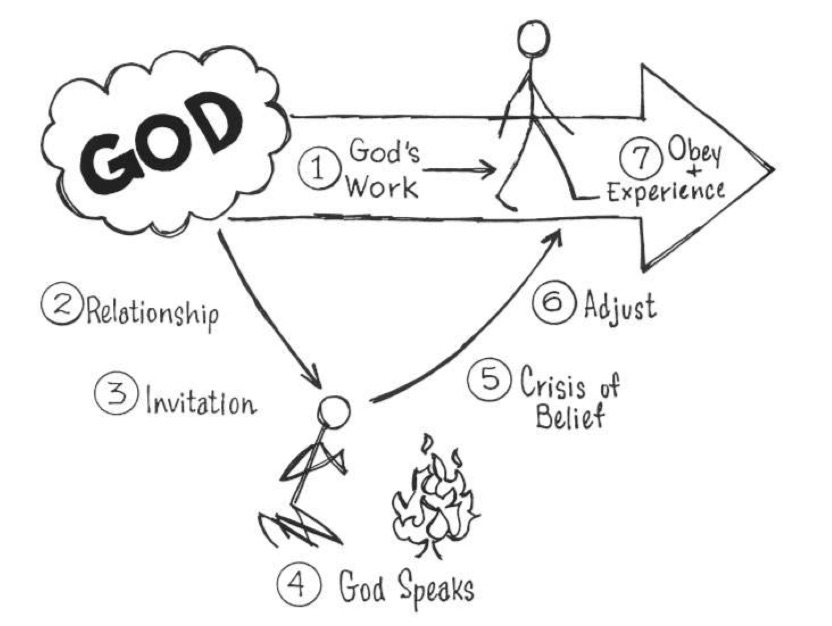
The 7 Realities of Experiencing God
Woke up to the news that Henry Blackaby passed away. What an incredible influence he had on a generation. His 7 Realities are so simple and profound. Worth review on this day and every day.
- God is always at work around you.
- God pursues a continuing love relationship with you that is real and personal.
- God invites you to become involved with Him in His work.
- God speaks by the Holy Spiritthrough the Bible, prayer, circumstances, and the church.
- God’s invitation for you to work with Him always leads you to a crisis of belief that requires faith and action.
- You must make major adjustments in your life to join God in what He is doing.
- You come to know God by experience as you obey Him and He accomplishes His work through you.
Say Yes to the Jesus’ Commands
When asked by Pew research to define what Jesus’ teachings were, people answered:
- Take care of the environment
- Buy from companies that pay fair wages
- Live healthy and exercise
Not bad things at all, but Jesus actually didn’t say any of that. What did Jesus actually say? We can find his commands in the four gospels – Matthew, Mark, Luke, and John. And his commands, his directives, were on his mind when he stood in front of his disciples before going back to heaven. He told them to “Go. Make Disciples. Baptize them. And teach them to obey EVERYTHING I HAVE COMMANDED” (Matthew 28:19-20).
What if we focused on obey everything Jesus commanded? If you look at and seek to obey his commands, you’ll find everything you need for a dynamic spiritual life that will make an eternal impact. There are commands for situations, like “What happens when someone attacks me?” Jesus says, Love them, Bless them, Pray for them. “What happens if I’m running out of food?” Jesus says, don’t worry. The father knows your need and will provide.
You also find commands that give meaning and purpose for all of life and that you can literally build life on. Like, “Seek first the kingdom of God” and “Love God and Love Others” and “Go and make disciples.” Jesus commands give us more than enough to build life on and to know how to live in difficult times.
And the best news of all. We’re not alone when it comes to obeying Jesus. This is not a checklist that we have to struggle with. That’s religion. And its powerless. These commands are given in the context of relationship that Jesus paved the way for with his own life. Jesus, as part of this relationship, has promised to put these commands in the hearts of those who follow Him (Ezekiel 36:27). And he has promised power to obey in the person of his Holy Spirit to live within us. To struggle with obedience to Jesus may reveal something amiss about your relationship with him. Obedience is a product of an abiding relationship with Jesus. Saying no to Jesus’ commands is saying “I am the Lord of my life. Jesus, no thanks.”
Saying Yes to Jesus is a way of life. For the person who has made Jesus the leader of their lives, we find joy and strength in obedience to him. It’s the best yes of every life and should be the first yes of every day for those who follow him. Have you said yes to Jesus today?

Look Beyond Numbers to Generations
 How many disciples have made disciples? Great challenge from Alan Briggs in his new book Guardrails: Six Principles for a Multiplying Church.
Reproducible discipleship looks beyond numbers to count generations – it measures how many disciples have made disciples… When we aim at mere numbers, we will rarely multiply disciples, but when we aim at generations, numbers come naturally.
Love this thinking! If church is about making disciples and one thing disciples do is make other disciples, we should be able to begin measuring generations within the first few years of our church. Take a look at your church roll and see how many generations deep you can go. If not far, examine your goal for people. Are you making disciples or just attenders? This is a mistake I have made in ministry. Attendance makes pastors feel good and populates the chairs on Sunday’s. Disciple making makes the kingdom grow and populates heaven.
Guardrails is a great book to help you get back to the simplicity of discipleship. Here’s a few other great quotes:
- healthy ministry always centers around making disciples.
- Our mission is to make disciples. That’s what missional people do.
- Spiritual leadership is not about gaining followers; it’s about making disciples.
- Disciple-makers are very ordinary people who take God’s mission seriously.
- Discipleship is a beautiful and rugged journey into living like Jesus.
- Discipleship is not something to be comprehended and mastered by something to be lived out and passed on to others.
- Every follower of Jesus has the capacity to become a multiplier of the message.
- When we portray discipleship as complicated, ordinary people leave discipleship to the experts, and reproduction is killed before it starts.
- We simply cannot afford to choose building our churches over making disciples. We must follow the progression of making disciples, developing leaders, and leading churches – in that order.
Grab a copy of Guardrails. Refreshing, challenging book to fuel the mission of making disciples. See the Trailer for the book HERE. Looking forward to having Alan Briggs as one of our Equippers in 2017 & 2018 for our Multiply Louisiana Church Planting Network! More info soon.

 Bridge Church tackled the book of Psalms in our summer series called Swells. We covered 8 major themes in Psalms including: Worship, the Word of God, Dealing with Difficult People, Dealing with Discouragement. Get the audio from this series

 Lane Corley