Blog Archives
The Shrinking Mid-Size Church
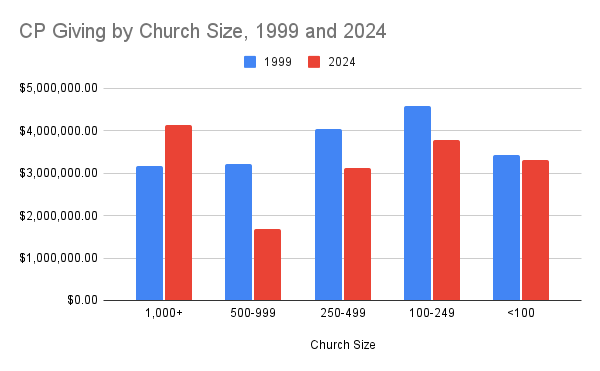
This week, a few bits of research on churches by size among Southern Baptists in Louisiana.
Churches by size:
- In 1999, there were 17 churches over 1,000 in attendance among Louisiana Baptist churches. In 2024, that number is still 17.
- In 1999, there were 31 churches between 500 and 999. Today there are only 15.
- In 1999, there were 94 churches between 250 and 499. Today, there are 56.
- In 1999, there were 305 churches between 100 and 349. Toda,y there are 200.
- In 1999, there were 785 churches under 100. Today, there are 884.
Louisiana Baptist Church attendance has declined by 20% over the last 25 years.
Among different size churches:
- Attendance in churches over 1,000 has grown by 8%. +2,344 worshippers. 24% of Louisiana Baptist worshippers attend a church over 1,000, up from 18% in 1999.
- Attendance in churches from 500-999 declined by 48%. -9,746 worshippers.
- Attendance in churches from 250-499 declined by 39%. -12,350 worshippers.
- Attendance in churches from 100-249 declined by 35%. – 16,540 worshippers.
- Attendance in churches under 100 in attendance increased by 12%. +3,912 worshippers.
- 53% of worshippers in 2024 attended a church under 250.
Of course, what’s happening is churches that were once 500-999 are now 250-499. Churches, once 250-499, are now 100 to 249.
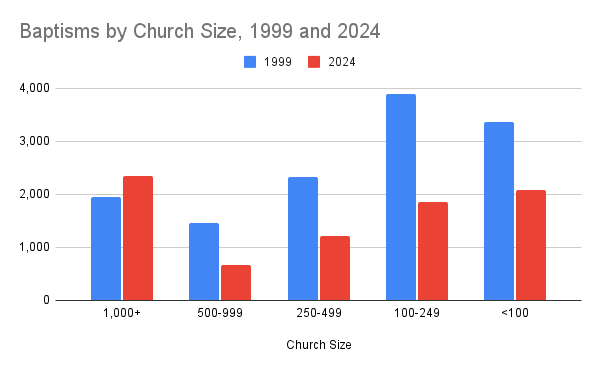
Over the 25-year period, baptisms increased by 20% in churches over 1,000 but shrank drastically in every other church size.
- -54% in churches 500-999
- -48% in churches 250-499
- -52% in churches 100-249
- -38% in churches under 100
- -37% among all Louisiana Baptist churches 1999-2024.
Takeaways: (I’d love to hear yours)
- Large churches are effective but not easily reproduced.
- Mid-size churches have faced some of the biggest challenges to sustainability over the last 25 years.
- With the loss of the mid-size church is the loss of significant evangelistic impact.
- Developing tools to help small and mid-size churches is a must.
- Large churches are effective, but not as effective as they seem in the grand scheme. Only 2,344 worshippers were added over 25 years, and only 24% of worshippers are in them. We need healthy churches of every size to adequately reach our population.
As one of our Associational Missions Strategists says when I ask him how things are going – “Well, the big churches are getting bigger, and the small churches are getting smaller.” And this bit of research bears that out. But at what cost to the kingdom?
What are your takeaways? Questions? Concerns?
See some tables with this data HERE.

A Church is…
The book of Acts provides a compelling and comprehensive model for a healthy, evangelistic church. Throughout the book of Acts, we observe God’s activity through his people, which leads to exponential growth in the number of disciples of Jesus and the working out of health in developing a local, regional, and cross-continental first-century evangelistic movement. The foundation for healthy churches that we see in the Book of Acts gives us a clear definition of a healthy church. We also see foundational insights for understanding the identity and role of an individual disciple. We also observe evangelism in its purest form and how evangelism and disciple-making relate. We also get a sense of what the earliest growing churches celebrated as success in evangelism. In the Book of Acts, we can explore these foundational elements of growing healthy, evangelistic churches through the foundational lens of the first churches formed after the death, burial, resurrection, and ascension of Jesus Christ.
So What is a Church?
According to the book of Acts, a church can be defined as a family of baptized believers in the Lord Jesus Christ, on a mission together to spread the good news about Jesus Christ to everyone everywhere by the power of the Holy Spirit.
A family. Acts 2:42-47 describes an overview of the life of the earliest post-ascension church. The descriptions given leave you with a distinct image of family. They ate together, met one another’s needs, and prayed and worshipped together, adding spiritual components to their lives as a family. New Testament writers confirm this distinct practice by calling the church a household, a body, and a family and instructing them to care for each other’s needs as families would.
A family of baptized believers in the Lord Jesus Christ. What made this church a family was their common faith in Jesus Christ and their common initiation into this family, which was believers’ baptism. Through baptism, they identified themselves with this new form of the family of God in Christ Jesus (Galatians 3:27). They also identified with his death, burial, and resurrection, perfectly symbolized through the believer’s immersion (Romans 6:3-4). As ancient families had in common their coat of arms and the family inheritance of land and treasure, this family had the common faith in Jesus and experience of baptism into his body.
A family on a mission together to spread the good news about Jesus Christ. The mission of this family is to expand (Matthew 28:18-20, Acts 1:8). Expand the family and expand the kingdom of God by spreading the good news about Jesus’ death for sin, burial, and resurrection, as well as the new life that believing can bring to anyone who puts their faith and trust in him. We see the family breaking out of Jerusalem in Acts 8:1-4, and the gospel’s message and transforming power begins marching across Asia Minor with the disciples scattering in response to persecution.
To everyone everywhere. In Acts 9, God begins breaking down the barriers in the hearts and minds of Jewish believers toward those outside of Judaism. In Acts 10, God revealed to Peter that all races, nationalities, and languages were equal before God and needed salvation through Jesus Christ. With the Apostle Paul’s conversion in Acts 9 and his call to take the gospel to the Gentiles, we see how the message of Jesus Christ broke down the walls of sin, racism, and nationalism and immediately made the disciples cross-cultural missionaries.
A family on a mission together to spread the good news about Jesus Christ by the power of the Holy Spirit. Jesus promised his Holy Spirit to the disciples in John 14 and 16. In Acts 2, we see the Spirit pouring his power on the disciples. The power behind the church was and is the Holy Spirit. The Holy Spirit transformed their fear into bold faith. The Holy Spirit directed them to the opportunities leading to the fastest spread of the gospel – as in Acts 8, with Philip and the Ethiopian, and in Acts 13:1-4, with the sending out of Barnabas and Saul. The book of Acts is genuinely the Acts of the Holy Spirit as he empowered and directed the mission of God’s people in their world.
A church is a family of baptized believers in the Lord Jesus Christ, on a mission together to spread the good news about Jesus Christ to everyone everywhere by the power of the Holy Spirit.
Useful Things This Week
- Mind Pumps MAPS Programs – I’ve been running MAPS Workout Programs for almost a year now. Decided to try weightlifting after giving up running due to arthritis in my feet. I’ve completed MAPS 15, MAPS Anabolic, MAPS Performance, MAPS Aesthetic, and now working through MAPS Strong. Mostly 12-week programs that change it up enough to keep it interesting. And programmed well, so there is very little soreness or joint pain. Feeling stronger.
- Bible Memory App – 2,037 straight days of using the Bible Memory App. I picked it up years ago to reboot scripture memory as a habit and it has been a great tool and companion. I now have over 2,000 verses mastered in the app. I review those scheduled for review every morning and evening. And I review those I read during my regular Bible Reading time every morning. Memorizing the word aids in witnessing, preaching, and meditating. I’ve written about how to get started with the Bible Memory App HERE. And about why and how of Scripture Memory HERE. Get a discount off the Pro Version HERE.
- Masters of the Air – Loving Spielberg’s latest WW2 series about the B-17 Bombers in Europe. New episodes every Friday.
- The Importance of Children’s and Student Ministry: 72% of Evangelicals came to faith before adulthood. We must prioritize Kids and Student Ministry. It’s not just a way to get more people in church. It’s THE way to reach the nation.
- NewChurches.com Preaching Masterclass – Starting the masterclass with our church’s Preaching Collaborative. Short vids with discussion guides. Looking forward to getting sharper in this area of my life and ministry.
What are you finding useful in life and ministry right now?

Reaching Rural Louisiana
This week we hosted Kyle Bueermann from NAMB’s Rural Replanting Team. Some great resources are available through this team. Check out: https://replanthub.com/ (register for free and gain access to an incredible library of resources). Also: https://www.namb.net/church-replanting.
The Rural Pastor Podcast with Andy Addis is really good –https://theruralpastor.com/. (Look it up wherever you get podcasts).
Rural Louisiana:
- 40 of Louisiana’s 64 Parishes are considered Rural by the Dept. of Health.
- 29% of Louisiana’s Population live in these 40 Parishes.
- 52% of our Louisiana Baptist Churches are in these 40 Parishes.
- We have 12 towns in these parishes with no SBC church.
- New churches are definitely needed in at least 3 of these parishes.
- Replanting is needed in most of them.
There are significant transitions and struggles happening for many of these churches.
- Declining Populations (45 of 64 parishes lost population over the last 10 years).
- The need for Bivocational Pastors with fewer jobs available in these areas.
- AND some are growing and stand to grow through Urban and Suburban spread, changing the culture in the area, which churches have to transition to as well.
Lots of great opportunities for meaningful ministry in Rural Louisiana. Partners, Planters, Replanters, Pastors needed.



Do I HAVE TO go to church? No, I GET TO go to church!!!
Church is sometimes billed as boring, out of step with real life, or something in the way of so many other awesome opportunities that come our way on the weekend. The question we sometime ask as kids, but that can stay with us into adulthood, “Church? Do I HAAVVVVEE to?”
If we really understood God’s view of church & His purpose for it, we would change it from a HAVE TO, to a GET TO. Here’s some of the things we GET TO experience through connecting with a church, that make it worth it.
1. I GET TO experience God at work.
Whenever believers get together, Jesus promised to show up as well (Matthew 18:20). And He promised His power would be active through the work of the church (Matthew 16:18). In Christian relationships, we see him at work in the lives of others as we hear & see God working in their lives. We also experience God at work using us as we step out & use our gifts in ministry in the church.
2. I GET TO pool my resources together with others for God’s purposes.
From the very beginning we see churches demonstrating radical generosity to meet each others needs & the needs of the world (Acts 2:41-47). Paul, who started many of the first churches in the Asia Minor, taught the churches to set aside money on the first day of the week to be given for God’s purposes (1 Corinthians 16:2). He taught that giving was to be done regularly, sacrificially, & cheerfully (2 Corinthians 8-9). Giving is not just about meeting the needs of the church. It is an act of worship, reflecting back to God how great He is worth to us, & declaring that our faith is in Him. But I do get excited about giving to my church as I think about how my giving, pooled with others, will make a great difference in our world.
Pooling my resources is also, not just about money, but gifts & abilities. In church, we pool our God given spiritual gifts, passion, abilities, & experiences for the good of each other & the world. The kingdom & church grows by each one contributing their part (Ephesians 4:16).
3. I GET TO die to my sin & selfishness.
Christian relationships are to be marked by selflessness & sacrifice (John 13:34-35; Matthew 20:28; Philippians 2:3-4). In relationships, I’m always seeing how selfish I am. Seeing my selfishness & the selfishness of others, is actually a great opportunity for growth! Some of us see it & change. Some of us see it & vow not to change. Some of us see it, & unfortunately run away. Yep. Relationships at church can be hard. People can be difficult. Differing personalities, beliefs, upbringings, preferences can collide & create sparks. But I’ve learned that if I embrace the sparks & not runaway when I’m confronted with sin & selfishness in me & others, then we are all sharpened & changed & transformed into what God desires for me to be.
Lane, do you mean, God wanted relationships to be hard. Proverbs 27:17 says it like this, “As iron sharpens iron, so one person sharpens another.” Iron sharpening iron is a messy process. But necessary for a tool or blade to be at its greatest strength. Same is true for us in regard to relationships. We will be at our greatest strength when we are sharpened by relationships with others. Relationships where I can humble give & receive love & correction & encouragement & teaching, etc., etc.
These are three things I GET TO DO as I commit to a church. There are more. Like I didn’t even mention the coffee & donuts. If you’re not a part of a church, let me encourage you to jump in. Commit to a relationship with God. Commit to relationships with imperfect people you’ll find there. Commit to change as your confronted with sin & selfishness. You won’t regret it.
You can join my church if your in West St. Tammany Parish. We meet each Sunday, 10:30am at the Maritime Museum in Madisonville. We’re finishing a series on relationships this Sunday called Let the Sparks Fly. Come early for coffee!


How to Be Satisfied By Church
If you ask people about their church today, you might get a “BUT.”
- “The music is great, BUT…”
- “The pastor’s teaching is good, but…”
- “I like my Sunday School, class, BUT…”
A lot of dissatisfaction out there about church. A product of our consumer culture I guess. We’re taught to critique anything we buy & we know we have other choices if we’re not satisfied. Unfortunately, that’s what church has become, simply another service vying for our time & attention & in our culture, we have choices!
Well, I’m not trying to sell you anything, but I believe that you can be SATISFIED by YOUR CHURCH or any Biblically sound church with some attitude changes. Here’s three Biblical attitudes that will bring much satisfaction to your life at church:
1. “My church is incomplete without me.”
See yourself as a part of the whole body, & the church as incomplete without you. See Ephesians 4:7 & 1 Corinthians 12:8-12.
he has given each one of us a special gift[a] through the generosity of Christ.
The human body has many parts, but the many parts make up one whole body. So it is with the body of Christ.
2. “I’m a player, not a spectator.”
Be a player, not a spectator. We’re actually all playing for an audience of one. Our leaders are there, not to entertain us, but to EQUIP US FOR THE WORK OF THE MINISTRY. See Ephesians 4:11-12
Their responsibility is to equip God’s people to do his work and build up the church
3. “What can I give today?”
Don’t focus on what you can “get out of it.” It’s not what you “get out of it” but what you give to others that makes you & the church grow AND (watch this) determines if you GET SOMETHING out of it or not. See Ephesians 4:16.
He makes the whole body fit together perfectly. As each part does its own special work
In the Old Testament book of Exodus – chapter 18, Moses found himself leading a very large group of dissatisfied people. They had many needs & they looked to Moses to meet them all. Moses’ father-in-law came to town & gave Moses a different plan. Empower the people to use their gifts & abilities to solve the problems of the community. And I love what he told Moses about this plan in Exodus 18:23.
“If you do this, and God so directs you, you will be able to endure, and also all these people will be able to go home SATISFIED.”
When we all come together TO GIVE of what God’s given us, take OWNERSHIP of the mission, & drop the “but’s” no matter where you are, we’ll get the most out of our experience in & with the body of Christ.
Learn more about Getting something out of church by grabbing the audio for last weeks message at Bridge Church in Madisonville where we talked about the On Ramp of Ministry & Mission as a vital component of our Spiritual Growth.


Beneath the Surface: Going to Church vs. Getting Involved in the Life of a Church
“every individual Christian will find in the communion of a local church the most perfect atmosphere for the fullest development of his spiritual life.” ~ A.W. Tozer
My observation is that most people never experience “the fullest development of his spiritual life” through the church or see the great value, because they may GO TO CHURCH, but they don’t get involved in the LIFE OF A CHURCH. There’s a big difference. Going to church makes you a CONSUMER of its services. Getting involved in the life of a church puts you in “COMMUNION” with a life source fed by God himself. The Apostle Paul said it like this
“From Him the whole body, joined and held together by every supporting ligament, grows and builds itself up in love, as each part does its work.” ~ Ephesians 4:16
It’s consuming vs. serving, sharing life, supporting, being supported, building up, being built up, etc.
 The enduring image of church for me is that of a forest. A forest stays strong, even in dry seasons, because BENEATH THE SURFACE, the roots of the trees are feeding off of one another for growth & strength. Roots can’t share their life with a tree that just lays itself upon the surface. It has to take root & do life with the others.
“I tried church, but it didn’t help.” Probably not, if you just showed up every now & then with little commitment, little humbling of yourself, little sharing of your life, little getting involved in relationships, little investment in ministries, little digging deep to support & be supported.
I love the Tozer quote, because I’ve experience it. Now, don’t read it wrong. The church is NOT a “perfect atmosphere.” Far from it. It is the perfect atmosphere for spiritual development BECAUSE of its imperfections. Relationships with people that are struggling through life together, growing as individuals, utilizing unique gifts no matter how imperfectly. And seeing God in Christ feed & nourish & heal & empower each other. It’s a beautiful thing! But you won’t see it on the surface by just GOING TO CHURCH.
Pastor, It Could Be Worse…
Church attendance is down & looking at stats can be depressing when thinking about faith in North America, BUT it could be worse, & it actually has been much worse in the history of Christianity. For instance, I recently read the great book How the West Won by Rodney Stark & he records the conditions of the reformation era churches in Germany:
In 1525, the newly reformed church put together a research arm & began making systematic observations & interviews of churches. Here’s some of what was in the reports:
- “You’ll find more of them out fishing than at service… those who do come walk out as soon as the pastor begins his sermon.”
- “A pastor testified that he often quits his church without preaching… because not a soul has turned up to hear him.”
- “Absenteeism from church on Sunday mornings was so widespread that the shod debated whether the city gates should be barred on Sunday mornings to lock everyone inside. Evidence from elsewhere suggests that this expedient would not have helped.”
- “Those who come to services are usually drunk… and sleep through the whole sermon, except sometimes they fall off the benches, making a great clatter…”
- “During church there is such snoring that I could not believe my ears when I heard it…”
- “People make indecent gestures at members of the congregation who wish to join in singing the hymns…”
- “The play cards while the pastor preaches, and often mock or mimic him cruelly to his face…”
- The researcher notes: “I have selected only such instances as could be multiplied a hundredfold.”
even Martin Luther admitted that neither the tidal wave of publications nor all the Lutheran preachers in Germany had made the slightest dent in the ignorance, irreverence, and alienation of the masses. Luther complained in 1529, “Dear God help us! The common man, especially in the villages, knows absolutely nothing about Christian doctrine; and indeed many pastors are in effect unfit and incompetent to teach. Yet they are all called Christians, are baptized, and enjoy the holy sacraments…”
And let us not forget that a small group of uneducated fishermen & the likes overcame the Pantheism of the Roman Empire with the same message & the same power of God that we have access to today. Be encouraged that the Gospel we preach has overcame incredible odds over & over again in the history of the world. And it can happen again.
How Much Does it Cost Your Church to Reach One Person for Christ?
 Got an interesting question that has me working the calculator this morning. How much money does it take to reach a person for Christ in the average SBC Church? So many factors could be thrown in to the equation here, but just some quick figuring in a few major population areas in Louisiana.
- A sample of 66 churches in one city spent $40,845,337 in 2013.
- The same 66 churches reported 503 baptisms in 2013.
- So it took this group of 66 churches $81,203 to baptize one person.
- Looking at the new churches in this group of 66, the total spent per baptism went down to $21,276.
- I’m guessing, it will go up for the age of the church, but more study will be needed.
How much does it cost your church to baptize one new convert? is this a good question to gauge our effectiveness? What do these figures tell us about our churches?
Creating More SENDING Capacity
“The greatness of a church is not in her seating capacity, but in her sending capacity” 
I’ve heard this saying over & over again for the past 15 years or so from Pastors and church leaders from all different perspectives of ministry. But I haven’t seen much about how to expand the SENDING capacity of a local church or a real change in strategy to developing SENDING capacity. Both are necessary for a missional movement. How can we understand the difference & add real SENDING capacity to our strategies?
- Seating capacity is about managing the movement of people into relationships. Sending capacity is about managing the movement of people into mission.
- The mission that Jesus gave the church was a SENDING strategy. The Great Commission & the Acts 1:8 Challenge are foundational
- Matthew 28:19 (NLT) – “go and make disciples of all the nations…”
- Acts 1:8 (NLT) – “you will be my witnesses, telling people about me everywhere—in Jerusalem, throughout Judea, in Samaria, and to the ends of the earth.”
- Seating capacity is easier. Not cheaper, but easier. It’s easier to draw a big crowd than to send a lot of people into missional roles in the world. It takes longer & requires different things from the leaders.
- Seating capacity is INSIDE. Sending capacity is OUTSIDE. Serving inside the church is great, but if the only mission opportunities we give people are inside, we fall short of a true Acts 1:8 SENDING strategy.
- Being SEATED is much more comfortable than being SENT. Going to church is for the majority of people, very safe, sanitary, & can be enjoyable. Being SENT requires sacrifice, risk, & a sometimes delayed reward for effort.
- I can be SEATED in my own strength. Being SENT requires the power of the Spirit.
- Being SEATED tends to make much of the leaders. Being SENT makes much of the mission. We hear a lot about the churches & leaders with the most SEATING capacity.
- SEATING capacity is easier to track and clean up after. It’s more static. SENDING strategies are hard to control and can get messy.
Do you see any difference between SEATING capacity and SENDING capacity? How does your church include SENDING in its strategies? What resources do you know about to aid SENDING capacity and SEATING capacity?


 Lane Corley