
We’re Not Done When We Make Converts, Our Mission is Maturity
The 2017 Generate Conference is a wrap. This years host and showcase church was North Monroe Baptist. Grateful to Pastor Bill Dye and staff for the generosity and hospitality. The Generate Conference is designed to help church planters in years 3 to 10 to get beyond growth barriers and leadership hurdles. Pastors and leaders in churches from >50 to <500 have also attended and took away actionable steps. With the Generate Conference we highlight the work of several Louisiana churches that have found ways to grow and break growth barriers in our unique context. Shawn Lovejoy, with Courage to Lead and Kirk Jones, Fellowship Church in Prairieville, also served as equippers this year, along with North Monroe’s staff. Here’s a few of my big takeaways this year:
From Bill Dye:
- You can’t be a great pastoral leader without having the heart of Jesus.
- Find a way to use new people. They are the best volunteers because they’ve bought in to the vision. Don’t wait to put them on ministry teams.
- Only person who likes change is a wet baby. Don’t attempt any substantial change until you’ve done at least one year of vision casting.
- Be willing to ignore and work around difficult people. Are you trying to win a fight or win the world for Christ.
- Let the quality of your work speak for itself. When you do tough things in a spirit of humility, your stock goes up with the right people.
- We’re not done when we make converts. Our mission is maturity.
- Church staff are not ministers, but administrators of ministry. We don’t pay people to minister. Everybody ministers.
From Shawn Lovejoy:
- The Three Gears of Growth: Culture – Team – Systems
- Growth depends not on your preaching ability but the ability to let go of control and build a great team.
- Decisions must be made based on who we might reach instead of who might leave.
- If you have the right culture and the right team, almost any system will work.
- You have to be the culture you want to build. We reproduce who we are.
- Behaviors of a High Performing Team: They Trust Each Other, They Engage in Healthy Conflict, They Commit to Decisions and Plans of Actions, They Focus on Collective, not Individual Results.
- Four things we owe our leaders: Clarity, Grace, Honesty, and Proper Placement.
- God will not bring you more followers than you have leaders.
- A learning church is a growing church. A learning leader is a growing leader.
- Church staff is to be the equippers, not to do ministry, but to develop ministers.
Other presenters were: Jacob Crawford, Life Point Mansura; Chad Merrell, First West Fairbanks; Jason McGuffie, FBC Tallulah.
Look forward to highlighting other growing churches and leaders in 2018. Lots to learn from those right around us.


Church Growth = Growing Friends + Growing Family
I’ve been a part of a couple of growing churches. The fun of it is having a growing number of people to call friends and then a growing number of people to call family. This is essentially a good, simple church growth strategy. Hey, let’s make more friends and let’s stick with them long enough that they become family. Scaling this to grow a church larger and larger requires intentional strategy. Nothing wrong with a small group of friends and small families. But most churches want to grow. Many pastors and most church planters want their churches to be self-sustaining and be around for future generations. So how do we grow friends and family?
1. Design systems to discover and track the number of friends your church has.
A friend is anyone that may be connected with your church or with a member of your church family. Do you know how many friends you have? In the past, we’ve called these prospects. I prefer to think of them as friends. Do you have a list of prospects / friends? Here’s some ways to discover them:
- Have a connection card on Sunday’s that people fill out. All first time guests are added to our Friends list, so that we can pray for them, and stay in touch with them.
- Ask people in your church to make a list of friends that don’t have a church family. List them, pray for them among the leadership, visit them, invite them.
- Have regular events that are just designed to make new friends. Easter Egg Hunts, Fall Festivals, Movie Nights in the park, etc. Let the community know that this is a safe place to know and be known.
- Our church uses a list we call Crowd – Congregation – Core to track where people are spiritually within our family.
2. Cast a vision and provide resources to help people in your church to make new friends.
Tim Keller said, “In the first two centuries, mission work was informal, conversational, and largely through friendship.” I think our world could use a lot of this kind of mission work as well. What if people got a vision for expanding the kingdom through friendship and caring for those around them. Here’s some ways a church may encourage this:
- Teach people the importance of initiating new relationships in the process of evangelism.
- Provide resources for people to celebrate and party well within the community. Like a block party trailer with inflatables, tents, and outdoor sound equipment. Like a big BBQ pit that can be loaned out to families on the weekends for Birthday parties and neighborhood gatherings.
- Have special friend days, designed just for people to invite new friends to church that promises a meaningful message with them in mind.
3. Design systems to lead to deeper family-like connections and commitments.
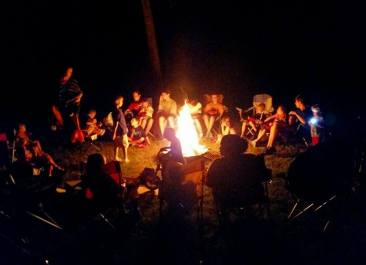
One of the growing small groups at our church, does an annual camp out. Friendship written all over this pic. Love it!
We become family-like by sticking with each other through difficult times and awkward moments. Having systems in your church that provides meaningful connections for friends going through transitions and crisis – like moving, bringing home a new baby, experiencing loss, etc. helps develop sticky family-like connections. How do we do that?
- Have a small group ministry where people can develop great connections where they can know and be known through good and bad seasons.
- Have a team in your church that looks for opportunities to serve people in transition of some kind. For our church it’s the Family Support Team and the individual small groups. Care and concern make relationships sticky and family-like.
4. Move people to Commit to God’s family by Connecting them with Christ.
Our ultimate goal is not to have family-like relationships. We can do that through other organizations and relationships. We want to move people to become real spiritual family members and we do that through connecting them with the person and work of Christ.
- Share the story of Christ at every gathering.
- Teach people to share their story of connecting with Christ as they build friendship in the community.
- Offer a Family Connections Class or Workshop or New Members Class that teaches people how to become real spiritual family through Christ.
Don’t focus on what you can’t do as a church. Make it simple. Friendship + Family. Every church can make new friends in their community and stick with them long enough to become family.

Grateful for these friends in our small group that our family is blessed to walk through life with through our church. Great stories around this table.

Choosing the Right Location for a New Church
Location! Location! Location! It’s not everything, the GOSPEL is, but the location can make a huge difference for the growth of a new church. Here’s some questions to ask as you look for the right location for your church plant:
1. Do we have room to grow?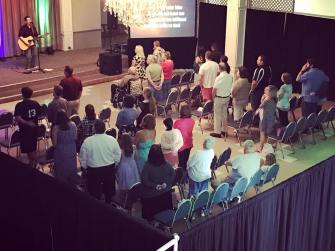
Grace Point Church in Destrehan meets in a community center with plenty of room for future growth. They use pipe and drape to make the room smaller for now.
Better to have more space that you can section off in the beginning than too little space for future growth. And if you’re signing a three-year lease, it had better be a place that you can grow toward sustainability over that period.
2. Do we have the proper government approval to have church here?
Never sign a lease until you’ve gotten complete assurance from local and state government, fire marshal, etc., that a church can meet there. We’ve had a few churches in Louisiana find out after binding agreements have been signed, that it would cost big money to bring the building up to code.
3. Is this a visible, familiar location?
If you save $300 per month on a poor location, but have to spend $500 per month on advertising, it’s not a great deal. A sign out front can cost less than $200. And having a location near a major intersection or community landmark can be a huge money saver as well.
4. What will it take to transform this space into a place of worship each week?
Can you leave equipment or will you have to store it off site? How early will we have to start each Sunday? Do I have the volunteers available to pull this off 52 times a year?
5. Where will we put the kids?
One of our church plants hit a growth barrier because we ran out of capacity for kids very quickly. Most church planters tend to under value the importance of adequate kids space. Assess the capacity – i.e. how many babies, preschoolers, elementary kids can we get into this space? What about the noise? Will the kids areas be affected or affect the worship service?
6. What about ambiance?
Does the facility match what you want people to remember about your church? I like off the wall places. My church plants have met in apartment complex offices, fire stations, parks, gyms, and homes. Our vision has always been simple, outward focused, relational, so decor wasn’t a make or break. Does an off the wall, less than appealing location match the vision your sharing with the community? Or do you need to make sure the facility communicates excellence, beauty, style, etc.?
What other questions are appropriate to ask as new churches approach potential locations for gatherings?


Developing and Deploying Leaders for the Glory of God
 Didn’t get to attend the Pipeline Conference last year, but have wore out a highlighter going through the feature book by Eric Geiger and Kevin Peck called Designed to Lead: The Church and Leadership Development. The thesis of the book is that the church should be a great catalyst of developing leaders in every sphere of life. Geiger and Peck lay out the theological case for leadership development in the church and also make practical steps to get started very accessible for churches of every size. Exposed is our lack of true leadership development in the church and our dependence on a professional class instead of God’s power through God’s people with clergy being equippers. Must read for church planters who must multiply leaders and set a course for maximum impact for years to come. Here are ten of my favorite quotes from Designed to Lead:
- The Church is uniquely set apart to develop and deploy leaders for the glory of God and the advancement of the gospel.
- The full extent of discipleship is the development of disciples who are able to lead and develop others, not merely people who gather for worship once a week.
- True leaders are servants who die to themselves so others may flourish.
- The Christian life is not about trying daily, but dying daily.
- The Church has been designed to possess a holy rhythm of gathering people to scatter that more may be gathered.
- It is not first the work of our hands that pleases the Lord, but the condition of our hearts.
- The Church is not a Christian club, weekly group counseling session, or weekend pick-me-up. Your local church is the beautiful bridge of King Jesus!
- People will follow your example before they follow your vision.
- Church leaders must confidently invite people to serve, knowing that the opportunities to serve provide moments where development occurs.
- Our churches don’t need spiritual travel agents who promote journeys they don’t take. We need tour guides who set a wise direction, take the journey with the people, and live all that they are inviting the people to live.
A few more posts coming from this book in coming weeks. More info and some resources on the book at DesignedtoLead.com. Also, check out and follow Eric Geiger’s Blog for other great leadership resources.

Church Planter, Get Ready! They’re NOT Coming…
The difference between a new church and an established church can be described like this:
In an established church, the staff goes about their day with the mindset, “They’re coming, how do I get ready?” In other words, Sunday will be here soon. The people are coming. Let’s prepare the building, the slides, the sermon, etc., etc.
In a new church, you have to start out with the opposite mindset, “They’re NOT coming, how do I get ready?” In other words, few people know about my church. And if they did, they are not predisposed to attend. How do I get ready to bring in the unchurched in my community. So,
- We must get out of the office into the community.
- We must find ways to invite people through invite cards, postcards, signs.
- We must look for open doors in the community for relationship and influence.
- We must scatter seeds of the gospel in all we do. (Proven ways to Scatter Seeds and Influence People in Your Community)
Now, every church and church staff SHOULD have the second mindset to some extent. The church exists for those who are NOT there yet. In church planting though, you feel this pressure every day, and it is a good thing. Jesus lived with this pressure and burden to be ready to go and serve and preach to those who were NOT already reached (Mark 1:38; Luke 4:43; Luke 19:10).
Church Planters often make the mistake of getting satisfied with a crowd and quit preparing like they are NOT coming too quickly. Live like they’re NOT coming for as long as possible. The church is for those NOT here yet.
Jesus answered, “It is not the healthy who need a doctor, but the sick. I have not come to call the righteous, but sinners, to repentance.”
Luke 5:31-32

From Impact to Faithful Presence
 Our first Greenhouse 2.0 is a wrap. Thanks to Alan Briggs for sharing his passion for multiplication with us. A few big takeaways:
>> The Western Church is suffering from a sense of suburban homelessness, never at home in its local neighborhood.
>> We worship IMPACT, but the gospel calls us to FAITHFUL PRESENCE.
>> Do I have any long-term meaningful relationships with not yet believers?
>> Love your neighbors. Not the ones you pick out for yourself, but the ones you actually have.
>> We will reap the harvest of the habits we build into our regular rhythms.
>> Don’t try to boil the ocean, just do the next right thing.
>> What lies are you believing about those in proximity to you?
Get to know Alan Briggs – http://www.alanbriggs.net/guardrails/. He’ll be back with us in Louisiana within the next year or so.
Watch for upcoming Greenhouse events at MulitplyLA.com.

Your Church as a Greenhouse
 I enjoy gardening. Even though I’m not very good at it. Why? I don’t always have the time to do what’s necessary to grow and multiply plants to their fullest extent. The best gardeners know how and put in the time to create the right conditions for growth and multiplication. The very best gardeners will start with a greenhouse to nurse the plants in early stages before they are ever put in the ground. A greenhouse is a tool where you can create the perfect conditions for multiplication & growth of plants at all different stages and with various needs.
I enjoy gardening in part because of the many parallels it has to church planting and ministry. I’ve began to see church as a greenhouse – a tool to create the right conditions for multiplication & growth OF DISCIPLES. Here are five truths I’m learning on church as a GREENHOUSE:
1. Disciples must be nurtured.
Like plants, like a garden, like a greenhouse, disciples need time and attention. One of the greatest books on discipleship has in its title a reminder we constantly need – Disciples Are Made, Not Born. While we are not completely responsible for the growth of a disciple, part of our commission from Jesus requires time and attention and energy and prayer, etc., etc., etc. One of the greatest disciple makers, the apostle Paul, said it like this in Colossians 1:28-29,
“We proclaim Him, warning and teaching everyone with all wisdom, so that we may present everyone mature in Christ. I labor for this, striving with His strength that works powerfully in me.”
If we’re going to make disciples, we must expect to give much time and attention to people from sharing the gospel, teaching basic truths, responding to questions, correcting, forgiving, etc., etc.
2. A Disciple’s needs change over time.
A greenhouse or a garden is organized based on maturity and needs of the plants. Expectation are based upon time and stage of growth. Just like this, as churches, we need to provide a variety of opportunities for growth for people at different stages of maturity. And we need to teach our leaders what you can expect from people as they grow. The best tool I’ve seen that helps with this is Jim Putman’s great book Real Life Discipleship and the Real Life Discipleship Training Manual. Putman guides readers to understand where people are spiritually based upon what they say, and then how to respond and what to provide for them at that stage. (See my post Things Spiritual Infants Say for a run down).
3. Disciples will eventually need to be sent out from the greenhouse to multiply themselves.
The Greenhouse is not the final destination for a plant, nor is the Sunday worship service the climax of maturity for the disciple. Just like plants are meant to be outside, producing fruit and multiplying, disciples should be trained, equipped, and released into this world for maximum fruitfulness and to multiply the gospel in their sphere of influence.
4. Not all disciples will respond to the conditions you create.
A hard reality to face for the gardener, and much harder for the disciple maker is the truth that some plants and some people just won’t respond to the conditions you create. It hurts when a disciple doesn’t respond to God’s word. It hurts when a disciple leaves your church, but maybe they needed conditions you couldn’t provide at the time. Jesus even said that perhaps only 25% of disciples would become fruitful (Matthew 13). It’s important to remember that we’re responsible for our faithfulness, not everyones response.
5. The church is the perfect tool to create the conditions for multiplication & growth of Disciples.
The church, with all its imperfections, does provide a perfect environment for growth of disciples. A church offers opportunities to learn from those walking with God for years, opportunities to get involved and serve in various capacities, opportunities to have relationship wins and losses. These and other conditions help us grow. A lack of desire to learn, serve, love, and forgive REVEALS a lot about where we are spiritually and our potential for fruitfulness, maturity, and multiplication.
Does your church function as a Greenhouse? How are plants maturing? Are you providing opportunities for people at different stages of growth? Are you training your leaders to know what to expect as people grow? Are you moving people out to multiply in their world? Are you spending time with people that just refuse to grow & may need different conditions or to be let go?

Church Revitalization Tools
 Church Revitalization tools that churches I’ve been privileged to work with have found helpful. Good for churches assessing ministry systems at any level. These tools are designed to allow leadership teams to assess themselves and work together on a path forward. Let me know what tools have worked for you. Let me know if I can help or answer questions about these tools or successful church revitalization stories in Louisiana.
- Do We Need A Church Revitalization Plan?
- When We Can’t Go On: Scenarios for a Church in Need of Radical Revitalization
- Tools for Revitalization: Church Systems Analysis
- Scenarios for Church Revitalization: Diagnosis
- Scenarios for Church Revitalization: Restructure or Restart
- Scenarios for Church Revitalization: Refocus and Re-Energize
- The Solution for Church Health and Revitalization
- 5 Attributes of a Church in Decline
- Revitalization Story: The Grove
- Church Revitalization: Merging & Multisite

Pray4EveryHome.com
Loving the App http://pray4everyhome.com/. You can sign up as a praying neighbor and get your church signed up as a partner church. Get five neighbors names emailed to you everyday.
Why Pray for Neighbors? In a typical neighborhood:
- 7 struggle with depression and thoughts of suicide
- 7 abuse or are addicted to drugs and alcohol
- 14 are crippled with fear and anxiety
- 60 don’t have a relationship with Jesus Christ
Check out pray4everyhome.com.


 Lane Corley