Lessons for when it seems it couldn’t get any worse
There was once a little bird that got a late start flying south for the winter. So late, that as he flew it began to snow and sleet and the temperature dropped far below freezing. His wings began to freeze to the point that he could fly no longer, so he made a crash landing. He began to realize that he would die in a pile of snow because he could not fly. Then a cow walked over to him and dropped a pile of manure on him. The little bird thought things had gone from bad to worse, but then realized that the warmth of the manure began to thaw his wings out. In jubilation he began to chirp loudly and constantly. He chirped so loudly and constantly that a nearby cat heard him and ran over, fetched him out of the manure and ate him at once.
Three lessons:
- Not everyone who drops manure on you is your enemy.
- Not everyone who pulls you out of manure is your friend.
- When you’re momentarily stuck in a pile of manure, keep your mouth closed.
Proverbs 27:6 – “Wounds from a sincere friendare better than many kisses from an enemy.”
Spurgeon on Missional Living
Stand in the stream and fish. Many preachers are utterly ignorant as to how the bulk of people are living; they are at home among books, but quite at sea among men, What would you think of a botanist who seldom saw real flowers, or an astronomer who never spent the night with the stars? Would they be worthy of the name of men of science? Neither can a minister of the gospel be anything but a mere empiric unless he mingles with men and studies character for himself. Read men as well as books, and love men rather than opinions, or you will be inanimate preachers.
– Charles Spurgeon in Lectures to My Students.
Am I A Spiritual Person?
Our Director of Mission and Ministries on the North Shore of Lake Ponchartrain, Lonnie Wascom enjoys scoffing at social networking sites and those of us who enjoy them (probably because of his lack of time and inability to get high speed internet at his current location), but he dishes out some great info via an old school weekly email. Here is a thought provoking list he generated recently that grabbed my heart.
Characteristics of Spiritual Christians:
- They do not care who gets the credit as long as God gets the glory
- They do not have chips on their shoulders, but they do take up their crosses daily and follow Jesus.
- They ignore mole hills and by faith move mountains.
- They are not afraid to assume spiritual responsibility.
- The have the ability to adjust without compromising principles.
- They can adapt to a changing world without the world changing them.
Marks of a True and Healthy Church
I had the privilege of conferencing with area pastors here on the North Shore today and we had a productive discussion on what is a true and healthy church. Discussion was led by Pastor Louis Husser of Crossgate Church in Robert, LA. Here’s the list:
What determines a True Church?
- What do they believe about Jesus Christ? Not if they believe, but what they believe. Jesus plus nothing, minus nothing is the right formula for salvation and for the teaching of a true New Testament Church.
What determines a Healthy Church?
- Pastor led
- Deacon served
- Congregational ruled – it was a Baptist group
- Ministry driven
- Worship friendly
- Prayer covered
- Evangelistic nature
- Biblically grounded
- Gift driven / Multi-task ministries around the purposes of the church
- Revival – Transformation and brokenness evident
Two questions for our churches to consider:
- Are lives being changed?
- Are we hauling water to the desert or the ocean?
That final question made the discussion worth our time. I believe it’s the question of the hour for today’s church. Are we taking our message to those who need it. They don’t need more water in the ocean. We need to reach those in the desert of sin/darkness/hopelessness.
Any additions or subtractions to this list?
What is Lent Anyway?
This week marks the beginning of a major religious celebration around the world called Lent. In our area it means FRIDAY’S ARE FOR SEAFOOD! What is Lent exactly? In Brief:
For Roman Catholics, the Eastern Orthodox Church, and other liturgical protestant denominations (those with a continuous history before AD 1500) Lent is the forty day period from Ash Wednesday to Holy Saturday. It is to be a season of soul-searching and repentance. It can be loosely traced to the early days of the church, but was certainly less formal (most scholars believe the time of fasting was two to three days and not forty) and of course much more spiritual. Lent, as we know it today, originated in the fourth century and has changed in practice throughout the years. In AD 325, the Council of Nicea discussed a forty day season of fasting and preparation for new converts to be baptized. In the seventh century, Gregory the Great moved the beginning of Lent from Sunday to Wednesday, now called Ash Wednesday. He is also credited with beginning the ceremony of marking foreheads with ashes, as a symbol of repentance taken from the Old Testament. The practice of fasting during Lent has become more relaxed over the centuries and in 1966, the Roman Catholic Church restricted fast days to Ash Wednesday and Good Friday.
Having moved to South Louisiana just seven years ago, I have observed that Lent is practiced but not understood by many. Even many irreligious people will give up something of value (if you count chocolate, certain adult drinks, coffee, or some other modern convenience that doesn’t really affect a person’s way of life) and will abstain from meat on Friday. When asked the purpose behind this, the person will say, “I’m not sure,” or take a great guess that would fool everyone if they were playing my favorite board game Balderdash. Herein lies the problem with modern spirituality – it’s long on activity and short on meaning and understanding.
Too often we use religious expression, such as Lent, as a means to fit in, to feel better about ourselves, but not to understand and conform to God’s desire for our lives. In many ways Lent illustrates our lack of understanding about God and His will for humanity. Many people give up for forty days what they know they shouldn’t be doing anyway. In the 2002, movie 40 Days and 40 Nights, a single man vows to stay celibate during Lent, but meets the girl of his dreams and regrets being unable to rebel against God’s commands concerning sexual purity (1 Thessalonians 4:3-8) and to “let the marriage bed be undefiled” (Hebrews 13:4) until Lent is over. As this movie illustrates, some people may see Lent as a window of time to be serious about their faith. I tend to believe God deserves and expects 365 days of devotion and obedience, not just forty.
A somber season of soul-searching and repentance, which includes fasting, is necessary for our generation. I don’t search my soul when I give up my favorite commodity but when I understand and get a glimpse of what God has done for me through Jesus Christ. His suffering, His sacrifice, and His love should make us forget modernity for awhile and focus ourselves on repentance and new life that Christ’s death and resurrection make possible.
So how should we view Lent? One 19th Century preacher called it “The Season of the Cross.” I like that. It’s the cross that is the centerpiece of our faith (1 Corinthians 15:3) and it’s the cross that we are called to carry (Luke 9:23). So, join me during the season of the cross and do more than just mark your calendar and do without some material luxury. Let’s increase our awareness of Christ’s love and His desire for our lives. We may find ourselves gaining more, spiritually, than we could ever give up in 40 days.
Church Planting Networks
Planting a new church is one of the loneliest and most vulnerable tasks one can undertake. Momentum can be allusive. Area churches can be at worst territorial, at best uncaring. The needs in the community greatly outweigh the capacity of the team. The loneliness can be stifling.
One solution: The Church Planter Peer Network. Getting together with other planters for prayer, encouragement, worship, and collaboration can broaden the perspective of planters to decrease the role loneliness plays in the church planting process.
Research has shown the validity of church planting networks. In the Church Plant Survivability and Health Study realeased in 2007, by the North American Mission Board’s Center for Missional Research, a survey found that church plant survivability increased by 135 percent when a planter met with a group of church planting peers regularly.
A 2003 study on the effectiveness of the Church Planting Process (meaning an Assessment, Basic Training, Field Supervision/Mentorship, Peer Network, etc.) in affecting attendance at new church starts, a survey of 600 church planters revealed that first year attendance was over 50 percent greater in the churches planted by those participating in a peer network.
As I speak with those that supervise and work with us church planters, the difficulty of getting network participation usually comes up. Why? Let me speak for myself:
- Pride. To be a planter you’ve got to have a bit of an independent streak and that can lead to an arrogance that says “I don’t need others” or “I don’t have time for others” or “I don’t care what others are doing.”
- Insecurity. Church planters are usually forced by circumstances to perform outside of all the boxes and decisions are made with little positive or negative input and uncertain consequences before or after. Insecurity about ideas can make a planter fearful of negative peer criticism, so we stay away.
- Competition. Probably one of the most disgusting things among ministry peers is territorialism and competition. As if one person or one ministry or one approach could possibly reach an entire area with the Gospel.
One of the best things that planting a church has done for me is drive away my independence. I am more certain than ever of my need for God (remember, we’re never alone as we go into the world – Matthew 28:19-20), my need for others, and my desire to invest and add value to those working to expand God’s kingdom through church planting. I’ve planted a church without a peer network and now, planting my second church, I’ll be leaning on peers in church planting for prayer, encouragement, and collaboration.
Friendly Reminders
 I thank God for friendly reminders. When it seems the mission I’m on as a church planter in North America is too difficult, too elusive, too costly, too lonely, etc., etc., God reminds me that the opposite is true.
Last night I met with a church planter who is starting churches in a country of 72 Million people and 3,000 Christians. He lives in danger as an underground Gospel worker. In four years he’s had three conversions. I’m praying for him and his family everyday.
Thank You Father for reminding me…
- that I’m not alone in my passion to do what sometimes seems impossible.
- that there are heroes willing to do what others won’t even imagine.
- that your call is to obedience not capitalistic results.
The state of the Church in Louisiana
 I recently came across some insightful statistics from the American Church Research Project, compiled by David T. Olson of the Lausanne Movement (see www.theamericanchurch.org). They seek to answer the question “How many people really attend church in Louisiana every week?” Here’s what they found:
- 27% of Louisiana residents attend a Christian church on any given Sunday (regular attenders are those who attend 3 out of 8 sundays), including Catholic, mainline, and evangelical. This is #1 in the nation. The national average is 17.5%, down from 20.5% in 2000. What about Barna and Gallup saying that 45% attend. Olson calls this the Halo Effect – people over inflate their participation in activities that create acceptability within their social group. For example, in 1996, 58% claimed they voted in the presidential election but only 49% actually did. Olson’s stats come from actual attendance counts, not cold calls to people who are answering questions based upon what they think they should do and what makes them look good.
- Attendance at Christian churches declined 5.8% in Louisiana from 2000-2005. (.6% in evangelical churches, 6% in mainline churches, 12.1% in Catholic churches)
- Every denominational group except Pentecostals decline in attendance from 2000-2005. (Baptist .1%, Methodist 2.2%, Lutheran 17.6%, Catholic 12.1%)
- There was a net gain of 25 churches in Louisiana between 2000-2005. However a net gain of 81 churches were needed to keep pace with population growth.
The research also reports on individual parishes. I’ll mention some stats on St. Tammany, the one in which I reside:
- 23% of the population of 230,000+ attend a Christian church on any given weekend (9.5% evangelical, 2.8% mainline, 11.0% Catholic).
Personal Observations: We have a lot of work to do if we desire to reach our population and transform lives, families, communities, states, and nations. New churches should be a part of a comprehensive plan to get people plugged into our churches, but more importantly to get church people plugged into the communities and the lives of 72% of people not attending a church and are most likely not in a relationship with Jesus Christ.
Find more info about other states and the US as a whole at www.theamercianchurch.org.
Also see some other finding from the study here.
Zimbabwe Update
 Eighteen students completed our 2008 Block Release Ministry Training for rural Pastors and Church Planters in Zimbabwe this weekend. The students met quarterly. Many of them walking and biking 10+ miles to attend. Eight new churches were planted from the group and the goal is set at ten new churches for 2009. Please join me in praying that these students will turn the world upside down from Zimbabwe. I’m grateful for kingdom partnerships that, forged by our Father, exceed our greatest expectations. Thanks to our partners in Zimbabwe for their hard work and determination to reach their country in the face of hardship. Thanks to Hope Church of Waldheim for generosity and willingness to be used thousands of miles away.
On the far right is Pastor Peter Mabasa and his wife Beauty. On the far left is Pastor Abiott Gwede.
Kingdom Partnerships: Zimbabwe
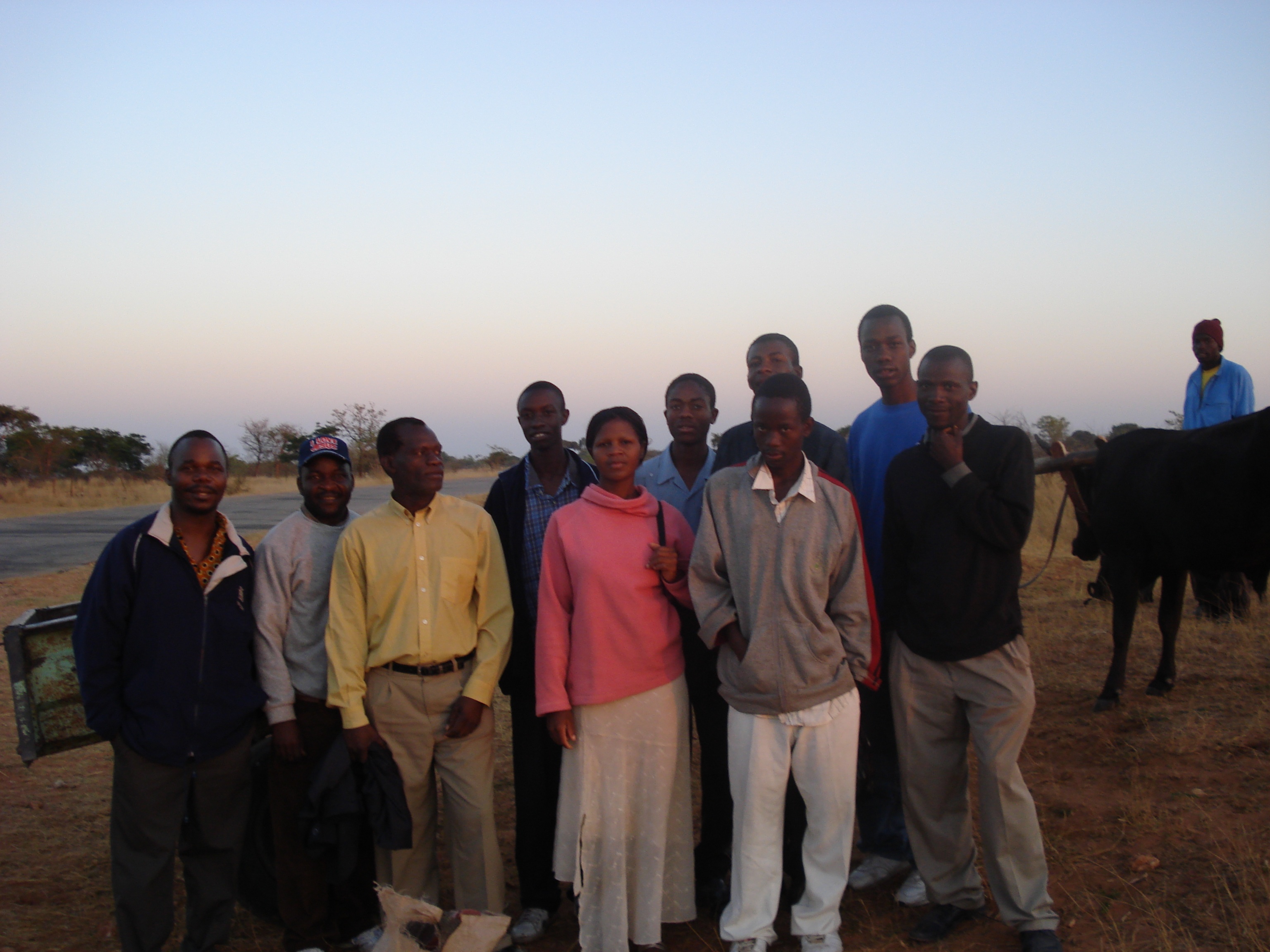 In 2005, I had the incredible opportunity to travel to Zimbabwe, Africa to initiate a partnership with Mbare Christian Fellowship in the capital city of Harrare. MCF is led by the visionary leadership of Peter Mabasa and a team of elders that just might fulfill the Great Commission even with inflationary rates in the millions in the once prospering now teetering country. The needs in Zimbabwe, then and now, are overwhelming. On our trip we visited orphanages providing medical care, worshiped in village churches, provided leadership training, and did some sight seeing. We shared an incredible worship experience with MCF which had an unfinished building with far too few chairs.
Upon returning to the US, our church added them to our missions budget and like good Americans hoped  that we would help them make improvements to their facilities and do a little outreach. I had a lot to learn about vision and passion for evangelism. Instead of taking our money and doing capital improvements they have spent the last three years spreading out all over Zimbabwe starting new churches and helping villages conquer social ills. And it was not that much money by the way. Pastor Mabasa and their small congregation in one of the poorest parts of Harrare, have demonstrated for us what it means to be on mission.
Currently, Hope Church sponsors six church plants monthly and has helped fund ten new churches in rural Zimbabwe through our partnership with MCF. We also help provide quarterly training for pastors, planters, and lay leaders working in rural churches. All this and more has been done through building a great Kingdom Partnership that has led to a movement.
Don’t let your short term mission trip be the end of your contact with a mission field. Build partnerships that can lead to movements. If you or your church are looking to build a partnership, please consider Zimbabwe. Tendai Nyatsunga, one of the elders at MCF is currently studying in the United States and is available to speak to you or to your church about what God is doing in Zimbabwe. You can contact him at Tendai@Hope-Waldheim.com.
Please join us in praying for Zimbabwe!
Read the latest correspondence from Peter Mabasa below:


 Lane Corley