Category Archives: Northshore Baptist Associations
A Simpler Northshore Baptist Association
Beginning in the mid 1600’s in England, Baptist churches have formed associations for fellowship, missions partnership, encouragement, and doctrinal accountability. Most likely the lines were drawn for relationship due to geography which would hinder or provide for ease of transportation between the partner churches. Such was the case for Baptist churches in the Florida Parishes on the Northshore of Lake Pontchartrain when 100+ years ago the St. Tammany, Chappapeela (Hammond-Ponchatoula area), and LaTangi (Springfield-Albany area) Baptist Association were forming. Last night these three Associations went out of business and formed the Northshore Baptist Association, which spans 2/3 of the I-12 Corridor from Holden to Slidell. Lots of reasons to do this:
- Geography and Demography are no longer issues with ease of transportation and the entire region experiencing 20% growth each year.
- We can do more as an association of 90 churches than an association of 20-30 churches.
- Less meetings, less paperwork, less administrative hassle. From 3 to 1 All Come Annual Gatherings, From 9 to 2 Executive Board/Business Sessions, From 20+ Committees to 5 Ministry Teams, from 3 to 2 Monthly Ministers Conferences.
- Even better strategic partnerships across the I-12 related to Church Multiplication, Compassion Ministries, Church Health, Community Engagement, Disaster Response, and more.
And I believe all of this will result in healthier congregations and better communities on the Northshore and beyond. Get to know the Northshore Baptist Association on our website, connect on Facebook and Twitter. Or drop by a Ministers Conference the 2nd and 3rd Monday’s of each month.
“All disciples of Jesus are called to be sent people”
Highlights/Reflections from our Basic Training Event for #ChurchPlanters: This weekend we held our first Basic Training for Church Planters on the Northshore. A diverse group of Church Planting teams from across Louisiana came together for the event, including a Biker Church, Asian American churches, Attractional and Missional approaches. This is about my 5th time through Basic Training and I’d say a developing trend that I’m excited to see may be Bi-Vocational church planting teams. Also, NAMB’s new Basic Training Journey has made some helpful adjustments. Get it online here. Also, here is a Google Doc with some resources mentioned and discussed during the workshop. Here are a few highlights for me:
- Church Planting is all about relationships.
- There is only one kingdom and it belongs to God. And God’s kingdom is extended to the ends of the earth through His church.
- All disciples of Jesus are called to be sent people.
- You can’t plant a church in your head, you have to plant it in the community.
- We don’t plant churches just for the community, we plant them for the whole world.
- Every congregation is a world missions strategy center.
- Contextualization is answering the communities questions about God and the gospel in their terms. NOT on their terms.
- Discipleship = Applying the inner meaning of the Gospel to persons at the point of their need.
- Multiplication principles: You reap what you sow. You reap later than you sow. You reap more than you sow.
- Don’t just start services, start making disciples.
- Discipling is a process of learning to obey Jesus.
- Two questions from Simple Church: What is a disciple? What is our process to make and mature disciples?
- Disciples are shaped by serving, not just sitting and singing.
- Don’t use people to get ministry done. Use ministry to get people done.
- Small Groups = Accountability = Growth.
- Small Groups are the seedbed to develop new leaders.
- In church history, a significant amount of missionary activity and advance was carried out by unrecognized teams of church planters. i.e – the Moravians
- The Moravians saw witnessing as the common concern from all members of the faith community and sent small groups of ordinary believers to plant churches and testify for Christ in new areas.
- “Ultimately, each church will be evaluated by only one thing – its disciples. Your church is only as good as her disciples. It does not matter how good your praise, preaching, programs, or property are; if your disciples are passive, needy, consumeristic, and not radically obedient…” Neil Cole
Upcoming Training for Planters and Multipliers
- Basic Training for Church Planters, September 8-10 @ Woodland Park Baptist Church in Hammond. More info here. Register for the event here. After registering Prepare for the Journey here. Basic Training is a workshop that helps shape the vision and direction of a new church. Looking forward to taking the journey again with our newest crop of planter in the NOLA region.
- Greenhouse w/Neil Cole and Church Multiplication Associates, October 21-22 @ New Orleans Baptist Theological Seminary. Here’s the event brochure. Register for the event here. Neil Cole’s writings have inspired me to think beyond planting a church to planting a movement. Looking forward to spending a few days learning with him and his team.
“In every apple is an orchard”
Yesterday was our annual luncheon to talk about opportunities and avenues for partnering to plant churches and multiply off-campus ministry on the Northshore. From my notes:
- North America is the only continent where Christianity is not growing.
- No county in America has a greater % of churched people today than 10 years ago.
- Since 1991, the number of adults in the US who do not attend church has nearly doubled.
- Missional affirmations by the LA Bapt Convention: “We believe the Biblical mandate to Make Disciples of All Nations is a call to plant multiplying churches among all people groups in Louisiana.” “We believe that planting indigenous, multiplying churches is the most effective strategy for making disciples and impacting lostness.”
- 1 out of every 2 Louisiana residents surveyed indicated no “personal relationship” with Jesus Christ.
- On the Northshore, population has grown 3 times as fast as church membership. Only 3.3% of the population attend a Southern Baptist Church on any given weekend. Less than 10% attend evangelical church of any kind. If we wanted to double that to 6.6% over the next 10 years we would need to add 16,000+ worshipers.
- Dr. David Hankins shared about the need for a paradigm shift in ministry mentality in North America and four unfounded fears that pastors have about Church Planting: 1) I’m going to lose members, 2) Will the new church remain baptist, 3) We can’t afford it, 4) I don’t have time. Eric Hankins writes about these four fears here.
If you’d like to get an info packet from the event or learn about some of the specific opps to partner in 2012, email me at lanecorley@gmail.com.
Meeting the Challenge of Population Growth and Church Decline
A recent study of the Northshore communities in SE Louisiana revealed that less than 4% of the popoulation attends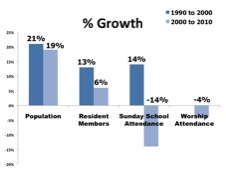 Southern Baptist Churches on any given weekend (11,000 attenders to 343,000 in population). Consultation with other evangelical groups revealed that less than 10% attend evangelical churches of any kind (approximately 25,000 attenders per weekend).
Over the next ten years the Northshore is projected to continue to grow at a rate of 22%, which would bring our population to over 419,000 people. 22% growth for Northshore Baptist churches would mean adding 5,296 new members in ten years. The real challenge is to increase the percentage of people attending worship gatherings and Bible Studies. Currently 3.3% of the population attends worship in Northshore Baptist churches. If we wanted to double that to 6.6% of the population in worship attendance over the next ten it would mean adding 16,434 worshipers. Currently, only 1.9% of the population attends Bible Study in NSBA churches. If we wanted to double that to 3.8% over the next ten years it would mean adding 9,304 people to our Bible Study rolls. Daunting numbers. How could we do this? And is it even possible?
Four suggestions to meet the challenge: First, we need some of our churches to breakout. Second, we need healthier and riskier church planting. Third, we need to partner to help churches in need of and willing to engage in revitalization. Fourth, we need a discipleship revolution.
Breakout Churches. A breakout church is defined by Thom Rainer in his book by that title as a church that reaches at least one person for Christ every two weeks or 26 persons per year, has a conversion ratio of 20:1 or 1 conversion for every 20 members per year, has tenured and consistent leadership, and the church makes a clear and positive impact on its community.[1] In our area, FBC Covington would be an example of a breakout church. In 1980, FBC had 322 in Sunday School and baptized 32. Dr. Waylon Bailey became pastor in 1989 and from 1990 to 2000, Sunday School attendance grew from 417 to 1,137. From 2000 to 2010, FBC relocated into a new facility, sponsored a new church on the Northshore which added 100+ members in its first five years, and today FBC has over 1,700 worshippers each week. And, since 1990, 1,745 people have been baptized through the ministry of FBC Covington. Bedico Baptist is another church that has broken out with tenured leadership. Leo Miller became Pastor in 1994. In 1995, Sunday School averaged 76 weekly attendees at Bedico. In 2000, that was up to 141, 2005 to 232, and Bedico has recently broken the 400 barrier. And since 1994, 537 have been baptized at Bedico. Others are poised to breakout across the Northshore. The momentum of growing churches breaking out will help us catch up with population growth and move past a season of decline.
Healthier and Riskier Church Planting. Healthier church planting means church planting that is led by churches with a heart to multiply and reproduce themselves for the sake of kingdom expansion. So, what’s needed for healthier church planting is healthy mother churches with a heart to reproduce. As Bob Roberts says in his great book The Multiplying Church, “The future of faith in America (and anywhere in the world, for that matter) is not tied to planting more churches, but in raising up of mother congregations of every tribe, tongue, denomination, and network that are reproducing… The hope is in pregnant mother churches.”[2]
Riskier church planting would be multiplication that targets hard to reach areas and unchurched pockets of our population. Missiologist Alan Hirsch suggests that current church models are reaching out to smaller and smaller segments of the population, with possibly as much as 60% of America untargeted by our evangelistic and outreach efforts.[3] Our study identified multi-housing residents as one potential segment that is underserved. Others may be those in their early 20’s with very little understanding of religion in any form. We need some church plants that go beyond planting a worship service that looks similar to others in the community, but will ask the question “Where is the church not?” and go there with the gospel. We need some church plants that have different scorecards and different expectations, but will faithfully deliver the message of Christ to unchurched people.
Partners in Revitalization. Church revitalization is needed to turn momentum around for congregations that are not effectively reaching their communities. This is already happening in a variety of ways on the Northshore, with Grace Memorial Baptist Church in Slidell becoming the sponsor of Covenant Baptist Church, which was in steep decline and in danger of shutting the doors. Also, with Woodland Park Baptist Church merging and taking on the assets and liabilities of New Life Church in Hammond, which was in steep decline, and now they are looking to plant a new church on the site. And FBC Hammond working through a self-assessment with the NSBA Staff to begin a process toward revitalization. Churches are needed who are willing to adopt or sponsor or merge with existing congregations for the glory of God. And churches are needed who are willing to admit there in need of coming under the wing of a benevolent parent church or work with a church wanting to help then in a revitalization effort.
A Discipleship Revolution. Call it revival, lay renewal, or awakening, what we need is a revolution of discipleship that will lead Northshore Christians to multiply themselves spreading the Gospel like a sneeze to their neighbors, classmates, coworkers, and beyond. In his book Church 3.0, Neil Cole observes, “we have lowered the bar of what it means to be a Christian, such that simply showing up to the weekly one-hour event with some regularity and a checkbook is all it takes.”[4] We must refocus on making disciples who will reproduce themselves by telling others, inviting others, and discipling others. Discipleship should lead to disciple makers on mission for others.
[1] Rainer, Tom. Breakout Churches. Grand Rapids, Michigan: Zondervan, 2005.
[2] Roberts, Bob. The Multiplying Church. Grand Rapids, Michigan: Zondervan, 2008.
[3] http://www.christianpost.com/news/alan-hirsch-church-model-reaching-only-40-percent-of-americans-47500/
[4] Cole, Neil. Church 3.0: Upgrades for the Future of the Church. San Francisco, CA: Jossey-Bass, 2010.
A few Church Planting dates for the Fall
- 8.24 – Partners in Church Planting Luncheon, 10:30am-1pm @ FBC Mandeville. For pastors and churches interested in getting involved with Church Multiplication. Ask questions, hear about opportunities and needs, plan and strategize with other multiplication minded leaders on the Northshore.
- 8.29 – Monthly Church Multiplication Network Meeting, 11:30am @ Cafe Nola in Ponchatoula. Network meetings are for planters, planting teams, future planters, planting enthusiasts, multiplication minded church leaders. Great time to fellowship, collaborate, encourage one another. And this fall we’ll add an optional Afternoon coffee training module/learning cluster after lunch. CP Networks are vital.
- 9.8-10 – Basic Training for Church Planters, 8:30am-4:30pm each day, @ Woodland Park Baptist Church in Hammond. For anyone planting or prepping to plant a church. Also, would be good for revitalization of a church. Pre-register here.
- 9.26 – Monthly Church Multiplication Network Meeting, 11:30am @ Northshore Church in Slidell.
- 10.21-22 – Greenhouse: Organic Church Planting w/Neil Cole @ New Orleans Baptist Theological Seminary. http://www.nobts.edu for more info. I read everything Neil Cole writes. Looking forward to learning from him at NOBTS this fall.
- 10.24 – Monthly Church Multiplication Network Meeting, 11:30am, @ TBA
- 11.28 – Monthly Church Multiplication Network Meeting, 11:30am, @ TBA
Northshore Pastors Utilizing Social Media for Ministry
The Gospel of Jesus Christ is big news. It’s a message to be declared, proclaimed, announced, and distributed to as many people as we can as often as we can. God’s work among His people is also news and a story that needs to be told. The tools that churches have relied upon to announce their message and distribute their stories are the pulpit, newsletters, letters and post cards, phone trees, scrolling power point announcements, and email. As a Pastor, my church utilized each of these tools and still I heard regularly from people in my church – “I didn’t know anything about that.” Communication is definitely one of our biggest challenges. Also challenging is the fact that a generation is here that is abandoning paper and phone lines for wireless messaging and social networking. Many pastors and churches are beginning to take communication to another level and engage the world in the fastest growing means of messaging that we have today and utilize the world of Social Media.
Check out some of our Northshore pastor blogs:
- Waylon Bailey, waylonbailey.com – Pastor FBC Covington.
- Pete Charpentier, godswordapplied.blogspot.com – Pastor Woodland Park Baptist Church, Hammond.
- Lane Corley, lanecorley.wordpress.com – Pastor/Church Planter Bridge Church & NSBA Church Planting Strategists.
- Randy Davis, kudzuvine.org – Pastor, Trinity Baptist Church, Hammond
- Avery Dixon, www.misfitjoys.com – Pastor Hope Church of Waldheim.
- Jeremy Harper, adesperateseeker.wordpress.com – Worship Leader at Ebenezer Baptist Church in Hammond
- Jay Johnston, jayjohnston.org – Associate Pastor at FBC Covington
- Matt Marrs, worshiptoolbelt.wordpress.com/ – Creative/Worship Leader at Bridge Church.
- Tobey Pitman, thechurchbreakingout.wordpress.com – NSBA Community Ministries Strategist.
- Ken Schroeder, kenschroeder.wordpress.com – Pastor FBC Mandeville & NSBA Vice-Moderator
- Nathan VanHorn, fbcfolsompastor.blogspot.com – Pastor FBC Folsom
Check out these resources on Social Media and Ministry:
- Why I Want to Write A Blog by Waylon Bailey
- How to Start a Blog by Tim Challies
- Utiilizing Social Networking in Ministry by Lane Corley – Presentation for Ministry Assistants Conference in 2010.
- All About RSS by Tim Challies – the best way to follow blogs and news sites.
Balancing Word and Deed?
Great conversations this week at a local pastors conference after a message from Tobey Pittman about Compassion. Tobey talked about a Biblical understanding of compassion and its implications for ministry. This led us to the topic of social actions relationship to local church ministry. A few questions generated:
- Our oldest pastor/preacher in the area asked have we excused ourselves away from ministry because of the welfare state. Great question: Does the fact that some get government checks keep us from responding to genuine needs in our community? When should we help? When should we not?
- Our newest Northshore Pastor exonerated us that the love of God is to be spread by word and deed. And that the church could do and should do more for the neediest than the government can and should. But what does a “word and deed” gospel look like?
- And then the inevitable question for all of us as believers in the Sola Fide, Sola Scriptura, Sola Christo: Does social action subvert or hurt the primacy of preaching the Word of God?
Northshore Probe: Meeting the Challenge
Only 3.3% of the population of the Northshore attends a SBC church on any given Sunday. After multiple interviews with leaders from other Evangelical denominations, it is highly likely that less than 10% of the population attends an evangelical church on any given Sunday. Maybe a better indicator of success is small group attendance and only 1.9% of the population of the Northshore attends a Small Group Bible Study on any given Sunday. To double these percentages to 6.6% and 3.8% over the next 10 years, keeping up with population growth means we would need to add 16,434 worshipers and 9,304 Bible Study attendees. Find all the data and full report here.
Four suggestions to meet the challenge: First, we need some of our churches to breakout. Second, we need healthier and riskier church planting. Third, we need to partner to help churches in need of and willing to engage in revitalization. Fourth, we need a discipleship revolution.
Breakout Churches
A breakout church is defined by Thom Rainer in his book by that title as a church that reaches at least one person for Christ every two weeks or 26 persons per year, has a conversion ratio of 20:1 or 1 conversion for every 20 members per year, has tenured and consistent leadership, and the church makes a clear and positive impact on its community.[1] The momentum of growing churches breaking out will help us catch up with population growth and move past a season of decline.
Healthier and Riskier Church Planting
Healthier church planting means church planting that is led by churches with a heart to multiply and reproduce themselves for the sake of kingdom expansion. So, what’s needed for healthier church planting is healthy mother churches with a heart to reproduce. As Bob Roberts says in his great book The Multiplying Church, “The future of faith in America (and anywhere in the world, for that matter) is not tied to planting more churches, but in raising up of mother congregations of every tribe, tongue, denomination, and network that are reproducing… The hope is in pregnant mother churches.”[2]
Riskier church planting would be multiplication that targets hard to reach areas and unchurched pockets of our population. Missiologist Alan Hirsch suggests that current church models are reaching out to smaller and smaller segment of the population, with possibly as much as 60% of America untargeted by our evangelistic and outreach efforts.[3] Our probe identified multi-housing residents as one potential segment that is underserved. Others may be those in their early 20’s with very little understanding of religion in any form. We need some church plants that go beyond planting a worship service that looks similar to others in the community, but will ask the question “Where is the church not?” and go there with the gospel. We need some church plants that have different scorecards and different expectations, but will faithfully deliver the message of Christ to unchurched people.
Partners in Revitalization
Church revitalization is needed to turn momentum around for congregations that are not effectively reaching their communities. Churches are needed who are willing to adopt or sponsor or merge with existing congregations for the glory of God. And churches are needed who are willing to admit there in need of coming under the wing of a benevolent parent church or work with a church wanting to help then in a revitalization effort.
A Discipleship Revolution
Call it revival, lay renewal, or awakening, what we need is a revolution of discipleship that will lead Northshore Christians to multiply themselves spreading the Gospel like a sneeze to their neighbors, classmates, coworkers, and beyond. In his book Church 3.0, Neil Cole observes, “we have lowered the bar of what it means to be a Christian, such that simply showing up to the weekly one-hour event with some regularity and a checkbook is all it takes.”[4] We must refocus on making disciples who will reproduce themselves by telling others, inviting others, and discipling others.
[1] Rainer, Tom. Breakout Churches. Grand Rapids, Michigan: Zondervan, 2005.
[2] Roberts, Bob. The Multiplying Church. Grand Rapids, Michigan: Zondervan, 2008.
[3] http://www.christianpost.com/news/alan-hirsch-church-model-reaching-only-40-percent-of-americans-47500/
[4] Cole, Neil. Church 3.0: Upgrades for the Future of the Church. San Francisco, CA: Jossey-Bass, 2010.
Northshore Probe: Final Report and Summary
The Northshore Baptist Association Probe was completed on April 1st and the results and findings are indeed a call to action. In preparation for the PROBE our office conducted the following research: a 30-year statistical summary of our churches, a study of multi-housing on the Northshore, and zip-code demographic studies for every community in the NSBA area. On Friday, April 1st, a group of pastors and laymen came together to conduct an area-wide windshield survey looking for opportunities for ministries and potential church plants. The teams identified 25 areas for potential church planting and ministry development. Here is a summary and some highlights from our findings:


 Lane Corley