Category Archives: Ministry
Highlights from our Upside Down Inside Out Series
 Yesterday we finished up a series of messages at Bridge Church on Upside Down Kingdom Principles. Looked at Humility: The Way Up is Down, Generosity: In Giving Away We Receive, Problems: Joy in Trials, Salvation: Working Out What God Works In, and some others. Find most of the series at http://www.bridgenorthshore.com. Our recording equipment turned upside down on us and we missed two weeks. But here is a few of my favorite quotes from the series:
- The basement is the penthouse, in God’s kingdom.
- The best cure for illness is death. It kills the cancer every time.
- “I am more broken and sinful than I ever dared to believe and at the same time because of Jesus, I am more loved and accepted than I ever dared to hope.”
- God’s love for you is not based on anything that you can do or not do. It’s based completely upon the work of Christ.
- There is nothing that we can do to enact our own salvation. If there were, the cross would have not been necessary.
- Faith is like the brain. The best evidence of brain function is motor function.
- The way up is down in God’s kingdom.
- “the cross undermines our self-righteousness, and we can stand before it only with a bowed head and a broken spirit” – John Stott in The Cross of Christ.
- Pride is the only disease in the world that makes everyone sick except the person who has it.
- There are no shortcuts to spiritual growth or greatness in the kingdom of God.
- The only way out of a trial is through it, & the more trials we go through, the stronger we will be.
- What is my greatest need during this problem? Not a vacation. Not a pill. Not a counselor. Not rescue. Not revenge. IT’S WISDOM.
- When there is no other answer, perseverance is the answer.
- God’s more interested in your character, than your comfort. He wants you to be more like Christ.
Worth Reading: How To Multiply Your Church by Ralph Moore

“The world is multiplying while the church adds (at best).” Ralph Moore in How to Multiply Your Church: The Best Way to Grow
Confession: I day dream about being caught up in a movement that would bring Great Awakening like transformation to my community, country, and world. I believe the concept of saturation church planting and evangelism is a path to take to this end. This book is now one of my favs (along with Viral Churches by Ed Stetzer and Warren Bird, The Multiplying Church by Bob Roberts, Deliberate Simplicity by Dave Browning, and Church Planting Movements by David Garrison) on this topic. Really not a whole lot of how to, but more motivation to get out there and do it. And that’s kinda the point we’re at in the history of Christianity. We’ve focused so much on how to and not enough on true reproduction that we are well behind when it comes to keeping up with evangelizing the world’s population. For instance, Moore states early in the book, “The # of protestant megachurches has mushroomed from 16 in 1960 to 1,210 by 1995. The population quadrupled since 1900, while the number of churches has grown by a mere 50%. In other words, the population grew 8x as fast as churches could multiply.” Ralph Moore speaks as a practicioner and coach. Here’s some of my favorite quotes:
- We need to overcome the peaceful isolation of our comfortable campuses. A missional church invades and permeates. The operative term is “Go,” not, “Come.”
- Reproduction abilities represent a sign of maturity in living organisms. They also represent the only way to preserve the species over time. Multiplication of the Church not only engenders greater evangelistic results but also ensures the survival of Christianity in our culture.
- I believe a stalled congregation can nearly always grow its way back to momentum by preparing for and launching a new church. The process is invigorating.
- An equipping church leads every member to live as a missionary, at home and on the road, in God’s great invasion force.
- Current church culture rewards a spectator’s environment and has proven capable of raising large crowds while the surrounding world disintegrates.
- It is hard to imagine John saying, “Repent and go to 12 weeks of confirmation before you can be baptized for your sins.” There is a healthy immediacy to the NT movers that we lack today. Ministry must be left in the hands of the Holy Spirit. While we run sanitary operations, He brings victory out of apparent disorder. While we are unwilling to take risks, He demands faith.
- Movements are dynamic and sloppy. They are alive, not static. Difficult to contain, they prefer pragmatism and innovation to institutions and traditions. They seek to inspire and empower rather than control people. Movements esteem teamwork and ordinary “heroes” above superheroes.
Good Words on Emotions in Church Planting and Ministry
Church Multiplication can seem similar to warfare. There are lots of days filled with single motive of perseverance. They are punctuated by threats to the very existence of the new congregation and rewarded with outbursts of blessing and growth. The process never actually gets to “feeling right.” If you wait until it all feels right, you probably won’t do much of anything…
From my perspective, each season has only looked victorious as we looked back on it. But it never feels quite right while we are going through the day-to-day activities of evangelism and church multiplication.
Ralph Moore in his great book How To Multiply Your Church.
In other words, “Just Do It.”
Are You A Transformational Leader?
Had the privilege of attending a Transformational Church seminar several weeks back with Bruce Raley from Lifeway. This list really has stuck with me ever since:
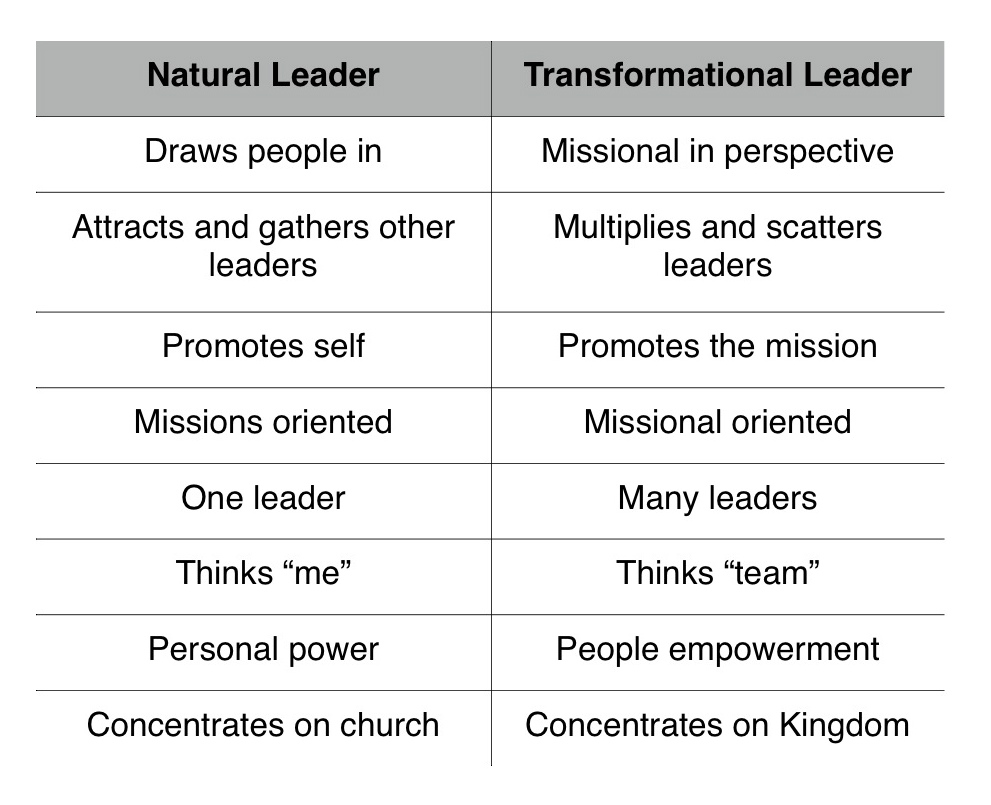 Check out the book Transformational Church by Ed Stetzer and Thom Rainer.
Good Advice for Church Staff Members
A few Interesting Stats on Church & Religion in the US
From the current issue of Outreach Magazine:
- More than 25 million people in the US have never heard the Gospel (Ralph Moore, How to Multiply Your Church)
- Only 34% of adults believe in absolute moral truth (Barna).
- Only 27% of adults are confident that Satan exists (Barna).
- For most churches the largest worship attendance occurs between the 15th and 20th years of their life cycle (Gary McIntosh, Taking Your Church to the Next Level).
- 2010 growth by denominations – 1) Mormon Church, 1.71% to 6 million, 2) Roman Catholic Church, 1.49% to 68.1 million, 3) Assemblies of God, 1.27% to 2.9 million. Every other mainline denom in the US decreased (National Council of Churches).
- Every year 2.7 million church members fall into inactivity (Schaeffer Institute).
- Residents of the south make up half of all the nations small group attendees (Barna).
- 28% of Americans believe religion is old-fashioned and out of date. Up from 7% in 1958 (Gallup).
- Christian Church attendance is 2 times higher in the South and Midwest than it is in the West and Northeast (David T. Olson, The American Church in Crisis).
Interestingly enough, these #’s reported in Outreach’s Annual 100 Largest and Fastest Growing Churches in America edition. Neil Cole notes in his book Church 3.0 that almost every statistical category for evangelical life and Biblical morality and spirituality is decreasing in America except one – the growth in the number of mega-churches. Correlations? or is it only that growth of our churches is not keeping up with the national birth rate? Whatever the case, we’ve got work to do.
“I was in prison and You came to me” Matthew 25:36
One of the goals for our current church plant in West St. Tammany Parish was to develop a sustained discipling presence at our local jail (which houses over 1,100) and to connect with their families on the outside. We have been able to walk with a group of guys through Celebrate Recovery, we’ve began a Sunday AM worship gathering at the Jail complex, we hope to launch a state approved Faith based recovery program this month, and we have seen several families of inmates plug in with Bridge Church. I have personally enjoyed being involved in these ministries and seeing the transformation in lives of men on the inside. Why? Two reasons at 10pm on Thursday night:
- The goal is community transformation. To transform a community requires a willingness to go to the dark corners with the light. What good is it, if our church grows, but the community continues to deteriorate. Reducing recidivism and bringing hope to the inmate is one way for churches to push back darkness in our communities.
- The heart of Christ – “I was in prison and You came to me.” Christ’s example to us was, whatever it takes, and that’s how he desires for us to live.
Last weekend, Bridge Church, sponsored the first ever Family Day at a local Work Release Center. It was great to see the second part of that goal coming to pass as we connected with families of inmates. It was also great to see members/partners of Bridge Church giving themselves in service to the prisoner.
Here’s part of a recent letter received at our church, written by an inmate in a local jail:
“Thank you for your part in bringing something so goo to a situation that is mostly filled with loneliness and loss and despair.”
“It is lonely here as a Christian and you coming here and bringing the Spirit you have is bitter sweet. It just magnifies the lack of it in so many others we are forced to live with. So, thank you for the time you spend with us.”
Glad to be part of a church that reflects the desire of Christ – “I was in prison and You came to me.”
Bridge Church’s First Building
 Our first building is now operational. It’s not your traditional first phase building for a one year old church. It’s actually a residential mobile home located in one of the largest mobile home parks in St. Tammany Parish. Our church will not meet their regularly, but will use it as a base of ministry, allowing two ministry minded students to live there instead. As they, do life together with the park, we’re believing that Bible Studies, Worship Gatherings, ministry to families, and to those in need will blossom in the coming weeks and months.
For me, it serves as a statement about our philosophy of ministry. A more incarnational approach, taking church to the community instead of demanding that they come and find us. Multi-housing ministry experts tell us that if a church simply does outreach to a multi-housing complex, it can expect to reach 4% of the population. But if a church actually takes church to property they can reach 30%. So far, our church through outreach has had 2% of the population of this park attend our services. Through our first phase building, I’m praying for 30% +.
Thanks to our partnering church Fairview Baptist in Coushatta, for helping us obtain the mobile home.
Measuring Success in Church
How do you measure success? Standard measures for success in church life is “How many? How much? How often?” That is, how many showed up, how much did it cost, how much was given, and how often did they return. Reggie McNeal’s latest book Missional Renaissance: Changing the Scorecard for the Church is about shifting measurements and posture of the church to reach new generations. Here’s a list from Eric Swanson of different measurements for success in church life that sets my imagination running wild:
- The number of cigarette butts in the church parking lot
- The number of adoptions people in the church have made from local foster care
- The number of pictures on the church wall of unwed mothers holding their newborn babies in their arms for the first time
- The number of classes for special needs children and adults
- The number of former convicted felons serving in the church
- The number of phone calls from community leaders asking the church’s advice
- The number of meetings that take place somewhere besides the church building
- The number of organizations using the church building
- The number of days the pastor doesn’t spend time in the church office but in the community
- The number of emergency finance meetings that take place to reroute money to community ministry
- The amount of dollars saved by the local schools because the church has painted the walls
- The number of people serving in the community during the church’s normal worship hours
- The number of non-religious-school professors worshiping with you
- The number of people wearing good, free clothes that used to belong to members of the church
- The number of times the church band has played family-friendly music in the local coffee shop
- The number of people who have gotten better because of free health clinic you operate
- The number of people in new jobs thanks to the free job training center you opened
- The number of micro-loans given by members in your church
- The number of churches your church planted in a 10 mile radius of your own church
Read the whole article here.
What are some other measures of success that you would add to this list?
Reflecting On One Year of Bridge Church
 This week we marked one year of Bridge Church in West St. Tammany. 83 Worship Gatherings, 4 Faith in Action Sundays, $25,000+ for missions and ministries, 20+ decisions for Christ, and 1 incredible start for a faith family gathered to give ourselves away for the sake of our community and world.
Two questions we asked at the outset in seeking to plant a church in West St. Tammany was, “where is this community in need of transformation” and “where is the church not present and how can we engage that population segment in our community?” (see my post on good questions for Assessing the Need for New Churches in the South). With that in mind, here are a few highlights for me that I hope propel us into the future:
1. St. Tammany Parish Jail / Set Free Fellowship – One of our goals was to have a sustained discipling presence at our local jail, home to 1,100+ men and women in need of the renewal, recovery, and restoration. As with most local jails, a majority of our inmates are local and a majority will be neighbors again within five years. This year, we were able to walk with 30+ trustees through Celebrate recovery and we launched a weekly Worship Gathering called Set Free Fellowship, that meets at the Work Release Center every Sunday morning. Next month we will launch Celebrate Recovery for around 160 inmates. We’ve also been able to connect with several families on the outside with the possibility of seeing entire family systems transformed forever.
2. Oak Villa Mobile Home Park – The largest Mobile Home Park in West St. Tammany is home to 400+ residents. Some with critical needs and many more without resources to meet basic needs. We started in January ’09 by building a relationship with the management of the park, taking food to the very neediest, and throwing block parties for kids and families. We’ve also, built wheelchair ramps, provided rental assistance, conducted home Bible Studies, and held Back Yard Bible Clubs. Multi-housing ministry statistics show that by simply reaching out to a multi-housing complex you can reach 4% of the population, but by taking church to the complex you can reach 30%. So, this week we will get the lights turned on to a Mobile Home provided by one of our partnering church, Fairview Baptist in Coushatta, in the hopes of reaching 30%+. This week we also have the honor of seeing six individuals from the park celebrate new life in Christ through baptism.
3. Intentional Engagement at local Festivals – Almost every weekend in Southeast Louisiana is an opportunity to throw a party or festival. And thousands gather regularly at Festivals in all of our Northshore communities. In October, Bridge Church gave up a Saturday and Sunday to serve the Madisonville Wooden Boat Festival, by painting faces, taking souvenir pics, hosting entertainment in the children’s area, and even moving our Worship Gathering to the Festival on Sunday in order to be ready to serve. We’ve also incarnated at the Columbia Street Block Party, holiday events at the YMCA, and a few other community events. This has been a great, unique, memorable way to meet a lot of unchurched people, build relationships with community leaders, get some name recognition buzz in the community, and have a great time as a group. I’m so committed to this we’ve even considered requiring a face-painting and balloon animal class for membership in our church.
4. Intentional Engagement in “Pure Religion” – James 1:27 defines one aspect of pure religion as taking care of widows and orphans in their distress or caring for those who can’t care for themselves. As a young Pastor and Christian for 20 years, I’ve learned that getting involved in ministry to others is a must for developing as a disciple and making disciples. Also, I’ve learned that in every community there are those who can’t help themselves and won’t ask for help. We’ve sought to create a culture of generosity and service through responsiveness to the needs of those who can’t help themselves. I’ve taught our team that the filters for our decision making will be: 1) Proximity to the needs of people, 2) Responsiveness to the needs of people, 3) and radical, sacrificial generosity as a normative practice. These ideas have led us to budget a large sum for Faith in Action projects, to partner and get to know leaders of community organizations that help the neediest, and to not simply look at the bottom line, because helping those who can’t help you in return will not always bring an earthly profit. This year, we’ve paid for bug service for an elderly man that was overwhelmed and had respiratory problems. We’re working on a plan to get a new gas line and heat for an elderly widow whose gas system has been condemned by the city. And individual members of Bridge Church are finding ways to engage through volunteering at local non-profits or using their job to meet the needs of those in need.
Looking forward to year two and beyond. Thankful for partners in ministry and our new faith family on the Northshore.


 Lane Corley