Category Archives: Books worth reading

Happy 4th of July!
Several good Revolutionary War Books out this year:
- Just finished Valiant Ambition: George Washington, Benedict Arnold, and the Fate of the American Revolution. Some good lessons on honor, self-control, & how not to raise a traitor.
- Reading now: Washington’s Immortals: The Untold Story of an Elite Regiment Who Changed the Course of the Revolution. Great stories about the Marylander’s who gave it all for the cause of American freedom.
Heather & I usually always watch all or part of the John Adams miniseries each summer. If you haven’t seen it, you should. Good depiction of the events & characters leading up to America’s independence.
Reminded by these books that the Declaration of Independence, signed on July 4th, 1776, didn’t automatically produce freedom. There would still be 7 more years of fighting until peace was signed with England on September 3, 1783.
Being a Christian means you’re free from sin’s ultimate penalty & we can experience freedom from sin’s power as we pursue righteousness through a relationship with Jesus Christ. But we’ll still battle sin & fight for this freedom as long as we’re on this earth – Pursue God & when we sin, seek his forgiveness. And remember one day, we’ll be FINALLY FREE from sin’s presence when we’re at home with God forever.

The Call to Preach is not just for Preachers
 Grateful for Tim Keller’s latest book Preaching: Communicating Faith in an Age of Skepticism, in which he writes that the New Testament call to preach goes beyond just pulpit ministry. Keller argues that there are three levels of preaching.
Level 1 would be through everyday Christian conversation. “Paul calls all believers to ‘let the message of Christ dwell among you richly’ & ‘teach & admonish one another in all wisdom’ (Colossians 3:16).”
Level 2 would be through things like “writing, blogging, teaching classes & small groups, mentoring, moderating open discussion groups on issues of faith, & so on.”
Level 3 would be preaching as we typically define it today – “the public preaching & exposition of the Bible to assembled gatherings.”
I appreciate these distinctions, because I’ve run into people that say they are called to preach, but then when you suggest they come along to the jail or start a small group or teach a sunday school class, they are unenthused. Biblical preaching seldom included a pulpit because such a thing didn’t yet exist. And sometimes we seem to think that vocational preaching is the highest rung on the ladder & everybody else is just a mere volunteer. Praying we recover Levels 1 & 2, without neglecting Level 3 & that we see all our conversation as preaching instead of preaching as just a possible career.
A few other favorite quotes from Tim Keller in Preaching:
- Every Christian needs to understand the message of the Bible well enough to explain and apply it to other Christians and to his neighbors in informal and personal settings.
- It is dangerous, then, to fall into the unbiblical belief that the ministry of the Word is simply preaching.
- No church should expect that all the life transformation that comes from the Word of God comes strictly through preaching.
- We must beware of thinking the Sunday sermon can carry all the freight of any church’s ministry of the Word.
- a church’s gospel ministry should be “pulpit-centered, but no pulpit-restricted.”
- while the difference between a bad sermon and a good sermon is mainly the responsibility of the preacher, the difference between good preaching and great preaching lies mainly in the work of the Holy Spirit in the heart of the listener as well as the preacher.
- Every time you expound a Bible text, you are not finished unless you demonstrate how it shows us that we cannot save ourselves and that only Jesus can.
- we are loved sinners in Christ – so loved that we don’t have to despair when we do wrong, so sinful that we have no right to be puffed up when we do right
- the temptation will be to let the pulpit drive you to the word, but instead you must let the Word drive you to the pulpit.
Keller’s book is also VERY insightful, as always, on preaching in our modern cultural context. Highly recommend adding this book to your library if you haven’t already.

Is Your Church Ready to Make a Lasting Impact?
 Carey Nieuwhof’s new book Lasting Impact: 7 Powerful Conversations to Help Your Church Grow is a great book to help you and your staff navigate change and how cultural shifts will be impacting your ministry in the future. Lots of challenging questions to help diagnose barriers to growth and help identify needed adjustments to reach a new generation. Here’s just a few of the powerful statements that have stuck with me and that I’m sharing with my staff and other church leaders regularly since reading this book:
- In every decision, focus on who you want to reach, not on who you want to keep.
- leaders who value attendance over engagement will see declining attendance.
- You need a flexible on-ramp that allows people to hang in the shadows for a while as they make up their minds and one that allows multiple jumping-in points throughout the year.
- The more you prioritize families, the more families will prioritize Sundays.
- A church that has a white hot sense of mission will almost always have the resources it needs to do what the church is called to do.
- Churches that love their model more than their mission will die.
- If we continue doing what we’re doing today, where will we be one year, two years, and five years from now?
Also, the chapter on Cultural Trends and how Netflix is influencing the culture is worth the price of the book. Must read for church leaders.
You can also find Carey Nieuwhof’s informative podcast on Itunes. Check him out online at http://careynieuwhof.com/.

5 Books to Put Under the Church Planter’s Tree
 Wondering what to get the church planter friend or loved one in your life for Christmas, etc.? It was actually a great year for books for church planter types. Lots of great books to choose from. Here’s five recent books that I think will make most church planters smile this Christmas or just because.
>> Saturate: Being Disciples of Jesus in the Everyday Stuff of Life by Jeff Vanderstelt. See some of my thoughts about the book HERE.
>> Gaining by Losing: Why the Future Belongs to Churches that Send by J.D. Greear. Great book on creating a culture of sending. Lots of how to’s. Must read for any missions or church planting enthusiast.
>> 100 Deadly Skills: The SEAL Operative’s Guide to Eluding Pursuers, Evading Capture, and Surviving Any Dangerous Situation by Clint Emerson. Do I have to explain why he’d love this?
>> The Great Fire: One American’s Mission to Rescue Victims of the 20th Century’s First Genocide by Lou Urenek. This would be a great movie, were it not for today’s political correctness. Inspiring story!
>> Staying is the New Going: Choosing to Love Where God Places You by Alan Briggs. Fellow church planter Alan Briggs helps all of us with a strong case for being on mission locally.
And if you wait too late you can’t go wrong with coffee shop or bookstore gift cards for church planters. :)
I keep an up to date, best stack of books for church planting HERE.

The Gravitational Pull of Any Church #quotes #booksworthreading
The gravitational pull of any church is toward insiders, not outsiders. Left unattended, your church will become a place where preference
s of the members trump passion for the mission. There are two primary ways to address this drift:
- In every decision, focus on what you want to reach, not on who you want to keep.
- Commit to losing yourself for the sake of finding others.
people automatically respond with “What about me and my needs?
… People who focus on helping others and honoring Christ soon discover that their needs are met far more deeply than they ever experienced otherwise.
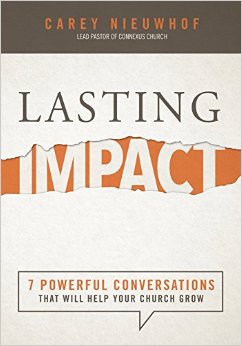
Carey Nieuwhof in his incredible new book Lasting Impact: 7 Powerful Conversations That Will Help Your Church Grow.

Things Spiritual Infants Say #discipleship #spiritualmaturity

How can I know where I am or where those I’m trying to disciple and lead are spiritually? Try listening. My last post was about Things Spiritual Giants Say. A few years ago, I posted about Jim Putman’s great book Real-Life Discipleship: Equipping Disciples Who Make Disciples. In the book, he breaks down five stages of spiritual maturity by what will be common phrases for a person at each stage. Jesus said, “The mouth speaks from the overflow of the heart” (Matthew 12:34 HCSB), so our words reveal our spiritual condition.
Spiritual Infant
- “I don’t have to go to church to be a Christian.”
- “I pray and read my Bible. That’s good enough for me.”
- “I didn’t know the Bible said that.”
- “Jesus helps me be a good person. I don’t need church.”
- Characterized by ignorance, confusion, dependence, worldly perspective.
- Needs personal attention of a spiritual parent, teaching and modeling the Christian faith, accountability to develop new habits.
Spiritual Child
- “My church isn’t taking care of my needs.”
- “I didn’t like the music today. If only they did it like…”
- “I love my small group; don’t add more people to it.”
- “I’m not being fed at my church, so I’m going to a church that can meet my needs better.”
- Characterized by self-centeredness, pride, idealism, spiritual highs and lows.
- Needs relational connections to a church family, help to start feeding themselves, teaching about identity in Christ.
Spiritual Young Adult
- “I love my small group, but there are others who need a group like this.”
- “Randy and Rachel missed church today. Their kids have the flu, maybe our group could make meals for them. I’ll start.”
- “I have some friends I’ve been witnessing to. I think I could lead a Bible Study for them with a little help.”
- “In my devotions, I came across something I have a question about.”
- Characterized by action, zeal, God-centered, others-centered, independent, desire to serve others.
- Needs opportunities to serve, ongoing relationships that offer encouragement, accountability and skills training.
Spiritual Parent
- “This guy at work asked me to explain the Bible to him. Pray for me.”
- “Our small group is going on a mission trip, and I have given each person a different responsibility.”
- “We get to baptize someone from my small group today. I want them to get plugged into a ministry right away.”
- Characterized by intentionality, reproduction mindset, dependability, desire to see others mature.
- Needs ongoing relationships with other disciple makers, a team approach, accountability and encouragement.
So where are you? If you’re moving toward spiritual maturity you may want to get this book or the training manual to learn more about how to be a spiritual parent and make disciples who make disciples. Here’s a few other great quotes from the manual:
- Every Christian is commanded to participate in the mission to make disciples.
- Your work is complete when the person you are discipling can make a disciple.
- The church was not designed to be a group of spectators who attend weekly lectures; it was designed to be a trained army with a powerful message.
- We cannot change the definition of discipleship to sit and listen and then expect to make disciples as Jesus did.
- Don’t mistake Bible Knowledge, years of church attendance, physical age, education, and so forth for spiritual maturity.
- A church is successful when everyone is in the game, maturing into disciples who can reproduce disciples.
- Relationships create the environment where discipleship happens best.
- Serving produces players, not spectators. Service helps a disciple develop and mature.

Am I Neighboring Well? Diagnostic Quesitons
 Just finished Alan Briggs’ book Staying is the New Going. Challenging book & easy to read. Briggs is a church planter in Colorado who challenges readers to stay well in their community through being a good neighbor, loving your city, embracing tension, drop wanderlust, etc. This book really makes you think & examine yourself by asking great questions. I found myself going back to these questions, during & now after reading, so I thought I’d share. I’m calling these Diagnostic Questions for Neighboring Well:
- Would anyone care if you put a for sale sign in your yard?
- Are you a character in the story of your neighborhood? Would others truly consider you a character in the story of your place?
- Is your home a fortress from life or a hub for life? A hub for ministry or a refuge from ministry?
- How many people enter your house in the course of a month? How many of those people don’t know Jesus?
- lingering is a sign others are comfortable enough to stay when everyone else has gone. How many people have lingered in your home this month?
- You know people are getting comfortable with you when they start to inconvenience you. How many last-minute favors have friends and neighbors asked of you this month?
- How many meals have you shared with people far from the church this month?
- How many unexpected opportunities have you seized for the sake of embodying and proclaiming the gospel?
- How many invitations have you had to serve on a community board or leadership team?
-
Would the businesses, residents, and organization around your church building care if your church relocated?
A few other quotes from the book that have stuck with me:
- Our mission trip began the day we were born; it ends when God calls us home.
- Christ followers should be a gift to their neighborhood, and a church should be a gift to its city.
- It’s always easier to lust after other places than to face the hard realities of our own place.
- How sad would it be if our neighbors only know us as the ones who drive to church on weekends, but never bring the gospel home with us.
Well worth reading! Look forward to taking up the challenge to stay well.

No Program Needed! You can Make Disciples in the Everyday Rhythms of Your Life!

That’s the message of the book Saturate: Being Disciples of Jesus in the Everyday Stuff of Life. Shared a few of my favorite quotes from the book in this earlier post. The thing I’ve come to appreciate most about Jeff Vanderstelt & the Soma story, is that you come away from this book believing that EVERYBODY can do this. How? Not by adding anything, but by redeeming the rhythms of your life. The challenge:
Seeing church mainly as an event creates a significant problem for mission, because most people are very busy. And the more we fill our lives with church events and programs, the more we get pulled out of everyday life with people who don’t yet know Jesus.
We need to see that life is the program, because people need to see what i means to follow Jesus in the everyday stuff of life.
When we engage in these everyday rhythms with Jesus-centered, Spirit-led direction, mission can happen anytime and everywhere, and anybody can be a part of it.
Vanderstelt and Soma identified six regular rhythms that most people are already engaged in, that can be changed through submission to Jesus.
1. Eating – “Eating is not an extra event added on to your life. What if you ate with others more often?” We eat 21 meals each week. How many could we commit to disciple making conversations with other people?
2. Listen – “One of the greatest gifts we can give one another is a set of open ears and a closed mouth.” Are you listening to God & others? Who is the dominant voice in your life? If we listen, people will often tell us how to reach them.
3. Story – “Everybody lives in light of a larger story… and the stories provide the lenses through which people view their worlds.” “The larger narrative of God’s story can bring redemption to each of our individual stories.” Do you know God’s story & how to apply it to your life & the lives of others?
4. Bless – “Whatever God gives to his people, he plans to give through them to others.”
5. Celebrate – “Disciples celebrate the grace of God given to us through Jesus in order to express how good & gracious God is.” Are you able to celebrate like God? Can you look back at what He’s done through you and say “This is very good!”
6. ReCreate – “Too many of us can’t rest and create. But we should be the most playfully rested people on the earth, because our Dad has it all taken care of for us!” Can you rest? Can you create freely? Can you play?
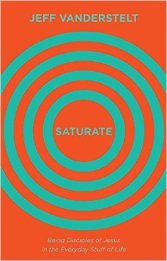 Eat. Listen. Story. Bless. Celebrate. ReCreate. Not really catchy. Doesn’t spell out anything. But these represent things happening all the time around us. As disciples of Christ we should embody his desires for people as we live them out.
No program needed! You can make disciples in the everyday rhythms of your life! Live it!
What everyday rhythm of your could you turn into a disciplemaking opportunity?
Check out Saturate by Jeff Vanderstelt. Great primer for Disciplemaking & doing church in the rhythms of your life.
Point Forward with Acts of Service
Through our lives, Jesus is showing the world the kind of king he is and the nature of the kingdom he rules. As his servants, we point forward with our acts of service to a far better world where Jesus’s rule will be experienced everywhere. Every one we serve experiences a taste of life in the kingdom.

Jeff Vanderstelt in Saturate: Being Disciples of Jesus in the Everyday Stuff of Life
>> Check out my Previous post about Saturate.

Resources for Helping Sons Discover Manhood
 My boys turn 13 & 9 this Summer. They’re moving on up the ladder of adolescence & I feel the clock ticking toward their release into the world like never before. I’m an imperfect parent at best & crave resources to help me be intentional in guiding them toward spiritual maturity. A couple of good books that I’ve found helpful in guiding conversations, especially with Jack as he enters the teen world:
The Manual to Manhood: How to Cook the Perfect Steak, Change a Tire, Impress a Girl, & 97 Other Skills You Need to Survive by Jonathan Catherman. Born out of experience raising sons, Catherman’s Manual gives boys a good place to find answers to questions that they don’t know they need to ask, as well as providing some good conversation starters for father-son or even mother-son talks.
I’ve already bought several copies of this for young men I know without Dad’s at home as well. Look around. They’re out there. And you can make a difference in their lives with a little attentiveness & encouragement.
The Two-Minute Drill to Manhood: A Proven Game Plan for Raising Sons by John Croyle. Now, for us LSU fans, you have to ignore some Alabama bravado, as Croyle & his sons are Crimson Tide alum, but the content is great. The outline for this book – M.A.N.H.O.O.D – has given me a great guide to talk to my son Jack about what it means to be a man.
- M = MASTER
- A = ASK & LISTEN
- N = NEVER COMPROMISE
- H = HANDLE YOUR BUSINESS
- O = ONE PURPOSE
- O = ONE BODY
- D = DON’T EVER, EVER, EVER GIVE UP
Talking through one of these on weekly evening runs with Jack this Summer.
Of course, the best resource you can give as a parent is TIME. Nothing replaces attentiveness, devotion, discipline, & genuine interest. Tools can help us as well. So if one of these fits you. I’d highly recommend.
Any other suggested resources on moving sons from boyhood to manhood?


 Lane Corley