Thanksgiving Journaling or Around-the-Table Exercise
Three ways to reflect on life at Thanksgiving:
- Responsive Thanksgiving – responding to who God is and what he has done for us. If God never gave us another thing, we still have much to be thankful for. Because he is good, faithful, righteous, and he provides, he saves, he’s powerful, etc., etc., etc.
- Aspirational Thanksgiving- responding to what we expect from God in the future or what we’re excited about. example: respond to God’s promise like Philippians 1:6 – “he who began a good work in me will be faithful to complete it.” Father, I can expect to grow this year. Teach me and guide me to maturity.
- Sacrificial Thanksgiving – thanking God for the hard things we’ve been through. “Offer God a sacrifice of thanksgiving” Psalm 50:14. This takes a lot of maturity, to reflect on the sacrificial/difficult/costly parts of life and thanking God anyway or mining the lessons learned and thanking God for them. It also could be a difficult investment you’ve made in a mission or person that has or has not born fruit yet.
So,
- How has the Lord been good to you this year? What attribute of his are you most thankful for?
- What are you most looking forward to in your relationships with God and his mission in the future?
- What has been costly experiences and lessons and relationships that you’ve taken this year that are hard to say thank you for?
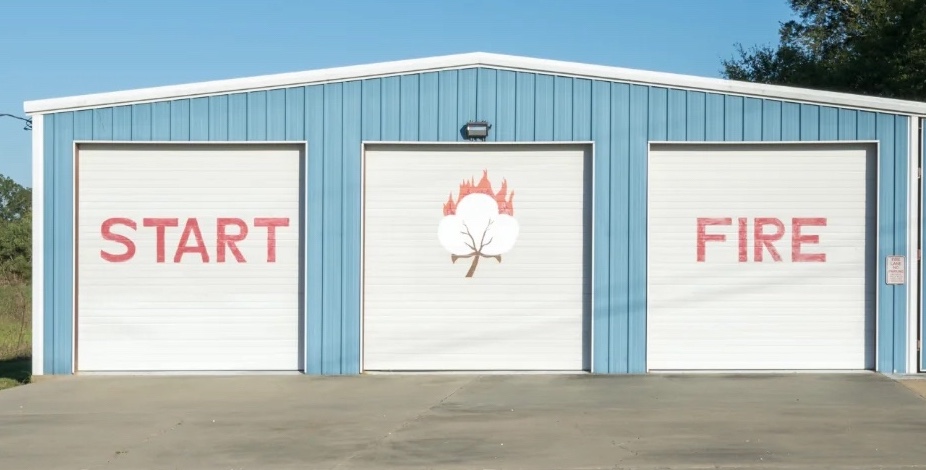
Start Fire
Passed through the town of Start on I-20 in north Louisiana this week. The Fire Department may have a messaging problem.

Lost Population vs. Active Witnesses
Can we estimate how many Active Christian Witnesses there are in a given community?
In Louisiana, the North American Mission Board has established the lost and unchurched population to be 62%. That’s 2,889,672 people.
The estimated number of participating protestant believers in Louisiana is 879,479.
A Lifeway study found that only 54% of believers are willing to share their faith. And only 10% have actually shared their faith. And those who have shared their faith typically share it about once per month. We’ll call the 10% active faith sharers.
So, if there are 879,470 participating protestant believers in Louisiana and if 10% are active faith sharers. That would mean there are 33 lost persons for every 1 active faith sharer in Louisiana.
For Southern Baptist in Louisiana, if 10% of the participating members are active witnesses. There would be 1 active SBC witness for every 249 lost or unchurched persons.
Here’s how it breaks down by region:
| Lost Population | Active Protestant Faith Sharers | Active SBC Faith Sharers | |
|---|---|---|---|
| North Louisiana | 703,076 | 1 to 18 | 1 to 110 |
| SW Louisiana | 759,680 | 1 to 35 | 1 to 349 |
| SE Louisiana | 1,426,917 | 1 to 41 | 1 to 400 |
And by Metro Area:
| Lost Population | Active Protestant Faith Sharers | Active SBC Faith Sharers | |
|---|---|---|---|
| Metro Shreveport | 244,069 | 1 to 18 | 1 to 160 |
| Metro Monroe | 128,487 | 1 to 20 | 1 to 100 |
| Metro Alexandria | 94,482 | 1 to 19 | 1 to 120 |
| Metro Lake Charles | 137,978 | 1 to 32 | 1 to 217 |
| Metro Lafayette | 296,789 | 1 to 57 | 1 to 659 |
| Metro Baton Rouge | 540,101 | 1 to 34 | 1 to 480 |
| Metro Hammond | 82,611 | 1 to 30 | 1 to 219 |
| Metro Houma | 128,508 | 1 to 63 | 1 to 630 |
| Metro New Orleans | 789,053 | 1 to 54 | 1 to 540 |
You notice the drastic difference between North Louisiana and South Louisiana. 65-70% of protestant evangelical churches are in North Louisiana, while 70% of the population of Louisiana is in South Louisiana.
Observations:
- How can we develop more active faith sharers? I love the E3 Partners mission of training 1 million people by 2025. We’ve had over 1,000 trained in Louisiana. Trainees are equipped with a simple process and easy-to-remember tools to develop a personal ministry of evangelism. Doing nothing is not an option. How will you develop faith sharers in your church and community?
- Where is the church not? This is a great question to ask about your community. With low numbers of active witnesses, there are certainly pockets in every community where the gospel is absent. What segments of the population likely have few active witnesses? These would be great places to engage. For us, that has meant local multi-housing complexes, business networks, local gyms, and community organizations. Don’t just go where all the other Christians go. We’ve got to break out of our bubbles and build relationships where Christ is not being named.
- We need believers to consider investing in the least reached areas. Of course, these numbers are drastically worse around the country and across the globe. How can they hear without a preacher? (Romans 10:14). How can they hear the gospel without active witnesses in the neighborhoods, workplaces, playgrounds, and schools around them. Christians tend to want to locate where there are more Christians and Christian stuff. It’s safer there. It’s safer because someone at some point took the risk to move there and share their faith actively.
Let’s pray for more active faith sharers. And let’s pray for a missionary movement to south Louisiana and other parts of our world that are desperate for an active witness.

Character and Righteousness
- Psalm 51:6: “You desire integrity in the inner self, and you teach me wisdom deep within.”
- Ezekiel 36:26 – “I will give you a new heart and put a new spirit within you; I will remove your heart of stone and give you a heart of flesh.”
- 2 Corinthians 5:21 – “God made him who had no sin to be sin for us so that in him we might become the righteousness of God.”
Character and Righteousness:
- Character is the face; reputation is the photograph.
- Character grows from within; reputation grows from without.
- Reputation is what you have when you move to a new community. Character is what you have when you leave.
- Reputation is what people think you are. Character is what God, yourself, and those closest to you know you are.
- Reputation is what man desires. Character is what God desires.
- Character is built over a lifetime. Reputation can be made in a moment.
- Character grows like an oak; reputation grows like a mushroom.
- Character is the one thing we develop in this world and take with us into the next.
- A single news report can give you a reputation. A life of diligence gives you character.
We’re not alone in our fight for a life of character. Through faith in Jesus Christ and His way of salvation, God has promised to put a new heart of character in us. Really, something more than character – RIGHTEOUSNESS. Righteousness is pure white, bright light, no blemishes, no decay. It is the character of heaven, living on earth.
Yes! We can choose character. Greater still is to receive the righteousness of Jesus Christ. Character will be a by-product.

The Resurrection was Just the Beginning!
A neat, often untold part of Jesus’ resurrection story is its festival. We know about the Passover festival’s relation to the crucifixion of Christ, but there was also a festival on the day of the resurrection. It was called the Festival of First Fruits. On the first day after the Passover Sabbath, which would have been Sunday, every Jewish male would be bringing a sheaf of barley to the temple. That barley would be offered to God, whose acceptance of the offering was a pledge for a greater harvest to come. Fifty days later, the Jewish people would celebrate the Festival of Weeks or Pentecost to celebrate that greater harvest of wheat that God provided.
Seeing any parallels?
Paul helps us out in 1 Corinthians 15:20-23:
“Christ has been raised from the dead, the firstfruits of those who have fallen asleep. For since death came through a man, the resurrection of the dead also comes through a man. For just as in Adam all die, so also in Christ all will be made alive.”
Christ’s resurrection, among many other provisions, is a pledge of a greater harvest to come. A harvest of people who are dead in sin will be made alive in Christ (Ephesians 2:4-5).
Fifty days after the resurrection, during the Festival of Pentecost, Jesus had ascended, the Holy Spirit was poured out on the church, and 3,000 were added to the kingdom (see Acts 2). A truly greater harvest.
So What? A few takeaways:
- The resurrection was just the beginning! The resurrection of Christ is God’s pledge to bring a harvest from our lives as believers. The life of Christ within us is the power to produce fruit for God. The fruit of godly character and a harvest of disciples made. What is my life producing?
- The harvest doesn’t come without laborers and labor. Fields still have to be cultivated, seeds still have to be planted, and weeds must be dealt with. We should commit to working the fields and do our part to ensure a harvest of disciples made him. He pledges resurrection power to us. What am I doing to prepare for a harvest?
Fifty Days Until Harvest
What will you have to offer God? How many could God add to your church if you, dependent on Christ, allowed him to use you for a harvest? Get started:
- Ask God every day to make you fruitful.
- Prepare the fields by identifying who you can reach.
- Plant seeds by sharing the gospel in every way you can.
- Get equipped HERE.


Worth Reading: Spiritual Multiplication in the Real World
One of the best books I read in 2022 was Bob McNabb’s Spiritual Multiplication in the Real World: Why Some Disciple-Makers Reproduce When Others Fail.
The book uses the personal experience of the author and research to answer the questions:
- Why do some fruitful disciple-makers cease to be fruitful?
- Why do some disciples become fruitful disciple makers and others do not?
The Answers are not complex. And they would be rather easy to implement for the church or leader that has the will.
Essentially:
- Evangelism training should be emphasized and ongoing and not just a one-off or a one-time event.
- Those who are part of a small group devoted to evangelism are the most effective at disciple-making.
- Effective Disciple Making Groups spend time talking about evangelism, praying for the lost, and doing something evangelistic every time they meet.
- Effective Disciple Making Groups define multiplication as their reason for existence.
- Effective disciple-makers have disciple-making leaders who model evangelism and disciple-making for them.
- Effective disciple-makers put themselves in a position to meet new people regularly and share the gospel early in relationships.
A lot of other research-based observations about effective evangelists and disciple-makers. You can take his survey and find other helpful resources mentioned in the book at McNabb’s website SpiritualMultiplication.org.
Some of my favorite quotes from the book:
- Those involved in ongoing evangelism training led twice as many people to Christ as those who weren’t.
- Becoming a part of a team that evangelizes together is the most important thing you can do if you want to multiply disciples.
- The groups that do the best job of helping their members grow and multiply disciples are the groups that meet for the express purpose of being a disciple-making team.
- Jesus’ goal was never to build individual disciples. He built a team and expected them to build other disciple-making teams called churches.
- Following involves fishing. If you are not fishing, you are not following. Churches are supposed to help their members be successful at catching fish and helping those fish mature and multiply.
- “Rather than asking the question ‘Are we growing?’ we need to ask, ‘Are our members leading people to Christ?’ and ‘Are they successfully helping new converts grow into mature believers?'”
- Wherever you find disciples exponentially multiplying, you will find an emphasis on training.
- Highly effective disciple-makers average twice as much time discussing evangelism, praying for the lost, and actually doing evangelism together with others in their small group as non-effective disciple-makers.
- Most groups that function well as a disciple-making team define multiplication as their reason for existence.
- There is a clear relationship between prayer for the lost and disciple-making effectiveness.
- While the bible plainly characterizes evangelism as a process, it does not teach waiting to talk about Jesus with someone until after one has developed a friendship.
- Respondents who usually shared the gospel within the first few times they met someone exposed an average of 52 people to the gospel annually. This average fell to 15 for those who waited to share the gospel until an ongoing friendship was established and 25 for those who employed a mixed approach.
- Those who shared the gospel within the first few times of meeting someone led more than 400% more people to Christ on average each year than those who waited to establish an ongoing relationship, and they led 44% more people to Christ on average each year than those who approached evangelism with a mixed approach.
- Disciple-makers who said they were a part of a small group that spent at least 20 minutes weekly discussing evangelism, 20 minutes praying for the lost, and 20 minutes doing some sort of evangelism together are far more effective than those who didn’t.
Spiritual Multiplication in the Real World is challenging, inspiring, and practical. A great resource for personal development as a disciple-maker and to be given to those in your disciple-making team. There is also a Study Guide and a companion book called Foundations that are referred to in the book that can be used in small group or team settings.


Church Mergers in Louisiana
(First published HERE)
Since 2015, 25 churches per year have closed their doors in Louisiana. While this is a necessary last step for some congregations, there are effective strategies that have both prolonged congregational life and restored the fruitfulness of Christ’s body at a church location. One such strategy is Church Mergers.
Since 2010, Louisiana Baptist strategists have assisted with at least 22 church mergers across our state. Churches of all sizes have found renewed life through making two congregations one. These have included:
- two smaller churches joining together to expand their capacity for outreach,
- growing church plants in need of space merging with older congregations in need of people,
- multi-site campus development, with a church agreeing to become a campus of a church in another part of the city or region,
- and churches merging with a church of another ethnic group in order to be more effective at reaching their transitioning community.
Determining if a merger is right for your congregation should be a matter of much prayer and careful discussion. In the book, Better Together: Making Mergers Work by Jim Tomberlin and Warren Bird, they suggest these key questions:
- Would our congregation be better by merging rather than remaining separate?
- Could we accomplish more together than we could separately?
- Would our community be better served if we joined together?
- Could the kingdom of God be further enlarged by joining together?
Our strategists are available to help you walk through these and other key questions in making the right and best next steps in the life of your church. Contact us today to discuss Church Mergers, Church Revitalization, or Replanting as options for your congregation.
- Lane Corley, Church Planting Strategist
- Sean Keith, Church Health Strategist
- 318-448-3402
Other helpful resources:
- Considering a Church Merger Conversation Guide for Congregations [PDF]
- Better Together: Making Mergers Work by Jim Tomberlin and Warren Bird [Book]
- Mergers: Combining Churches to Multiply Disciples by Matt Rogers [Book]
- 9 Keys to Successful Church Revitalization that Include Church Mergers [Article]


You Lost…
The first year of Legal Sports Betting in Louisiana is in the books – LINK.
- Louisiana Casinos made $35.8 million off sports bets.
- Mobile Apps made another $152 million off sports bets.
- 268 million wagers were made in November 2022 alone.
Paul Harvey used to report on Gambling earnings with the totals and a pithy dig at the reality of gambling. He might say about this report,
“Sports betting made $188 million last year in Louisiana. That means you LOST $188 million last year in Louisiana.”
The only bright spot for Louisiana was the winnings and losing brought in about $26 million in taxes.

Don’t Burn those Leaves!
What’s happening in the garden right now?
- Carrots are still in. We covered them during our rare ultra cold snap here in south Louisiana. Hopefully they made it through. We’ll harvest them in February.
- A little bit of lettuce planted. Lettuce can handle some cold weather. And lettuce is on a 15-30 day cycle, so it can be harvested as is or covered heavy should another cold snap come through.
- LEAVES! LEAVES! LEAVES! This month, most of my neighbors are raking and bagging leaves. I steal them from their driveways before the garbage truck arrives. I’ve probably collected close to 40 bags at this point. Along with another 20 or so of my own leaves. What are we doing with all these leaves?
- Mulching and Composting. As time allows, I’ll run over these leaves with my mulching push mower. Each bag is reduced down to about 10 gallons when mulched…
View original post 199 more words
Make Church Planting Evangelistic Again
A troubling trend I’ve noted among church plants in Louisiana. Since 2012, Professions of Faith are down 86%, and Baptisms are down 66% in Louisiana church plants. It’s not just church plants. The decline in evangelism outcomes is well-noted across North America. It’s most surprising among church plants because church planting is supposed to be for the purpose of evangelism.
Why the Decline? Some possible reasons to note:
- Contacts and Evangelistic Contacts are down 52%. Church Planters should aim for 200 contacts and 50 Gospel Conversations per month. 2022 numbers were 81 and 20 per month. We reap what we sow. Sowing the gospel broadly should be priority #1 for church planters. And these should multiply exponentially as team members are added and begin to learn the habits of evangelism and disciple-making from the church planter.
- It’s definitely a changing missional landscape. Evangelism may be harder today than it was 10 years ago. The pace of evangelistic responses may have slowed. This is more reason to share the gospel more broadly than ever before.
- Ecclesiological issues have taken precedence. Our organizations, logos, websites, and by-laws are in better order than ever. In the early 2000’s we started with a prospectus detailing how we would reach the community. Today, church planters often hand me their constitution and by-laws, and elder training plan first. Sometimes even before they’ve moved to the field. These churches often start with the need to fill the org chart rather than spread the gospel. I haven’t met one lost person who wanted to see my church’s org chart or bylaws.
- More bi-vocational church planters. More planters are splitting time between ministry and the workplace. This may result in a slowing down of contacts and evangelistic contacts. To plant evangelistically, finding bi-vocational employment that allows for broad seed sowing is necessary.
- A non-evangelistic church planting plan. Evangelistic Church Planting plans should focus on meeting, building relationships, and gathering unchurched people to Jesus. Believing team members who are willing to be trained and can best help with this mission should be added. Non-evangelistic church planting plans focus on events and communication that are attractive to the already reached. A Night of Worship, Deep Bible Study, Expository Preaching, highlighting a tribe or network. These are important rhythms for a growing church. However, these advertised upfront speak mainly to already believers and signal that this might be BETTER than my current church. Similar-minded people are drawn to a brand but do not necessarily come together to reach the lost in a community.
Others have questioned the evangelistic success of our current church planting paradigms.
How can we make Church Planting Evangelistic Again?
- Adopt an Evangelistic Church Planting Strategy. Plan on evangelizing a new church into existence. Set a target for at least 50% of your church to be from the unchurched community. Ask about every event, post, and series – how does this help us communicate the gospel to those far from God in this community.
- Train People to Multiply the Gospel in their Circle of Relationships. The most effective means of evangelism and spiritual growth is relational evangelism. I don’t mean friendship evangelism. Relational evangelism is helping people identify and reach their relational network for Christ. Evangelism is most effective friend to friend, family member to family member. And, obedience to Jesus’ Great Commission and the faith it takes to share the gospel with others will prove effective at maturing believers.
- Make Some Old Evangelism Practices New Again. Do you have a prospect list? Do you have personal evangelism training? Do you have prayer meetings specifically for the lost? Do you have harvest events like revivals? Do you start new things regularly? These are some habits of evangelistic churches of old that need to be brought back and maintained. Make them your own, but don’t bury all the old ways. See my article Five OLD Innovations for Our NEW Day.
What would you add to this list? What other reasons may there be for the evangelistic decline in our churches?


 Lane Corley