
My Friend from Syria
“You Were Different Before!”
 I had a friend from Syria in college. We had several classes together & it seemed we ended up sitting next to each other in most of them. He was muslim. He was full of life. He was always smiling. He was always joking. He was very interested in American life. We did set some things on fire in the chemistry lab, but he had no ulterior motives, except getting an education. Religion came up a lot, especially after my second speech in Speech 101. 7-minute informative speech on a particular aspect of a historical persons life. I chose the miracles of Jesus. I talked about the first & last miracles of Jesus, how many miracles are recorded in the New Testament, & then about how John said that if all the works Jesus did had been written down, the world couldn’t hold the books (John 21:25). Then I finished by stating that miracles still happen today even though you may not see one yourself. And then about how the greatest miracle is how God changes human hearts through a relationship with Christ & I gave my personal testimony of that change. I sat back down & my Syrian friend was visibly disturbed. He whispered to me with an angry look – “I want to talk to you after class!” Well, I didn’t know much about muslims at that time, but I’d read a few issues of Voice of Martyrs, so sweaty palms & extreme possibilities filled my mind. When class ended, I tried to shoot out quickly, thinking he may forget about it, but he caught me. Forcibly & loudly, he began putting his finger in my chest & almost shouting over & over again, “You were different before! You were different before! You were different before!” I said, “what are you talking about?” He said, “Your story. You talked about how you were changed on the inside. You were different before you found religion! And that there was something powerful that happened inside your heart!” He went on to tell me how he is pulled back & forth between his religion & the world & how there’s no power in his religion to change his heart. We skipped our next class to talk. I shared the gospel with him & about how Jesus does change us inside out when we confess him as Lord & believe in him & his work. He said it just seemed too simple & that being Muslim was a part of his family identity, like it probably was mine. I asked him to share his faith with me on several occasions, but he would just say, “It isn’t as good a story as you have.” The last few years of college we had fewer & fewer classes together & he moved on to a different campus for our senior year & we lost touch. But I’ll never forget that day in the hallway. It’s been a reminder to me of the power of the Gospel – “You were different before! You were different before! You were different before!” There’s real power in the gospel to change people from the inside out. That’s the hope we see lived out in the lives of other believers around us everyday. That’s the hope that keeps us sharing the gospel with others. That’s the hope that our muslims friends around the world & in our neighborhoods need to know about, & what many of them, like my friend from Syria, may be looking for.
Christian, you were different before! Live it! Share it! Never forget it!

The Duty of Encouragement #devo

One of the highest of human duties is the duty of encouragement… It is easy to laugh at men’s ideals; it is easy to pour cold water on their enthusiasm; it is easy to discourage others. The world is full of discouragers. We have a Christian duty to encourage one another. Many a time a word of praise or thanks or appreciation or cheer has kept a man on his feet. Blessed is the man who speaks such a word.
William Barclay (1907-1978), via CQOD
Verses on Encouragement – Heb.10:25; Job 4:4; Rom. 12:7-8; 14:19; 15:2; 1 Cor. 14:3; Eph. 4:29; 1 Thess. 4:18; 5:11

Church Planting Makes a Difference
Since 2010, 124 new churches planted in Louisiana with 8,987 new commitments to Christ reported in the first 36 month of these churches. That’s 72 new commitments to Christ per church plant.
How could 72 new commitments to Christ impact your community?


And that doesn’t account for a now lifetime partner in fighting community issues like addiction & hunger, a new partner in global missions, total evangelism as new believers get involved in new testament relationships & serving. Church Planting makes a difference.
Missiologist Peter Wagner said, “Planting new churches is the most effective evangelistic methodology known under heaven.”
Tim Keller says, “The continual planting of new congregations is the most crucial strategy for the growth of the body of Christ.” (get his great article Why Plant Churches).
Keep exploring the question “Does My Community Need a New Church?” HERE.
Check out these resources to help you get started:
- 10 Biblical & Practical Ways to Get Involved in Church Planting
- Every Church Can Encourage Church Planting and Multiplication
- Every Church Can Be a Church Planting Partner
- Your Church Can Be a Parent to a New Church or Campus

“Holy Ghost, with light divine; Shine upon this heart of mine” – Andrew Reed, 1817
Holy Ghost, with light divine
Shine upon this heart of mine;
Chase the shades of night away,
Turn the darkness into day.Let me see my Savior’s face,
Let me all His beauties trace;
Show those glorious truths to me
Which are only known to Thee.Holy Ghost, with power divine
Cleanse this guilty heart of mine;
In Thy mercy pity me,
From sin’s bondage set me free.Holy Ghost, with joy divine
Cheer this saddened heart of mine;
Yield a sacred, settled peace,
Let it grow and still increase.Holy Spirit, all divine,
Dwell within this heart of mine;
Cast down every idol-throne,
Reign supreme, and reign alone.See, to Thee I yield my heart,
Shed Thy life through every part;
A pure temple I would be,
Wholly dedicate to Thee.
Author: Andrew Reed, 1817

Connecting Dots, Defining Impact – Church Planting Highlights from the Louisiana Baptist Annual Meeting
Enjoyed a great couple of days of networking in Bossier City with the Louisiana Baptists Annual Meeting. The big highlight for me personally, was hearing my good friend Kirk Jones, Pastor of Fellowship Church in Prairieville, preach the Convention Sermon. Fellowship started from scratch in a Prairieville Fire Station in 2002. Since then 440 people have been saved & baptized at Fellowship & 700+ gather for worship each week on two campuses in hard to reach Ascension Parish.
Kirk took time to connect some dots & show the impact of the Southern Baptist Cooperative Program on his life. Kirk & I are the same age, so I saw myself in this exercise he led us through. From his local church having a Missions education program for boys called Royal Ambassadors, to the Annual Youth Evangelism Conference held each year to inspire teens to be on mission, then through Baptist Collegiate Ministries during college & Seminary training at SBC seminaries, & then deployment as church planter through the North American Mission Board & Louisiana Baptist Convention. Now 440+ new brothers & sisters in Christ & a healthy, multiplying church that is now a partner through the Cooperative Program & SBC Missions offerings. There are not many in our generation connecting these dots today. Thanks to Kirk for the great reminder. It’s not perfect. It’s not the only way to do it. But the Cooperative Program works.
A few other highlights:
- Annual Church Planting Network Luncheon – We have some amazing folks planting churches in Louisiana & the Annual Meeting is the one time each year that we can get a majority of them in one room for lunch & to say thanks.
- We had 48 of our 77 planters on stage for our Annual Report Monday night. It was cool to see the diversity & depth of church planting in the state in one big group.
- Our Mission Support Committee, which oversees the work of the Missions & Ministry Team, met & approved funding for 110 church planting & compassion ministry projects around Louisiana for 2016. Grateful for the Cooperative Program, Georgia Barnette State Missions Offering, and Annie Armstrong Offering for North American Missions that makes this possible.
- Greg Shyne, church planter for United Outreach in Shreveport received recognition for Outstanding Bivocational Ministry from the Louisiana Bivocational Pastors Fellowship. We’ve seen & embraced a big upswing in bivocationalism in church planting over the last few years in Louisiana. Love it!
- The Louisiana Baptist Pastors Conference was also great with H.B. Charles, Frank Cox, Phillip Robertson, Brad Jurkovich & others giving us some great encouragement to pursue the call.

Kirk Jones, Planter/Pastor of Fellowship Church in Prairieville, LA preaching the Convention Sermon at the Louisiana Baptist Annual Meeting at FBC Bossier City.

Annual Church Planter Network Luncheon. Currently 77 church planting projects in years 1-3 in Louisiana.

Great to have a big group of our current Louisiana Church Planters on stage with us for our Annual Church Planting Report, Monday night.
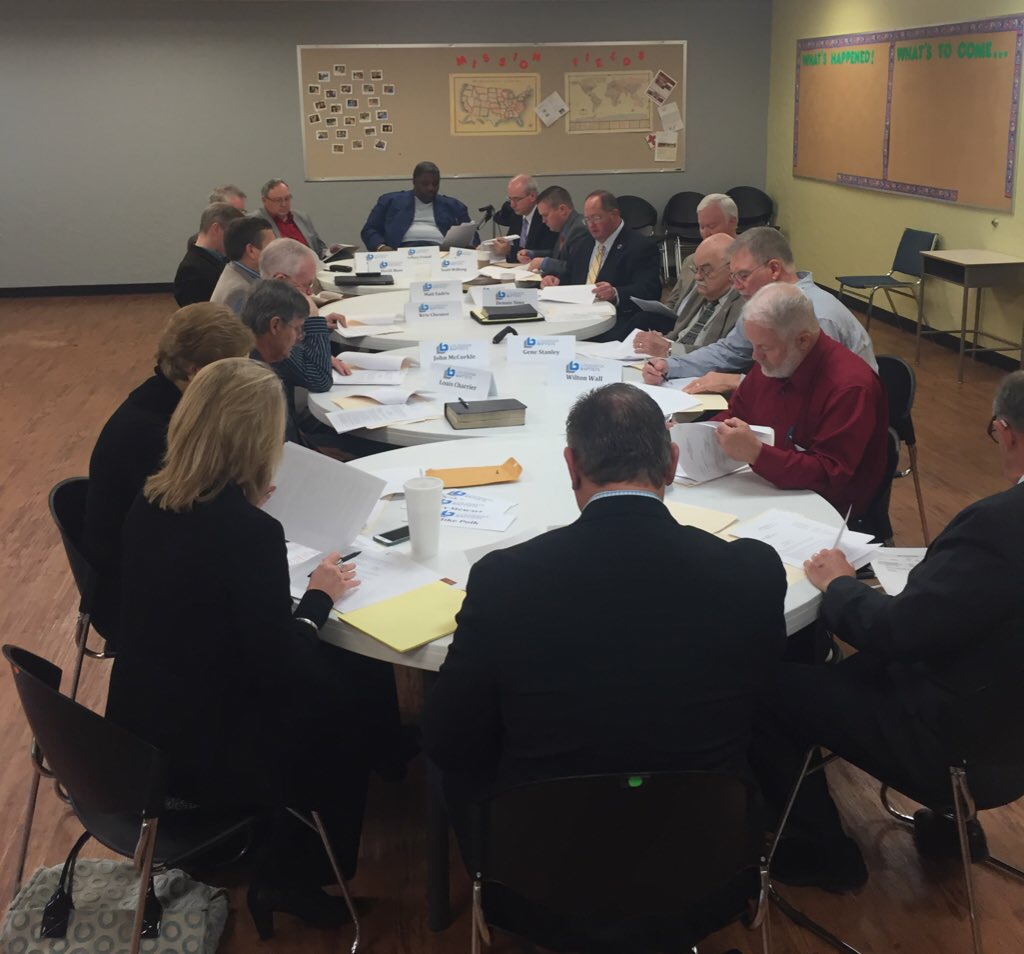
The Missions Support Committee is made up of leaders from Louisiana Baptist churches & oversees the work of the Missions & Ministry Team. They approved funding for 110 church planting & compassion ministry projects for next year across Louisiana.

Congrats to Shreveport church planter Greg Shyne, Bivo Pastor of the Year.

“The power of preaching is in its content, not its function.” – HB Charles closed out the Pastors Conference. Great to finally get to hear him in person.

Church Planting = Water for the Thirsty and A City for the Hungry #devo
 Two of my favorite images of church planting are found in Psalm 107:35-38.
35 He turns a desert into a pool of water,
dry land into springs of water.
36 He causes the hungry to settle there,
and they establish a city where they can live.37 They sow fields and plant vineyards
that yield a fruitful harvest.
38 He blesses them, and they multiply greatly;
He does not let their livestock decrease.
In every city & community there are a dry desert places that need the living water of God’s presence. In every city & community God wants to gather the hungry people for the sake of establishing a fruitful multiplying community. This gives great purpose to the work of the church planter & church planting team: FINDING DRY, DESERT, PARCHED PLACES IN THE COMMUNITY. Settle there & establish a place for hungry people to gather, grow, & multiply.
Questions for planters:
- Are we planting for the purpose of seeing God water the dry places? or are we planting in places that are well watered?
- Are we establishing a place for the hungry or the already full?
- Are we ready to sweat & experience the difficulty of desert life as we plant in dry places?
- Are we ready to lay brick #1 in a million as we build a city for the hungry?

Church Planter Fit
SUNDAY 11082015
- 1x pull trailer
- 4x unload equipment
- 4x hang signs
- 125x setup chairs
- 4x make coffee
- 125x shoulders (shaking hands)
- 4x 30 yard sprint (chasing kids)
- Repeat backwards
(And I guarantee this workout for 10,000 Fitbit steps before noon on Sunday.)
Who’s ready? There’s a church plant near you that can get you on the schedule ASAP.

Inspired by Crossfit.com.


ASAP in Church Planting: What should I do first? #churchplantingfaq
 When starting a new church or anything else, getting off to a good start is very important. A great question I’ve been asked several times this year – “What should I do first?” I wrote about what to do BEFORE starting a church and what to do in THE FIRST YEAR of a new church. But what should I be most concerned about in the very beginning, the first quarter, of a new church planting project. Looking back at my three first quarters of church planting projects, here’s what I’d do before I ever start to think about finding a building, getting a 501(c)3, or hiring a worship leader.
1. Gather partners.
Before getting on the field, you should have been developing a network of partners for prayer, financial support, etc. Establishing good communication patterns at the very beginning is essential. Every Monday email, closed Facebook group, hard copy E-newsletter, discipline on reporting if you’re partnering with an organization that requires a monthly report. Get in a rhythm of sharing with your partners early. And continue to work your plan to develop & establish good partnerships.
2. Meet some new people.
Establish yourself as a people person immediately. Build some relationships, get to know your neighbors, stick your nose in some conversations at a coffee shop, & share the gospel. If you get into month 3 or 4 & you don’t have some relationships on the field, the walls will start closing in & the loneliness will begin to stifle you. And these relationships will hopefully give you some soundbites to communicate needs to your partners & some potential core team members as well. I used Dan Morgan’s KISS method as a strategy for meeting new people: Know a name, get Involved, Share your Story, Share the Gospel.
3. Gather at least one circle.
Three keys to church planting: Gather, Gather, Gather. To grow the church, you’ll need to effectively gather CIRCLES (small groups), ROWS (worship gatherings), CROWDS (special events). Right now, focus on gathering one circle by inviting some of the people you meet to a Bible Study. You may be blessed to have a launch team from a sending church to help you form a circle. If so, work hard to keep that circle open to the unchurched. Or start a second circle for the unchurched. The more circles the first year, the better.
4. Meet with a coach/mentor.
Most church planters have read widely before getting on the field. You’ve got a ton of ideas. You’ve kept up with what others are doing. You need to establish some relationships with people that can help you focus on the best courses of action right now. A good coach or mentor will hold you accountable, help you process & sort through plans & ideas, & give you honest feedback. Eventually, you’ll have a team inside your church that can help with some of this, but now you need trusted advisors on the outside that believe in you, love you, & want to see your church succeed. In my experience, the closer to the field your working that they are, the better. Don’t wait until you need some advice. You need it now whether you know it or not. Establish a pattern of meeting with someone in the first month.
5. Establish patterns of devotion & rest.
One hour each day, one day each week, one weekend per month, two weeks per year. Plan out when you’re going to spend time with God, what will be your day off, date nights, vacations. Running past your devotional life & seasons of refreshing will lead to a quick flame out for most church planters.
So, a good checklist for the first 3-6 months of church planting:
- How many partners do I have? Have I communicated with them effectively?
- How many names do I know in the community?
- How many circles have I started?
- Who is my coach or mentor(s)? And when do we meet?
- Have I rested well this quarter?

What’s Up With the Local Baptist Association?
In Louisiana, there are 32 Associations of Southern Baptist Churches. Each Fall, my job as Church Planting Strategist with the Louisiana Baptists allows me to attend 6-8 of their annual meetings. This year, I attended meetings in several different parts of the state. I love Associations & Associational Annual meetings, because I love LOCAL. And it’s in the local that you can get a glimpse of the Southern Baptist Convention at the ground level. For those of you who don’t know, Associations are basically regional networks of Southern Baptist churches that affiliate based on their geography. We have associations with as few as 15 churches and as many as 120 in Louisiana. Each Association has a Director (the DOM), a slate of officers, and ministry teams that have various functions from church revitalization to disaster relief. Each Association has 2-3 Executive Board meetings each year. Executive Boards are made up of pastors and members of local Southern Baptist churches. Each Association has one Annual Meeting, usually in the Fall, where business is conducted and budgets are set for the following year. Churches voluntarily give a set amount or percentage of their budgets to the local association.
Here’s a few encouraging observations after attending about 15 Associational Annual Meetings over the last few years:
-
Young Pastors are showing up, serving, and asking questions when they have opportunity.
Two of the largest associations in our state had moderators that were under 40 last year. Younger pastors seem not only interested in, but excited about being part of what’s happening locally and in supporting their local association.
-
The Southern Baptist Convention is growing at the Associational level.
Every Annual Meeting I attended this year had new congregations affiliating and being voted in as member churches. The Association is where you join in Southern Baptist life. Connecting at the national and state levels is through voluntary financial contributions. It’s great to see churches choosing the deeper connection and accountability that local affiliation provides.
-
Strategies are not monolithic and that’s OK with everyone.
Each association seems to go about the work a little differently. Some are more institutional, other are more organic and network like. Some are more pastor focused, others are more missions focused. Interestingly enough, they all work when the people agree and engage. There’s no sense of competition or “why don’t we do it more like…” among associations.
-
Much great work is being done that you and I will never know about.
The southern baptist association is not a big conference topic and the small church pastors, or big church pastors in smaller towns, that are usually more engaged in associational life, may never write a book or speak at a major conference. However, the innovation and creativity and passion for the local mission always amazes me when I’m able to gather with a local association.
-
Generational gaps in methodology appear to be closing.
A few years ago, there seemed to be present among younger and older pastors an “us” vs. “them” mentality toward the how to’s of church and outreach and ministry. That gap appears to be closing. The older generation is amen-ing and cheering on the younger. The younger generation are asking question of the older. All are seeing the culture changes shaking our foundation as bigger than fighting for my preferred methodology or philosophy.
-
Local churches are meeting each others needs through their associations.
When churches experience conflict, face property damage, pastors experience debilitating health issues, churches experience the loss of a pastor, etc., it’s beautiful to see the local associations of churches work toward providing for their sister congregations.
-
There are questions about the future, but the Local Association is not going away.
Attendance at associational meetings seem to be growing, not shrinking. Shifts are taking place to make associations more nimble and flexible for the sake of the mission. Thom Rainer reports that there are only 575 out of 51,000 southern baptist churches that have over 1,000 in attendance. Dr. Chuck Kelley reported that 90% of all SBC churches have 250 people or less attending worship on any given Sunday. Nearly 70% of all SBC churches have 100 or fewer in attendance each week. It’s these churches that need and are seeking the fellowship of fellow pastors and missions leaders at the associational and state level. Institutions are adjusting. There are questions about the future, but these networks do not appear to be going anywhere.
Find out more about the Baptist Associations in Louisiana HERE. For an overview of Southern Baptist life and where Associations fit in, check out this Presentation.
Here’s a few of my pics from Annual Meetings this year.


 Lane Corley