
Who Can I Reach? Discovering New Persons of Peace
You have a network of people that only you can influence for Christ. The term used for these people is Persons of Peace. A person of peace is someone who:
- God is drawing to Himself and opening their heart to the Gospel. (see John 6:44; Acts 16:13-15).
- Is open to hearing your story, God’s story and the Gospel.
- Welcomes you. Invites you in to their life and relationships.
- Has an interest in spiritual things and / or are interested in your life as a believer.
- Opens doors for you to meet others and gain more opportunities to share your faith.
At any given time, we all have in our network persons of peace that we can share with and lead to next steps in their faith. These should be our first priority because we already know them and have a relationship with them. We can also DISCOVER NEW Persons of Peace around us. God is in the world reconciling people to himself (2 Corinthians 5:15-20). He’s always at work around us drawing people to himself (John 6:44). Here are some ways to Discover New Persons of Peace:
1. Pray expectantly to meet persons of peace throughout your week. When we’re praying for opportunities to be a witness, our eyes are more open to the opportunities around us. Pray everyday for God to show you where and with whom he is working.
2. Initiate relationships with new people. Study after study show that people are lonely. Most people want relationships and appreciate kindness. In line at the store, walking around the neighborhood, wherever you are, take the time to initiate relationships. Stop. Ask questions. Invite people into your life. You’ll discover persons of peace by being a relationship builder.
3. Learn to fish for spiritual interests. Develop a way you explore peoples spiritual interest. Questions may include: Do you have a church you attend? Do you have a spiritual background? Or just being a good listener can clue you in to spiritual interests in peoples lives. Listening for change talk (“I need to make some changes in my life) or for first steps of interest in spiritual things (“I’ve been reading the Bible lately” or “I’m looking for a church”).
4. Observe people’s behavior. In Acts 8, Phillip saw the Ethiopian Eunoch reading the scroll of Isaiah. Along with the prompting of the Holy Spirit, Phillip used this behavior as a springboard for spiritual conversation. We can discover people of peace by observing unusual kindness, observing someone reading a sacred text, overhearing a conversation about spiritual things.
5. Serve with the purpose of finding Persons of Peace. Every outreach effort of a local church should have as one of its goals, discovering persons of peace. You can also discover persons of peace by serving in your local community. Often, God’s work in our lives leads us toward generosity. Like Cornelius in Acts 10, who was a God-fearer and was known to be generous, even helping the Jews with synagogue building projects. Get involved in volunteer opportunities around the community and discover persons of peace.
6. Proclaim the Good News. We should use every means necessary to boldly proclaim the good news of Christ. “Faith comes by hearing and hearing by the word of God” Romans 10:17. As we actively share about our faith in every conversation, on social media, and with our actions, we will find that Persons of Peace will find us. And today, more than ever, people are looking to discover truth, not in a building or through an institution, but through a relationship.
Don’t get discouraged with those who lack spiritual interest. Keep looking. Keep waiting. Keep watching. That’s what Jesus instructed his disciples to do (See Matthew 10:11-14). Be confident that God is working. Connect with people. Get their info and get ready to help people with next steps in the faith. Which is where we’ll pick up next week!

Who Can I Reach? Discover Your Persons of Peace
Evangelism in the early church was not propelled by the attractional worship venues, great music ministries, or interest piquing events of the churches. Evangelism and disciple making was propelled then, and can be today, by the personal networking of ordinary believers who faithfully shared the gospel with those they knew and those they met.
You have a network of people that only you can influence for Christ. That may include inviting them to church. It’d be better, and more effective today, if it included you actively witnessing to them, teaching them to obey, and leading them to reach THEIR network as well.
Identifying Who I Can Reach
Have you thought about who in your network of relationships are open to spiritual conversations? You probably have someone right now who is a neighbor, a family member, or friend on a social media platform, who is open to learning more about Christ. Think about it and write down a few names.
The term used for these people is Persons of Peace. A person of peace is someone who:
- God is drawing to Himself and opening their heart to the Gospel. (see John 6:44; Acts 16:13-15).
- Is open to hearing your story, God’s story and the Gospel.
- Welcomes you. Invites you in to their life and relationships.
- Has an interest in spiritual things and / or are interested in your life as a believer.
- Opens doors for you to meet others and gain more opportunities to share your faith.
Who do you know right now who is a possible person of peace? Who has reached out to you and asked spiritual questions? Who has ask you about your church? Who has commented or liked your post about spiritual things on Social Media? Is it possible that God may be preparing that person for reconciliation and salvation? And is it possible that he wants to use you to lead this person to know and follow Him?
One of my favorite person of peace experiences was when Heather and I were trying to start a church in a rural area. The only potential gathering place was an old fire station, which was also used for community events. We were praying for persons of peace and finding none to this point. I mustered up the courage one day to stop by the fire station to ask them about using the old station for Bible Studies. I met the fire chief and within five minutes he had asked me questions about God and church, asked me if I would be the chaplain of the Fire Department, and offered me the use of any of the department facilities for church events at no cost, without me even asking. He was one of our first persons of peace. Over years of friendship, the chief has opened up many doors of ministry for me and most importantly, committed his life to Jesus Christ as well. God was preparing him and me for that moment in time. What a rush to see God working and drawing people to himself.
God is preparing people around you as well. Think about who they may be right now.
A few other resources on Persons of Peace:

Mobilizing Prayer through Prayer Partners
 Being on mission to make disciples will quickly bring us to the end of ourselves. We need divine help and resources. The pathway opened up for us to request and receive them is prayer (Matthew 7:7-8). Getting more serious about making disciples, should include getting more serious about prayer. Disciple makers create a culture of prayer around their life through personal habits (like with daily prayer prompts), including diligent intercession (like with a prayer calendar), and humbly seeking the prayers of other like minded believers. Do you have a prayer partner or a prayer partner network? You can build these relationships and increase the capacity of prayer for those you desire to reach and disciple.
Here’s how to get started:
1. Make a list of people you know that have invested in you, prayed for you, and will be interested in your efforts to share the gospel and make disciples. These may be people in your church, people you grew up with, people who discipled you. And these are people who should have a heart to see people saved and discipled.
2. Reach out to them and invite them to be a prayer partner with you in making disciples. Consider this approach: “You’ve been an important part of my spiritual life to this point. Thank you! I’m getting more serious about my life as a witness and disciple maker. Would you be willing to pray for me and with me on this journey.”
3. Communicate with your partners regularly about specific people that you’d like them to pray for. Email or text message are great tools to mobilize prayer. The more specific the prayer requests the better. Consider names and stories of lost people that God is bringing to your mind. You may want to brand your communication around a favorite verse or aspect of your personal calling.
4. Keep communication brief. These are most likely people who are busy and active in other spiritual endeavors. They’ll appreciate brevity and respect for their time.
5. Celebrate the stories of life change through prayer. And when God’s people are mobilized to pray specifically and according to his heart for the lost, there will be life change!
Years ago, I was a prayer partner with a young lady who wanted to see a friend saved. She invited everyone she knew that prayed and had a heart for the lost to pray for him by name. She sent reminders everyday for three weeks. Dozens, if not hundreds prayed for this man for three weeks.
I was then part of a team from our church that went to his house specifically to share the gospel with him and his family. After small talk, we asked him, “Have you ever thought about your relationship with God? about heaven and hell? about eternal life?”
He said, “Are you kidding me? That’s all I’ve been able to think about for the last three weeks!”
He gave his life to Christ right there and was soon baptized and dozens of people who prayed were able to celebrate the life change in this families life.
Creating a culture of prayer can increase the potential and capacity for fruitfulness in our lives and praise to God as he is glorified through answers to prayer. Get started by making your list of potential partners.

Mobilizing Prayer with a Prayer Calendar
Church leaders are known for encouraging prayer. Encouraging an action is not as effective if the person is not actively involved in it. Encouraging works best from alongside or behind, when you’re observing an action. I’ve recently been inspired by a prayer mobilization tool called the Prayer Calendar. This tool and the habits that go along with it, go further than personal prayer, but are meant to draw other people into your life of intercession and create a culture of prayer around your life.
Here’s how to get started:
1. Make a list of 30 to 90 people who you know that need prayer.
2. Focus first on those who are lost or whose spiritual condition is unknown to you.
3. Put these in a spreadsheet numbered 1-30. So if you have 60 names, you will make two columns. If 90 names, 3 columns. I’ve made a template for you HERE.
4. Pray for the names on the corresponding day of the month that you’ve written or typed in everyday. So the names in row 1, you’d pray for every 1st day of the month. The names on row 25, you’d pray for every 25th day of the month.
Other tips here:
-
-
- You could organize the columns if you’d like into Lost, Unknown Spiritual Condition, Family, Church Family, Missionaries or whatever.
- I have about 150 people in my Prayer Calendar, so 5 columns of 30. Which allows me to intercede for 5 people each day.
-
How does this draw people in and create culture? It seems pretty individualistic at this point.
5. Call or text one or more of the people you pray for everyday and let them know you are praying for them. Ask them if they have any prayer requests. Pray with them on the phone if the occasion is right for that.
Disciple Making Tip:
-
-
- If they are already believers, tell them what you’re doing and ask them if they’d like to join you in making a prayer calendar for themselves.
- If yes, set up a time to meet with them to go over the plan for a prayer calendar.
- A yes, and a follow up here may tell you that this is a person ready to say yes to obedience and becoming a disciple maker. This may be someone that you can train and mentor and partner with.
-
What does this process do?
- It helps you organize the intercession part of your prayer life, which is essential to the life of a Disciple Maker. In Matthew 6:1-18, Jesus talked about three key habits of kingdom people: Giving, Praying, Fasting. Why were these three, so important? Lots of reasons, but one is: YOU HAVE TO BE ORGANIZED TO PRACTICE THEM. If you don’t set a budget, you probably won’t give. If you don’t set a time and place and make a list, you probably won’t pray. If you don’t plan your meals and make a commitment, you probably won’t fast. Intercession requires organization. The Prayer Calendar has worked to establish intercession for me.
- It helps create a culture of prayer around your life. When you call or text people and let them know you are praying for them, you are letting them know what your life is about. You’re establishing yourself as a person they can call with needs or problems. Those people that have called me through the years and ask how they could pray for me are all close to my heart. They are unforgettable. They are now on my prayer calendar and will be getting calls from me as well.
- It helps you find persons of peace. Those who are excited about your efforts to pray for them and who may say yes to establishing their own prayer calendar are people God has prepared for this time. Your prayer for them and your call to them may very well be a divine appointment that propels them into spiritual maturity and binds the two of you together as partners in disciple making from now on.
Get Started Mobilizing Prayer!
Take some time this week to make your list and start your prayer calendar. If we want to make disciples, we must do what Jesus did, and he prayed regularly and consistently. Go beyond encouraging prayer. Mobilize prayer and expand the kingdom as Jesus did.
For more information on this process check out these resources:
-
- How to Pray Like a Disciple Maker – Video (1:32)
- Contagious Disciple Making Podcast on the Prayer Calendar (This one got me started)


7:14 – 10:01 – 4:02
Establishing prayer as a priority and rhythm of life is about being intentional. Jesus said, “When you pray, go into your private room, shut the door, and pray to Your Father who is in secret” Matthew 6:6. Three intentional acts in this one verse – “Go…shut…pray…” We see the intentionality of Jesus, as he often withdrew to quiet places to pray. Developing intentional rhythms for prayer and communion with God must be a priority for the believer.
One intentional step that has helped me prioritize prayer is using technology to remind me to pray regularly throughout the day. My smart watch buzzes everyday at 7:14am, 10:01am, and 4:02 pm. These times are reminders of three key verses for prayer and intercession.
7:14am
2 Chronicles 7:14 says, “if my people, who are called by my name, will humble themselves and pray and seek my face and turn from their wicked ways, then I will hear from heaven, and I will forgive their sin and will heal their land.”
This is my usual devotional time, and this alarm reminds me to pray for humility, desire, forgiveness, and healing for our nation and the nations of the world. I’ll usually pull up the Unreached People of the Day during this time and pray for them as well.
10:01am
Romans 10:01 is the Apostle Paul’s heart for his fellow country men – “my heart’s desire and prayer to God concerning them is for their salvation.”
This is the normal break time for my work, so it’s a great time to pray. This alarm reminds me to spend some time praying for people I know who are far from God. You can develop an active list using a process called Oikos Mapping and pray for those people everyday.
I usually also pray the 10:02 prayer for laborers at this time as well – “The harvest is abundant, but the workers are few. Therefore, pray to the Lord of the harvest to send out workers into his harvest.
4:02pm
James 4:2-3 says, “You do not have because you do not ask. You ask and don’t receive because you ask with wrong motives.”
This alarm, toward the end of the day, gives me an opportunity to stop and ask –
- What have I needed today, that I haven’t asked God for?
- What or who have I thought about today, that I haven’t prayed about yet?
- Where have my motives been selfish?
These three prayer prompts have helped establish times of prayer throughout the day. Consider setting alarms for yourself for 7:14am, 10:01am, and 4:02pm and join me in prayer.
- How have you established rhythms of prayer?
- What verses would be prayer prompts for you?
Considering the Cost of Disobedience
David’s disobedience to God cost his family peace (2 Samuel 12). Solomon’s disobedience to God cost his sons a united kingdom (1 Kings 11). Adam’s disobedience cost humanity fellowship with God (Romans 5:19). Our acts of disobedience may not be as earth shattering as these, or will they? We never know the cost of disobedience to God. Thinking about the cost of disobeying Christ’s command to “Go… make disciples” (Matthew 28:19-20). What if my neglect to be a faithful witness and disciple maker cost someone a place in eternity? What if my neglect to be a faithful witness to someone in my neighborhood that moves to another country and doesn’t have a faith to pass on to next generations and unbelievers?
Considering the cost of disobedience, makes me want to obey. And in every act of obedience is the potential for more growth as the risk leads us to trust God and experience God and display our love for God (John 14:21, 23).
The cost of disobedience may never be fully known, but it will be high.
Lord, make me an obedient, willing servant of your will.

More Than a Church Member
The identity and mission of a Christian is so seldom lived to the full. The reason is that so few fully accept it. We consider ourselves as “just a church member” or define ourselves by our past or our weaknesses. How does Jesus define us and what is the identity that He wants us to accept and live out? I find statements of our new identity in Christ almost every day in the Bible. A few of my favorites and some of the most challenging statements of our identity are found in Matthew 4:18-22; Matthew 28:18-20; 2 Corinthians 5:18-20.
- Fisher of Men – Matthew 4:19
- Disciple Maker – Matthew 28:19
- Persuader of People – 2 Corinthians 5:16
- New Creation – 2 Corinthians 5:17
- Reconciled – 2 Corinthians 5:18
- Messenger of Reconciliation – 2 Corinthians 5:18-19
- Ambassador of Christ – 2 Corinthians 5:20
- Righteousness of God – 2 Corinthians 5:21
These statements of identity speak to the task and the mission that God has laid out for us. We are to be about…
- Finding and catching people
- Teaching people how to follow Jesus
- Persuading people
- Sharing the message that leads to a right relationship with God
- Representing God before the world
Are you living as “just a church member”? Does your past or weaknesses define you, more than the mission of God? If you are a Christian, Jesus has decided that He wants to use you, to shape you, to empower you. Say yes to Jesus’ call and take up this new identity.
Questions:
- What are things that have defined you in your life?
- How have you been shaped by the mission of God?
- Who are people in your life that you know live out the identity that Jesus desires?
- Have you said yes to Jesus? Are you ready for Him to re-define your life as a Disciple Maker?
- Who around you lives out the identity of a disciple maker every day?

Lost in Louisiana’s Metros
Louisiana has nine Metropolitan Statistical areas, which includes all of our major cities and 34 of our 64 parishes. 82% of the population of Louisiana lives in one of these Metro areas. These are not all urban areas. Extremely rural parishes including Union and Grant are included in these areas.
So how are we doing at reaching Louisiana’s Metros?
Combined – Link with Metro by Metro Breakdown
- 3,655,086, live in Louisiana’s Metros
- 76.5% are potentially spiritually lost
- 26.2% or 957,829 are evangelicals
- 3.1% or 111,486 attend a SBC Church
- There are 956 SBC churches in our Metros, which means there is 1 church for 3,823 residents.
Data on each Metro area individually:
- New Orleans – Worksheet– By Parish with SBC Data
- Baton Rouge – Worksheet– By Parish with SBC Data
- Lafayette – Worksheet– By Parish with SBC Data
- Shreveport-Bossier – Worksheet – By Parish with SBC Data
- Lake Charles – Worksheet – By Parish with SBC Data
- Houma-Thib – Worksheet – By Parish with SBC Data
- Monroe – Worksheet – By Parish with SBC Data
- Alexandria – Worksheet – By Parish with SBC Data
- Tangipahoa – Worksheet
By Population:
| Metro | Population |
| New Orleans – includes Jefferson, Orleans, Plaquemines, St. Bernard, St. Charles, St. John the Baptist, St. Tammany, St. James | 1,167,866 |
| Baton Rouge – includes Ascension, East Baton Rouge, East Feliciana, Iberville, Livingston, Pointe Coupee, St. Helena, West Baton Rouge, West Feliciana | 802,484 |
| Lafayette – includes Lafayette, St. Martin, Acadia, Iberia, Vermilion | 426,897 |
| Shreveport-Bossier – includes Bossier, Caddo, De Soto | 398,594 |
| Houma-Thib – includes Lafourche, Terrebonne | 208,178 |
| Lake Charles – includes Calcasieu, Cameron | 199,607 |
| Monroe – includes Ouachita, Union | 176,441 |
| Alexandria – includes Grant, Rapides | 153,922 |
| Tangipahoa | 121,097 |
By Potential Lostness:
| Metro | Lost | % Lost |
| Tangipahoa | 98,743 | 81.5% |
| New Orleans | 921,058 | 78.9% |
| Baton Rouge | 615,413 | 76.7% |
| Shreveport-Bossier | 301,040 | 75.5% |
| Monroe | 132,834 | 75.2% |
| Lafayette | 316,971 | 74.2% |
| Houma-Thib | 153,567 | 73.8% |
| Alexandria | 113,342 | 73.6% |
| Lake Charles | 143,782 | 72.0% |
By Evangelical Population:
| Metro | Evang | % Evang |
| Houma-Thib | 22,651 | 10.9% |
| Lafayette | 61,335 | 14.4% |
| New Orleans | 186,390 | 16.0% |
| Tangipahoa | 34,691 | 28.6% |
| Baton Rouge | 241,123 | 30.0% |
| Lake Charles | 61,906 | 31.0% |
| Shreveport-Bossier | 189,528 | 47.5% |
| Alexandria | 73,499 | 47.8% |
| Monroe | 86,706 | 49.1% |
By SBC Attendance and Churches:
| Metro | SBC Attenders | % SBC | SBC Churches | Church to Population |
| Houma-Thib | 2,477 | 1.2% | 29 | 1 / 7,179 |
| Lafayette | 6,653 | 1.6% | 60 | 1 / 7,115 |
| New Orleans | 24,473 | 2.1% | 191 | 1 / 6,114 |
| Baton Rouge | 22,194 | 2.8% | 192 | 1 / 4,709 |
| Tangipahoa | 4,450 | 3.7% | 60 | 1 / 2,018 |
| Lake Charles | 8,221 | 4.1% | 64 | 1 / 3,119 |
| Shreveport-Bossier | 17,764 | 4.5% | 146 | 1 / 2,730 |
| Monroe | 13,438 | 7.6% | 99 | 1 / 1,782 |
| Alexandria | 11,816 | 7.7% | 115 | 1 / 1,338 |

Where the Rubber Meets the Road
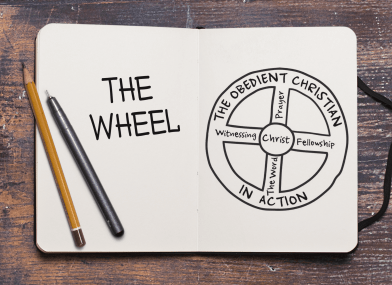 Obedience is where the rubber meets the road in the Christian life. The Wheel Illustration was a tool a friend used to help me grow in my faith. If you’re unfamiliar with it, it is a simple way to help someone solidify the basics in the Christian life, identifying two verses with six topics that are must for believers. It’s the start of the Navigators Topical Memory System. Jesus is the Center of the Wheel. Fellowship, Witnessing, The Word of God, and Prayer are the spokes. But where the rubber meets the road is OBEDIENCE. It’s not enough just to know truth about Christianity. Putting it into practice through obedience is where the Christian life takes off. This is what I found out as I grew in my faith as a young believer. I struggled to make sense of church, as many do. But when I combined what I was learning, with active doing, the lights began to come on.
Now, we don’t obey, so that we can be accepted by God. We’re accepted by God, because of Jesus’ work on the cross. We also don’t obey and work in our own power. We’re empowered by a resurrected and ascended Christ, who has sent His Spirit to be present with us as we follow him. The work of Christ and the power of Christ is promised to us when we believe and are experienced in full as we obey.
Your obedience to God puts you on the road to spiritual maturity, fruitfulness, and a growing faith in God’s power. Disobedience is a ditch, a flat tire, a dead end for spiritual growth.
What command of Christ have you neglected in your Christian life? Have you been fully obedient to everything Christ has asked you to do? If you had to describe the wheels of your Christian life, what would they be like? In need of repair? Ready to for the road?

Faith – Fellowship – Fruit
Three things God desires for each of us. Three things every disciple must pursue.
1. Faith. When Jesus was asked what work needed to be done to be acceptable to God, he answered: “This is the work of God–that you believe in the one he has sent” (John 6:29). Faith in the person and work of Jesus Christ in his incarnation, death, burial, and resurrection, saves us (Ephesians 2:8-9) and makes us right with God (Romans 4:25). Have I placed my FAITH in God’s provision of eternal life through Jesus Christ? Who have I shared my FAITH with recently? Does your faith extend to giving to God?
2. Fellowship. One of the big WHY’s of Christ’s sacrifice is that God wanted a relationship and fellowship with us. He desired the fellowship of Adam and Eve in the garden restored. He wanted the relationship broken by sin reconciled (See 2 Corinthians 5:17-21). We carry on the relationship with God through prayer and devotion (Matthew 6:6). How is my FELLOWSHIP with God? How is my life of devotion with God? Am I spending time with God in prayer? Am I spending time in His Word, the Bible? Am I experiencing the peace and joy of His presence?
3. Fruit. Our Faith in and Fellowship with the Lord will produce fruit. The fruit of Godly character (see Galatians 5:22-24) and the fruit of people reached and disciples made (Matthew 28:18-20). Every person should expect fruit. Fruit is not automatic. It does require some labor on our part (Colossians 1:28-29). Jesus asked us to pray for more laborers, assuming we are laboring ourselves. What fruit do I have to offer God? Have I noticed a change in character? Who am I discipling? Who am I praying for the opportunity to share with? “My Father is glorified by this: that you produce much fruit and prove to be my disciples” John 15:8.
Faith. Fellowship. Fruit. God desires for each of us the discover the blessings of salvation by Faith, the joy of Fellowship with Him, and the reward of producing Fruit for His glory. How are you pursuing Faith, Fellowship, and Fruit-bearing in your life today?


 Lane Corley