Coming Face to Face with Self
Luke 9:23 (ESV) “If anyone would come after me, let him deny himself and take up his cross daily and follow me.”
Here’s Following Jesus 101: Deny yourself, consider yourself as good as dead, and now you’re ready to get in line behind the One reconciling and restoring the world. It’s a call to come face to face with your own selfishness and put it to death.
The disciples didn’t get it. Just 23 verses later they are arguing about which one of them was the greatest disciple (Luke 9:46). They needed to come face to face with their selfishness.
When you are obedient to the call of God to love, to serve, to give and go, you often come face to face with self and see it for what it is. If your life revolves around pleasing self, you will avoid the call of Jesus and ignore the needs of others.
My Journey:
- I came face to face with my own selfishness as I stood in an orphanage in Zimbabwe looking at 150 orphans, many of them HIV positive, as the director of the home told me they had enough food for one more meal.
- I came face to face with my own selfishness as I stood under a tent in a remote village in Chiapas, Mexico, as a lady received life saving medication that cost less than an American dining experience.
- I came face to face with my own selfishness as I stood in an emergency room with a young man and his family as he lay dying from wounds received in an auto accident.
- I came face to face with my own selfishness when I met a couple in my area who both have had strokes and live in substandard housing.
This Saturday, August 29th, our church will follow the reconciling and restoring One into that neighborhood to put aside self and love, serve, give, and go.
If we don’t deal with self, we may never see the needs around us and be blessed to respond to His call and follow His steps. I couldn’t afford either of those mission trips. I didn’t have time to stop by that hospital. I’ve got plenty of other places that me and my family could be on Saturday, August 29. That is according to self. But what’s going to really matter? That I get all I want to please myself or that I make a difference in the lives of others?
Jesus calls us to a new outlook on life. And it gets better! He gives us a new outlook. He gives us the ability to see beyond ourselves, to hear his voice, to respond to needs as He would.
Father, give us the grace and courage to lay aside self and follow Jesus.
I’m Part of a Church Plant – Where are we now?
 Since last fall, our family has been a part of a core group/launch team for a new church in St. Tammany Parish. The question of viability is always on the mind of an entrepreneur. How do you think this is going? How’s it going so far? What are we supposed to be doing right now? are questions that can be hard to answer. One of the most helpful and practical books on Church Planting helps with this. Steve Sjogren’s Community of Kindness is the dream book for a church planter. It answers almost every question you could have in short bursts of experience laden advice. Most chapters are less than two pages, so it is great for those who may have a deficit of attention and focus, like most in the first year of a church plant.
One of the most helpful sections of the book is part four where Sjogren outlines the focus of the planter and team at each phase of the plant. Currently, myself and several plants in our region are in the 5-50 People phase, so I share I wanted to share it here in brief. Planter and plant team members take note.
5-5o People: Where are we now?
- Focus: Meet the people, Reproduce people
- Sr. Leader Role: Gatherer, Philosopher
- Burning questions: Where can I find people to talk to?
- Theme song: “Heigh ho, heigh ho, it’s off to work we go” and “It’s gonna take a lotta love”
- Greatest Assets: Infectious smiles, enthusiastic handshakes, a great love for people.
- Greatest Needs: Belief that you will succeed with faithfulness
- Growth Strategy: Gathering, Planting seeds of kindness and generosity around the city.
- What Steve wishes he would have done differently at this stage: Taken the difficult people less seriously and spent more time meeting a broad base f people in the community.
Well said.
A few random lessons from Fatherhood, Church Planting, Denominational work:
- Experience in church planting just means you understand how hard the journey is going to be.
- A five-month old puppy can tear up anything. Anything!
- There is lots of ways to sponsor a church plant, but the most successful plants happen when senior leaders bet the farm and make it a top tier priority. That’s why multi-site works. Leadership buys in and is willing to pay the bills – spiritually, physically, and financially – putting the name of the ministry on the line for the sake of the plant.
- Entrepreneurial leaders make it happen anyway, because no is not an answer when the eternal destinies of people are at stake.
- The community is very open to the involvement of the faith community when we can fit them into our schedule.
- No matter what you tell them, children insist on following your example.
- 1 & 2 Corinthians could have been written to the churches in North America yesterday.
- Hurting people, hurt people, and are more easily hurt by people.
- God is raising up a generation of young people who are ready to change the scorecard for the church from “how much, how many, how often” to community transformation and people development.
- Don’t give people large-scale influence with others based upon potential and likeability. Humility, an others orientation, and teachability are the best predictors that influence will be multiplied in positive ways.
- The way to Christ-likeness is to be consumed with serving others instead of being served.
- There’s not enough Philippians 2:3-4 or Hebrews 13:17 in most churches today.
- I have a lot of lessons to learn and I’m learning to pay attention to the people and experiences God is putting into my life.
Worth Reading: Deliberate Simplicity
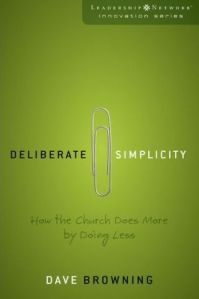 One of my new favorite books is Deliberate Simplicity by Dave Browning. I heard a podcast of Dave speaking at a Leadership Network Confab on multi-site churches last year and when I saw his name and the title I had to get it. Browning is the pastor and leader of Christ the King Community Church in Washington, which is really a network of fast multiplying churches around the globe. The Deliberately Simple Church is a refreshing approach and the book has been hard to leave on the shelf since I read it earlier this spring.
So, what is a Deliberately Simple Church? Browning says its a “boots on the ground approach to the Church’s mission” which changes the focus of church growth from big is better to more is better and makes the main thing the main thing in the Christian life. He describes the approach through this formula:
- Minimality – Keep it simple. The challenge of eliminating the unnecessary to complete the mission of the church.
- Intentionality – Keep it missional. Finding out what really matters to God and concentrating on doing it.
- Reality – Keep it real. Saying goodbye to “impression management” and hello to candor in relationships.
- Mutility – Keep it cellular. More is better than bigger.
- Velocity – Keep it moving. Developing a sense of urgency about the mission and moving from idea to implementation faster for the sake of people.
- Scalibility – Keep it expanding. Staying outward focused.
The book is a must read for anyone interested in seeing an evangelistic movement in the 21st Century West.
Here are a just a handful of my favorite quotes:
- “… the gap holding back most believers is not the gap between what they know and what they don’t know. It’s the gap between what they know and what they’re living. Many Christians are trafficking in unlived truth. They are educated beyond their obedience.”
- “The greatest sin of the church today is not any sin of commission or sin of omission but the sin of no mission.”
- “There is an important difference between asking people to come to us so we can build a church and asking us to go to them so we can change the world.”
- “Activity for God can be the greatest enemy of devotion to him.”
- “… the pastor’s role is to create and sustain an environment wherein the people of the church can carry out their ministry with minimal obstacles and maximum fulfillment.”
- “… our calling is not to build a church but to reach a community. And … trying to reach a large numbers of people in one place is a very limited idea.”
- “The world is moving so fast that there are days when the person who says it can’t be done is interrupted by the person who is doing it.”
- “For the most part we do church as if the gospel commission were given to the lost, telling them to come to our churches. The Great Commission does not say come; it says go.”
Out Being the Church
Launching a new church in North America is not easy, success rates are low, momentum can be elusive, and detractors can be found everywhere. The first church plant I was a part of, we focused on “having church,” which was in a borrowed building, without Air Conditioning, and with as many inconveniences as you could think of. In that environment God was able to open my eyes to the fact that church isn’t just something you “have,” it’s something you “are.” The congregation of God is a people, not a place. So the focus should be on being. Now I’m a part of a new launch team/core group and the cornerstone of our strategy is to “BE” the church. As we “have” church by gathering together (1) we are encouraged by the results of our “being” during the week and (2) we anticipate God using our new church in incredible ways in the coming days. So here is what many churches and plants lack: (1) encouragement because the crowd in attendance when they “have” church is small and (2) anticipation of future fruitfulness. Solution: Get out and be the church!
This week our launch team of 25 accomplished some big things through small acts of “being”:
– Monday, four volunteers taught Recovery and Life Skills at our local jail. Three hours commitment, but fulfilling the call of Christ to visit those imprisoned is a big feat.
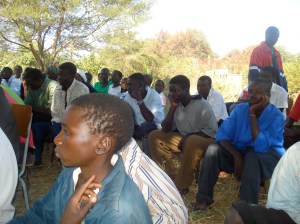 – Tuesday, received word that the launch of a new church is rural Zimbabwe that we helped to sponsor financially and with prayer was successful. As a church that doesn’t yet have weekly worship services we are already investing in church planting and evangelism around the world.
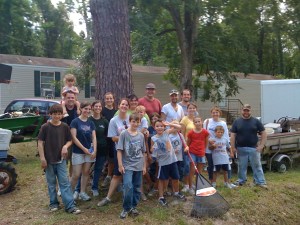
– Saturday, our launch team got together and cleaned the yard of a family in need in our area. Loving our neighbor as ourselves through simple ministry projects can bring hope to many in our communities.
Being the church is not difficult. You just have to find a need and say yes. And being the church is just plain fun. Let’s not focus on what kind of Sunday you are “having”, but on what kind of people are you “being.”
“For we are his workmanship, created in Christ Jesus for good works, which God prepared beforehand, that we should walk in them” Ephesians 2:10.
“But you are a chosen race, a royal priesthood, a holy nation, a people for his own possession, that you may proclaim the excellencies of him who called you out of darkness into his marvelous light.” 1 Peter 2:9.

North Shore Church Planting update

Sometimes I can’t believe they pay me to do what I do. Spent this weekend hanging out and worshipping with church planters from various demographic contexts.
Friday and Saturday I was privileged to conference with our Filippino-American Church Planter Network. Lito Magbanua leads our network and his passion for people to know Christ has ignited a mini-movement in our region. I learned a ton about Church Planting movements and the Filippino culture. International Director of the Philippino Missions Association was our presenter. We talked Church Planting Movements, House Churches, and the need for missionaries and missions monies in the the least reach regions. Most challenging question of the weekend: How do we reach Muslims for Christ? Answer: Increase the witnesses in the Muslim world. Problem: This would also most likely increase the martyrs in the world as well. Still more interesting is that the word for witness and the word for martyr are one in the same in the Net Testament. 73% of the Bibles printed today are printed for the 33% of the world that have much access to the gospel. .5% of mission monies actually go to reaching the 172 billion unreached peoples in the least reached regions. We’ve got a lot to do, and we as Americans have a lot to learn from Asian believers about moving the Gospel through and over obstacles.
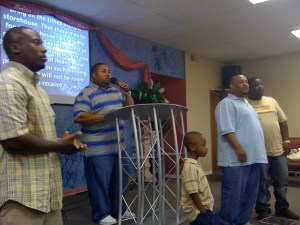 Today, our family had the honor of worshipping with and teaching at Stillwater Baptist Church in Hammond. The sign outside said, “Worship Experience, 10am” and it was not false advertising. Stillwater Baptist Church is alive. They are a four year old church that were bounced around by Hurricane Katrina and currently worships in a 2,300 square foot warehouse. Today, they celebrated the signing of a contract on a 12,000 square foot former gym. Lonnie and Frankeya Tucker have led well and are sure to bring in a great harvest for God’s kingdom. I’m looking forward to being back at Stillwater real soon.
The church that I am planting, Bridge Church of West St. Tammany met this evening for Admin. night. Matt Marrs, our worship pastor is in South Africa for a Mission Trip, so we punted on music and crunched numbers for the glory of God all night. We decided to give away 25% to Missions and try to increase it 2% each year. Glad to be a part of Church Planting efforts in Southeast Louisiana.
“In the case of false reports against yourself…”
A great lie, if unnoticed, is like a big fish out of water, it dashes and plunges and beats itself to death in a short time. To answer it is to supply it with its element, and help it to a longer life. … Your blameless life will be your best defense, and those who have seen it will not allow you to be condemned so readily as your slanderers expect. Only abstain from fighting your own battles, and in nine cases out of ten your accusers will gain nothing by their malevolence but chagrin for themselves and contempt from others. …our best course is to defend our innocence by our silence and leave our reputation with God.
– Charles Spurgeon in Lectures to My Students
Are You Humble?
If you say yes, you’re probably not. Like the church I heard of that gave a ribbon to the Most Humble Man in the congregation. They ran into a problem when he wore the ribbon back the next Sunday. Humility is something we are all developing. Recently I listened to a sermon by Mark Driscoll on this topic. He gave eight helpful questions for testing our humility. Take the test:
- Are you teachable?
- How do you respond to correction and rebuke?
- Do you repent quickly and thoroughly?
- How considerate are you of others?
- Do you give and receive service well?
- Are you constantly aware of God’s grace?
- Do you disagree agreeably?
- How much do you need attention and affirmation?
Get the entire sermon here. Those of you in leadership might want to hear the previous weeks message on Humble Pastors.
Lessons for when it seems it couldn’t get any worse
There was once a little bird that got a late start flying south for the winter. So late, that as he flew it began to snow and sleet and the temperature dropped far below freezing. His wings began to freeze to the point that he could fly no longer, so he made a crash landing. He began to realize that he would die in a pile of snow because he could not fly. Then a cow walked over to him and dropped a pile of manure on him. The little bird thought things had gone from bad to worse, but then realized that the warmth of the manure began to thaw his wings out. In jubilation he began to chirp loudly and constantly. He chirped so loudly and constantly that a nearby cat heard him and ran over, fetched him out of the manure and ate him at once.
Three lessons:
- Not everyone who drops manure on you is your enemy.
- Not everyone who pulls you out of manure is your friend.
- When you’re momentarily stuck in a pile of manure, keep your mouth closed.
Proverbs 27:6 – “Wounds from a sincere friendare better than many kisses from an enemy.”
Spurgeon on Missional Living
Stand in the stream and fish. Many preachers are utterly ignorant as to how the bulk of people are living; they are at home among books, but quite at sea among men, What would you think of a botanist who seldom saw real flowers, or an astronomer who never spent the night with the stars? Would they be worthy of the name of men of science? Neither can a minister of the gospel be anything but a mere empiric unless he mingles with men and studies character for himself. Read men as well as books, and love men rather than opinions, or you will be inanimate preachers.
– Charles Spurgeon in Lectures to My Students.