Category Archives: Ministry
Weatherization Tips for Mobile Homes
If you do ministry to Mobile Home parks, here’s a quick download that we shared with one of the largest MHP’s in our region. We actually put on a short weatherization clinc with hot chocolate, popcorn, and a follow up outdoor kids movie at Christmas. The tips were passed out along with caulk and other weatherization supplies. All in all, we spent $200 on the event.
And, interestingly enough, a Spray Foam insulation company heard about what we were doing and volunteered to insulate the trailers for a few of the neediest residents before Christmas. Great ideas usually attract great partners. It’s a Word Doc, so feel free to adapt it, or add to it. If you make it better, send it back to me please :))-.
Doc – WeatherizationTips
Partnering w/the Non-Profit World
Getting ready for a day of meetings with one of the largest networks of relationships in our community. Nope, not going to an denominational or church meeting, but to hang out with a local non-profit that I’ve been privileged to work with over the past few years. Lots of great reasons for churches to partner with non-profit organizations in our communities. In his great book, Barefoot Church, Brandon Hatmaker list several great ones:
- Nonprofits typically have a great reputation in the community. “While nonprofits are often the most well-connected organizations in the city, churches remain some of the most isolated voices in our community.” Getting involved can help open doors for greater influence and greater impact for the gospel.
- Nonprofits are experts in their field of work.
- Partnering with nonprofits offers a new posture for the church. A few years ago I attended a volunteer roundtable hosted by the Lt. Governor of our state, and as the only pastor in the room I sunk in my chair as leaders of non-profits asked why churches didn’t get more involved in the community. They saw the potential for impact for and with the church before I did. And don’t assume that these partners are against us sharing our message. Most expect it and desire faith engagement.
- Nonprofit partnership is an easily reproducible strategy. If you’re looking for opps to engage the community, the nonprofit world is a easy “plug and play” arena. We as leaders need only to assimilate opportunities to serve, communicate the process, and empower people to go.
- Nonprofits need volunteers more often than they need money. Hatmaker notes that “lack of resources is the most common excuse churches make not to serve the poor.” While they’d certainly appreciate a financial donation, a working relationship does not hinge on it. Often the greatest need is people.
- Serving with nonprofits provides a platform to serve selflessly. Serving with a nonprofit is an opportunity to shine the spotlight on something happening for the good of our community. Our culture sees churches as self-absorbed (I asked one non-profit leader how a church could help him and he said honestly and without malice based on his experience personally and professionally, “I didn’t know churches helped people”).
Hatmaker also lists six steps to effective partnerships:
- Start with a common redemptive purpose. There are definitely nonprofits that are doing much of what God’s word calls us to do in relation to justice and bringing hope. Start there.
- Prioritize developing relationships. There will be worldview issues that collide when engaging outside the church. And we’ll have a better platform for engaging these as we build nonagenda-oriented relationships with community leaders.
- Trust their leadership. If you can’t trust their leadership, then move on to a different non-profit. But I’ve found nonprofit leaders from Fire Depts to Food Banks to be hard working, trustworthy, and eager to have the church as a partner.
- Lose your agenda. We’re coming to serve them in a common redemptive purpose. Focus on serving them.
- Give away the credit. “If you are willing to partner with local nonprofits who have spent years building credibility in different areas of service, take a backseat, and don’t seek a name through this.”
- Commit to be available. The best way to build credibility with community leaders is through availability and follow through.
Check your local government website. They should have a list of nonprofits in the area. If you’re in St. Tammany it’s here. You can also sign up to receive a monthly update to this list with specific opportunities called The Loop.
Check out this church in Austin, TX that assimilates opps to serve through nonprofits in their city. Here is their Christmas list.
What nonprofit are you working with? Have you learned any lessons in this regard?
Another topic for another day is starting a nonprofit alongside the ministry of the church.
Pick up Barefoot Church: Serving the Least in a Consumer Culture by Brandon Hatmaker for more great ideas and inspiration for incarnational ministry.
Serving on Sunday, part two
A trend in church life is congregations taking a Sunday and scattering throughout the community to serve. Most are doing it once a year. A few, like the church I’m part of, are doing it once per quarter. I’ve heard of at least one church doing it once a month. This week I saw an article about Rick Warren’s southern California mega-church Saddleback, taking a weekend called Good Neighbor day. I don’t think this is for every congregation and I don’t know that the congregation I lead will do it forever, but I think that a Faith in Action Sunday can be a powerful tool of cultivation in church and community.
A few weeks back I mentioned three reasons why to do it from the book Barefoot Church: Serving the Least in A Consumer Culture by Brandon Hatmaker. Here is a bit of the reasoning and strategy behind Bridge Church’s quarterly FIA Sunday’s.
- The end goal of faith-filled disciples and missionaries. The Great Commission’s call is to make disciples. As a second journey church planter I begin to ask myself and others: “If I really wanted to make a disciple what would I do?” and “What was the greatest tool for spiritual growth in your life?” The answer was most often, ” Relationships and serving.” I was often disappointed when people didn’t recall my beautifully illiterated sermon as causing a spiritual growth spirt, but pointed to relationships with other Christians and ministry/mission opportunities as the greatest catalyst for growth. So, we begin to pray about how we could structure for relationships and mission, which led us to the idea of taking four Sunday’s a year for Faith in Action. Let me say: this is not a church growth gimic and definitely NOT a good strategy for church growth. If you’re goal is more attenders, DON’T do it, but the goal of producing faith-filled disciples who see themselves as missionaries caused us to rethink strategy and structure for serving a bit radically and non-traditionally.
- The other 60%. Alan Hirsch and Dave Ferguson write in their book On the Verge, that around 60% of the population is outside of the church’s reach. That the majority of churches are fishing out of the same pond which includes about 40% of the population. I’ve found this to be a trend in the area where I live and serve. A segment of our population is not attracted by or will most likely not be influenced by our current forms of church. What can we do to reach these people? One answer: Go to them. And as one part of an incarnational strategy of engagement in the hardest to reach areas, we seek to take church to them four Sunday’s per year. Somebody once said that to reach people nobody is reaching you need to do things nobody is doing. In our community we have some amazing churches offering professional worship music, incredible preaching by some unbelievable communicators and men of God, and a full service ministry menu for every day of the week. So we’ve got that covered. Our niche is to be the ground troops moving into difficult areas, bringing the gospel and making disciples/missionaries as we go. Faith in action Sunday serves as a great tool in this regard.
I’ve written about some reason NOT to do this here. In the next two posts on this subject, I’ll take on some of the frequently asked questions and criticisms for Serving on Sunday, like:
- It subverts the importance of preaching the Word of God.
- It hurts church growth by making things awkward and uncomfortable for newcomers, visitors, and the disconnected.
- “We can’t go a Sunday w/o taking an offering.”
- It promotes a liberal agenda of social action.
- “I can’t imagine how we would find enough for everyone to do around our community.”
- Some good ones offered here by Kevin DeYoung.
Then lay out a plan for putting together a Faith in Action Weekend, whether it’s on Sunday or not.
What Makes A Successful Church? A few links:
Spent part of this week crunching numbers getting ready for the Northshore Baptist Association’s staff mini-retreat next weekend. Every year I do this, it gets me thinking about what we measure. Are we measuring the right things? Are the metrics we use causing us to fire at the wrong targets? How would Jesus measure success in ministry? What do you think?
Came across a few interesting articles in this regard as well this week. Thought I’d share:
- Input results in the church world focus on the number of people and dollars that “come into” the church. Common ways we talk about input results include the “ABC’s” (attendance, buildings and cash) or “nickels and noses” or “butts and bucks”
- Output results refer to actual life-change outcomes that God intends for followers of Christ individually and together.
- Impact results capture the broader effect of the church in the surrounding city or community.
Corporate Church vs. Movemental Church by Mike Breen. This one really made me think!
- Efficiency has replaced effectiveness. Many churches are organizationally efficient, but we aren’t affecting the lives of people the way in which Jesus imagined a family would do.
- while churches may claim to have “leadership development programs,” what they really have are “volunteer pipelines” that are run by managers, not leaders.
- What we need is a way of making and moving people so that as we make disciples, we release them into their destiny of pushing into new Kingdom-frontier.
- Financially self-sustaining within two-years. (Urban Plants may be longer)
- Self-governing after two-years.
- Multiplication minded. (Involved in planting other churches from day one.)
- Giving 10%, from day one, towards missions (Out of weekly offerings).
- Growth which comes primarily through conversion.
- At least 45% of attenders actively volunteering in the church.
- Engaged in transforming the community. (Not just individuals)
- Growing numerically.
- Developing new leaders for ministry.
- Members are continually and actively inviting their neighbors to church and sharing their faith journey with those around them.
- At least 80% involved in small groups by year-two.
- Actively involved in foreign missions work.
- Mega-churches are cooler, hipper, usually more exciting than other area churches, therefore they are natural gathering points for already-converted people who are looking for “something more” – namely more program options, better worship, more services with fewer demands…
- My bottom line: I’d rather plant a network of 15 churches of 500 that are maximizing their potential for outreach than to have one church of 7,500 that is fun to lead, fun to be a part of, that strokes my ego…
Church Planting Numbers that Matter by Steve Pike. Great equations and guide for the “big launch” model of church planting.
How to Shrink Your Church – Some good thoughts on how dying is gain in church life. Are we pursuing the Hallmark moment and whatever works to grow?
- while a generation of church leaders acquiesces to the demands of our consumer culture. The demands are simple: tell me something that will make me feel better (sentimentality for the churchgoer), and tell me something that will work (pragmatism for the church leader). Yet it is not clear how either one of those are part of what it means to be the church.
- you can grow a church without God if you have good preaching, great music, killer children’s ministry, and an engaging youth minister. In the pragmatic church, there is only one question that matters, “What will work to grow my church?”
- Convincing the church she does not exist for the benefit of her members, but for the life of the world is a bad church growth strategy. It’s also exactly what the church must do. It’s a tough sell because crucifixion seems like a losing strategy unless you believe in the resurrection.
What would you consider success for a church?
Serving on Sunday, part one
A growing trend in church life is congregations taking a Sunday and scattering throughout the community to serve. Most are doing it once a year. Some, like the church I’m part of, are doing it once a quarter. I even heard of one recently doing this once a month! Outreach.com even created some products for this segment of congregations. Seems Pastors and church leaders either hate this idea or love it. Some reasons I’ve heard and can think of against this:
- It subverts the importance of preaching the Word of God.
- It hurts church growth by making things awkward and uncomfortable for newcomers, visitors, and the disconnected.
- “We can’t go a Sunday w/o taking an offering.”
- It promotes a liberal agenda of social action.
- “I can’t imagine how we would find enough for everyone to do around our community.”
Brandon Hatmaker in his great book Barefoot Church: Serving the Least in a Consumer Culture talks about his church’s experience with this practice. Austin New Church does a “Serving Austin Sunday” every time there is five Sunday’s in a month. He gives three reasons why:
- It creates a service minded DNA. It’s an opportunity to communicate serving is a priority to the church.
- It changes the posture to the community. The community sees the church’s deed matching the creed.
- The opportunity to invite others. Hatmaker says it’s the most highly attended Sunday for non-believers, skeptics, the unchurched, and the dechurched. “I’m constantly amazed at who might show up at a service project.”
Other reasons for and against? Leave in the comments. I’ll share some of my thoughts for and against after two years and eight Faith in Action Sunday’s a little later.
Brandon’s book is well worth reading! Also check out his blog.
A Few Basics for Longevity in Ministry
At our monthly Pastor’s Gathering in Tangipahoa recently, 89 year old A.L. Palmer shared a great and challenging message about the Gospel being for every man and our responsibility to carry the Gospel to every man. After the message he was asked how he stayed so sharp mentally and physically through 60+ years of ministry. His responses were simple:
- Constant Review – Memory will lapse, truths must be reviewed over and over again.
- Physical Exercise – noticing that people who had physical fitness routines were sharper than those that didn’t, at 55 yeas of age he became a jogger, lost 25 pounds, and ran 3 miles a day for 12+ years.
- On dealing with Problems in the church – Don’t let troubles build up, get at’em early, find out what the facts are. Don’t be afraid to challenge problem people.
Great to listen to those leading the way into Gospel ministry longevity. Grateful for men like Dr. Palmer.
Here him in his own words. You’ll be blessed:
Are you a Church Curmudgeon?
A curmudgeon is basically a grumpy old man. But the spirit of a curmudgeon can come out of any of us whatever our age or gender. The attitude is not very helpful in church and is actually spoken against in scripture (Philippians 2:14). The Church Curmudgeon is actually on Twitter and if you’re there you should follow him for a good laugh and for a good look at how generations are colliding in 21st century church life. Here’s a few of my favorite Tweets by the Curmudgeon. I promise you I’ve heard a few of these as a Pastor and now around the Director of Missions office.
- Counted many blessings, named them one by one. Listing all my grievances is much more fun.
- Pastor says his sermons are relevant, but they never help me find where I put my glasses.
- The worship leader looks depressed. Maybe I ought to write him a note to tell him how to do his job better.
- Thou shalt not repeat that chorus one more time, for we get it already.
#10Curmudgements - Thou shalt not steal, and that includeth my spot on my pew.
#10Curmudgements - In the war on obesity, I’m fighting for the side that has the gravy.
- I rarely feel so fulfilled as when I get to call the cops on the neighbor kids. What a night!
- Church work day. I just come to see if the pastor knows which end of the hammer to hold.
- I shudder to think about what I would have become if I had grown up with padded pews.
- Ushers seated a new family in my spot; had to sit 36″ closer to drummer. Great is the hour of my trial.
- Better is a dry morsel with quiet than a house full of feasting with strife. But better still is Cracker Barrel, period.
- Every couple of weeks, I wish Truett Cathy had been an Adventist.
- Don’t know what a “felt need” is, but I’m pretty sure if you tried to minister to it, I’d knock you down.
- Pastor wants us all in “small groups”. Been in one since ’54. It’s called “Me, Elmer, and Jake”. Don’t mess with it.
- Put me in as a greeter. I’ll keep your service to a manageable size.
- Pastor has his library on his iPad. That way, we can’t tell if he’s doing sermon prep or Angry Birds.
- Understand: If you call me “dude”, I will raise cane. And lower cane on your bumptious head. It’s “sir.”
- The bulletin’s got more junk in it than Tuesday at the mailbox.
- The Children’s Ministry budget is outrageous! How much do flannel-graphs cost these days?
- I don’t mind standing on the promises, but I can’t stand for a half hour while we sing about ’em.
- Youth pastor asked me if I even had a right side of the bed to wake up on. Punk.
- Every once in a while I raise my hand to rededicate. Helps the pastor’s totals and it don’t cost nothing.
- I was a greeter today. Got to stay in the foyer during the sermon to glare at the latecomers.
- Pastor, if you must be on the HD screen, trim the nose hairs. Thanks.
- People were holier when the pews weren’t padded.
- The worship leader was on fire yesterday. Hair gel and candles don’t mix.
- Yes pastor, do teach us about stewardship while you sip on your $5 coffee. We’re all ears.
- The anonymous prayer request cards are very helpful for making veiled criticisms of the worship service. Thanks, pastor.
- Worship leader: If you’re trying to please us, “Shine, Jesus, Shine” does not count as an old hymn.
- God takes care of the Presbyterians, Jesus takes care of the Baptists, the Holy Spirit gets the Pentecostals, is how it was explained to me.
- Pastor, thanks for keeping your sermons short. Any longer than 30 minutes, and it’s hard for me to wake up.
- The way I see it, things started to go south when they put in the heated baptistry.
- Our worship leader spends so much on hair gel that he has to wear old jeans with holes in them. Sad.
- Listened to a sermon on life’s hardships from a man who has to pay a gym to make him break a sweat. Mercy.
- Hey Pastor, I like your missional tattoo. I got mine on a mission to kill Nazis.
- Installed a shot clock in the back of the sanctuary. Pastor has to maintain our interest every 45 seconds.
- There’s a reason that the Lord doesn’t want Baptists to dance. Have you seen a Baptist dance? Right.
- Personally, I’m a cessationist. That is, I believe that church signs should cease.
Incarnational Living: “Am I just attending church, or am I BEING the church?”
Great question from a friend of ours at Bridge Church, reflecting upon her families journey into incarnational living in suburban St. Tammany Parish. Evan and Angie McGinty have partnered with two other couples (Jeremy and Elizabeth Butler and Josh and Jenna Norris) to throw a monthly block party in their neighborhood designed to be an intentional effort to get to know people, build community, and have fun.
Check out the entire story here at Angie & Evan’s blog.
And ask yourself, how am I BEING the church in my neighborhood, workplace, community, etc.?
Here’s Angie’s challenge:
Are we taking on the flesh of Christ daily, even when it is inconvenient with our time schedule. Are we missing opportunities that could be used to show other’s love? Jesus didn’t always wait for people to come to him, He went to them… He loved on and hung out with the people that no one else would.
The real challenge comes when you are just “on the way” of life. Will I make it a point to go out of my way for others in the little opportunities that come along, or will I let them pass me by? I continue to be challenged in this, but on those occasions when I do rise up to meet that challenge…wow….what a difference it makes!
Here are a few tangible and easy ways to show others love:
- Bring baked goods to a neighbor for no reason or to police and fire departments to say thank you.
- visit an old folks home (most of those people don’t get visitors)
- pay for someone else’s: coffee, meal, etc and do it anonymously (like the car behind you or the table across the room)
- cook a meal for someone who could use a break or help
- use your talents: our church has built lots of wheelchair ramps for elderly people who can’t afford it.
- babysit for someone free of charge and offer to do it
- leave an AMAZING over the top tip for your server
- write a kind note to someone
Those are just a few ideas…there are soooo many opportunities to give of ourselves EVERY day, it’s just a matter of DOING IT!
Thanks to Evan and Angie for showing us the way into incarnational living!
What are other ideas and ways to BE the Church in our communities?
Story-Tellers Needed
- Researchers believe that 70% or more of the people in North America prefer non-literate means of communication.
- Over the past twenty years, 20 million people have completely stopped reading.
- Only 14% of Americans still read extensively.
- 80% of American families did not buy a book last year, and the average reader only makes it to page 18.
- Over 50% of people over the age 16 are functionally illiterate.
- 58% of US adult population never reads another book after high school.
- 42% of college graduates never read another book. (I actually had a doctor recently tell me that he had never read a book all the way through!).
- Each day, people in the US spend four hours watching TV, three hours listening to the radio, and 14 minutes reading magazines.
- It’s estimated that we spend as much as 80% of our non-working, non-sleeping time in front of a screen – TV or PC. [1]
As I come across more and more folks who are post-literate, I’m challenged to think about my communication of the Gospel. 75% of the Bible is story, and by making it primarily propositional truth do we take it out of the comfort zone of learning for many of our hearers and especially for those who are unchurched and not accustomed to listening to preaching. What about you? What is your preferred method of learning? Outline? Story? What do you remember most from the last sermons that you have heard? Leave your comments below.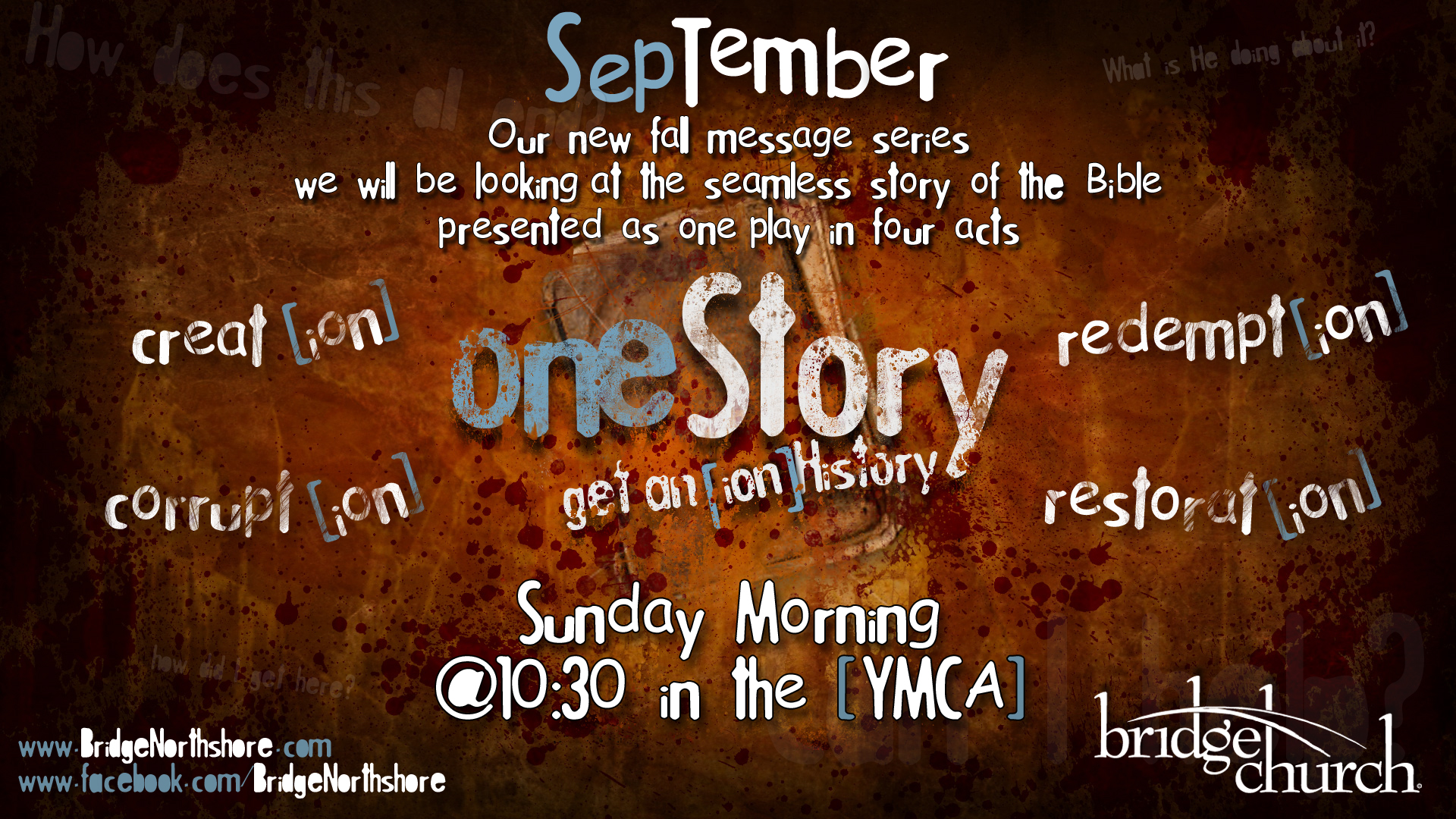
Trying my hand at more story-telling this Fall with our new Message series called One Story. Enjoying it so far and seeing the impact already.
Check out a few resources on this if your interested:
- Truth That Sticks: How to Communicate Velcro Truth in a Teflon World by Avery T. Willis, Jr. and Mark Snowden
- Story Thru the Bible: An Interactive Way to Connect with God’s Word from Walk Thru the Bible
- Story of God Training by Soma Communities Church in Tacoma Washington.
- Making Disciples of Oral Learners from the Lausanne Committee for World Evangelization
Faith in Action Sunday!
Four times per year Bridge Church takes a Sunday and instead of gathering, we scatter for worship by serving and giving ourselves away in our community in a variety of ways. Here’s a quick list of our scheduled projects and a few before pics:
- Disabled single mom had a kitchen fire in 2007. She’s washed dishes in her bathtub since then. This summer,Homeworks teams re-roofed and painted the house. Sunday she’ll get new cabinets and sink. We’ll also cut the grass, clean up the yard, and serve her any other way we can.
- Habitat House in Abita Springs – Habitat loved our Faith in Action Sunday idea so much, they asked if we could be on their project list. They have several homes at different points of completion.
- Several projects at a local Mobile Home Park including hand rails for a recent stroke victim and two elderly widows, new door locks for a single mom who can’t lock her house and cleaning the place up in a Tipping Point kind of way.
- A new porch and steps for a family with special needs child in Hammond.
- Hadden Hall, Jahnke St., Covington – Council On Aging Senior Center in need of repair, pressure washing, andpainting.
- Food Baskets – @ the YMCA, Ladies will prepare baskets with food, Bibles, etc. to be delivered to elderly residents at Oak Villa MHP & other places.
- Potted Plants – @ the YMCA, kids will prepare plants to be delivered to elderly residents at Oak Villa MHP &other places.
- Bake Goods to Public Servants – Families can deliver baked goods to area fire depts and police depts. Great way to say thanks & get to climb on a fire truck :).
- ICU Waiting Room visits – we’ll have gift cards to deliver to area ICU waiting rooms. Cafeteria’s are closed on weekends, so this meets a basic need and communicates to those in crisis that they are not alone.
- Block Party @ Dave’s Trailer Park – as we work on the porch in Hammond, we’ll bring light to the West Hammond community with inflatables, snow cones, hamburger, hotdogs, and an old old story.
- Block Party for Visitation at a local work release center to connect with families of inmates that we minister to on a weekly basis.
Wondering Why? Click here. Or show up at 9am with a willingness to serve. It’s more than singing and sitting that shapes a disciple of Christ. God wants to use us as well. Through Faith in Action Sunday, everybody can serve, we can see our community in a different way, we shine light on hundreds of people who are not in church on Sunday morning. Looking forward to serving with my family on mission tomorrow!


 Lane Corley