Category Archives: Ministry
Utilizing Social Media for Ministry
 The Gospel of Jesus Christ is big news. It’s a message to be declared, proclaimed, announced, and distributed to as many people as we can as often as we can. God’s work among His people is also news and a story that needs to be told. The tools that churches have relied upon to announce their message and distribute their stories are the pulpit, newsletters, letters and post cards, phone trees, scrolling power point announcements, and email. As a Pastor, my church utilized each of these tools and still I heard regularly from people in my church – “I didn’t know anything about that.” Communication is definitely one of our biggest challenges. Also challenging is the fact that a generation is here that is abandoning paper and phone lines for wireless messaging and social networking. It’s time for the church to take communication to another level and engage the world in the fastest growing means of messaging that we have today and utilize the world of Social Media.
Why?
So you’re not a computer geek, you don’t enjoy video games, you hate hype and fads. These are some of the reasons given for not engaging in the popular social networking domains. Here are four reasons why you should put all excuses away and just do it:
1. It’s where the people are. In February, Facebook announced that it now has close to 1 billion users and with 669 million logging in every day! Twitter boasts 550 million users and growing at a rate of 135,000 per day. Currently there are 58 million tweets everyday, about 9,000 tweets per second. These interfaces are growing and people are using them more and more each day. If we’ve got a message that we want to get out to as many people as possible, it seems that we’d want to get it where the people are and social media seems to be that place.
2. Message saturation is possible. A few years ago I asked a group of Church Secretaries and Administrative Assistants if the teenagers in their church are reading the church’s publications. 100% expressed uncertainty. We recognize that a hard copy newsletter does not reach all of our audience. Utilizing social media will allow you to get the exact same information to them in a way that does attract their attention. It is possible to saturate your message throughout the different age-grades and audiences in your church today like never before.
3. It’s Free. The most compelling reason for utilizing the fastest growing communication tools today is the cost. It’s completely free! At every level of social networking, free is an option that gets you out to where millions of people are interacting every second of everyday.
4. You Might Have Fun. Why has Facebook grown so fast? It’s enjoyable. People like having info at their fingertips in real time. They like talking about themselves and connecting with people. They will enjoy connecting with your church and discovering what it’s all about as well. And it’s ok to have fun while we proclaim His message and tell our story.
This report was originally presented at the Total Church Life Conference in Baton Rouge on August 24th. Download the PDF version here: Utilizing Social Networking for Ministry – Aug 2013.
Why is Local Outreach So Hard? 20 Reasons:
 As church attendance declines, we must look at our communities as a mission field. Why don’t we? Here’s some reasons, assumptions, & excuses I’ve heard, said, felt as a church leader:
- As churches, we have turned inward & focused on campus.
- As churches, we have “hired it done” by church staff instead of equipping people for the work of local outreach.
- Witnessing means inviting people like me to my church.
- The compelling call to “Go” (Matthew 28:19-20) begins at the borders of our own country.
- Assumption: “Everybody has a church already.”
- Assumption: “They know where we are if they need us.”
- Assumption: “The needy around here get plenty of help from the government.”
- Assumption: “We don’t have enough money.”
- Assumption: “The city won’t let us share the gospel.”
- As church leaders, we feel tension between “Go. It’s about the people out there” & “Come. What’s going on in here is vital.”
- It takes a lot of energy to maintain the on campus ministry.
- If we challenge people to reach out & serve in non-traditional ways they may go to another church.
- Local outreach = Advertising.
- Excuse: “Our area has some dangerous neighborhoods.”
- Excuse: “We will one day.”
- Excuse: “We tried that already.”
- Excuse: “We might get taken advantage of.”
- Excuse: “My people are not ready.”
- Sinful unspoken assumption: “We don’t really want ‘those people’ coming to our church.”
- Sinful unspoken assumption: “It won’t help our bottom line.”
What other reasons, excuses, assumptions could you add to this list? How does your church reach out to your local community?
Commitment, Honor, and Transfer Growth
Transfer Growth is the term church leaders use when members swap churches. It’s not the preferred method of church growth but is accepted as part of ministry in our “church of your choice” culture. This topic makes for a lot of hallway conversation at Pastor’s conferences & is brought up as issues of concern for pastors regarding church planting & revitalization efforts. I’ve written about the Transfer Growth Boogie Monster & its implications for church multiplication. There ARE good reasons for Christians to transfer, i.e. moving to a new community, being led by the Spirit to connect with another church’s mission, or being sent out by a church to start something new. And bad reasons: “I’m not getting fed”, difficulty in relationships, “they’re too judgemental” – i.e. the church confronted my sin, wanting to disconnect from responsibility to serve. Here are some of the issues that transfer growth creates and has created for the church:
- Designing ministries for Christians. As church leaders, it’s easy to strategize & plan either out of fear that people might leave for another church, or in hopes that Christians will notice our church & jump on. So, instead of equipping/releasing people for the work of the ministry (Ephesians 4:11-12) & focusing on the needs of the unchurched culture, we slowly begin trying to hold onto or attract people by giving them what we think they want.
- Low Commitment, Disposable Relationships. Our low-commitment culture has crept into the church & produced shallow relationships that are disposable after one difficult conversation or awkward moment. We grow spiritually & relationally through such conversations & moments. Without them, shallow, superficial, non-confessional faith could result. Seen this in church lately? How can we teach that commitment to Christ & a community of followers, not a cooler church with more going on is the pathway to spiritual growth?
- Greener grass thinking. Today, we have people who have transferred two to three times and found the same issues at every place and have given up completely on church. What if leaders could have used it as an opportunity to teach about commitment, that relationships are tough & messy everywhere & that God wants to use these issues to shape & form us? Grass gets green because you water & fertilize it. In church that means committing to Christ, obeying his word, & doing it with others – consistently.
- The appearance of success. Churches growing by transfer growth appear successful & can be the envy of ministry circles, but the real measure is the influence on the community. Only allowing the gospel to infuse the cultural context & change indigenous unreached people will result in a transformed city. What difference does it make if our church grows, but the community around us remains the same?
How can we fulfill the Great Commission, teach people to honor commitments, be a unified church in our communities, and make room for those swapping churches? A few ideas from a sojourner:
- Develop a vision for expanding the kingdom, not growing one church. When your church grows by transfer growth it may be at the expense of another church. If that church is small, big holes may be left to fill. How does that help the kingdom? Can I help that Pastor? Should I hold these people accountable to fulfill the commitment they made at the church? I heard Bob Roberts say years ago, “What’s good for my church numerically is not always best for the kingdom, but what’s best for the kingdom is always best for my church.” I think that applies well to transfer growth.
- Get to know other pastors in the area. When people know that you’re not in competition with Pastor ____ & that you actually like him, want to see him succeed, & intend to honor him at every turn (Romans 12:10), you will help them get a vision for the kingdom & release any ill will they may have. Especially those who are coming with an axe to grind. I learned pretty quick in ministry that when someone comes to my church with an axe in the back of a pastor down the street, it won’t take long for that axe to be in my back. If you ARE in competition with Pastor ____, REPENT, & get a kingdom mindset, then invite an area pastor or two to lunch or join or start a network of ministry leaders working for the good of the region.
- Assuming you have an intentional process for developing members – When people are transferring ask, “Have you talked with your current pastor about this?” If we believe that church membership is a spiritual decision, then God will confirm it. Encourage them to talk with their current pastor about how God is leading them. This is another way to honor our brothers in arms pastoring other congregations in our area. It also communicates that this is a serious decision & that you’re more interested in spiritual growth than gaining another satisfied consumer of your particular religious goods & services.
- Assuming you have an intentional process for developing members – When people are transferring ask, “Have you made any pledges or commitments that you need to honor or be released from at your current church?” If we believe that church membership is a spiritual decision, and if we believe what scripture says about commitment (Proverbs 20:25; Ecclesiastes 5:4-6), this is a great question to ask of transfers. Especially if churches in your area are in the middle of building or capital campaigns. Pastors, we have little right to complain about lack of commitment in our congregants, if we welcomed them in at the expense of their commitments to another congregation.
- “…do the work of the evangelist…” 2 Timothy 4:5. The evangelist is concerned about growing the flock from those outside of it. And that’s what we must do to turn the tide of decline in Western Christianity. In their book On the Verge, Dave Ferguson & Alan Hirsch, outline the strategic problem facing the church in North America. “The majority of churches in the US are using a model of church designed to reach 40% of the population. This leaves around 60% outside the reach of the church.” Simply put, we’re all fishing in the same pond. We need churches that design ministries for the 60%. Churches that will step out of the church of your choice circle of influence & send people to the hard places, to have hard conversations with people who have little inclination to be impressed by our music, programs, building design, or clever sermon outlines. Churches that won’t be as concerned about size as they are about reach into the unchurched community. Churches that see the opportunity to take mission trips into their communities just as they do to foreign countries. Churches that will ask “Where is the church not?” & go there until the gospel message has been heard by all.
Not all transfer growth is bad or bad for the kingdom. But my desire is for commitment, honor, evangelism, kingdom growth, and community transformation to take precedence over a bigger crowd at my church next Sunday.
What are other issues created by Transfer Growth? What do you do as a ministry leader to disciple transfers? Does this matter at all?

Creating Sending Capacity: Make Room for the Apostles (with a little “a”)
 If I came to your church next Sunday, I’m sure I would be impressed. The music, the preaching, the smiling faces, the facilities would inspire and refresh. However, because of the way I’m wired, I would not be content. There’s a whisper I hear anytime I’m on the inside of Christendom that says, “This is great, but what about all the people out there.” I may even lose track of the sermon for a minute thinking about the trailer park I passed on the way or all the people gassing up their boats at the marina or the story of the broken home I’d heard the week before. As a member of a church, if I voiced these whispers, I might be seen as off the reservation. A trouble maker who needs to get with the program. Or a contrarian that can’t be pleased, always pointing out what we’re not doing, instead of what we are doing. Now, some people are just off the reservation, trouble makers, and contrarians who need to be corrected. But what if God gives these whispers to a segment of every church so that the church could have some outward energy? What if we as leaders heard these whispers and considered them God’s leading and potential open doors for our church? What if God has given you all the tools you need for expansion of the kingdom in the form of that person always pointing out where ministry is not happening in the community? I believe He has done all of this and more through the different gifting in every church.
Ephesians 4:11-12 says,
“And HE GAVE some to be apostles, some prophets, some evangelists, some pastors and teachers, for the training of the saints in the work of ministry, to build up the body of Christ…”
The person I’m talking about is the first in the list, the little “a” apostles. They are God’s gift to our church to stretch our thinking outside the walls.
If we’re describing the church as a flock, here’s how I think each of these descriptors would play out: the apostles are always looking for new territory, the prophets are warning of danger, the evangelists are passionate about adding more to the flock, the pastors or shepherds are concerned about taking care of the sheep we have, and the teachers are given to guide the flock in truth.
Today’s church seems to have grown heavy on the last two, shepherds to take care of what we have and teachers to teach us what we don’t know. And the other three are relegated to itinerant ministries at best, taught to set down and shut up at worst.
Are we missing valuable pieces to what God wants our church to be? How do we recognize and empower little “a” apostles for the building up of our body?
Here’s a few things I’ve learned about the work of the little “a” Apostle:
- He/she feels the needs of the community, the way others feel the needs of the church. They experience the drive to church differently. They see the world differently. Their perspective will open the eyes of others to ministry opportunities.
- He/she wants the church to grow wider, more expansive in influence. They are interested in reproducible processes & fast moving systems. Don’t put them on the long range planning committee. The urgency of expansion to new fields is the greatest need.
- He/she does not want your money. Most pastors hear an idea from these people & see big dollar signs,. But money is most likely not in the apostles mind when they’re sharing ideas. However, if you give them a little money, they will do more with it than you can imagine. Like the apostolic leader in Africa that our church pledged $100 a month to, hoping they would get some chairs & a roof on their building. Six months later, they’re still sitting on the floor with no roof, but a church planting movement is happening in an unreached area 10 hours away.
- Just like in Acts, the little “a” apostle naturally builds relational networks that make kingdom expansion possible. Tap into it, by asking them if they know anyone in that neighborhood or area you’d like to reach or the apartment complex or the city government. If they don’t, you’ve said enough. Step aside & watch them work their relational networking powers for the good of your church in no time.
- He/she doesn’t want the credit, just the experience. Shepherd/Teachers will think this leader is looking for glory or influence. They’re not. The African leader in the above story, called me a year later to say, “Come & see what YOU HAVE done in Africa!” I didn’t even write the check, but he was more than willing to give the credit away.
- 1-3% of your congregation thinks outside first. They don’t say it out loud, because they don’t want to seem contrarian, but their heart is to see the church out there: at the trailer park, the local bar, the gym, the coffee shop. They are God’s gift to expand the tent of the church.
- Many of these folks have heard no so many times from church’s that they are serving alone. They would love to serve their church, but they cannot say no to the needs of the community. I’ve met them at local jails where they’re leading discipleship groups, serving on community boards, starting new things to make life better for underprivileged neighborhoods. You asked them if they’re doing this through their church, & they’ll say no with a frown.
How can I as a church leader recognize and empower the little “a” Apostle:
- Listen to their ideas just like you’d listen to the health related prayer requests of a senior adult member. They are just as serious to this person.
- Say yes. “Could we start a Monday night service for restaurant workers?” “Could we start a small group at the Tattoo Parlor called Labeled?” “Could we adopt nursing home residents with no local family?” “Could we start a food pantry at the local trailer park?” Find a way to say yes with limits to the risky, off the wall ideas every now and then & see what happens. Consider it the Research & Development arm of your church.
- Give them outside of the building research & ministry projects. “We’re thinking of starting a new campus in ____. Could you find out the potential in the area?” “I’ve heard there are a lot of Asians in _____ neighborhood. Could you verify that for me?” “The coffee shop owner is asking about us doing a Bible Study at their location on Sunday morning. Could you pray about leading that?”
- Don’t let them kill themselves. The danger for the little “a” apostle, is that they see every good opportunity as possible. Help them set boundaries.
What are other strengths of the church that can be found in the apostolic gifts? What ways have you seen this gift set utilized to grow the kingdom?
For more info on the little “a” apostle:
- The Permanent Revolution: Apostolic Imagination and Practice for the 21st Century by Alan Hirsch.
- Creating a Missional Culture: Equipping the Church for the Sake of the World by JR Woodward.
- Five Fold Ministry Test – Spiritual Gifts tests based upon Ephesians 4:11-12
- Church Zero: Raising 1st Century Church Out of the Ashes of the 21st Century by Peyton Jones
Tools for Revitalization: Church Systems Analysis
I like this line of thinking. Just like the human body stays healthy because of healthy systems – respiratory, nervous, digestive, skeletal, etc., a church needs healthy systems to stay healthy. Here’s an Assessment tool we’ve developed to help a church leadership team assess its systems. Get Nelson Searcy’s book on systems here. 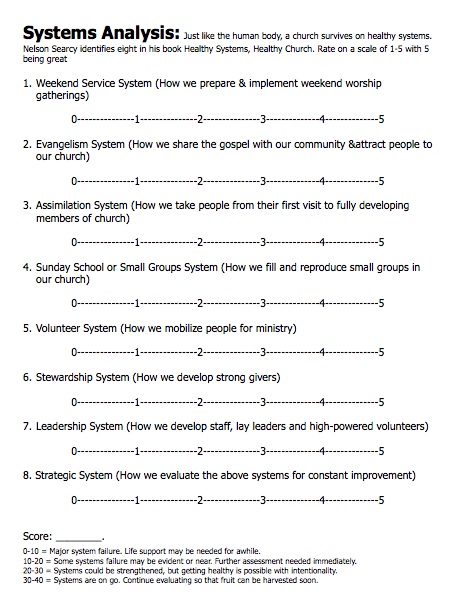
ChurchSystemsAnalysis – PDF Download
“caring for orphans AND widows in their distress”
Much attention is being given to the orphan crisis in the world and rightfully so, with 147 million orphans worldwide. I’m excited that our family is participating in several fundraising projects for orphan causes currently. But let’s not neglect the second part of the admonition in James 1:27, “Pure and genuine religion in the sight of God the Father means caring for orphans AND WIDOWS in their distress” (NLT).
In my community we recently found out about a widow that has been without refrigeration or hot water for 7 months. There are widows whose yards are overgrown because they can’t afford lawn care and have no nearby family. Our church is helping a widow who’s still displaced from her home due to hurricane damage with no flood insurance or government help to make repairs. And it’s a global crisis, just like with orphans. A church in Zimbabwe that we’ve partnered with hosts a regular widows meetings with over 400 in attendance that lack the ability to care for themselves. The stories of grief, loss, and suffering from these meetings are shocking and heartbreaking.

Before & after a ramp was installed for an elderly widow in my community.

Over 400 widow gather for prayer in Mbare, Zimbabwe.
God’s heart in James 1:27 is that we take care of those who can’t take care of themselves. In every community there are opportunities. Here’s some ways to get started:
- Open your eyes to those around you that may be home bound, unable to care for themselves, or whose properties are showing signs of neglect. Don’t do like some in my community, who recently called the Parish reporting code violations at area shut ins homes, leading them to extra unneeded stress as they faced fines until getting it cleaned up.
- Ask your church secretary for a list of homebound, shut-ins, widows & challenge your small group or Sunday School class to get involved in some way.
- Contact the local Council on Aging and ask about needs of widows and disadvantaged elderly. Partnership with our local COA has opened doors for different kinds of light construction projects for the men in our churches, connecting the elderly with community resources they did not know existed, and they have assisted with purchases of needed appliances for widows like the one mentioned above.
- Go by the local nursing home and ask if there are any residents with no family locally. Their walls will be bare and simple things to help them maintain physical and emotional health are not available. Love them.
- I heard of one church that does a widow’s banquet around Valentine’s Day, serving a meal for widows in the community and making a list of how the church can help around their properties.
- Cook a hot meal. If you’re cooking a big pot of something. Make sure you have enough for the elderly widow or couple in your neighborhood.
- Partner with those in your small group or church to spend a few days per year helping the elderly with yard work, food needs, etc.
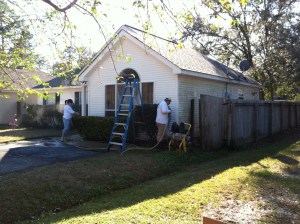
A Small Group with Bridge Church recently took a Sunday afternoon to pressure wash & spruce up the homes of two elderly neighbors.

There’s no earthly glamor in widow ministry. Their needs persist. They don’t have much to contribute to you or your church. But if we want to be God-like and we want our churches to fight God’s battles in our community, we will be about this important work.
“Father of the fatherless and protector of widows is God in his holy habitation” Psalm 68:5 ESV.
What are other ways to minister to widows? What other groups “in distress” can we serve as ambassadors for Christ?
If you’re in West St. Tammany Parish and looking for opportunities or have one to suggest. Please let me know.
Scenarios for Church Revitalization: Restructure or Re-Start
With over 70-80% of churches plateaued and declining, church revitalization must be a major topic of conversation for church leaders and strategists. In the last two posts (Diagnosis and Refocuse & Re-Energize), I’ve shared our developing strategy with the Northshore Baptist Association. 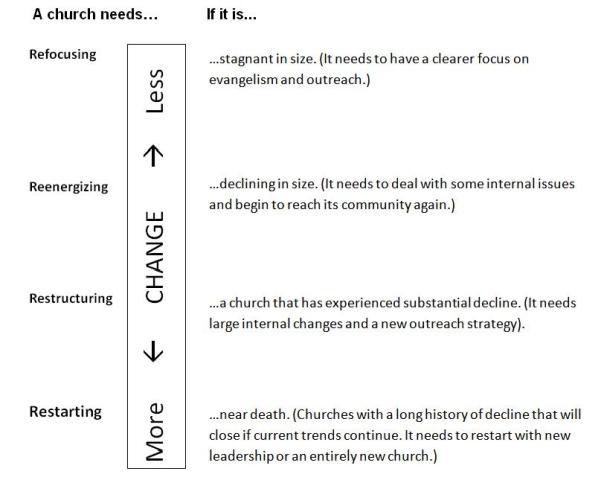
So how do we Restructure or Re-Start?
If a church is diagnosed with needing restructuring or restarting, there are really only two next steps:
Step #1: Decision. The congregation must decide if large internal changes are possible or is it time to close the doors & allow something new to be born. All living things are born, they live, & they die. No New Testament Church still exists today. But even if a church continues it must die to its current way of thinking, so that a new vision can develop. Living things experience death as they age & mature & adapt to changing environments. Every growing church has had to die to various ideas, paradigms, and programs in order to grow. A final death that doesn’t lead to growth as the church exists may happen when we are unable to continue to adapt & grow through challenges faced.
Questions:
- Can we afford the large internal changes that are needed?
- Do we have the resources, energy, & determination to dream a new dream for our community?
- From where we are, can we adapt to the changes of our current environment?
Step #2: Death. Once the decision to die has been made there are two options:
1) Adaption by Re-Structuring. Deciding to adapt/re-structure & grow means dying to the current model of ministry & mission. Scenarios for adaptation:
- Reverting to Mission Status & submitting to the authority of another congregation that can assist in dreaming a new dream.
- If resources are available, working with the local association to develop a plan to Assess, Align, & Advance the mission of the church.
2) Closure to Re-Start. Deciding to close/re-start means laying to rest the current church so that a brand new ministry can be started in its place. Scenarios for closure:
- Formally decide to close the church, giving the assets & liabilities to the local association so that a new church can be planted or ministry developed.
- Formally decide to close the church, giving the assets & liabilities to another local church with ties to the local community.
Next week I’ll share some of our local success stories and lessons learned.
Scenarios for Church Revitalization: Refocus and Re-Energize
When a church is stagnant or declining in size, diagnosis is that refocusing and re-energizing is needed. How do we refocus & re-energize? Three steps to revitalization: Assessment, Alignment, Advancement.
Step #1: ASSESSMENT.
- Discover needs of community and potential new ministries.
- Assess Leadership capability and needs.
- Identify Church Systems in need of restoration. Nelson Searcy of Church Leader Insights identifies Eight Systems of a Healthy Church:
- The Weekend Service System,
- The Outreach/Evangelism System,
- The Assimilation System,
- The Small Groups System,
- The Ministry Mobilization System,
- The Stewardship System,
- The Leadership Development System,
- The Strategy Planning System
- Research legal documents and history. History and legal documents need to be researched in order to identify potential threats to growth.
Step #2: ALIGNMENT.
- Recover Faith Factors. In Chapter Three of the book Comeback Churches, Ed Stetzer identifies three faith factors that are essential to church revitalization: 1) A renewed belief in Jesus Christ and the Mission of the Church, 2) A renewed attitude for servanthood, 3) Strategic Prayer Efforts.
- Discover/Recover the unique, God given Mission, Vision, Values. The revi team should participate in Church Planter Basic Training & take advantage of coaching networks & suggested reading lists to help discover a vision for the community.
- Make necessary identity changes. Name? Signs? Location? What identity changes may be necessary to birth new vision & energy in the church?
- Restore needed Church Systems for life and health. See above comment about Church Systems. What systems will need new energy & attention going forward?
Step #3: ADVANCEMENT.
- Vision Renewal Launch Service. Plan for a Vision Renewal Celebration as the church moves into a period of advancement and growth.
- Plant, water, and bring in the harvest. The church should experience some growth as systems are slowly restored and outreach, assimilation, small groups move people to Christ and spiritual maturity.
- Multiply disciples, leaders, and ministries. A new generation of leaders will begin to emerge that will carry the Church into the future.
- Partner in Acts 1:8 Missions. The Church will be capable of taking on missions endeavors beyond its Jerusalem and potentially assist other churches with revitalization/renewal.
Download the paper, Steps to Revitalization.
Scenarios for Church Revitalization: Diagnosis
With over 70-80% of churches plateaued and declining, church revitalization must be a major topic of conversation for church leaders and strategists. In the next few posts, I’ll share the strategy we are working on with the Northshore Baptist Association. Everyone working on revitalization should be indebted to Ed Stetzer and Mike Dodson for their great book Comeback Churches. One of my top gleanings from the book is the diagnostic tool for assessing a congregations needs:
This image gets even those most entrenched in the attitude “we’re fine the way we are” thinking about the need to change. Great tool to help churches diagnose their need for revitalization.
The next question is – How? How do we refocus? re-energize? Restructure? Restart?
Sending the Whole Church
“He has filled him with the Spirit of God, in wisdom, in understanding and in knowledge and in all craftsmanship” Exodus 35:31 NASB.
We know God gives power to preachers, worship leaders, teachers, and missionaries. BUT do the people in the church know that their skill, whatever it may be, can be used to fulfill God’s purpose. Bezelel was a carpenter/craftsman and filled with the spirit to craft instruments for God’s glory.
“I never knew my skills could help the church” said one craftsman we utilize to build wheelchair ramps for the handicapped in our community.
How does you church make a way for those God has filled with his spirit for craftsmanship, carpentry, sewing, scrapbooking, flooring, arts, trimming trees  (like in the picture of tree surgeon Mark Johnson taking trees off the house of an elderly widow during a recent Faith in Action weekend with our church), landscaping, etc. etc.? Sending and equipping the whole church means realizing the Spirit empowers for all kinds of ministry.


 Lane Corley