Category Archives: Discipleship

Beneath the Surface: Going to Church vs. Getting Involved in the Life of a Church
“every individual Christian will find in the communion of a local church the most perfect atmosphere for the fullest development of his spiritual life.” ~ A.W. Tozer
My observation is that most people never experience “the fullest development of his spiritual life” through the church or see the great value, because they may GO TO CHURCH, but they don’t get involved in the LIFE OF A CHURCH. There’s a big difference. Going to church makes you a CONSUMER of its services. Getting involved in the life of a church puts you in “COMMUNION” with a life source fed by God himself. The Apostle Paul said it like this
“From Him the whole body, joined and held together by every supporting ligament, grows and builds itself up in love, as each part does its work.” ~ Ephesians 4:16
It’s consuming vs. serving, sharing life, supporting, being supported, building up, being built up, etc.
 The enduring image of church for me is that of a forest. A forest stays strong, even in dry seasons, because BENEATH THE SURFACE, the roots of the trees are feeding off of one another for growth & strength. Roots can’t share their life with a tree that just lays itself upon the surface. It has to take root & do life with the others.
“I tried church, but it didn’t help.” Probably not, if you just showed up every now & then with little commitment, little humbling of yourself, little sharing of your life, little getting involved in relationships, little investment in ministries, little digging deep to support & be supported.
I love the Tozer quote, because I’ve experience it. Now, don’t read it wrong. The church is NOT a “perfect atmosphere.” Far from it. It is the perfect atmosphere for spiritual development BECAUSE of its imperfections. Relationships with people that are struggling through life together, growing as individuals, utilizing unique gifts no matter how imperfectly. And seeing God in Christ feed & nourish & heal & empower each other. It’s a beautiful thing! But you won’t see it on the surface by just GOING TO CHURCH.

Out of the Box Ideas for Starting More Groups
 Notes & Presentations from the 2015 ReGroup Conference. Shared today at the ReGroup Conference at First Baptist Lafayette. Enjoyed sharing some learnings on where Small Group Strategies & Church Planting intersect. Here’s my two presentations & my notes:
- Discovery Groups: Strategies for Starting Groups from the Unchurched Communities
- “Where Does Your Group Meet?” Small Group Strategies for Portable or Space Limited Churches
One of the least common denominators of New Testament Christianity is the small group of people gathered around the word of God. So we need to figure it out.
Sought to answer two questions in my breakouts:
- How do we start more groups from the unchurched population?
- How do we start more groups when I have no or limited space?
Notes from Session One: Starting Discovering Groups –
- Empower your Apostolic leaders to start new groups. Say yes to those with an itch to start new things in different places. More on Sending the Apostolic leaders in your church HERE.
- Make it simple for EVERYONE to see themselves reaching their friends. (Example: The HOST Strategy)
- 3 out of 21 Meals – Encourage people to see meal times as opportunities to invest in unchurched people. And you’re going to eat anyway. More on this in the book Saturate: Being Disciples of Jesus in the Everyday Stuff of Life by Jeff Vanderstelt.
- Groups with a Purpose – People may get involved with a mission or project before they get involved in your church. What need can you meet in the community that will gather people in relationship & move step by step to sharing the gospel.
- “Discussion Group” – Go Hall of Tyrranus on your community. Some people will come only if they can ask questions & discuss.
- Start a Book Club – Yours &/or Theirs. At your home, church, or consider getting involved in book clubs in the community book stores or libraries to invite people to your group. Try a nondescript invite to a Bible Study or discussion & see what happens.
- Meetup.com & other social media sites – Utilize Social Media to gather people. People are looking online for spiritual connections & helps.
- Don’t neglect Community Bulletin Boards, Newspapers, Coupon Mags, Radio.
- Look for Affinity Groups: Stay at home moms, Sr. Adults, Service Industry (Monday nights), First Responders, Dads (Allprodad.com), etc.
- Look for Needs in the Community that Group studies can meet: Grief, Addiction, Money, Marriage, Parenting, Parenting Your Parents, Step family issues, etc..
Notes from Session Two: Out of the Box Ideas for Starting More Groups when you have no or limited space:
- Double the opportunity by launching a new service &/or new Sunday School hour.
- Clean out the Closets. Utilize EVERY possible space. Most churches under utilize their space.
- Groups that kill two birds with one stone. Service oriented groups. Make ministry & group life synonymous.
- Think beyond Sunday morning. It’s Biblical to start groups every day of the week.
- Go public with your groups! There’s more 3rd spaces today than ever before.
- No need to be afraid of Home groups. HOST Strategy.

No Program Needed! You can Make Disciples in the Everyday Rhythms of Your Life!

That’s the message of the book Saturate: Being Disciples of Jesus in the Everyday Stuff of Life. Shared a few of my favorite quotes from the book in this earlier post. The thing I’ve come to appreciate most about Jeff Vanderstelt & the Soma story, is that you come away from this book believing that EVERYBODY can do this. How? Not by adding anything, but by redeeming the rhythms of your life. The challenge:
Seeing church mainly as an event creates a significant problem for mission, because most people are very busy. And the more we fill our lives with church events and programs, the more we get pulled out of everyday life with people who don’t yet know Jesus.
We need to see that life is the program, because people need to see what i means to follow Jesus in the everyday stuff of life.
When we engage in these everyday rhythms with Jesus-centered, Spirit-led direction, mission can happen anytime and everywhere, and anybody can be a part of it.
Vanderstelt and Soma identified six regular rhythms that most people are already engaged in, that can be changed through submission to Jesus.
1. Eating – “Eating is not an extra event added on to your life. What if you ate with others more often?” We eat 21 meals each week. How many could we commit to disciple making conversations with other people?
2. Listen – “One of the greatest gifts we can give one another is a set of open ears and a closed mouth.” Are you listening to God & others? Who is the dominant voice in your life? If we listen, people will often tell us how to reach them.
3. Story – “Everybody lives in light of a larger story… and the stories provide the lenses through which people view their worlds.” “The larger narrative of God’s story can bring redemption to each of our individual stories.” Do you know God’s story & how to apply it to your life & the lives of others?
4. Bless – “Whatever God gives to his people, he plans to give through them to others.”
5. Celebrate – “Disciples celebrate the grace of God given to us through Jesus in order to express how good & gracious God is.” Are you able to celebrate like God? Can you look back at what He’s done through you and say “This is very good!”
6. ReCreate – “Too many of us can’t rest and create. But we should be the most playfully rested people on the earth, because our Dad has it all taken care of for us!” Can you rest? Can you create freely? Can you play?
 Eat. Listen. Story. Bless. Celebrate. ReCreate. Not really catchy. Doesn’t spell out anything. But these represent things happening all the time around us. As disciples of Christ we should embody his desires for people as we live them out.
No program needed! You can make disciples in the everyday rhythms of your life! Live it!
What everyday rhythm of your could you turn into a disciplemaking opportunity?
Check out Saturate by Jeff Vanderstelt. Great primer for Disciplemaking & doing church in the rhythms of your life.

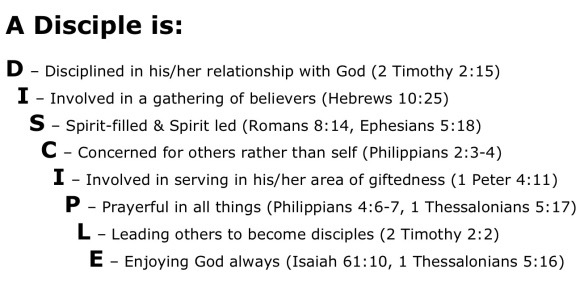
Discipling Tool: What is a Disciple?
Use this acrostic to lead someone in a conversation about what a disciple does:
Point Forward with Acts of Service
Through our lives, Jesus is showing the world the kind of king he is and the nature of the kingdom he rules. As his servants, we point forward with our acts of service to a far better world where Jesus’s rule will be experienced everywhere. Every one we serve experiences a taste of life in the kingdom.

Jeff Vanderstelt in Saturate: Being Disciples of Jesus in the Everyday Stuff of Life
>> Check out my Previous post about Saturate.

What’s So Great About the Great Commission?
Hudson Taylor, missionary to China in the 1800’s, may have been the one to popularize the term Great Commission for Jesus’ last command to his followers on earth.
Matthew 28:18-20 HCSB – “All authority has been given to Me in heaven and on earth. Go, therefore, and make disciples of all nations, baptizing them in the name of the Father and of the Son and of the Holy Spirit, teaching them to observe everything I have commanded you. And remember, I am with you always,to the end of the age.”
What’s so great about it? For starters:
- Jesus said it. This is a directive straight from the master himself. And it’s the last words he left with his followers. It’s clearly what he wanted the cause of our lives to be as his people.
- It’s repeated in all four gospels. The four gospels vary on a lot of details about the life of Jesus. And few things are mentioned in all four. The Great Commission is one of them, telling us that this statement left an indelible mark on his followers & served as a highlight of Jesus’ teaching
- If we do it, people are changed for eternity. Obedience to the great commission means communicating the gospel which will result in people being included in eternal life in Heaven forever. Neglect means the opposite.
- Jesus did it & so did his first followers. If we want to follow the example of Christ & the early church, we’ll busy ourselves with going, making disciples, baptizing, & teaching.
- If you’re a Christian today, it’s because someone else took it seriously.
But the real question is: Do I live like this commission is GREAT? Do I take it seriously? Does my church take it seriously? Unfortunately, many of us as Christians LIVE like the Great Commission is NO BIG DEAL.
How can we make Jesus’ commission GREAT?
- Get serious about how to be & make disciples. Check out Robby Gallaty’s book Growing Up: How to Be a Disciple Who Makes Disciples.
- Give to & pray for those who are making disciples.
- Take responsibility for your home, neighborhood, & work place.
- Use your gifts to serve through a local church that is purposing to make disciples.
- Pray for those around you & look for opportunities to start conversations about the gospel.

#ChurchPlanting Hack: The Stewardship System
 This week our church is sending out the Annual Contribution Statements to our 2014 contributors & church members. This is part of a healthy Stewardship System designed to make disciples that are generous givers to the kingdom ministry that is their local church. A contribution statement is a simple report of the households giving to the church & its ministries over the previous year. Many churches do this on a quarterly basis as well. Our statements include a letter from one of the leadership team (2014 Contribution Letter) as well as an offering envelope. We’ve also included the annual church budget in the packet before. It’s a great reminder of the responsibility we have as disciples to be good stewards.
Check out this years Contribution Letter from our church.
Here’s a simple outline of what a beginner Stewardship System should look like for a new church:
- Provide a variety of avenues for giving to your church. Online Giving, Bank Draft, ACH Online Bill Bay, Sunday Morning Offering Box/Basket/Plate, Offering Envelopes. With people attending church less often than ever before, offering more than just the Sunday Morning Offering time for people to give is necessary.
- Use an Offering Counting Sheet to record each weeks offerings. At least two people should count, and the planter/pastor should be one of them only in case of grave emergency. When possible a third person should make the deposit. Integrity in counting & depositing boils down to a solid paper trail that tracks every cent. A counting sheet is the best tool for this.
- Get a good cloud-based Church Management System & input the data from each counting sheet every week. Popular ones are Fellowship One, The City, ACS, Church Community Builder. These can be costly but worth it. You sponsor church may allow you to use theirs for awhile. A good CMS is an important time saver for your Stewardship System because it allows for quick printing on Contribution statements & mailing labels to deliver them.
- Teach that good stewardship of God’s gifts & resources (time, talent, treasure, property, etc.) is part of being a follower of Christ. Paul told the disciples at Corinth, “I don’t want what you have–I want you” (2 Corinthians 12:14). The Stewardship System shouldn’t just be about the needs of the church budget, but it should be about discipleship. As people become more like Christ, they should become more generous & live by kingdom principles in spending. This probably will positively effect the church budget, but that should be secondary to our desire for people to live like Christ.
- Model generosity & good stewardship as a leader & as a church. “You won’t be able to lead anyone somewhere that you’re not willing to go yourself.” The Church Planter/Pastor should lead the way as a faithful, generous steward. And the church should model generosity through regular missions giving & radical generosity in the community. Recently read: “If a person is self-focused, we call them selfish. If a church is self-focused, we call it normal.” via @cnieuwhof. We should model what we want others to become.
- Report regularly & transparently to the congregation through individual contribution statements & church budget reports. Contribution Statements & Budget Reports can serve as report cards for Disciples & Churches on the journey to Christ likeness.
What else would you include as part of a churches Stewardship System?
A couple of favorite resources on this subject:
Not Life PLUS Mission, Life ON Mission
the secret to increasingly living our lives together on God’s mission is to move away from seeing discipleship as something that needs to be tacked onto an already busy schedule, toward seeing all of the normal stuff of life as full of opportunity for discipleship and growth in the gospel.
This is not a call to life plus mission; rather, it is a call to life on mission.
If life on mission, a life of discipleship, is too hard, or seems impossible with your schedule… Choose a different rhythm.
 Ceasar Kalinowski, in Small is Big Slow is Fast: Living and Leading Your Family and Community on God’s Mission
Loving this book!
Worth Reading: Missional Essentials
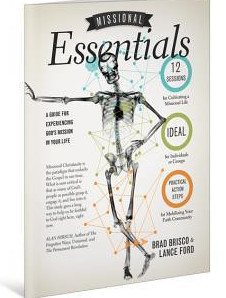 This past summer I worked through a 12 lesson study by Brad Brisco & Lance Ford called Missional Essentials. This is a great primer for discovering life on mission right where you are and understanding basic missiology. It would be great for small groups, discipleship groups, or personal use. Deals with issues like the nature of God & the church, consumerism & mission, rest & time management, biblical hospitality, & more. Check it out here:
A few of my favorite quotes:
- in the church, we have focused almost exclusively on the idea of sending rather than being sent. We think primarily of sending and supporting missionaries in faraway places rather than seeing ourselves, both individually and collectively as being sent.
- We should be sending people in the church out among people of the world rather than attempting to attract people of the world in among the people of the church.
- We in the church often wrongly assume that the primary activity of God is in the church, rather than recognizing that God’s primary activity is in the world, and the church is God’s instrument sent into the world to participate in his redemptive mission.
- Instead of thinking of the church as an entity that simply sends missionaries, we should instead view the church as the missionary.
- God has sent you on assignment as a participant in his mission to the world. Your locale is no accident.
- Hospitality involves living life in a way that places a higher value on relationships and community than on consumption and productivity.
- Our families and our homes should be places where people experience a foretaste of heaven.
- LIGHT: Listen to the Holy Spirit, Invite others to share a meal, Give a Blessing, Hear from the Gospels, Take Inventory of the day.
8 Things You’ll Never Hear an On Mission Christian Say
There’s a marked difference between living the Christian life ON MISSION, & just going to church on Sunday’s. You can tell which side of this equation you’re living on by what comes out of your mouth (Matthew 12:34). Here’s some things I’ve said & heard others say when NOT on mission for God as a Christian:
 1. “Christianity is boring.” Anybody that says Christianity is boring has never done a backyard bible club in a dangerous neighborhood, gave away food to someone in desperate need, watched a disabled person use a handicap ramp you just built for the first time, led someone to put their faith in Christ, ate something they weren’t sure of b/c to not do so would offend their foreign host, prayed with a coworker experiencing a storm in their life, etc., etc., etc. Life on mission is an adventure.
2. “I don’t know my spiritual gifts.” The On Mission Christian has either through trial & error or careful study & prayer discovered what God has gifted & called them to do. They do this b/c they understand that God has gifted & empowered every believer to do something. And to do nothing is not an option when we see the needs of the world & the great sacrifice of Christ.
3. “I would love to help, but nobody invited me.” Not that we shouldn’t make sure that everyone feels invited, but On Mission Christians tend to find a way to get in the middle of meeting needs for the good of others & glory of God. They’re not waiting around for an invitation.
4. “I would love to help, but I don’t know any people in need.” Being On Mission is a way of seeing the world. An On Mission Christian lives with a constant awareness of the needs around him/her. Wherever they are, they will find needs to be concerned about or met. The harder thing may be saying no to needs because it’s physically impossible to meet every one.
5. “I don’t feel like I’m being stretched in my faith.” If you live life on mission, you will regularly come to the end of yourself. That’s why Jesus promised His presence (Matthew 28:19-20) & power (Acts 1:8-10) to those who will take up his mission. Being on mission will take you out of your comfort zone & out of the limitations of your own ability. Hello FAITH, hello HOLY SPIRIT, hello SUPERNATURAL LIFE.
6. “You didn’t hear me say this but…” Gossip is one thing that threatens the mission of the church. The On Mission Christian is usually both too concerned about others & the unity of their church to engage in it, or just too busy to waste time with it. As one person said, “Those rowing the boat, do not have time to rock it.”
7. “The carpet/chairs/coffee/preacher/singing is too…” Little time or energy for criticism when you’re on mission either. The On Mission Christian will struggle to be concerned about small issues of esthetics around the building when there are people in need.
8. “My church isn’t meeting my needs.” The assumption here is that church & Christianity is about “my needs.” We do receive so much personal reward & benefit from being a Christian & the church should certainly consider the needs of people as it strategizes & plans its ministries. But the On Mission Christian does not live with these assumptions at the forefront of their lives. Paul was clear in Philippians 2:3-8. The Christian life, patterned after Jesus, is about the needs of others & sacrificing ourselves for the need of others.
If your Christian life is boring, faithless, about you, filled with criticism of others, etc. Let me challenge you to get involved in the next ministry or mission opportunity you hear about & get to know true Christianity which is about life on mission with God in the world.
What else would you add to this list?


 Lane Corley