Category Archives: Books worth reading
Partnering w/the Non-Profit World
Getting ready for a day of meetings with one of the largest networks of relationships in our community. Nope, not going to an denominational or church meeting, but to hang out with a local non-profit that I’ve been privileged to work with over the past few years. Lots of great reasons for churches to partner with non-profit organizations in our communities. In his great book, Barefoot Church, Brandon Hatmaker list several great ones:
- Nonprofits typically have a great reputation in the community. “While nonprofits are often the most well-connected organizations in the city, churches remain some of the most isolated voices in our community.” Getting involved can help open doors for greater influence and greater impact for the gospel.
- Nonprofits are experts in their field of work.
- Partnering with nonprofits offers a new posture for the church. A few years ago I attended a volunteer roundtable hosted by the Lt. Governor of our state, and as the only pastor in the room I sunk in my chair as leaders of non-profits asked why churches didn’t get more involved in the community. They saw the potential for impact for and with the church before I did. And don’t assume that these partners are against us sharing our message. Most expect it and desire faith engagement.
- Nonprofit partnership is an easily reproducible strategy. If you’re looking for opps to engage the community, the nonprofit world is a easy “plug and play” arena. We as leaders need only to assimilate opportunities to serve, communicate the process, and empower people to go.
- Nonprofits need volunteers more often than they need money. Hatmaker notes that “lack of resources is the most common excuse churches make not to serve the poor.” While they’d certainly appreciate a financial donation, a working relationship does not hinge on it. Often the greatest need is people.
- Serving with nonprofits provides a platform to serve selflessly. Serving with a nonprofit is an opportunity to shine the spotlight on something happening for the good of our community. Our culture sees churches as self-absorbed (I asked one non-profit leader how a church could help him and he said honestly and without malice based on his experience personally and professionally, “I didn’t know churches helped people”).
Hatmaker also lists six steps to effective partnerships:
- Start with a common redemptive purpose. There are definitely nonprofits that are doing much of what God’s word calls us to do in relation to justice and bringing hope. Start there.
- Prioritize developing relationships. There will be worldview issues that collide when engaging outside the church. And we’ll have a better platform for engaging these as we build nonagenda-oriented relationships with community leaders.
- Trust their leadership. If you can’t trust their leadership, then move on to a different non-profit. But I’ve found nonprofit leaders from Fire Depts to Food Banks to be hard working, trustworthy, and eager to have the church as a partner.
- Lose your agenda. We’re coming to serve them in a common redemptive purpose. Focus on serving them.
- Give away the credit. “If you are willing to partner with local nonprofits who have spent years building credibility in different areas of service, take a backseat, and don’t seek a name through this.”
- Commit to be available. The best way to build credibility with community leaders is through availability and follow through.
Check your local government website. They should have a list of nonprofits in the area. If you’re in St. Tammany it’s here. You can also sign up to receive a monthly update to this list with specific opportunities called The Loop.
Check out this church in Austin, TX that assimilates opps to serve through nonprofits in their city. Here is their Christmas list.
What nonprofit are you working with? Have you learned any lessons in this regard?
Another topic for another day is starting a nonprofit alongside the ministry of the church.
Pick up Barefoot Church: Serving the Least in a Consumer Culture by Brandon Hatmaker for more great ideas and inspiration for incarnational ministry.
“Apathy is passionless living. It is sitting in front of the television night after night and living your life from one moment of entertainment to the next. It is the inability to be shocked into action by the steady-state lostness and suffering of the world. It is the emptiness that comes from thinking of godliness as the avoidance of doing bad things instead of the aggressive pursuit of doing good things.”
John Piper, in his latest book Bloodlines
Serving on Sunday, part one
A growing trend in church life is congregations taking a Sunday and scattering throughout the community to serve. Most are doing it once a year. Some, like the church I’m part of, are doing it once a quarter. I even heard of one recently doing this once a month! Outreach.com even created some products for this segment of congregations. Seems Pastors and church leaders either hate this idea or love it. Some reasons I’ve heard and can think of against this:
- It subverts the importance of preaching the Word of God.
- It hurts church growth by making things awkward and uncomfortable for newcomers, visitors, and the disconnected.
- “We can’t go a Sunday w/o taking an offering.”
- It promotes a liberal agenda of social action.
- “I can’t imagine how we would find enough for everyone to do around our community.”
Brandon Hatmaker in his great book Barefoot Church: Serving the Least in a Consumer Culture talks about his church’s experience with this practice. Austin New Church does a “Serving Austin Sunday” every time there is five Sunday’s in a month. He gives three reasons why:
- It creates a service minded DNA. It’s an opportunity to communicate serving is a priority to the church.
- It changes the posture to the community. The community sees the church’s deed matching the creed.
- The opportunity to invite others. Hatmaker says it’s the most highly attended Sunday for non-believers, skeptics, the unchurched, and the dechurched. “I’m constantly amazed at who might show up at a service project.”
Other reasons for and against? Leave in the comments. I’ll share some of my thoughts for and against after two years and eight Faith in Action Sunday’s a little later.
Brandon’s book is well worth reading! Also check out his blog.
Diagnosing Spiritual Immaturity
“the mouth speaks from the overflow of the heart”
http://bible.us/Matt12.34.HCSB.
How can I know where I am spiritually or where are those I’m trying to disciple and lead? Try listening. Jim Putman in Real-Life Discipleship: Equipping Disciples Who Make Disciples breaks down five stages of spiritual maturity by what will be common phrases for a person at each stage.
Spiritual Infant
- “I don’t have to go to church to be a Christian.”
- “I pray and read my Bible. That’s good enough for me.”
- “I didn’t know the Bible said that.”
- “Jesus helps me be a good person. I don’t need church.”
- Characterized by ignorance, confusion, dependence, worldly perspective.
- Needs personal attention of a spiritual parent, teaching and modeling the Christian faith, accountability to develop new habits.
Spiritual Child
- “My church isn’t taking care of my needs.”
- “I didn’t like the music today. If only they did it like…”
- “I love my small group; don’t add more people to it.”
- “I’m not being fed at my church, so I’m going to a church that can meet my needs better.”
- Characterized by self-centeredness, pride, idealism, spiritual highs and lows.
- Needs relational connections to a church family, help to start feeding themselves, teaching about identity in Christ.
Spiritual Young Adult
- “I love my small group, but there are others who need a group like this.”
- “Randy and Rachel missed church today. Their kids have the flu, maybe our group could make meals for them. I’ll start.”
- “I have some friends I’ve been witnessing to. I think I could lead a Bible Study for them with a little help.”
- “In my devotions, I came across something I have a question about.”
- Characterized by action, zeal, God-centered, others-centered, independent, desire to serve others.
- Needs opportunities to serve, ongoing relationships that offer encouragement, accountability and skills training.
Spiritual Parent
- “This guy at work asked me to explain the Bible to him. Pray for me.”
- “Our small group is going on a mission trip, and I have given each person a different responsibility.”
- “We get to baptize someone from my small group today. I want them to get plugged into a ministry right away.”
- Characterized by intentionality, reproduction mindset, dependability, desire to see others mature.
- Needs ongoing relationships with other disciple makers, a team approach, accountability and encouragement.
So where are you? If you’re moving toward spiritual maturity you may want to get this book or the training manual to learn more about how to be a spiritual parent and make disciples who make disciples. Here’s a few other great quotes from the manual:
- Every Christian is commanded to participate in the mission to make disciples.
- Your work is complete when the person you are discipling can make a disciple.
- The church was not designed to be a group of spectators who attend weekly lectures; it was designed to be a trained army with a powerful message.
- We cannot change the definition of discipleship to sit and listen and then expect to make disciples as Jesus did.
- Don’t mistake Bible Knowledge, years of church attendance, physical age, education, and so forth for spiritual maturity.
- A church is successful when everyone is in the game, maturing into disciples who can reproduce disciples.
- When disciple-making is reduced to a program, people often fail to connect it to a lifestyle.
- Relationships create the environment where discipleship happens best.
- Serving produces players, not spectators. Service helps a disciple develop and mature.
Changing the Scorecard for the Church
“The typical church scorecard (how many, how often, how much) doesn’t mesh with a missional view of what the church should be monitoring in light of its mission in the world. The current scorecard rewards church activity and can be filled in w/o reference to the church’s impact beyond itself”
from the introduction to Reggie McNeal’s Missional Renaissance: Changing the Scorecard for the Church. This book outlines the shifts that must take place to make the church in America a missional movement again. The book is also full of ideas of how to engage in making these shifts. He admits to not having the silver bullet, but Missional Renaissance provides great insight for next generation ministries. I read this book when it first came out and its been bugging me ever since. The ideas are provocative and thrilling and now more and more leaders are coming to the conclusion that our measurements must change. Much is being written about this right now. Others that I’ve read and been helped by are Transformational Church by Ed Stetzer and Thom Rainer, On the Verge by Dave Ferguson and Alan Hirsch, and Barefoot Church by Brandon Hatmaker. This is a great conversation for us to have, so grab McNeal’s book and be provoked. Here’s the three shifts he suggests with a few of my fav quotes:
Shift #1: From an Internal to an External Ministry Focus. The missional church engages the community beyond its walls because it believes that is why the church exists.
- Moving to an external focus pushes the church from doing missions as some second-mile project into being on mission as a way of life.
- Internal focus is to define effectiveness by church activity and whatever it takes to be a “full-service” church.
- Externally focused means seeing ourselves as a CONNECTOR not the DESTINATION. Like an airport is a place of connection, not a destination. It’s job is to help people get somewhere else. When church sees itself as the destination the scorecard gets confused.
Shift #2: From Program Development to People Development. Moving away from the assumption that people are better off if they just participate in certain activities and processes that the church or organization has sanctioned.
- We’re learning that there is no necessary correlation between time logged sitting in pews or chairs at church and attaining Christlikeness in mindset and mission or purpose.
- a new scorecard celebrates investments in people, not just programs, and cheers breakthroughs in people’s lives, not just organizational achievement.
- McNeal’s question: “Are people better off for being a part of this church, or are they just tireder and poorer?
Shift #3: From Church-based to Kingdom-based Leadership. …thinking of kingdom impact more than church growth.
- Church based leadership is institutional, maintenance-oriented, positional, church-focused, and highly controlling.
- Kingdom leadership is organic, disruptive, prophetic, kingdom-focused, empowering.
- Kingdom leadership focuses on people development not program management and event production.
- Good questions for church leaders: Does your call revolve around a mission or a job? Have we minimized the call of God down to a guaranteed employment contract and a regular paycheck?
A few of my favorite quotes:
- The true vitality of a congregation rests in the abundant lives of its participants and in the blessed lives in the community it serves.
- To think and live missionally means seeing all of life as a way to be engaged with the mission of God in the world.
- We must change our ideas of what it means to develop a disciple, shifting the emphasis from studying Jesus and all things spiritual in an environment protected from the world to following Jesus into the world to join him in his redemptive mission.
- Missional followers of Jesus don’t belong to a church. They are the church. The missional church is not a what, but a who.
- Our job is not to “do church” well but to be the people of God in an unmistakable way in the world. Our “thereness” is what the world needs.
- Number of growing relationships with people who are not Jesus followers or church people.
- Number of personal relationships with community leaders.
- Number of venues for interpersonal service in the community each month.
- Number of hours in personal service in the community each month.
- Number of life-coaching relationships.
- Number of external, missional experiences and stories used in speaking and writing.
“Sometimes I would like to ask God why He allows poverty, famine, and injustice in the world when He could do something about it…but I’m afraid he might ask me the same question.”
– Anonymous
Read in Barefoot Church: Serving the Least in a Consumer Culture by Brandon Hatmaker. Loving this book!
Getting Your Church Unstuck
Follow American church-life today and there is one word that keeps popping up – DECLINE. Every major denomination except one – (the Assemblies of God, whose aggressive church multiplication strategy is making a great impact) – is experiencing a decline. And even the positive note of big churches getting bigger is dampened by decline in belief/discipleship metrics among Christians – like belief that the Bible is the Word of God, or that marriage is between a man and a woman, or that adultery is a sin. Books and blogs and doctoral dissertations are filling up the shelves about what’s wrong and how to change it. Reading many of them myself and looking forward to reading more. Let me suggest a resource if you’re in this battle to stop the decline in your own church or if you’re planting a church that you don’t want to stall:
Tony Morgan’s FREE E-books The Leisure Suit Trap: 8 Reasons Your Church is Stuck and Hanging Up the Leisure Suit: How to Get Unstuck. These can be read in an hour and give practical helps that you can put into action right away. Follow Tony’s Blog for other helpful thoughts on organizational effectiveness, systems, etc.
A few other helpful resources for revitalization:
- Comeback Churches by Ed Stetzer and Mike Dodson. Research based on 300 churches that turned it around.
- We use this graphic from Comeback Church to help diagnose a church’s need for Revitalization.
- And also this graphic from Tony Morgan about the why behind churches in decline.
Are You Plateaued?
Few leaders finish well. Maybe as few as one in three. And this was true of the leaders described in the Bible as well. Whether you’re leading a family, a church, a team, or a business, it is difficult and God’s wisdom is needed if we are to do what it takes to finish well. How can we keep from plateauing and burning out as leaders?
Just finished Neil Cole’s latest book, Journey’s to Significance: Charting a Leadership Course from the Life of Paul. In the
last chapter he describes a plateaued leader who’s on the way to burn out or worse:
He says plateaued leaders…
- Avoid relationships of personal accountability. How many degrees of separation are there from you and other leaders?
- Have infrequent personal application of God’s word. Are you mastering a subject or following and pursuing a King?
- Have seen joy, peace, and love replaced with envy and resentment. Is your character being shaped by Christ or by the opinions and actions of others?
- Frequently look for greener pastures in other places. Are you too focused on the circumstances around you to bring transformation to the place God has called you?
- More easily find fault in others than in themselves. Do you give others as much grace as you give yourself?
- Are burned out from lots of activity that has been substituted for intimacy with Christ. Are you exhausted from thinking more effort and more activity will bring you more blessings from God?
- Compromise ethical principles once held dear. Are you taking liberties that you once would not, because of entitlement?
- Stay within safe areas of expertise rather than branching out into new learning endeavors. Does the idea of learning something new make you afraid or proud?
- Are teachers and experts more than learners. Are you easily offended when instruction and advice comes from others?
- Have reduced the Christian life to the rut of a routine. Can your Christian walk be described as a few do’s and many don’ts?
- Perspective. They are focusing their energies on consistency over the course of their lives.
- Renewal. They take time to refresh and renew and rest and reconnect with God.
- Discipline. “Finishing well over the course of a lifetime is not accidental but intentional” ~ Cole.
- Learning. They maintain a learning posture throughout their lives.
- Mentoring. They mentor others and are mentored themselves.
- They maintain a personal vibrant relationship with God right up to the end.
- They maintain a learning posture and can learn from various kinds of sources.
- They manifest Christ-likeness in character as evidenced by the fruit of the Spirit in their lives.
- Truth is lived out in their lives so that convictions and promises of God are seen to be real.
- They leave behind one or more ultimate contributions.
- They walk with a growing awareness of a sense of destiny and see some or all of it fulfilled.
For the City
There are four postures that churches take toward their society and populations: 1) IN the city. Just a location. 2) AGAINST the city. An US vs. THEM mentality. 3) OF the city. There’s no godly distinctives at all. 4) FOR the city. A model of engagement where church seeks to speak the truth and bring transformation to its region.
So say Matt Carter and Darrin Patrick in their book entitled For the City: Proclaiming and Living Out the Gospel. This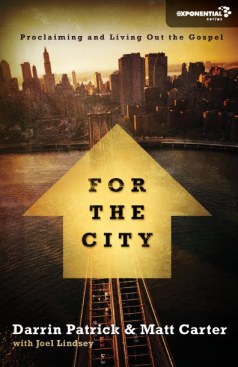 was one of my Exponential Conference book takeaways and it was on my summer reading list. It’s a short book but packed with ideas and the kind of ideas that’s shaping how church will look for the next generation. In the book, these two young leaders tell the story of the growing churches which they planted (Austin Stone in Austin, TX and The Journey in St. Louis) and how they are transitioning them to be focused on being FOR their respective cities. Lot of great ideas here, including one that we’ve picked up in our region of partnering with local non-profits and starting new non-profits to meet the practical needs in the city. Well worth reading. Here’s a few of my favorite quotes:
- We are on dangerous ground when we seek to define the worth of a church by how it meets our felt needs.
- A great church, a healthy church, is one in which Jesus Christ is found in word and deed.
- A God-honoring, gospel-loving church is one where the Word of God is the primary motivator for doing the work of God.
- the church does not exist to fix problems. Instead, the church is to carry the burdens of the world to Jesus.
- the most effective way to know God more intimately is to be in deep relationships with other Christians who are also seeking to know God intimately.
- The common temptation in the American church is to neglect the world in order to protect the church…yielding to this temptation results in a bunch of Christian who, instead of being bought in – loving and serving their neighbors – are mostly checked out from their neighborhoods, closing themselves up in a sanctuary several hours a week rather than opening their home to share dinner with unbelievers who live right next door.
- …if you are not currently in a relationship with a drunk, a prostitute, a beggar, an outcast, or a modern social equivalent to one of these people, you are not wholeheartedly following Jesus.
- …true, biblical community is so rare. And even rarer is a Christian community that sets its focus on the welfare of its city and not just the welfare of its church.
- We want to tear down the false teaching that has crept into our churches that church is all about checking an attendance box and eating out after service on Sundays
- Church is a group of radically changed people infiltrating the world and propelled to love others at great cost to themselves, all empowered by the simple message of the gospel.
- The church in the west has drawn people into the church, but it has done a poor job of sending them back out into the messy world.
- the notion that God will not put on us more than we can handle is unbiblical. God always calls us to do more than we can handle, and he does this in order to bring us back to him as the source of our strength and power.
Missional Axioms
If you’re looking for simplicity in communication of your vision or pithy things to add to the twitter-verse, it doesn’t get any simpler or pithier than David DeVries Six Word Lessons to Discover Missional Living. 100 short statements about what missional living looks like. Each statement includes a one page explanation. Some of these make you think, start conversations, and keep you coming back to them. Here’s a few of my favorites:
- Love others like Jesus loves you.
- The outcome of disciple making is disciple makers.
- Don’t start services, start making disciples.
- Mission starts in my zip code.
- Every believer is sent on mission.
- Loving your neighbor requires knowing them.
- Gospel living is show and tell.
- Church isn’t a destination, it’s a people.
- Your character development precedes ministry accomplishment.
- God’s “well done” is worth it.


 Lane Corley

