Category Archives: Books worth reading

Co-operation, Commitment, Communion, Commission
Prayer is co-operation with God. It is the purest exercise of the faculties God has given us—an exercise that links these faculties with the Maker to work out the intentions He had in mind in their creation. Prayer is aligning ourselves with the purposes of God…
Prayer is commitment. We don’t merely co-operate with God with certain things held back within… We, the total person, co-operate. This means that co-operation equals commitment. Prayer means that the total you is praying… Your whole being reaches out to God, and God … reaches down to you…
Prayer is communion. Prayer is a means, but often it is an end in itself… There are times when your own wants and the needs of others drop away and you want just to look on His face and tell Him how much you love Him…
Prayer is commission. Out of the quietness with God, power is generated that turns the spiritual machinery of the world. When you pray, you begin to feel the sense of being sent, that the divine compulsion is upon you.
… E. Stanley Jones in Growing Spiritually. Via CQOTD

Developing and Deploying Leaders for the Glory of God
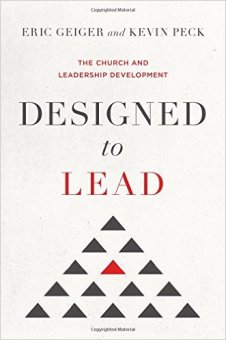 Didn’t get to attend the Pipeline Conference last year, but have wore out a highlighter going through the feature book by Eric Geiger and Kevin Peck called Designed to Lead: The Church and Leadership Development. The thesis of the book is that the church should be a great catalyst of developing leaders in every sphere of life. Geiger and Peck lay out the theological case for leadership development in the church and also make practical steps to get started very accessible for churches of every size. Exposed is our lack of true leadership development in the church and our dependence on a professional class instead of God’s power through God’s people with clergy being equippers. Must read for church planters who must multiply leaders and set a course for maximum impact for years to come. Here are ten of my favorite quotes from Designed to Lead:
- The Church is uniquely set apart to develop and deploy leaders for the glory of God and the advancement of the gospel.
- The full extent of discipleship is the development of disciples who are able to lead and develop others, not merely people who gather for worship once a week.
- True leaders are servants who die to themselves so others may flourish.
- The Christian life is not about trying daily, but dying daily.
- The Church has been designed to possess a holy rhythm of gathering people to scatter that more may be gathered.
- It is not first the work of our hands that pleases the Lord, but the condition of our hearts.
- The Church is not a Christian club, weekly group counseling session, or weekend pick-me-up. Your local church is the beautiful bridge of King Jesus!
- People will follow your example before they follow your vision.
- Church leaders must confidently invite people to serve, knowing that the opportunities to serve provide moments where development occurs.
- Our churches don’t need spiritual travel agents who promote journeys they don’t take. We need tour guides who set a wise direction, take the journey with the people, and live all that they are inviting the people to live.
A few more posts coming from this book in coming weeks. More info and some resources on the book at DesignedtoLead.com. Also, check out and follow Eric Geiger’s Blog for other great leadership resources.

Family Devotions: Yes! They ARE Listening!
Good encouragement here from Tony Evans, for when the Family Devotion just seems like a lot of commotion. Parents, keep showing up!
There were times when our four kids would be acting up around the table while I was trying to lead devotions, and it would irritate me. They would be talking out of turn, or one would be pouting. It just seemed like a lot of commotion rather than devotion! I admit there were even times when I called it quits and told everyone to go to their rooms because they weren’t paying attention or they were being disrespectful. But more times than not, I stuck it out, and then, at a later point, I would be surprised how one child or another would bring up something I thought for sure no one had heard during the devotions at the table simply due to the noise. They were listening— even when it didn’t look like they were listening. Those were the moments God used to remind me to hang in there when I would want to walk away from the table early and call it a night. I would remember that it was my responsibility to train these children to the best of my ability— imperfectly but consistently. I was called to show up and do my part, leaving the hard work of getting the truth into their hearts to God.
Excerpted from Raising Kingdom Kids by Tony Evans

Hudson Taylor on Faith, Spending, and Debt
 One of my all time favorite books that I try to read at least every other year or so is Hudson Taylor’s Spiritual Secret. Hudson Taylor was a missionary to China in the mid to late 1800’s. The book is a biography written by his children that details his work establishing the China Inland Mission which is still in operation today.
What’s the secret? The secret lies in his deep devotional life and trust in God to provide as a rule of life. As he stated:
Drawing for every need temporal or spiritual, upon “the fathomless wealth of Christ.”
This of course influenced his view on debt and spending which he saw as contradictory to a life of faith in God to provide:
To borrow money implied to my mind a contradiction of Scripture – a confession that God had withheld some good thing, and a determination to get for ourselves what he had not given.
Debt is now being called a national disaster. So many start out their careers burdened with tens of thousands of dollars. We drive and possess much that we don’t completely own. The thought of living without or waiting on God is foreign to our generation. What if we trusted God to know and provide what we needed? Think about these questions:
- Are you burdened with debt? Maybe you need to get on a plan to get rid of it and began living in freedom. Our family has found Dave Ramsey’s Financial Peace materials to be helpful in this regard.
- Do you feel a sense of entitlement to have that leads you to consider buying what you can’t afford? Try getting on a budget that allows you to live on what you actually make and set priorities for what you need and want. You might be surprised how richly God has blessed you and how satisfied you might be in Him, without a hunger for more stuff. Our family uses YNAB or You Need A Budget to track expenses and set our monthly budget. Also check out EveryDollar.com.
- Would you love to give and live generously, but you can’t because of things you have (too many debt payments) or things you want? God promises to provide for the sacrificial, regular, cheerful giver. God directs us to store up treasure in heaven, not on earth. Giving and living simply are great tools in this regard.
It takes discipline to try to live with generosity and without debt, credit cards, overspending today. But it’s worth it. Check out a few other Hudson Taylor quotes on money that challenge me to live simply and generously with complete faith in God:
- “My experience was that the less I spent on myself and the more I gave to others, the fuller of happiness and blessing did my soul become.”
- “We can afford to have as little as the Lord chooses to give.”
- “God’s work, done in God’s way, will never lack God’s supplies.”
- Once when told the bank account was down to $.87 he said, “We have $.87 and all the promises of God.”

The Art of Neighboring
This weekend, our church talked about living out life In Christ in our Neighborhood’s and with those in close proximity. Get the message audio and follow up guide HERE.
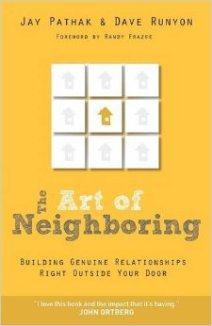 A couple of years ago I read one of the most challenging and informative books on this subject called The Art of Neighboring: Building Genuine Relationships Right Outside Your Door. Here’s a few great quotes from the book that should get you thinking about how to live out your faith in your neighborhood:
- “The majority of the issues that our community is facing would be eliminated or drastically reduced if we could just figure out a way to become a community of great neighbors.” – local small town mayor
- We are often moving too fast to notice that those who are right around us need a good neighbor.
- To love someone, it helps to actually know their name.
- It’s vital to take a step back and ask ourselves if we live at a pace that allows us to be available to those who live around us.
- In this life, we can only do a few things really well; I think it’s a good idea to make certain that one of those things is what Jesus says is most important.
- Love and hurry are fundamentally incompatible. Love always takes time, and time is the one thing hurried people don’t have.
- If you don’t set your priorities, others will do it for you.
- God is already working in your neighborhood. Being a good neighbor simply means slowing down and being aware of what he is designing.
- Jesus didn’t tell us to become acquaintances with our neighbors; he called us to love them, and that means we need to have an actual relationship with them.
- We don’t love our neighbors to convert them; we love our neighbors because we’re converted.
- If we live out the Great Commandment, an environment is created where the Great Commission can be effectively obeyed.
- Good neighboring – you walk alongside those in need and help them find their way.
- Behind every door is a story.
Questions:
- What would happen if every Christ-follower made it a point to know and befriend their literal neighbors?
- Do I live at a pace that allows me to be available to those around me? And if not, are all of those things I’m doing more important than taking the Great Commandment literally?
- What are the activities you most enjoy doing, and how might they become tools for building relationships with your neighbors?
- Which of your neighbors do you feel God calling you to spend more time with?
Find some great resources that go with the book at ArtofNeighboring.com.

The Key to Everything – TEACHABILITY
I’ve been the young leader that has it all figured out and doesn’t need anybody’s help. ESPECIALLY not anyone older than me. Now I’m fighting being the older leader that has been there, done that, and knows exactly how to do it, no matter what’s working for others or what others say. I’m also in a position where I get to help a lot of younger leaders that are 5-10 years behind me in planting churches, but often meet the brick wall of no or low teachability. The prideful side of this can be ugly. The innocent side of this can be costly. I truly believe this strong statement that TEACHABILITY is the KEY TO EVERYTHING. Where is that in the Bible? I think its wrapped up in James 4:6 – “God opposes the proud but gives grace to the humble.” Teachability is humility. Being humble enough to know that I’m not always right, that I need others, and that I need correction and instruction from God and others.
Matt Keller’s book The Key to Everything: Unlocking the Secret to Why Some People Succeed and Others Don’t is a great primer on Teachability. Highly recommend it to every leader. Would be a great addition to a residency reading list. Keller builds his case for teachability looking at King Saul on the wrong side and the Apostle Paul on the right side. Much needed reminder for me at this stage in my life. And another book added to the file “I wish I’d read this 15 years ago.” Lol!
Here’s a few of my favorite quotes:
- people’s level of teachability is the greatest determinant of their long-term success. (p. xviii).
- Desire to learn times willingness to change equals our level of teachability. (p. 7).
- pride breeds presumption, and presumption kills teachability. (p. 16).
- the only way to multiply is to be willing to lose control— or better, to share control with others. (p. 33)
- everything good in life, including teachability, lives and grows in the margins. And an unhealthy pace eliminates the margins in our lives. (p. 65).
- Without margin, creativity stops. Without margin, fresh ideas don’t emerge. Without margin, conversations that produce breakthroughs don’t happen. Without margin, you don’t have the ability to grasp anything new. Without margin, teachability dies. (p. 70).
- Are you allowing your natural ability to give you a license to not pay attention and learn from others? (p. 102).
- One of the leading characteristics of the most teachable people in the world is that they don’t just tolerate feedback, they welcome it. Teachable people see feedback as their friend— their best friend. (pp. 107-108).
- openness to feedback is the great multiplier (p. 110).
- Your teach-ability determines your use-ability. — TODD MULLINS (p. 135).
- Real teachability says, “I’ll learn anything, anytime, anywhere from anyone.” — BRAD LEACH (p. 139).
- When you make the choice to invite teachability into your life on a daily basis, life becomes an adventure. Every day you are given another opportunity to gather valuable insight that will make you a better person in some way. (p. 187).
Check out the website for the book and hear from Matt Keller and check out some neat resources HERE.

God doesn’t try… God ACTS
 Our Church has been tracking through the book of Acts on Sunday’s this Fall in a series called This IS Church. Our small groups have been tracking through Greg Matte’s Bible Study on the book of Acts called Unstoppable Gospel. Matte also published a great book called Unstoppable Gospel: Living Out the World Changing Vision of Jesus’ First Followers. I love books that put us into the 1st century with the first believers of Jesus. My favs are probably 30 Years that Changed the World and The Rise of Christianity. I’m adding Greg Matte’s book to that list as well. Here’s a few of my favorite quotes:
- God’s purpose is for the church to be more than just an event on Sunday morning; it’s meant to be a fuse lit to unleash the explosive power of a believer’s life.
- He has made no provisions for us to follow Him while living in isolation from other believers.
- Nowhere in the book of Acts do you see the word church used to describe a building where people gather on Sunday mornings. In Acts, the church is the people of God in love with God doing the will of God.
- God doesn’t try. God doesn’t attempt. God ACTS.
- We cannot pray a prayer so big that God will not wish we had prayed for something even bigger.
- Christianity has never had a more dangerous enemy than Saul of Tarsus, or a more dedicated friend that Paul the Apostle; both are the same man.
- The book opens with a handful of terrified disciples. It closes with Paul, ambassador for Christ par excellence, telling the story of Jesus “without hindrance” in the capital of the known world. (on Acts 28:30-31)
If you’re looking for a new perspective on the book of Acts, pick up Unstoppable Gospel. And I’d highly recommend Unstoppable Gospel Bible Study for small groups.

What Do You See?
How we see people is a good test of our heart for God and the Gospel. Do we see people as objects of His love and opportunities for us to show His love? Do we see their spiritual needs? Do we see potential or problems?
Gregg Matte in Unstoppable Gospel: Living Out the World-Changing Vision of Jesus’ First Followers, his great book on the book of Acts, gives three categories of people in our everyday lives and how we see them:
1. SCENERY. Passersby. Shoppers ahead of us in line. People in our way. People who are scenery are not really seen as souls in need of Christ.
2. MACHINERY. People that are necessary to us. Clerks, waitresses, attendants. We may see them as just nuts and bolts. The focus is on what we need from them, not who they are or what they need from us.
3. MINISTRY. No person should be just scenery or machinery. People are God’s creation whom He desires a relationship with. Every interactions should be seen as divinely appointed opportunities to minister to them and deliver the gospel to their thirsty souls.
How big are these categories in your life? How will you see the people you intersect with today?

Look Beyond Numbers to Generations
 How many disciples have made disciples? Great challenge from Alan Briggs in his new book Guardrails: Six Principles for a Multiplying Church.
Reproducible discipleship looks beyond numbers to count generations – it measures how many disciples have made disciples… When we aim at mere numbers, we will rarely multiply disciples, but when we aim at generations, numbers come naturally.
Love this thinking! If church is about making disciples and one thing disciples do is make other disciples, we should be able to begin measuring generations within the first few years of our church. Take a look at your church roll and see how many generations deep you can go. If not far, examine your goal for people. Are you making disciples or just attenders? This is a mistake I have made in ministry. Attendance makes pastors feel good and populates the chairs on Sunday’s. Disciple making makes the kingdom grow and populates heaven.
Guardrails is a great book to help you get back to the simplicity of discipleship. Here’s a few other great quotes:
- healthy ministry always centers around making disciples.
- Our mission is to make disciples. That’s what missional people do.
- Spiritual leadership is not about gaining followers; it’s about making disciples.
- Disciple-makers are very ordinary people who take God’s mission seriously.
- Discipleship is a beautiful and rugged journey into living like Jesus.
- Discipleship is not something to be comprehended and mastered by something to be lived out and passed on to others.
- Every follower of Jesus has the capacity to become a multiplier of the message.
- When we portray discipleship as complicated, ordinary people leave discipleship to the experts, and reproduction is killed before it starts.
- We simply cannot afford to choose building our churches over making disciples. We must follow the progression of making disciples, developing leaders, and leading churches – in that order.
Grab a copy of Guardrails. Refreshing, challenging book to fuel the mission of making disciples. See the Trailer for the book HERE. Looking forward to having Alan Briggs as one of our Equippers in 2017 & 2018 for our Multiply Louisiana Church Planting Network! More info soon.

Worth Reading: Who Moved My Pulpit? Leading Change in the Church
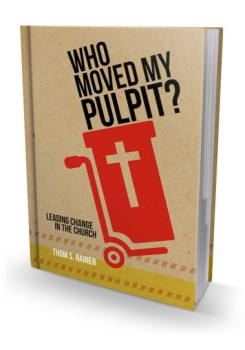 Loved Thom Rainer’s short but extremely helpful book on leading change in the local church called Who Moved My Pulpit? Rainer shares lots of personal & real life scenarios from churches experiencing & going through change. A must read if you are a leader of a church in need of change.
Rainer’s Formula or Process of Leading Change:
- Stop & Pray.
- Confront & Communicate a Sense of Urgency.
- Build an Eager Coalition.
- Become a Voice & Vision of Hope.
- Deal with People Issues.
- Move from Inward Focus to an Outward Focus.
- Pick Low Hanging Fruit.
- Implement & Consolidate Change.
Lot’s of great how to info for each point of the process.
A few of my favorite quotes:
- “I have never seen successful and sustaining change take place in a church without prayer. Never. Not once.”
- “Coasting is for leaders who have stopped leading. But true change leaders expend a tremendous amount of effort. They face challenges and conflicts regularly. They have discouraging setbacks.”
- “Effective change leadership in the church will not take place in human power; it can only come from God.”
- “Too many of our church members treat their congregations as a religious country club. They pay their dues and expect to be served. It’s a “me-first” attitude that is endemic in the unhealthy churches in America.”
- “If you are not being criticized, you are not leading.”
- “If you know you have to make a difficult decision with someone, don’t delay. The situation will only worsen.”
- “Great leaders are transparent leaders. Great change takes place when the leaders are transparent.”
- “If you want to be comfortable, don’t lead change in the church. If you don’t want to be criticized, don’t lead change in the church. If you never want to put your paycheck at risk, don’t lead change in the church.”
Must read it you are one of the vast majority of pastors & churches in need of change across America. Can be read in a day or two & immediately applied whatever your situation. Resource Kit & more available with the book HERE. Get it on Amazon HERE.


 Lane Corley