Author Archives: Lane Corley
“Dad, are you almost finished with the Bible?”
 Question from Hudson, our 7 year old a few weeks back. Led to a great conversation about the fact that even though dad is a VERY slow reader, we never FINISH the Bible. God’s truth are meant to be digested over a lifetime. They’re our nourishment (Matthew 4:4), our directives (John 14:21), our curriculum (2 Timothy 3:16-17, Matthew 28:18-19), our protection (Psalm 119:9), & so much more.
Grateful to God for giving us His word. The more I know it, the more I realize I need Him everyday.
If you’ve never started a journey of discovering God through the Bible, check out this short resource from Bridge Church called How to Get a Grip on the Bible. It will guide you through FAQ’s, then some habit & practices to develop that could lead you to a vibrant devotional life with God.
The Importance of Initiating New Relationships
From our Basic Training for Church Planting module on Context & Cultivation:
Billy Graham once said that it takes 20 people to lead someone to Christ. The first person thinks they had nothing to do with it. The last person thinks it was all him. The work of cultivation was those first 19 people. And if they’re not careful, they can think their effort was all for nothing.
Smile. Learn to say, “Hello!” Introduce yourself. Be interested in others. Bake cookies for the new neighbors. Get involved in a community organization. If it takes 20, somebody has got to be #1.
On Evangelism – Research says, A Personal Approach Works Best
Great article on evangelism from Facts & Trends Mag – Go + Tell: Taking a Personal Approach to the Gospel:
“If you know how to pray, if you know how to be a friend, if you know how to help people experience God, and if you have learned how to tell the story of the gospel, you can do evangelism,” he (John Teter) says.
When it comes to evangelism, that kind of personal approach works best, according to a 2009 report from LifeWay Research. Most Americans are open to hearing about faith from a friend or neighbor (56 percent), or from a family member (63 percent).
Other approaches seem to turn off most Americans. Three out of four (76 percent) say they are unwilling to hear about matters of faith from people going door to door. Americans are also unwilling to receive spiritual information from door-hangers (66 percent), a letter in their mailbox (55 percent) or social media (66 percent).
Less than half are interested in a TV ad (40 percent) or radio spot (41 percent) on faith.
A personal approach is also a better way to invite people to church. Nearly two out of three (63 percent) Americans surveyed say a personal invitation from a friend or neighbor was an effective way to be asked to visit a church. An invitation from a family member was rated as effective by 67 percent of those surveyed.
Less than a third (31 percent) say a door-to-door invitation would be effective. Radio (33 percent) and TV (34 percent) also received low ratings. So did email (30 percent) and social media (30 percent).
About half (52 percent) say they might visit a church after receiving a postcard on a topic that interested them.
Time of year and current events also impact Americans’ openness to spiritual conversations. Americans were most open to matters of faith at Christmas (47 percent), Easter (38 percent) or after a natural disaster (34 percent). They were least open in summer (11 percent) or fall (11 percent).

What is Lent? “The Season of the Cross”
 This week marks the beginning of a major religious celebration around the world called Lent. In our area it means FRIDAY’S ARE FOR SEAFOOD! What is Lent exactly? In Brief:
For Roman Catholics, the Eastern Orthodox Church, and other liturgical protestant denominations (those with a continuous history before AD 1500) Lent is the forty day period from Ash Wednesday to Holy Saturday. It is to be a season of soul-searching and repentance. It can be loosely traced to the early days of the church, but was certainly less formal (most scholars believe the time of fasting was two to three days and not forty) and of course much more spiritual. Lent, as we know it today, originated in the fourth century and has changed in practice throughout the years. In AD 325, the Council of Nicea discussed a forty day season of fasting and preparation for new converts to be baptized. In the seventh century, Gregory the Great moved the beginning of Lent from Sunday to Wednesday, now called Ash Wednesday. He is also credited with beginning the ceremony of marking foreheads with ashes, as a symbol of repentance taken from the Old Testament. The practice of fasting during Lent has become more relaxed over the centuries and in 1966, the Roman Catholic Church restricted fast days to Ash Wednesday and Good Friday.
Having moved to South Louisiana just 10 years ago, I have observed that Lent is practiced but not understood by many. Even many irreligious people will give up something of value (if you count chocolate, certain adult drinks, coffee, or some other modern convenience that doesn’t really affect a person’s way of life as valuable) and will abstain from meat on Friday. When asked the purpose behind this, the person will say, “I’m not sure,” or take a great guess that would fool everyone if they were playing the board game Balderdash. Herein lies the problem with modern spirituality – it’s long on activity and short on meaning and understanding.
Too often we use religious expression, such as Lent, as a means to fit in, to feel better about ourselves, but not to understand and conform to God’s desire for our lives. In many ways Lent illustrates our lack of understanding about God and His will for humanity. Many people give up for forty days what they know they shouldn’t be doing anyway. In the 2002 movie 40 Days and 40 Nights, a single man vows to stay celibate during Lent, but meets the girl of his dreams and regrets being unable to rebel against God’s commands concerning sexual purity (1 Thessalonians 4:3-8) and to “let the marriage bed be undefiled” (Hebrews 13:4) until Lent is over. As this movie illustrates, some people may see Lent as a window of time to be serious about their faith. I tend to believe God deserves and expects 365 days of devotion and obedience, not just forty.
A somber season of soul-searching and repentance, which includes fasting, is necessary for our generation. I don’t search my soul when I give up my favorite commodity but when I understand and get a glimpse of what God has done for me through Jesus Christ. His suffering, His sacrifice, and His love should make us forget modernity for awhile and focus ourselves on repentance and new life that Christ’s death and resurrection make possible.
So how should we view Lent? One 19th Century preacher called it “The Season of the Cross.” I like that. It’s the cross that is the centerpiece of our faith (1 Corinthians 15:3) and it’s the cross that we are called to carry (Luke 9:23). So, join me during the season of the cross and do more than just mark your calendar and do without some material luxury. Let’s increase our awareness of Christ’s love and His desire for our lives. We may find ourselves gaining more, spiritually, than we could ever give up in 40 days.
How to Plant a Church Without Losing Your Family
 Great list for anyone in ministry or not, by Brian & Amy Bloye in their new book It’s Personal: Surviving and Thriving on the Journey of Church Planting.
- Do what is important, not what is urgent. “If you try to make everyone happy, the ones who lose out will be the ones your know will forgive you: your spouse and your children.”
- Bring fun and adventure into your relationship. “when wives of pastors get involved in extra-marital affairs, it tends to be because the other man was someone who was fun to be with.”
- Take time off every week. “Sometimes it appears that you can’t afford a day off; the truth is, it’s the other way around. You can’t afford not to take a day off.”
- Keep intimacy a priority.
- Focus on being a team.
- Find your significance & security in Christ. “We were created, as human beings, to find our meaning not in what we do but in what God has done for us.”
- Make time for meaningful communication. “Get the conversation rolling…keep your ears unclogged – listen attentively.”
- Help your spouse go as far as he or she can go. Don’t put extra weights on him or her. Help him feel light and fast in the race of life.
- Share your spiritual lives with each other. The pastor shares his spiritual journey from the stage. Do it at home as well.
- Make your spouse your project. Get to know her strengths and weaknesses, love languages, keep a prayer list of her needs. etc.
- Set meaningful boundaries. “people come and go, and even staff come and go, the only constants are God and the two of us; to lose us is to lose everything…”
This book is really helpful. Looking forward to sharing it with church planting friends.
You Might Be A Church Planter if… part two
Yesterday I shared five observations that are likely true of someone who’s a fit for church planting. Here’s five more simple observations that say, “You might be a church planter.”
 6. You get a kick out of calluses on your hands. Church planting is hard work. Gathering & motivating people can seem like pushing a rock up hill. Setting up church in non-traditional locations is not easy. If you are afraid of physical & emotional calluses & soreness then run the other way. Some go into church planting to avoid what they perceive as hard things in church leadership, but you’ll find many of the same things plus some in church planting. Make sure its a calling.
7. You’ve shared the gospel more times than you can remember. Sharing the gospel must be a natural part of the church planters life & vocabulary. A church is a church because of the Gospel & the Gospel must be shared. The church planter must lead the way.
8. Friends call you with spiritual questions. Leadership is innate & merely recognized by others. Do people see in you something that they want & need? Do people seek you out when there are questions about life & God? As a church planter you’ll probably be without title, position, & respect. Your character & ability to earn the respect of people because of leadership ability will be important.
9. You usually travel with a group. You are more comfortable in a group & with a team, a posse. You will not be able to do this alone. Church planters must love people & believe that everyone is better off sticking together. Lone Ranger Church Planter is an oxymoron.
10. You daydream about solving big problems in the world. North Korea, the crime ridden multi-housing complex down the street, the high school dropout problem, etc. These issues may cause you to stare off into the future & make list in your mind about how you would go about reaching people & changing the places with the greatest problems.
If this list still doesn’t talk you out of it, find out a little more about next steps here. And feel free to hit me up (lanecorley@gmail.com). I’d love to help you get started on the church planting journey.
Church and Technology Roundtable
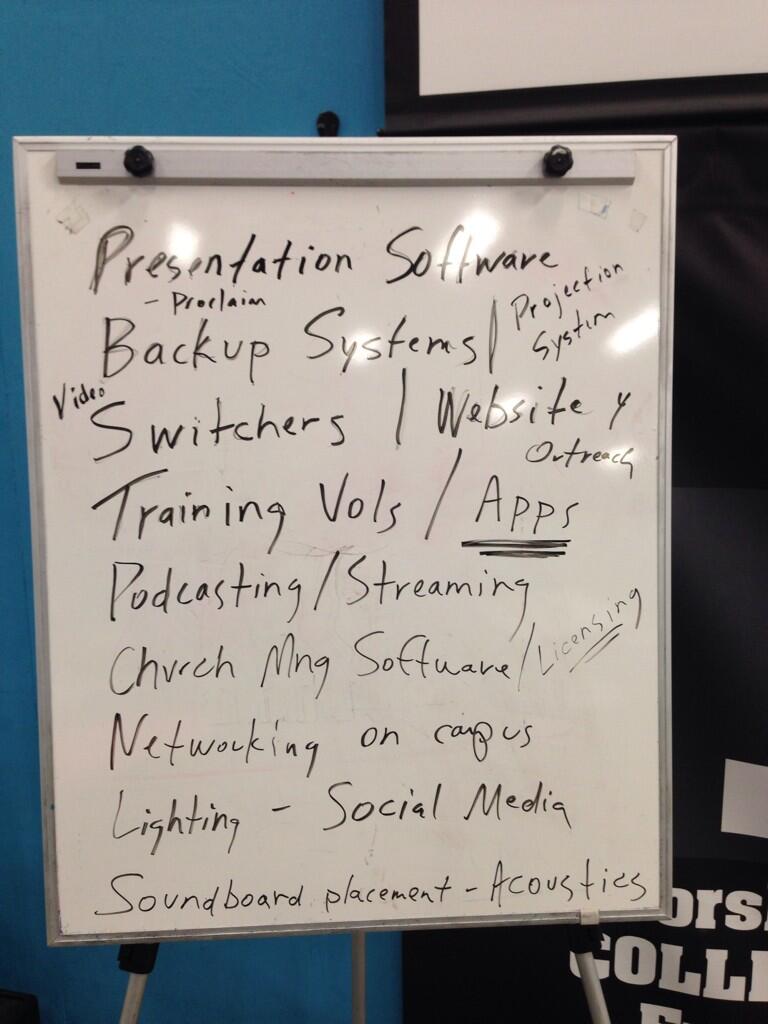 Spent some time today roundtable-ing with ministry leaders in the Northshore Baptist Association around the topic of technology. Thanks to Louisiana Media Group for leading & providing rich content on a variety of topics, AND for providing lunch for our gathering. We also heard from Magnolia Development Group on Web & Social Media questions. These are two trustworthy companies working together to provide affordable, accessible solutions for church tech issues. Joe McCarty, Tech Associate with The Village Church in Dallas, and Brandon Cox, editor of Pastors.com & author of Rewired, spent some time with us as well. They both reiterated the importance of getting on top of mobile development.
A few resources & sites mentioned during the roundtable that you might want to check out:
- ChurchTechToday.com
- 78p.tv
- CovenantEyes.com/blog
- Rightnow.org
- MinistryGrid.com
- ChurchLinkApp.com
- The Experience Conference
- BrandonACox.com
- Pastors.com
- FellowshipOne.com
- Elexio.com
- ChurchOfficeOnline.com
- Platform: Get Noticed in a Noisy World by Michael Hyatt
- Rewired: How Using Today’s Technology Can Bring You Back to Deeper Relationships, Real Conversations, and the Age-Old Methods of Sharing God’s Love by Brandon Cox
Technology is affecting ministry in many ways. Great discussions today about how to utilize technology without going broke or crazy.
How has technology helped or hurt your ability to reach people for Christ? What’s the big tech issue you’re facing right now?
You Might Be a Church Planter if…
 Church planters are seen as a rare breed in the body of Christ, but I don’t think they’re as rare as we think. God calls & empowers people for this important role. Many times they’re just not discovered or mobilized because we’re not looking to discover or mobilize them. Knowing church planters & being one, here’s an observational list that you may find true of yourself if you’re thinking you may be a fit for church planting. Not saying all of these have to be true, but they may be true.
1. You made a lot of visits to the ER growing up. Church planters are risk takers at heart & this probably started early. The desire to jump off of, over, or go through any obstacle to the detriment of personal health is often a characteristic of pioneering church planters.
2. You can’t concentrate in church because of the kids you saw playing in the street on the way. You’re heart will be with those who are NOT in church on Sunday’s. At times it may consume you to the point that you seem at odds with church leaders. God may put that discontent there if he’s leading you to those outside the camp. (See my post on Sending the apostles).
3. You think Chic-Fil-A would be a good place for a church. If you find yourselves in different environments & believe that spiritual life could happen there you might be a church planter. The imagination of the church planter is usually full of ideas about creating environments to share the gospel. The new churches I have been involved in have met in apartment complex offices, a fire station, a former bar, a local gym, & a museum. Doesn’t make sense? Made perfect sense to me! And worshipping in Chic-Fil-A on Sunday is a dream of mine!
4. You hang out with the wrong kind of people for the right kind of reasons. In college, I didn’t play intramural ball with my collegiate ministries intramural teams. I had a desire to use the skills I had to build relationships with non-Christians. The church planter will often be energized more by these relationships than relationships in Sunday School. But get ready…
5. Your Christian friends think your weird for that. You may even be labeled by religious friends for hanging around sinners & disreputable characters. But seems like I saw someone in the Bible that had the same thing happen. Mark 2:13-17.
Five more later this week… If you’re seeing these patterns in your life. Contact me (lanecorley@gmail.com) about how to get started on the Church Planting journey.
How to Get a Grip on the Bible
 The Bible contains sixty-six books, written in three languages (Hebrew, Greek, & Aramaic), over a period of more than a thousand years, by more than forty authors on three continents. Authors of the Bible include kings, peasants, philosophers, farmers, fishermen, poets, statesman, & scholars. The books of the Bible cover history, sermons, letters, songs, geographical surveys, architectural specifications, travel diaries, genealogies, & legal documents. It covers hundreds of controversial subjects with amazing continuity. It’s the best selling book of all time & is now available in nearly three thousand languages. So what’s the big deal about the Bible?
When you & I read the Bible, we can hear directly from God.
Check out the latest message at Bridge Church in Madisonville on The Bible & the Bridge Church “How to” called How to Get a Grip on the Bible that answers some FAQ’s about the Bible and leads you to six simple practices that can help you Get a Grip on the Bible.
13 Things I Found Useful in 2013
Here’s my list of things that made life easier this year. Share yours or any upgrades so we can both make the most of 2014.
- Feedly – My new newspaper is my online feed reader. When Google Reader went down, I jumped onto Feedly & love it. If you do any reading online, try it out. And now the App allows you to read your feeds on any device. The Chrome Extension allows easy content adding.
- Delicious – I’ve been using Delicious for a few years now. Allows you to save articles online in your own data base. Greatly beneficial for sermon preparation. Also, now catalogues all your online activity including facebook, twitter, & instagram posts, etc. Also available as an app, so your catalogued articles & posts are available to you on the go. The Chrome Extension allows for quick tagging of articles & pages.
- YNAB – We started out with Microsoft Money, then jumped to Quicken for our household financial management. Got tired of the updates, so I looked into some cloud based solutions. We’ve used YNAB for a year now & love it. The app makes it easy to record purchases when you make them or check the budget while you’re in the store.
- Mailchimp – Tried almost all the others & found Mailchimp far easier, more affordable. Now doing about 5 e-news pieces each month & looking to add more this year.
- Dollar Shave Club – $6 a month for raisers, mailed to your house automatically. Heard about this during a church marketing training & decided to try it. Satisfied customer.
- All Pro Dad – I think one of the most challenging things I’ve done is be a dad. Love it, but as my boys get older, I find my inadequacy often. Lots of great encouragement & resources at AllProDad.com.
- YouVersion.com – Best Bible Study resource online & in the App Store. Love to use it to scan different translations when I’m doing my morning devotions. Also, love the easy sharing features for texting encouraging verses to friends & sharing on social media networks.
- Church Planter Magazine – Found Peyton Jones book Church Zero this summer & loved it. Found his podcast & digital mag soon after. Great resource for planters & planting leaders.
- BBC World News Podcast – In search of serious news from a world wide perspective, I love downloading the BBC Podcast in the mornings & listening while getting ready or commuting. So many things we miss with American media’s fascination with what the stars are eating for breakfast, etc.
- Allowance Manager – Helps manage allowances, while teaching budgeting, saving, wise spending to kids. They can have an app on their gaming devices that allows them to check their balance & learn to love managing money.
- Evernote – I’m not using this near to its potential, but love to be able to take notes & have them on all my devices or type ideas on my phone while I’m waiting in the barber shop. Best note taking & info saving advice there is.
- Plugged In Online – I’ve never been interested in video games & don’t read a lot of entertainment news. And my boys generation is devouring games online & on devices like crazy. Plugged in Online provides reviews of games, music, & movies from a Christian perspective. Saves a lot of time when you get, “Hey dad, can I download this game?”
- Lose It – Ok. I love & hate lose it. Allows you to keep up with calorie intake & exercise. Every New Year we get reacquainted. Gonna use it all year this year :)).
What hacks, tips, & tricks made you’re life easier in 2013? Would love to know. I need all the help I can get.


 Lane Corley