Yearly Archives: 2013
What is Lent? The Season of the Cross
This week marks the beginning of a major religious celebration around the world called Lent. In our area it means FRIDAY’S ARE FOR SEAFOOD! What is Lent exactly? In Brief:
For Roman Catholics, the Eastern Orthodox Church, and other liturgical protestant denominations (those with a continuous history before AD 1500) Lent is the forty day period from Ash Wednesday to Holy Saturday. It is to be a season of soul-searching and repentance. It can be loosely traced to the early days of the church, but was certainly less formal (most scholars believe the time of fasting was two to three days and not forty) and of course much more spiritual. Lent, as we know it today, originated in the fourth century and has changed in practice throughout the years. In AD 325, the Council of Nicea discussed a forty day season of fasting and preparation for new converts to be baptized. In the seventh century, Gregory the Great moved the beginning of Lent from Sunday to Wednesday, now called Ash Wednesday. He is also credited with beginning the ceremony of marking foreheads with ashes, as a symbol of repentance taken from the Old Testament. The practice of fasting during Lent has become more relaxed over the centuries and in 1966, the Roman Catholic Church restricted fast days to Ash Wednesday and Good Friday.
Having moved to South Louisiana just 10 years ago, I have observed that Lent is practiced but not understood by many. Even many irreligious people will give up something of value (if you count chocolate, certain adult drinks, coffee, or some other modern convenience that doesn’t really affect a person’s way of life as valuable) and will abstain from meat on Friday. When asked the purpose behind this, the person will say, “I’m not sure,” or take a great guess that would fool everyone if they were playing the board game Balderdash. Herein lies the problem with modern spirituality – it’s long on activity and short on meaning and understanding.
Too often we use religious expression, such as Lent, as a means to fit in, to feel better about ourselves, but not to understand and conform to God’s desire for our lives. In many ways Lent illustrates our lack of understanding about God and His will for humanity. Many people give up for forty days what they know they shouldn’t be doing anyway. In the 2002 movie 40 Days and 40 Nights, a single man vows to stay celibate during Lent, but meets the girl of his dreams and regrets being unable to rebel against God’s commands concerning sexual purity (1 Thessalonians 4:3-8) and to “let the marriage bed be undefiled” (Hebrews 13:4) until Lent is over. As this movie illustrates, some people may see Lent as a window of time to be serious about their faith. I tend to believe God deserves and expects 365 days of devotion and obedience, not just forty.
A somber season of soul-searching and repentance, which includes fasting, is necessary for our generation. I don’t search my soul when I give up my favorite commodity but when I understand and get a glimpse of what God has done for me through Jesus Christ. His suffering, His sacrifice, and His love should make us forget modernity for awhile and focus ourselves on repentance and new life that Christ’s death and resurrection make possible.
So how should we view Lent? One 19th Century preacher called it “The Season of the Cross.” I like that. It’s the cross that is the centerpiece of our faith (1 Corinthians 15:3) and it’s the cross that we are called to carry (Luke 9:23). So, join me during the season of the cross and do more than just mark your calendar and do without some material luxury. Let’s increase our awareness of Christ’s love and His desire for our lives. We may find ourselves gaining more, spiritually, than we could ever give up in 40 days.
Our church will be going through The Explicit Gospel Series during this season. Pick up a book or devotional guide this Sunday.
The Bible on Partying
“These are the Lord’s appointed festivals, the official days for holy assembly that are to be celebrated at their proper times each year” ~ Leviticus 23:4.
It’s unfortunate that Christianity is often seen as an un-Party. Christians often leave their party lifestyles and join churches where we do socials instead of celebrations. Unfortunate because God used Celebration and Festivals and Parties to reveal much about Himself and His Messiah throughout scripture. While some of these festivals were somber occasions for soul searching and repentance, there were also occasions where God called his people to elaborate celebration of His work on their behalf.
There is one BIG DIFFERENCE in a real Christian celebration than the world’s parties:
The world parties to FORGET and ESCAPE reality. Christ followers party to REMEMBER and CELEBRATE present and future reality.
Here’s a brief overview of the Old Testament Festivals, what they celebrated, and why they were important:
- The Sabbath – Lev 23:1-3. One day each week. A time of rest from work celebrating God’s rest at the end of creation week.
- The New Moon – Numb 28:11-15. One day each month. Celebration that included special offerings and blowing of trumpets.
- Passover – Lev 23:5. One Day. Celebrated when God spared the lives of Israel’s firstborn children in Egypt and freed the Hebrews from slavery. Reminded the people of God’s deliverance.
- Unleavened Bread – Lev 23:6-8. Seven Days. Celebrated the Exodus from Egypt. Reminded the people the were leaving the old life behind and entering a new way of life.
- First Harvest – Lev 23:9-14. One Day. Celebrated the first crops of the barley harvest. Reminded the people how God provided for them.
- Harvest or Pentecost – Lev 23:15-22. One Day. Celebrated the end of the barley harvest and beginning of the wheat harvest. Gave the people an opportunity to thank God and throw a party over the harvest.
- Trumpets – Lev. 23:23-25. One Day. Celebrated the beginning of the civil new year. Expressed joy and thanksgiving to God for the past year.
- Day of Atonement – Lev 23:26-32 One day. Celebrated the removal of sin from the people and the nation. Provided restored fellowship with God.
- Shelters – Lev 23:33-43. Seven Days. Celebrated God’s protection and guidance in the wilderness. Served as a time for people to renew their commitment to God and their trust in His guidance and protection.
These celebrations formed the story of the peoples lives, led them in celebrating God’s character and revelation, and provided a foretaste of what was to come in Christ.
Jesus often used these festivals and times of celebration to reveal Himself. It was the Festival of Shelters or Booths that Jesus used as the backdrop of several big reveals about Himself. This was a 7-day party, which celebrated God’s protection and guidance of the Israelites during their flight to the wilderness. And by all accounts this was an awesome celebration. The Roman Historian Josephus referred to this festival as the greatest of the Hebrew celebrations.
Living Water. The event climaxed with a water event at the pool of Siloam. The people would parade, with loud music, from the Temple to the pool where the priest would fill up a pitcher with water. They would then parade back to the Temple, approach the altar and pour the water along with a pitcher of wine into two basins as a thank offering to the Lord for his provision. An ancient Rabbi wrote that “Anyone who has not seen this water ceremony has never seen rejoicing in his life.” It was either at the pool or at the temple pouring ceremony that John 7:37-38 tells us, “Jesus stood and shouted to the crowds, ‘Anyone who is thirsty may come to me! Anyone who believes in me may come and drink! For the Scriptures declare, ‘Rivers of Living Water will flow from his heart.’”
The Light of the World. On the first day of the Festival, the Temple was illuminated with a huge candelabras that stood 75 feet tall, with 16 large blazes that burned throughout the week. This was to celebrate the Pillar of Light that God provided for the people during the wilderness wanderings. Since the Temple was on a hill, everyone could see the light from miles around. During the lighting there would have been loud music, dancing, and parades. It was this setting that most likely played backdrop to Jesus‘ statement in John 8:12, “I am the light of the world. If you follow me, you won’t have to walk in darkness, because you will have the light that leads to life.”
Matthew’s Table. But maybe most instructive for us as Christians, is Jesus’ unscripted parties. The New Testament tells us that after and encounter with Jesus, Matthew, a wealthy Tax Collector turned disciple, threw a party and invited all his friends to meet Jesus (see Matthew 9:9-13, Mark 2:13-17, Luke 5:27-32). And evidently this group would not have been invited to today’s church social. The religious leader actually called them “scum” (Mark 2:16) and Matthew himself calls them “disreputable sinners” (Matthew 9:10). It seems that part of Jesus‘ plan for reaching people was to go where they were, meet them as they are, and be Himself. To practice “active proximity” to those who needed to hear His Good News the most.
Alan Hirsch in his great book Untamed: Reactivating a Missional Form of Discipleship quips, “not only did the social outcasts and sinners want to be around Jesus, but Jesus wanted to be around them.” When we’re seeking to be like Jesus, we’ll be looking for opportunities to reveal Him to the world. Celebration is still one great way. In our day there are still many opportunities. Here’s a few ideas:
- Invite friends to a community celebration around a holiday. Take time to share with individuals or the group how this holiday helps you worship or makes you grateful to God.
- Organize a team to volunteer at a community festival and be available to the non-profit or municipality putting it on. Intentionally build relationships.
- Throw a party in your front yard or back yard and invite neighbors who you don’t know.
- Have people over to dinner. Begin a Matthew’s Table night where you share your home and your table with people that you know who need a second chance or could never hang out at the church socials.
God wants to reveal Himself. He wants to use you. He used celebration in the past and he can today. And who knows how many of those “disreputable sinners” around Matthew’s table became followers of Christ and Church Planters that gathered at festivals and around tables and continued the Jesus story for the rest of their lives. Imagine the possibilities…
Check out the Bridge Church How to guide on Block Parties and begin using celebration to glorify God and reach out to friends and neighbors.
Church Multiplication INSIDE
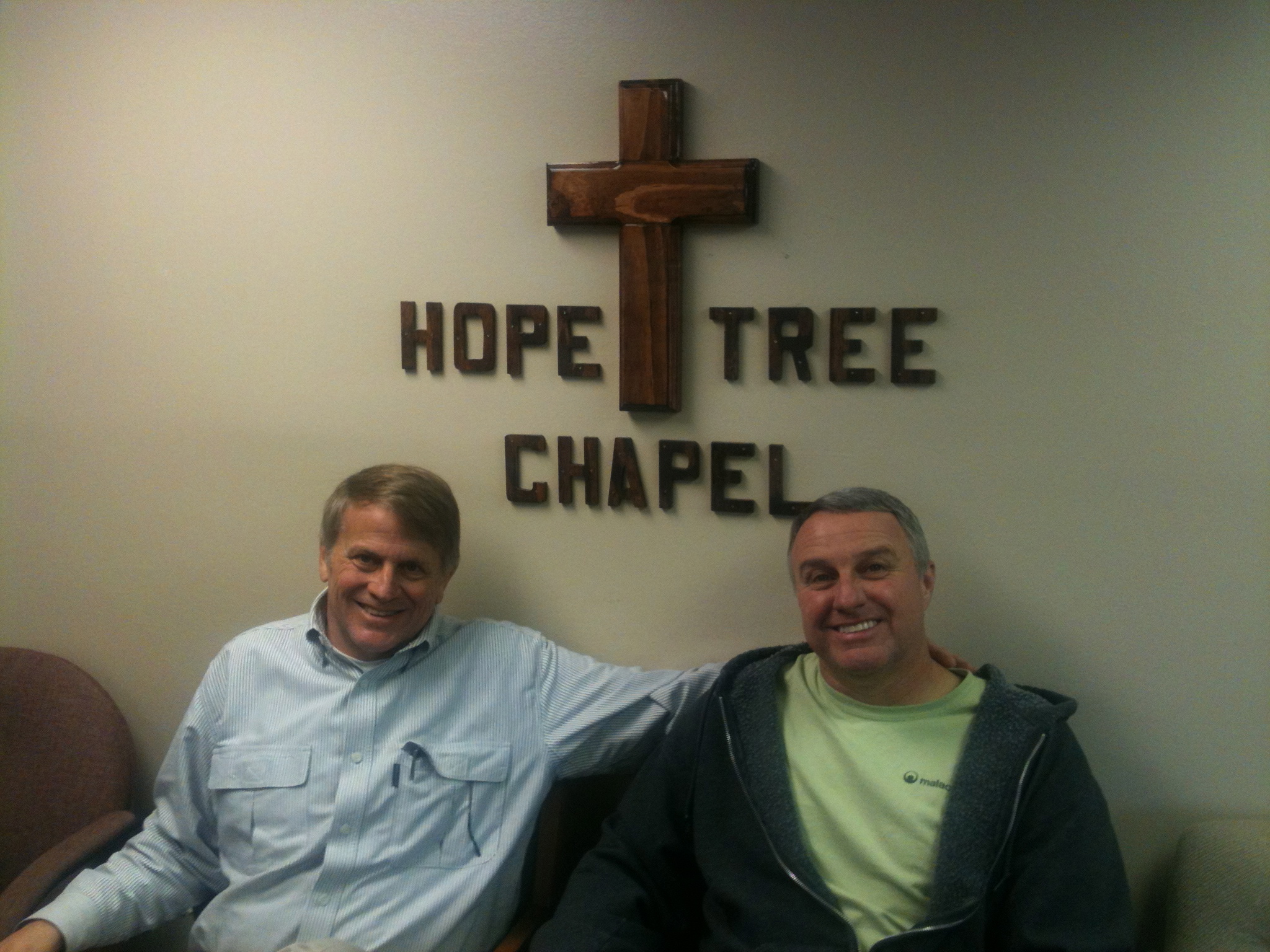
Shane O’Hara (left) director of Team 518. Dave (right), Inmate Chaplain & Church Planter at a South Louisiana Jailhouse.
Dave is now a hero of mine. Met him this week and learned about his church starting endeavor INSIDE one of South Louisiana’s Jailhouses. He served there as an inmate chaplain. He will be released on Friday and will continue his mission on the OUTSIDE. Pray for Dave and others like him who are overcoming and helping others overcome through prison ministry. Pray for the many Inmate Chaplains, reaching out to those INSIDE like none of us can.
If you’re interested in joining men like Dave and being ON MISSION to those in prison, shoot me a line. Laborers are needed to facilitate Celebrate Recovery, Fatherhood classes, Financial Planning classes, Discipleship courses, or help with churches starting INSIDE.
“I was in prison and you came to me” ~ Jesus, Matthew 25:42
Creating More SENDING Capacity
“The greatness of a church is not in her seating capacity, but in her sending capacity” 
I’ve heard this saying over & over again for the past 15 years or so from Pastors and church leaders from all different perspectives of ministry. But I haven’t seen much about how to expand the SENDING capacity of a local church or a real change in strategy to developing SENDING capacity. Both are necessary for a missional movement. How can we understand the difference & add real SENDING capacity to our strategies?
- Seating capacity is about managing the movement of people into relationships. Sending capacity is about managing the movement of people into mission.
- The mission that Jesus gave the church was a SENDING strategy. The Great Commission & the Acts 1:8 Challenge are foundational
- Matthew 28:19 (NLT) – “go and make disciples of all the nations…”
- Acts 1:8 (NLT) – “you will be my witnesses, telling people about me everywhere—in Jerusalem, throughout Judea, in Samaria, and to the ends of the earth.”
- Seating capacity is easier. Not cheaper, but easier. It’s easier to draw a big crowd than to send a lot of people into missional roles in the world. It takes longer & requires different things from the leaders.
- Seating capacity is INSIDE. Sending capacity is OUTSIDE. Serving inside the church is great, but if the only mission opportunities we give people are inside, we fall short of a true Acts 1:8 SENDING strategy.
- Being SEATED is much more comfortable than being SENT. Going to church is for the majority of people, very safe, sanitary, & can be enjoyable. Being SENT requires sacrifice, risk, & a sometimes delayed reward for effort.
- I can be SEATED in my own strength. Being SENT requires the power of the Spirit.
- Being SEATED tends to make much of the leaders. Being SENT makes much of the mission. We hear a lot about the churches & leaders with the most SEATING capacity.
- SEATING capacity is easier to track and clean up after. It’s more static. SENDING strategies are hard to control and can get messy.
Do you see any difference between SEATING capacity and SENDING capacity? How does your church include SENDING in its strategies? What resources do you know about to aid SENDING capacity and SEATING capacity?
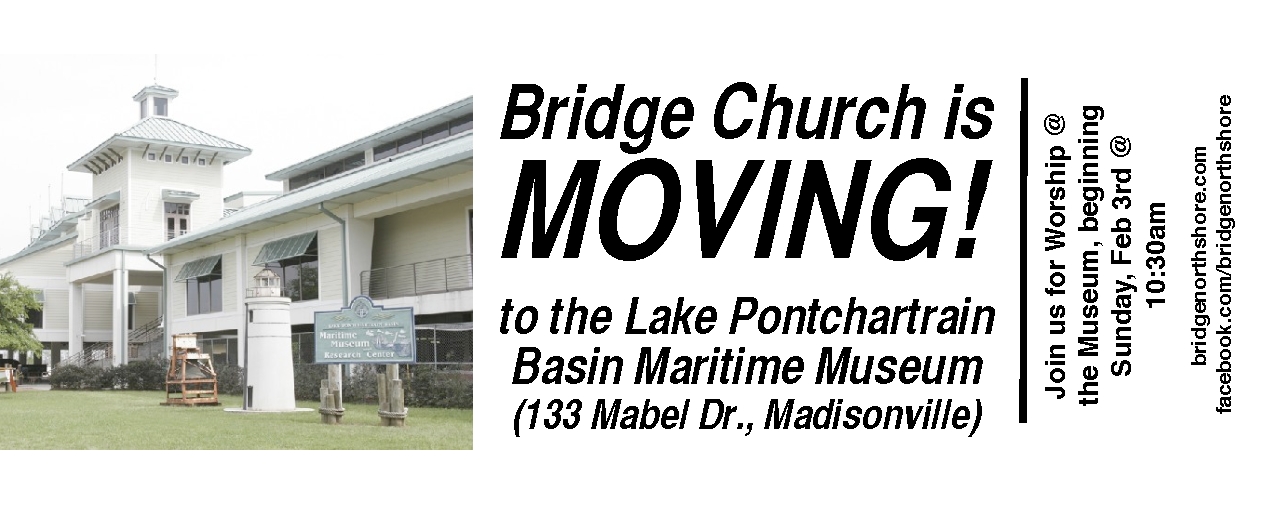
Bridge Church West St Tammany Gathering is Moving! [Video]
Beginning this weekend, February 3rd, Bridge Church will be gathering on Sunday’s 10:30am at the Lake Pontchartrain Basin Maritime Museum in Madisonville (Map It). Come early for coffee & donuts. More info about Bridge Church at BridgeNorthshore.com or Facebook.com/BridgeNorthshore.
Compelled by Generosity
“see that you also excel in this grace of giving” 2 Corinthians 8:7
I’m sold on generosity as a way of life. Few things have opened my eyes and heart to God’s work like giving and seeing others give generously. This statement is so true: “We make a living by what we get, but we make a life by what we give.” I wish I could compel you to generosity as well. OK, I guess I’ll ty:
Giving and Generosity. Why?
1. Because God says to. “Bring the whole tithe into the storehouse…” Malachi 3:10. Proverbs 3:9-10, 1 Corinthians 15:2, 2 Corinthians 9:7. Basic Christianity = Listen to God + Do what He says.
2. Because it opens doors for others. “into the storehouse” Malachi 3:10. The Old Testament storehouse had three functions: to take care of the temple and it’s servants, to take care of the poor and needy, and to spread the glory of God to the unbelieving gentile world. Generosity then and now served to open doors for others to be cared for and experience God’s goodness.
3. Because it opens “windows” for us. “…see if I will not open the windows of heaven for you and pour down for you a blessing until there is no more need” Malachi 3:10. God gives TO us, so that he can give THROUGH us. And He promises to respond when we participate with Him in His mission to the world.
4. Because it produces glory for God. “your generosity will result in thanksgiving to God” 2 Corinthians 9:11. The chief end of man is to glorify God. If that’s your motive then giving will be a way of life. Recently, someone our church helped penned this in a note: “God promised to take care of us, and thank God He always keeps His promises!” Through our generosity, not our hesitation and excuses, another person is giving glory to God. That should be a continuous cycle among His generous people.
5. Because it’s a statement of faith in God to provide. “test me in this” Malachi 3:8. God is able to provide for His peeps. Many times we play it safe in the area of giving, because we believe not in God’s ability, but in our limited capacity to provide for ourselves. So, we and others never get to experience God’s ability.
6. Because God’s a giver and I want to be just like Him. “For God so loved the world that He GAVE…” John 3:16. And as we become more like Him, we will want to give that His glory will be known on the earth.
How can I be obedient to God, open doors of blessing to others, guarantee heaven’s blessings on my household, produce more praise and glory for God in the world, show God and others that I’m a believer, and become more like Christ?
It’s simple: began giving regularly, consistently (2 Corinthians 16:1-2), sacrificially (2 Corinthians 8:9), and cheerfully (2 Corinthians 9:7) toward God’s mission. For my family, that comes in the form of giving monthly to my church (the modern day storehouse), monthly support of missionaries serving in unreached areas of the world, monthly support of orphan causes, and budgeted amounts for spontaneous generosity when God speaks. It’s not always been easy, but I’ve never regretted following God’s path of generosity.
How do I start?
- Pick a % of your income that you can give regular/consistently, that’s sacrificial (for some 10% is not sacrificial), and begin giving it cheerfully to your church.
- Ask God to open your eyes to needs around you and listen. When God shows you a need don’t just hope SOMEBODY ELSE will help. Respond with generosity and watch God work in and through you.
- Become a better manager in every area of your finances. Generosity takes intentionality. What are you spending money on that can be considered waste? Ask God to show you how you can be a better manager of His provision.
Do You Believe God’s Promise to Provide?
The world has been in crisis since the Fall of Creation (Genesis 3). Impending doom, economic uncertainties, and causes for handwringing have been the norm for residents of planet earth for most of our history. But another common occurrence, has been that men and women, boys and girls have been able to cry out to God in the midst of uncertainty and hardship and find help. God HEARS, God SPEAKS, and God PROVIDES for people who will humble themselves and trust Him.

Our church has been studying God’s Promises to Hear, Speak, Provide this month in a series of sermons called In His Hands. This week we talked about God’spromise to provide. Here’s a few verses we looked at, along with a checklist that can be used to check how you do in the area of believing this promise.
Psalm 37:25 – “I have been young, and now am old, yet I have not seen the righteous forsaken or his children begging for bread.”
Psalm 55:22 – “Cast your burden on the Lord, and he will sustain you…”
Philippians 4:19 – “my God will supply every need of yours according to his riches in glory in Christ Jesus.”
Romans 8:32 – “He who did not spare his own Son but gave him up for us all, how will he not also with him graciously give us all things?”
Hebrews 13:5 – “Keep your life free from love of money, and be content with what you have, for he has said, ‘I will never leave you nor forsake you.'”
DO I BELIEVE GOD’S PROMISE?
1. Prayer & Praise vs. Worry – Is it instinctive for you to pray and praise when difficult times come or worry and wring your hands? Philippians 4:6-7, Matthew 6:25-32. I contend that worry is essentially the opposite of prayer. Give the burden to God instead of keeping it in your heart and mind. The result will be God’s glory and less heartburn.
2. Christ First vs. Me First – Do you live with a God’s will and Jesus as Lord, or with the goal of meeting all your earthly desires? Matthew 6:33 says seeking God’s kingdom first opens the door for God’s provision. We live with much common grace, like rain which falls on the righteous and unrighteous. But God promises to provide supernaturally for those who seek Him first.
3. God provides vs. My Hard Work – Complete this sentence: “What I have comes from…” Two ways to answer: “…my hard work.” or “…from the hand of God.” If you believe God’s promises, you will believe James 1:17, which says “Every good and perfect gift is from above…”
4. Generosity vs. Safety – God gives TO us because He desires to give THROUGH us. Generosity is a product of believing God and wanting to see Him glorified. And generosity is a result of believing God is and will provide. God even tells us to test him in this in Malachi 3:8-10, where he says that generosity will open the “windows of heaven” upon our lives.
5. Horizontal Living vs. Vertical Living – Believing God’s promise means we believe that when we give, work, fellowship, etc., we do it toward God, not just man. When I put money in the offering basket at church, I’m not just giving it to pay my church’s bills. I’m giving vertically, so that God will be glorified and His kingdom will grow. When I give my best at work, I’m working to glorify God, not just make my employer happy. Believing God’s promise means we see all of our lives in relation to God providing and God receiving honor and glory.
10 Biblical and Practical Ways to Get Involved in Church Multiplication
 There’s no right or wrong way to support church multiplication in North American and beyond. I like this list. Don’t let failure of imagination or the excuse, “I don’t know how”, keep you and your church from engaging the lost through church planting and multiplication.
- Engage in strategic intercessory prayer – Proverbs 16:3.
- Adopt a church planter and his family – Philippians 4:14-15.
- Contribute to the financial needs of a church plant – Acts 11:29.
- Provide materials and equipment for a new church – Acts 11:30.
- Share your campus facilities with a new church – Acts 3:6.
- Serve on a church planting mission trip – Acts 12:25.
- Discover unreached or under-reached people in your community – Matthew 28:19.
- Start an outreach Bible study that could become a new church – Acts 16:32.
- Send people and families to help a church get off the ground – Acts 13:2-3.
- Mentor Church Planting leaders – Philippians 2:22.
We are Wired for Worship, but…
our worship terminates on the shallow and vacuous.
We have a war going on, and a good portion of the world is in an unbelievable mess of poverty, famine, civic unrest, and violence. And yet if you turn on the new in the United States you will be far more likely to hear about the daily activities of pop stars and actors or how much money an athlete is making and who he’s dating than anything meaningful. Surely anyone can see that our worship switch is always set to On, and we’re tuned to some ridiculously finite broadcasts. Grown men paint their bodies and surf an incalculable number of websites to follow a sports team – significant emotional energy poured into the physical abilities of children in a game. Go to any concert and you’ll see people lift their hands spontaneously and clap and close their eyes and be spiritually moved by music. People fish or hike to be in tune with nature. We put posters on our walls, stickers on our cars, ink under our skin, and drugs into our system. We do all of these things and others like them, pouring ourselves automatically and quite naturally into what is decaying. We want to worship something. Worship is an innate response. We are wired for it by God himself.
But something has gone wrong with the wiring.
Matt Chandler , in The Explicit Gospel
What is your worship directed at today?
“… when you pray… And when you fast” ~ Jesus, Matthew 6:5, 16
Jesus seemed to assume that prayer and fasting would be a part of the lives of his followers. He didn’t say “if” but “when.” With his assumptions we see again that spiritual disciplines were not just meant for the clergy, but for everyone. This month, Bridge Church will be participating with other churches in Louisiana in 21 Day’s Prayer and Fasting for Spiritual Awakening. With that in mind, here’s some basics on fasting from a few of my favorite books on the subject of prayer.
From Celebration of Discipline by Richard Foster:
- Fasting refers to abstaining from food for spiritual purposes. It’s not a hunger strike or a form of dieting. Biblical fasting always centers on spiritual purposes.
- Fasting must forever center on God. It must be God-initiated and God-ordained.
- More than any other discipline, fasting reveals the things that controls us. We cover up what is inside us with food and other good things, but in fasting these things surface.
- In Scripture the normal means of fasting involves abstaining from all food, solid or liquid, but not from water (Luke 4:2).
- Sometimes a partial fast is described. Like Daniel, “I ate no delicacies, no meat or wine entered my mouth” (Daniel 10:3).
Isaiah 58 is one of the best resources on fasting in the Bible. Tom Eliff in his great book, A Passion for Prayer shares an outline with us on improper and proper motivations for and the promised benefits of fasting:
Four Improper Reasons for Fasting:
- Fasting to get God’s attention (Isaiah 58:3a).
- Fasting w/o focusing on the Lord (Isaiah 58:3b).
- Fasting w/o humility of heart (Isaiah 58:4).
- Fasting for a brief external show of piety (Isaiah 58:5). Jesus spoke against this as well in Matthew 6:16-18.
Proper motivations for fasting (Isaiah 5:6-7):
- To bring spiritual liberation and freedom.
- To relieve heavy burdens.
- To increase our awareness of the needs of others.
God’s promised benefits for those who fast sincerely and seriously:
- Insight and understanding (v. 8)
- Physical well-being (v. 8)
- A deep sense of what is right (v.8)
- God’s presence to protect and provide (v. 8)
- A sense of immediate access to God (v. 9)
- Release from spiritual oppression (v. 10)
- Real-time guidance from God (v. 11)
- Satisfaction and joy during difficult times (v. 11)
- Increased strength to accomplish the Lord’s work (v. 11)
- Fruitfulness (v. 11)
- Recovering and restoring culture (v. 12)
- Rebuilding what was destroyed (v. 12)
Some Options for introducing fasting into your life:
As you consider fasting, before conducting an extended, lengthy complete or total fast from all food, consider your past health and conditioning and some of you may want to consult a doctor. Consider your work. If your work is rigorous then you need food for energy to give your best to your employer. A complete fast may not be for you at this point. Here are a few other options:
- One meal each day—The fast is not about only giving up food, but also includes praying during mealtime. Jesus said, “Could you not watch with me one hour?” (Matthew 26:40). It takes about an hour to prepare a meal or travel to a restaurant or get ready to eat. So this time is a perfect opportunity to pray. Those who work in hot exhausting jobs cannot fast completely because they need their strength and stamina for physical exertion. However, they can sacrifice one meal a day for the Lord.
- Two meals each day—Some people can pray for two hours each day, sacrificing two meals to the Lord.
- Eat only veggies—The Daniel Fast involves giving up meats, desserts and snacks, eating only the food that Daniel most likely ate. While the fast doesn’t give extra time to pray, it is a commitment of the heart that when joined with prayer, moves the heart of God.
- Give up television—Secular people might laugh at “fasting television” or “sacrificing television” but it is a commitment to God to place loyalty to Christ first above all else. This is a spiritual choice in response to Christ, who promises, “Seek first the kingdom of God and His righteousness, and all these things shall be added unto you” (Matthew 6:33).
- Give up sports—Giving up bowling league, golfing, fishing, jogging or other activity for a season (such as 40 days) to pray during that time is a choice. It places spiritual exercise above physical exercise.“Bodily exercise profits little, but godliness is profitable for all things” (1Timothy 4:8).
- Give up pleasure reading—Beyond what you must read for your work or preparing for teaching the Word of God, pleasure reading could be turned into prayer time. You could consider laying aside reading the daily newspaper too.
- Restrict mobile phone use and text messaging—While some of these communication devices are necessary, they are serious time robbers that could be placed aside for praying.
- Facebook and other social media—These activities can consume huge chunks of time. Part of a fast could be to cease social media and use the time for prayer and intercession.
- Other—There may be something that the Holy Spirit brings to mind that you could place aside for a season while you focus on more prayer.
The Daniel Food Fast
Also check out www.ultimatedanielfast.com & www.danielplan.com/ for info, recipes, & more.
The Daniel Food Fast is a very healthy way to eat. So health professionals will support this eating plan but might suggest a few modifications if you have health issues that need special attention. For example, pregnant and nursing mothers might get instructions to add fish, chicken and cheese into the Daniel Food Fast but otherwise stay the course. Diabetics may need to add more carbohydrates or include chicken and fish. Also, those who are especially active either through sports, bodybuilding or vocation may need to slightly alter the eating plan. I encourage you to check with your doctor . . . and by the way, being addicted to Snickers and Coke don’t count as a special need!
What is the Daniel Food Fast?
The Daniel Food Fast is a biblically based partial fast. It is a method of fasting that men, women and young people all over the world are using as they enter into the spiritual discipline of prayer and fasting.
There are two anchoring scriptures for the Daniel Food Fast. In Daniel 1, the Prophet ate only vegetables (that would have included fruits) and drank only water. So from these scriptures we get two of the guidelines for the fast:
1. Only fruits and vegetables
2. Only water for a beverage
Then in Daniel 10, we read that the Prophet ate no meat nor any precious breads or foods and he drank no wine for 21 days. So from this scripture, we get a third guideline:
3. No sweeteners and no breads
Another important guideline is drawn from Jewish fasting principles, where no leaven is used during the fast. So that’s why yeast, baking powder and the like are not allowed on the Daniel Food Fast.
Check out www.danielplan.com & www.ultimatedanielfast.com for more info, including recipes.
Other resources for your 21 Day’s of Prayer & Fasting:


 Lane Corley