Jesus’ Church Planting Strategy
Could it really be this simple?
if you began a movement now the same way Jesus got things going in his day, it would mean telling everyone you meet about Jesus, watching who responds with keen interest, and then selecting a few people who are most open and investing lots of time in them. You would start to meet this group of seekers in times of discussion over a meal. You would ask one of them to read a few short verses from the words of Jesus, another to lead a discussion about what Jesus meant and how his teaching applied to their lives…
You would encourage them to tell their family and friends what they were learning about Jesus. You would meet in their homes, not yours. You would want as many of their friends and family to sit in on the discussions as possible. When you would come together as a group around a meal, you would model a facilitative style of leadership that got everyone involved, carefully taking a back seat so you could encourage their development. You would be pleased as they quickly took ownership of what was happening.
From Floyd McLung’s book You See Bones I See An Army.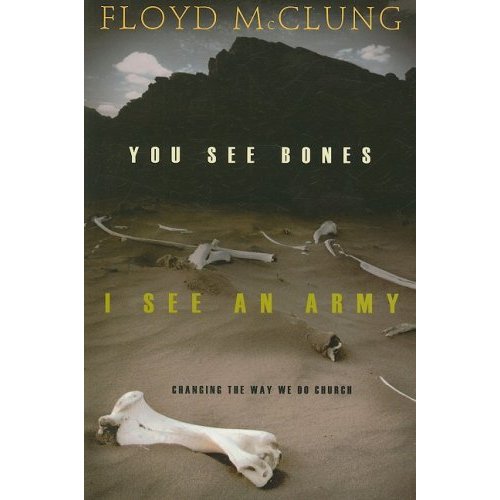
Oversimplification? Maybe, but refreshing. Great book about simple strategies to make disciples.
10 Things Your Kids Should Catch You Doing
“Dad, I liked it better when you didn’t have an IPhone.” Heard these words from my oldest son several years ago. It was a wake up call and a reminder that everything I do as a parent is about teaching and proclaiming a message of what is valuable. And so much about faith and life is more CAUGHT than TAUGHT, so we must be ENGAGED. I loved this list that Carey Long shared with our church today.
10 Things Your Kids Should Catch You Doing as A Parent:
- Serving Others.
- Living w/Integrity and Humility.
- Chasing a Vision.
- Modeling a Godly Marriage.
- Respecting Authority.
- Admitting Mistakes and Asking for Forgiveness.
- Engaged in Worship and making Worship a priority.
- Studying your Bible.
- Practicing prayer.
- Depending on God.
What are your kids catching from your life?
Carey is available for Parenting seminars, Youth events, etc. He’ll be a great resource for your church. Check out www.careylongministries.com.
 Join Bridge Church this Sunday as we continue our message series through Ephesians. Currently, we’re taking on the Ephesians 5:1-6:4, which emphasizes Relationships In Christ. Here past messages at bridgenorthshore.com or check us out on Itunes.
ONE DAY Learning Cluster for Church Planters
 Our Spring Church Planting Network Meeting will be in the form of a Mini-Conference at New Orleans Baptist Theological Seminary. March 26, 9am-12noon. Click here to register. For Church Planters, Sponsors, Wannabe Church Planters & sponsors, Church Planting Enthusiasts, etc. Content will also be good for anyone in church leadership. Craig Ratliff, with Celebration Church will be lead the sessions. Topics: 1. Vision: Having and maintaining vision (early vision, long term vision, staying on course) 2. Planning: How to plan for continual grown and “Splash” growth? More info here. More info on the importance of Church Planting Networks here.
Big Day for Max
Our dog went to Pre-K w/Hudson today. And he showed great restraint by not p-ing on the backpacks when he had the chance. Good job Max!

“Can Baptist Dance?” and other recent questions
When someone ask me, “What kind of church is Bridge Church?” I don’t immediately start talking denomination, but we affiliate with the Southern Baptist Convention. In many South Louisiana minds, Baptist are known for two things: They don’t drink and they don’t dance.
So recently I was asked: “Can you dance?”
My answer: “No. But that has little to do with Baptist doctrine and more about my inability to do anything in rhythm. I probably would dance if I could.”
I’m not sure where the “Baptist don’t dance” thing got started, but I know a church in our area actually had to amend their By-laws a few years back so that a wedding party could do a “first dance” at their reception.
So if someone asks you if Baptist can dance, the correct answer is: “Some can and some can’t.”
What makes a Baptist a Baptist? One thing: Authority. Baptist believe in the authority of the Bible alone for faith and practice. So that informs us on our other major distinctives. Such as, Believers Baptism – the practice of baptizing those who put their faith in Christ at the point of their decision to follow Christ and not until. And baptists are not alone in this belief, but that’s the short answer anyway.
Do you believe someone can lose their salvation? My answer: No. Some verses that inform my belief are in John 10:27-29.
My sheep listen to my voice; I know them, and they follow me. I give them eternal life, and they will never perish. No one can snatch them away from me, for my Father has given them to me, and he is more powerful than anyone else. No one can snatch them from the Father’s hand.
I’m reminded that salvation is God’s work, not mine. So if I can do nothing to gain it, how could I do something to lose it.
The Baptist have gotten a bad rap for this statement which I hate – “Once saved, always saved.” Thinking of John 10, I like “if saved, always saved” because “No one can snatch them from the Father’s hand.”
That’s me. What’s your belief?
Of course my favorite answer to questions about personal beliefs came from my Systematic Theology prof in Seminary who would always say: “This is what I believe. But if I get to heaven and it’s not that way, I’m not going to ask for a transfer.”
The main thing and the thing that is non-negotiable is – Jesus alone get you there. Do you have a relationship with him? We’ll let Him set us straight on all the other issues throughout all eternity.
And, I do believe that I’ll have rhythm in heaven. Looking forward to that!
Distinguishing Marks of a Quarrelsome Person
Hot-headed, divisive Christians are not pleasing to God (Proverbs 6:19). We are told to drive them out (22:10) and avoid such people (Rom. 16:17). This doesn’t mean we only huddle with the people we like. We are not talking about awkward folks or those who disagree with us. We are talking about quarrelsome Christians–habitually disagreeable, divisive, hot-headed church people.
This is an important issue for churches today. Seems we have a lot of churches unable to break out because of relational difficulty. Maybe partly because our generation doesn’t do well with anything that’s hard and requires commitment, like relationships that delve below the surface. And that’s what God desires. It’s easier to just go somewhere else. But discerning when someone is being divisive and quarrelsome is something we must do and determining whether I am the quarrelsome person who is hurting the cause of Christ. I thought this list by Kevin DeYoung was helpful. Read the whole post here.
So what does a quarrelsome person look like? What are his (or her) distinguishing marks?
- You defend every conviction with the same degree of intensity. You don’t talk about secondary issues, because there are no secondary issues.
- You are quick to speak and slow to listen. You rarely ask questions and when you do it is to accuse or to continue prosecuting your case. You are not looking to learn, you are looking to defend, dominate, and destroy.
- You are incapable of seeing nuances and you do not believe in qualifying statements.
- You never give the benefit of the doubt. You do not try to read arguments in context. You put the worst possible construct on other’s motives and the meaning of their words.
- You have no unarticulated opinions.
- You are unable to sympathize with your opponents.
- Your first instinct is to criticize. Your last is to encourage.
- You have a small grid and everything fits in it. Everything is a social justice issue; everything relates to the regulative principle, everything is Obama’s fault; everything is wrong because of patriarchy; everything comes down to one thing–my thing.
- You derive a sense of satisfaction and spiritual safety in being rejected and marginalized. You are constitutionally unable to be demonstrably fruitful in ministry and you will never affirm those who appear to be. You only know how to relate to God as a remnant.
- You are always in the trenches with hand grenades strapped to your chest, never in the mess hall with ice cream and ping pong.
- You have never changed your mind on an important matter.
Doing the opposite of this list will help us go deeper with God and others in the body of Christ and reproduce less people who don’t go to church anymore, because of how Christians treat each other.
Painful Realities of life in Africa
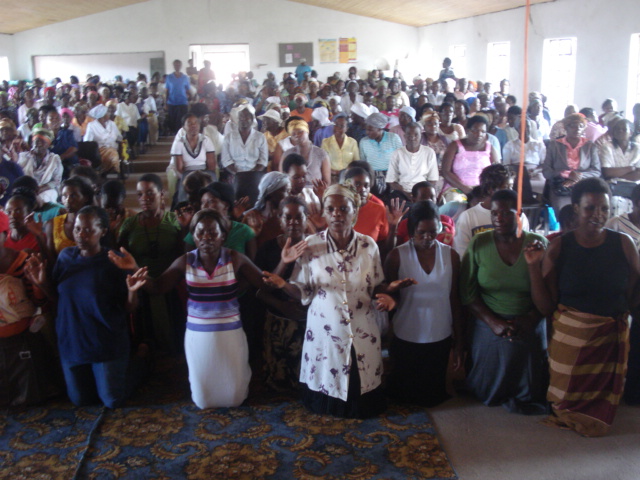
This is a picture of a Widows seminar at a friend and partners church is Harrare, Zimabwe. Over 400 widows responded to the seminar. The picture tells of the devastation of AIDS, poverty, poor governance, etc. Imagining the pain of losing loved ones, caring for orphans, and more. Praying for relief, comfort, hope through the Gospel, laborers for their good.
Here’s a statement from the pastor:
The poverty gripping our country could be seen with all its viciousness on the faces of many of these women some of who are having to look after many children with no visible form of support. Some are also maintaining children of relatives who would have died from the AIDS pandemic. It was such a moving sight seeing these ladies receiving the word of God for spiritual empowerment as well as some clothing donations soap and lotions.
Let me know if you’d like to help meet needs in Zimbabwe.
The Sin of Dabbling
Can your spiritual life be defined by a lot of starts and stops? Do you find it hard to follow through past the new sermon series at church, new years resolution, or recommitment after a season of pressure? In the book, You See Bones, I See An Army, Floyd McLung defines Dabbling as having a casual or superficial interest in something, to paddle, play, or splash in the water. Never diving in with all our hearts, we get stuck in a state of paralysis and failure. Jesus calls us to a radical life of wholehearted obedience and focused faith, not a shallow, wading around in unbelief and doubt that God could actually be more real and fulfilling than the stuff that I actually follow. The solution: Dive in deep. “If anyone would come after me, let him deny himself and take up his cross daily and follow me” Luke 9:23.
And have we as church leaders encouraged the sin of dabbling by making discipleship easy and programmable instead of risky and faith-driven? Do we enjoy creating dependence upon our teaching and ideas instead of releasing people to experience the deep water for themselves? How can we lead people beyond superficial splashing in the wading pool to deep diving, abundant life in Christ? Do I as a leader DABBLE from commentary to commentary or is my preaching and teaching out of an overflow of what God is doing deep inside of me?
Worth Reading: The Next Christians
 The religious landscape of America is changing and with it the attitudes and beliefs of the next generation of Christians are changing. Without a doubt the church in the future will look much different. In the book, The Next Christians: The Good News About the End of Christian America, Gabe Lyons gives us a glimpse of what that church might look like as he describes the new generation of Christians. Using quotes from the book, here’s a list of questions to see if you fit into their number:
- Do you wish to separate from or blend into the world; or thoughtfully engage?
- Are you OFFENDED by the world, or PROVOKED to engage and transform?
- Do you wish to run from the problems of the world or run to them as an agent of change?
- Are you bent toward CRITICIZING and throwing rocks at people in the world, or CREATING a new cultures through transformation?
- Are you CALLED or EMPLOYED? Do you separate your work from your identity as a Christian? Are you simply working a job, or serving in a vocation?
- Are you easily DISTRACTED by the goods and gadgets in the world or are you GROUNDED and disciplined in a growing relationship with God as you engage the world?
- Do you enjoy being ALONE and hiding from close relationships or are you defined by intentional relationships and COMMUNITY?
- Do you hang out with your own kind or do you engage the diverse community around you?
- Are you striving for RELEVANCE and popularity or to COUNTER the culture through transformed living?
- Do you feel called to restore the brokenness of the world?
The Next Christians are not separatists but restorers and transformers, provoked to engage the problems in the world as change agents and creators of beauty. Their vocations serve as a launching pad for living out God’s calling on every Christian to make disicples. They don’t allow the world to distract them, but desire to be deeply GROUNDED in the faith and engaged in intentional COMMUNITY with others. They understand that relevance is not leadership, but countering culture with the values of Christ.
If you’re a Christian leader I encourage you to read this book and ask if you are seeing this in your current ministry context and how your church may need to adjust as a new generation moves into leadership roles. We know the numbers, 80% of teens leave home after high school, and leave the church. This book will help you understand how they are thinking about the world and how we may can provide a path for involvement for them.
Here’s a few more of my favorite quotes:
- when the faithful saturate their schedules with Christian events at Christian venues with Christian people, the world has a hard time believing we hold the rest of the world in high esteem.
- The Gospel is a radical call to a stark existence, not a shallow assimilation.
- Christ death and resurrection were not only meant to save people from something. He wanted to save Christians to something.
- Provoked Christians know that Christian faithfulness often means living dangerously on the front edges of pain in the world.
- Where your talents and your heart come together, this is where God has called you to be.
- Understanding Scripture is difficult. Passively watching television or quickly clicking through Internet links and Facebook updates is much easier.
- Serving others together is the key ingredient in creating community.
- the Christian has a calling and a responsibility to think, work, and live in terms of how the world ought to be…
Consumer Christianity
Attitudes that show we are relating to our church as consumers:
- Consistently dwelling on the thought, “Is this church the right fit for me?”
- Having an attitude that says, “If the leadership would just do ______________ better, then I would be happier.”
- Comparing the offerings of your church to another church.
- Seeing things that need to be improved in your church but taking no responsibility to do anything about them yourself.
A church operates more like a family than a store. If we miss this, then we will always have dissatisfaction towards those who are trying to love and help us.
Read the whole article here.