Category Archives: Thru the Bible
When It Comes to Character, Make No Exceptions
“David had lived an exemplary life before God all his days… (EXCEPT for that time with Uriah the Hittite)”
1 Kings 15:5 MSG.
An “EXCEPT” in relation to your character could change the course of history for your family. David made an exception in his mission, by not going out to battle with his armies (2 Samuel 11:1). He made an exception in his obedience to God, by sleeping with another man’s wife, then having that man (Uriah the Hittite) killed to protect his own image (2 Samuel 11-12). The result was death, brokenness, & pain for David’s family, along with the curse of division & war in David’s family line forever (2 Samuel 12:10). Make no mistake, the “EXCEPT” in parentheses in David’s life was devastating. And it would be devastating for you & I as well. Make no exceptions in your relation to your character & put no parenthetical “EXCEPT” next to your testimony & family name.
- What exceptions are you making, considering, or imagining for yourself? (“I don’t have to go to church” ; “It will never happen to me” ; “It’s just this once” “No one will ever find out”) In relationships, spiritual disciplines, habits & beliefs?
- If there is already an “EXCEPT” in your life, have you repented & allowed God to bring healing? (see Psalm 32 & 51) And how have you moved past the temptation to make sin common & OK in your life?
- Ask God to help you put a period instead of parenthesis on your testimony forever.
Join Bridge Church this Summer, 10:30am at the Maritime Museum in Madisonville, as we study the Old Testament book of Psalms in a series called Swells. We’ll look at how David & others learned to ride the ups & downs of life, like sin, discouragement, problem people, & more.


Does the Bible Condone Slavery?
In our study of Colossians, our church hit 3:22 today, which says, “Slaves obey your masters…” Several times over the last few years I’ve heard the argument go against the Bible like this: “The Bible’s just a book written by men. And it even condones slavery.” Does the Bible condone slavery? and if not, how should I answer such claims from skeptics? Check out a great article on this HERE.
A few points we discussed this morning:
Does the Bible Condone Slavery? Yes & No.
Yes. The Bible addresses slaves that were considered the property of another person. But NO! Not the kind of slavery we think of in our modern era, where someone is taken against there will and sold with little recompense and harsh treatment. Not that this type of slavery didn’t occur in Biblical times extensively, but it was not condoned by the Bible.
Exodus 21:16 (ESV) – “Whoever steals a man and sells him, and anyone found #in possession of him, shall be put to death.”
Slavery in the Bible consisted of a social class that was not bound by racial distinction, but was in servitude to another for some reason that may included indebtedness, choice, or empire politics. A few facts:
- There may have been as many as 60 million slaves in this time period. Potentially ½ the population at the time
- Slave was not the lowest on the societal food chain. The day laborer was.
- As a matter of fact, slavery actually provided protection from poverty, from debt, from a bad name. Many even sold themselves into slavery.
- Slaves were often educated, owned property, could accumulate wealth & status.
None of this is true of modern slavery where a person owned by another was taken against their will, had no rights, little hope of improvement of status, and subjected to harsh treatment and poor work conditions.
And the Gospel changed everything for both types.
Galatians 3:28 (NIV) “There is neither Jew nor Gentile, neither slave nor free, nor is there male and female, for you are all one in Christ Jesus.”
And it was the Gospel’s influence that fueled the movement to end the modern American slave trade in the 1700’s-18oo’s, through men like William Wilberforce and John Newton. And it’s the Gospel that’s fueling a new generation to stand up and fight for the million’s still being sold into slavery around the world.
Check out a fuller treatment of this in this article, Does the Bible Condone Slavery?
In Christianity, the opposite of ignorance is not knowledge – it’s obedience to Christ.
“Why do you call Me, ‘Lord, Lord,’ and do not do what I say? Everyone who comes to Me and hears My words and acts on them…” ~ Luke 6:46-47
Maturity is not just KNOWING, it’s ACTING on what we know. Jesus doesn’t say to hear His words and study them real hard til we memorize them. He’s more interested in what they produce in us everyday. When was the last time you acted on a truth of God’s word? Christian leader are you empowering leaders who are knowledgeable about Jesus or obedient to Jesus? Is your life aligned in such a way that you can respond with obedience to Jesus, or is it just about a set of facts that you’re plowing through on Sunday’s.
You might be wise if…
Talking about Wisdom today in our One Story Message Series. Are you a wise? Take this little test ripped right from the pages of Proverbs and Ecclesiastes:
You might be wise if…
- You choose your friends wisely.
- You listen to others.
- You can receive correction from others.
- You fear the Lord.
- You discipline your children effectively.
- You are generous with your wealth.
- You treat the poor with care & concern.
- You are careful with your words.
- You refuse gossip & slander.
- Your words mean a lot to others.
- You save sex for marriage.
- You love your spouse enthusiastically.
- You can control your temper.
- You understand the dangers of abusing alcohol.
- You are not afraid of hard work.
- You are honest in your business dealings.
- You can be trusted as a friend.
- You can be kind to your foes.
- You rely on God’s word.
- You trust God for salvation & provision.
- You are not easily led into evil by others.
- You do not lie.
- You are humble instead of prideful.
- You stay away from flirtation & the flirtatious.
- You hate evil.
- You are more concerned about who you are that what you have.
- You can define riches without talking about money.
- You have a truly meaningful life.
- You have a good reputation with others.
- You trust God instead of yourself & others.

“so that”
Motives are so important. They reveal the sometimes hidden reasons behind our actions. They answer the question why. Testing our motives can diagnose initial heart issues that can lead us to big heart issues in our relationship with God and others. One phrase that’s been jumping out at me recently is “so that.” What follows these two words reveals motives and mission. Here’s a few of God’s “so that’s”:
- Why blessings? Genesis 12:2 – “I will bless you…SO THAT you will be a blessing.” Not just so I can
- Why God works? Exodus 8:10 – “…SO THAT you may know that there is no one like the Lord our God.”
- Why Bible Study? Joshua 1:8 – “This Book of the Law shall not depart from your mouth, but you shall meditate on it day and night, SO THAT you may be careful to do according to all that is written in it.”
- Why remember and retell? Psalm 102:18 – “Let this be recorded for a generation to come, SO THAT a people yet to be created may praise the Lord.”
- Why serve and reach out? Matthew 5:16 – “let your light shine before others, SO THAT they may see your good works and give glory to your Father who is in heaven.”
- Why did Jesus teach? John 15:17 – “These things I command you, SO THAT you will love one another.”
- Why Church? John 17:21 – “…SO THAT the world may believe that you have sent me.”
- Why Spiritual Gifts? 1 Corinthians 14:5 – “SO THAT the church may be built up.”
Try a little exercise with me. Write down the big to do’s of your life or what you’re doing or wanting to do. Then write a big SO THAT and complete the sentence. Be honest even if it hurts. If you’re a leader do this for your church or organization. My questions: Do my motives line up with God’s eternal purposes or my temporal wants and desires? Are my motives drifting as I experience success or failure? Am I passing off eternal motivations and perspective to those I lead? Are my motives baptized in consumerism and marketing? Are my motives derived from looking at God or looking at others?
So often I get off track when my motivation gets fouled or becomes secondary to my to do’s.
Fool-Proofing Your Life
Fool is a very Biblical word. We all have been fools. As a matter of fact we’re born that way. Proverbs 22:15 (NASB) Foolishness is bound up in the heart of a child; the rod of discipline will remove it far from him.
All children are foolish, and that’s OK. Parents should expect foolishness, and seek to drive it away. But it’s not OK when we stay foolish and some of us do. How do we deal with them? and discern our own foolish behavior. Start with defining what a fool is and the book of Proverbs is the one stop place for that.
Three Hebrew words used in Proverbs for fool:
- Kesil – dull, closeminded. 49X in Proverbs, 70X in OT. “right in his own eyes.” Will not consider the value of unselfish things.
- Nabal – spiritually bereft, lacks spiritual perception. 18x in OT. Incapable of seeing God’s side of things. Self-damaging. Abigail about her husband – “no one can talk to him”
- Ewil – obstinate, hardened fool; sees no benefit to wisdom. From root “thick of fluids.” Hard headed. 26x in OT. My way or the highway.
Characteristics in Proverbs of a fool: How can we discern foolish behavior?
Jesus in the Old Testament
“The Bible’s really not about you – it’s about him.” Darrin Patrick in his great book Church Planter: The Man, The Message, The Mission, shares a thoughtful list by Tim Keller on Jesus in the Old Testament. Take a look:
- Jesus is the true and better Adam who passed the test in the garden and whose obedience is imputed to us.
- Jesus is the true and better Abel who, though innocently slain, has blood now that cries out, not for our condemnation, but for acquittal.
- Jesus is the true and better Abraham who answered the call of God to leave all the comfortable and familiar and go out into the void not knowing wither he went to create a new people of God.
- Jesus is the true and better Isaac who was not just offered up by his father on the mount but was truly sacrificed for us. And when God said to Abraham, “Now I know you love me because you did not withhold your son, your only son whom you love from me,” now we can look at God taking his son up the mountain and sacrificing him and say, “Now we know that you love us because you did not withhold your son, your only son, whom you love from us.”
- Jesus is the true and better Jacob who wrestled and took the blow of justice we deserved, so we, like Jacob, only receive the wounds of grace to wake us up and discipline us.
- Jesus is the true and better Joseph who, at the right hand of the king, forgives those who betrayed and sold him and uses his new power to save them.
- Jesus is the true and better Moses who stands in the gap between the people and the Lord and who mediates a new covenant.
- Jesus is the true and better Rock of Moses who, struck with the rod of God’s justice, now gives us water in the desert.
- Jesus is the true and better Job, the truly innocent sufferer, who then intercedes for and saves his stupid friends.
- Jesus is the true and better David whose victory becomes his people’s victory, though they never lifted a stone to accomplish it themselves.
- Jesus is the true and better Esther who didn’t just risk leaving an earthly palace but lost the ultimate and heavenly one, who didn’t just risk his life, but gave his life to save his people.
- Jesus is the true and better Jonah who was cast out into the storm so that we could be brought in.
- Jesus is the real Rock of Moses, the real Passover Lamb, innocent, perfect, helpless, slain so the angel of death will pass over us. He’s the true temple, the true prophet, the true priest, the true king, the true sacrifice, the true lamb, the true light, the true bread.
Paul vs. James
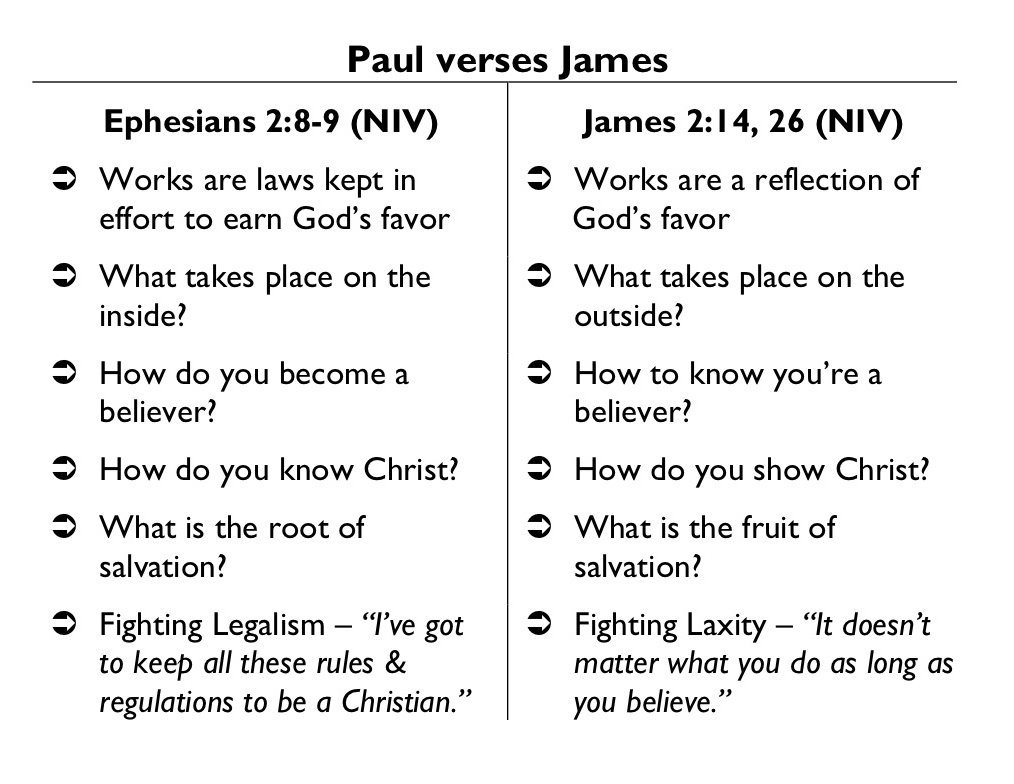
Touching on Faith and works this weekend at Bridge Church. Remembered these charts that I found helpful about the different motivations for the teachings of Paul and James. While Martin Luther thought James to be a “strawy epistle” and some use it to defend works based salvation, I believe they were dealing with different sides of the same coin. What is the place of works in the believers life?



 Lane Corley