Category Archives: Discipleship
Church Growth vs. Kingdom Growth
“what’s good for my church numerically may not be best for the kingdom – but what’s good for the kingdom is always best for my church.”
Challenging post by Bob Roberts. I actually got to hear Bob teach this while I was a Southwestern Seminary. His books Transformation, Glocalization, and The Multiplying Church (I blogged about this book here) have been very influential in my thinking about ministry.
What about the health factors in ministry that might shrink the church numerically. Bob mentions a few:
- church planting can impact the size of your local church. That isn’t bad – it’s good. We’ve helped over 20 churches get going all around us. There are over 10,000 people in those churches combined – but I doubt seriously if we’d ever run 10,000 at our local church.
- loving other people radically can hurt your church attendance. People want lost people to find Jesus – but they want nice, acceptable, like us lost people – I’m so glad Jesus wasn’t that way. We must go after the ostracized, the neglected, the marginalized – these are the ones that Jesus went after.
- being serious about making disciples will actually hurt your “church attendance” at times. We live in a very consumeristic culture…being a disciple isn’t going to church – and it’s not just feeling good about life and all your dreams coming true.
Read the entire post here.
What are other markers of Kingdom Growth?
Make Disciples? Great Q’s for churches:
I’m hearing this statement more and more: “I don’t know how to disciple someone, I’ve never been discipled myself.” The good things about this statement is that we’re owning the mission of making disciples more than ever before. It’s not just the Pastor’s job. The Great Commission was meant for every believer. The bad thing about the statement is that we think of discipling as very difficult and complicated. For Jesus it meant building relationships, calling people to a new way to live, teaching them the basics, sending them out to try it themselves, debriefing, walking, doing it again. It was a fluid motion, not a curriculum set. I loved the three questions in this article by Mike Breen:
- How am I defining Disciple?
- Am I separating mission from discipleship?
- Am I making this way too complicated?
Great Questions for church leaders and I appreciate Mike’s responses as well.
Christianity is in decline in North America partially because we aim at great churches instead of great disciples. Disciple making will lead to great churches. I think we’re coming to the conclusion that vice versa doesn’t always apply.
I’m walking through a great resource right now dealing with these questions: Real Life Disicipleship by Jim Putman and Avery T. Willis. Love the tag – “Equipping Disciples Who Make Disciples.” Is your ministry model completing the process? Discipleship should lead to disciple makers. Or as I heard Don Wilton say, “The process of evangelism is not complete until the evangelized becomes the evangelist.” Also, picking up Mike Breen’s book on Kindle, Building a Discipleship Culture.
Also, check out this great list by Jason Dukes of recommended books for Disciple Makers.
Vision vs. Christian Sentiment
It is easier to serve God without a vision, easier to work for God without a call, because then you are not bothered by what God requires; common sense is your guide, veneered over with Christian sentiment. You will be more prosperous and successful, more leisure-hearted, if you never realize the call of God. But if once you receive a commission from Jesus Christ, the memory of what God wants will always come like a goad; you will no longer be able to work for Him on the common-sense basis.
~ Oswald Chambers
Meeting the Challenge of Population Growth and Church Decline
A recent study of the Northshore communities in SE Louisiana revealed that less than 4% of the popoulation attends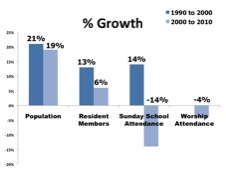 Southern Baptist Churches on any given weekend (11,000 attenders to 343,000 in population). Consultation with other evangelical groups revealed that less than 10% attend evangelical churches of any kind (approximately 25,000 attenders per weekend).
Over the next ten years the Northshore is projected to continue to grow at a rate of 22%, which would bring our population to over 419,000 people. 22% growth for Northshore Baptist churches would mean adding 5,296 new members in ten years. The real challenge is to increase the percentage of people attending worship gatherings and Bible Studies. Currently 3.3% of the population attends worship in Northshore Baptist churches. If we wanted to double that to 6.6% of the population in worship attendance over the next ten it would mean adding 16,434 worshipers. Currently, only 1.9% of the population attends Bible Study in NSBA churches. If we wanted to double that to 3.8% over the next ten years it would mean adding 9,304 people to our Bible Study rolls. Daunting numbers. How could we do this? And is it even possible?
Four suggestions to meet the challenge: First, we need some of our churches to breakout. Second, we need healthier and riskier church planting. Third, we need to partner to help churches in need of and willing to engage in revitalization. Fourth, we need a discipleship revolution.
Breakout Churches. A breakout church is defined by Thom Rainer in his book by that title as a church that reaches at least one person for Christ every two weeks or 26 persons per year, has a conversion ratio of 20:1 or 1 conversion for every 20 members per year, has tenured and consistent leadership, and the church makes a clear and positive impact on its community.[1] In our area, FBC Covington would be an example of a breakout church. In 1980, FBC had 322 in Sunday School and baptized 32. Dr. Waylon Bailey became pastor in 1989 and from 1990 to 2000, Sunday School attendance grew from 417 to 1,137. From 2000 to 2010, FBC relocated into a new facility, sponsored a new church on the Northshore which added 100+ members in its first five years, and today FBC has over 1,700 worshippers each week. And, since 1990, 1,745 people have been baptized through the ministry of FBC Covington. Bedico Baptist is another church that has broken out with tenured leadership. Leo Miller became Pastor in 1994. In 1995, Sunday School averaged 76 weekly attendees at Bedico. In 2000, that was up to 141, 2005 to 232, and Bedico has recently broken the 400 barrier. And since 1994, 537 have been baptized at Bedico. Others are poised to breakout across the Northshore. The momentum of growing churches breaking out will help us catch up with population growth and move past a season of decline.
Healthier and Riskier Church Planting. Healthier church planting means church planting that is led by churches with a heart to multiply and reproduce themselves for the sake of kingdom expansion. So, what’s needed for healthier church planting is healthy mother churches with a heart to reproduce. As Bob Roberts says in his great book The Multiplying Church, “The future of faith in America (and anywhere in the world, for that matter) is not tied to planting more churches, but in raising up of mother congregations of every tribe, tongue, denomination, and network that are reproducing… The hope is in pregnant mother churches.”[2]
Riskier church planting would be multiplication that targets hard to reach areas and unchurched pockets of our population. Missiologist Alan Hirsch suggests that current church models are reaching out to smaller and smaller segments of the population, with possibly as much as 60% of America untargeted by our evangelistic and outreach efforts.[3] Our study identified multi-housing residents as one potential segment that is underserved. Others may be those in their early 20’s with very little understanding of religion in any form. We need some church plants that go beyond planting a worship service that looks similar to others in the community, but will ask the question “Where is the church not?” and go there with the gospel. We need some church plants that have different scorecards and different expectations, but will faithfully deliver the message of Christ to unchurched people.
Partners in Revitalization. Church revitalization is needed to turn momentum around for congregations that are not effectively reaching their communities. This is already happening in a variety of ways on the Northshore, with Grace Memorial Baptist Church in Slidell becoming the sponsor of Covenant Baptist Church, which was in steep decline and in danger of shutting the doors. Also, with Woodland Park Baptist Church merging and taking on the assets and liabilities of New Life Church in Hammond, which was in steep decline, and now they are looking to plant a new church on the site. And FBC Hammond working through a self-assessment with the NSBA Staff to begin a process toward revitalization. Churches are needed who are willing to adopt or sponsor or merge with existing congregations for the glory of God. And churches are needed who are willing to admit there in need of coming under the wing of a benevolent parent church or work with a church wanting to help then in a revitalization effort.
A Discipleship Revolution. Call it revival, lay renewal, or awakening, what we need is a revolution of discipleship that will lead Northshore Christians to multiply themselves spreading the Gospel like a sneeze to their neighbors, classmates, coworkers, and beyond. In his book Church 3.0, Neil Cole observes, “we have lowered the bar of what it means to be a Christian, such that simply showing up to the weekly one-hour event with some regularity and a checkbook is all it takes.”[4] We must refocus on making disciples who will reproduce themselves by telling others, inviting others, and discipling others. Discipleship should lead to disciple makers on mission for others.
[1] Rainer, Tom. Breakout Churches. Grand Rapids, Michigan: Zondervan, 2005.
[2] Roberts, Bob. The Multiplying Church. Grand Rapids, Michigan: Zondervan, 2008.
[3] http://www.christianpost.com/news/alan-hirsch-church-model-reaching-only-40-percent-of-americans-47500/
[4] Cole, Neil. Church 3.0: Upgrades for the Future of the Church. San Francisco, CA: Jossey-Bass, 2010.
Excuses
The thing that makes an excuse so powerful is the bit of truth tucked inside. Billy Sunday said an excuse is a “skin of a reason stuffed with a lie.” I think an excuse is a reason with self instead of faith applied to it. Here’s some examples of things that are true, but are not worthy excuses.
- “I don’t want to get too close to people. Relationships are too messy.” Yes, relationships are hard & messy. People will offend you and say the wrong things and not notice you and forget to call you. Build relationships anyway.
- “Sunday is my only day to get things done.” Yes, Sunday is the perfect day to get things done before the work week. And it’s hard to wake up. And it’s hard to get the kids ready. Get involved in church anyway.
- “People will try to take advantage of you.” Yes, if you help people you will get taken advantage of. And they do get some help from the government. And they could do more to help themselves. Help people anyway.
- “I can’t share my faith b/c I might not know how to answer people’s questions.” No, you don’t know all the answers and you will get confused by their questions and you will be afraid to talk to them about your faith. Do it anyway.
- “I don’t get along with my neighbor.” Yes, your neighbor is rude not to wave at you and they don’t seem friendly and they seem to be perfectly happy. Look for opportunities to serve them and invite them into your home anyway.
- “Serving others is outside of my comfort zone.” Yes, if you put your Faith in Action you might get your hands dirty and you may not get to consume great worship songs and preaching and you might not get home before noon. Put your faith in action anyway.
If you’re looking for an excuse you’ll find one. Apply faith to any excuse and it will fade away. For the real Christian who walks by faith, what once was hard and weird and easy to excuse becomes a necessity.
Discipleship and Choice
American Christianity has become about choices. Early service, late service, contemporary music, traditional music, small groups, Sunday School, big church, little church. And these choices are for the most part self-focused – “I’m looking for a great kids ministry” or “I like a small church” or “I like the early service” or “I like an older pastor.” Not that any of these things are bad and we must commend ministries in the west for making church life and the word of God as accessible for everyone as we can get it. The question is, How does this square with the New Testament picture of a disciple or follower of Christ? Read the New Testament and THE CHOICE was often RISK or SECURITY, DEATH or LIFE. I know the environment was different, w/o the freedoms and technology that we enjoy today, but did Jesus intend Christianity to be free from risk and sacrifice. Jesus said, “If anyone would come after me, let him deny himself and take up his cross daily and follow me. For whoever would save his life will lose it, but whoever loses his life for my sake will save it” Luke 9:23-24. In Acts, we see the first Christ followers, after initial fears, CHOOSING risk and suffering over and over again. The Apostle Paul spoke of “the brand marks of Jesus” Galatians 6:17 (NASB) on his body, obviously speaking of the torture that he’d endured for sharing the Gospel in unreached areas. He catalogued his suffering in 2 Corinthians 11:25-28:
countless beatings, and often near death. Five times I received at the hands of the Jews the forty lashes less one.Three times I was beaten with rods. Once I was stoned. Three times I was shipwrecked; a night and a day I was adrift at sea; on frequent journeys, in danger from rivers, danger from robbers, danger from my own people, danger from Gentiles, danger in the city, danger in the wilderness, danger at sea, danger from false brothers; in toil and hardship, through many a sleepless night, in hunger and thirst, often without food,tin cold and exposure. And, apart from other things, there is the daily pressure on me of my anxiety for all the churches.
Neil Cole in his interpretive biography of Paul’s life called Journey’s to Significance suggests that Paul could have avoided the “forty lashes minus one” but could not b/c of his love for the Jews.
This type of scourging was sometimes meant to purge or restore a brother to the synagogue instead of making him suffer excommunication. The punishment was executed by three or more leaders…and was exercised for a number of reasons…including being a false teacher and entering the temple unclean, both of which Paul would be accused of having done. Saul saw the synagogues as strategically important for the mission he was ultimately called to fulfill, and so perhaps HE CHOSE to be beaten raw in this way just to maintain access. He could have escaped this horrendous suffering by being excommunicated or keeping his mouth shut, but neither was a real option for him, and so instead he endured.”
New Testament Christianity seems to ASSUME risk and its adherents seem to CHOOSE risk and sacrifice at every turn. And the catch is, according to Jesus’ words in Luke 9:24, it’s in risk and death to self that we find the thing we’re often looking for in our choices at church – security and life.
So what’s the riskiest choice you’ve made as a Christ-follower lately? To attend service at a different time? Joining a new class or group? Do those things, but ask, does this require faith and denial and sacrifice for me? If not, could I be missing a key to real obedience and growth toward God?
What can I do to risk more? Well, you’ll most likely not be asked to endure beating and torture, but here’s a few risk for starters:
- Take some risk in your neighborhood and invite someone over for coffee or dinner that you don’t know that well and build a redemptive relationship with them.
- Find an organization that’s reaching out to the hurting in your region. There are many. Like orphans and widows, inmate children, homeless or those facing imminent homelessness, the hungry through local food banks, etc., etc.
- Instead of consuming your church’s ministries, contribute by volunteering to teach or lead a group.
- Take a short-term mission trip or fund another mission trip goer.
And Pastor, I’m asking myself as a church leader – Am I offering my church the opportunity to experience growth and grace through risk, sacrifice, and adventure? If not, do we keep our church from experiencing the life Christ spoke of in Luke 9:24?
GO…
One word stands as a clarion call to God’s work of transformation in the world. The word is “Go.” …nothing of God’s Kingdom happens unless someone is willing to GO.
Sometimes going will require a 30-second email to encourage a friend, a five minute walk across the street to help a neighbor, or the willingness to give up a quiet evening with your spouse in exchange for inviting some friends over who don’t know Christ. Other times, GOING may require a week-long commitment, a large chunk of money, or even a lifelong commitment to leave your city or country to serve God.
Whatever the case, the word GO will cost you something. It will require that you creatively look for the opportunities that God provides you to leave what’s natural and self-serving in order to extend his love to others.
~ from the Tangible Kingdom Primer
- Join a TK Group with Bridge Church.
- Here are a few resources for those interested in the TK:
- The Tangible Kingdom book.
- The Tangible Kingdom video.
- Tanglible Kingdom Primer Introduction. 17 minute description and training session led by the Author.
- Order the TK Primer and check out other Tangible Kingdom resources here.
Not FOR God, but BY God’s Power
Language is important. I’ve been thinking lately of the language I use in relation to serving God. Often I say that I’m doing things FOR God, as if God needs me to get his work done.
“He is the God who made the world and everything in it. Since he is Lord of heaven and earth, he doesn’t live in man-made temples, and human hands can’t serve his needs—for he has no needs. He himself gives life and breath to everything, and he satisfies every need.” Acts 17:24-25
God allows me to be part of what He’s doing. And even what I do for him, I do in the strength he provides.
“‘Not by might nor by power, but by My Spirit,’ says the Lord” Zechariah 4:6
“Blessed are those whose strength is in you…” Psalm 84:5
“if anyone serves, [it should be] from the strength God provides, so that God may be glorified through Jesus Christ in everything” 1 Peter 4:11
When I find myself doing things FOR God, it’s sometimes been in my strength and to make myself feel good about what I can do. Because of what God has done and By God’s Power are proper motives and help keep God as the one glorified and worshiped.
Splitting hairs? Maybe. Just thinking.
Is It Worth the Trouble?
“Where there are no oxen, the manger is clean, but abundant crops come by the strength of the ox” Proverbs 14:4.
The goal of an on mission disciple of Christ is a harvest of changed lives and transformed relationships. The goal of a casual Christian is a safe, comfortable, inspirational, clean life. Casual Christianity may be popular and prevailing because of the mess that being on mission will create. IS IT WORTH IT? If you believe that hell is real and that sin and addiction and poverty and worldliness wreck peoples lives and that the gospel is the answer. Yes. If you believe that God’s top priority for you is a clean stable. No.
What does the on mission disciples stable look like? It may look like exhaustion from serving people not like you, books piled high from digging into peoples honest questions, late nights and long conversations, a broken heart over the plight of people’s lives, stress over people who initially respond to grace but turn back and go their own way, the home not as a refuge but as a safe haven for seekers and strangers, instead of work to play, work to provide and be generous.
In the Great Commission we don’t have the assurance of a clean stable, but of Christ’s presence with us. He was willing to pay the price. Now he sends us. A harvest of change lives will be costly and messy. I don’t want to settle for clean.


 Lane Corley