Category Archives: Discipleship
What does “I don’t know how” really mean?
There is so much information available to us today. This year, I ran into questions like “How to clean a carburetor” and “How to pickle okra” and “How to change a delta shower faucet.” Found the answers all on Youtube! and in the case of cleaning a carburetor, found a video of a 10 year old demonstrating. Reminded me that “I don’t know how” many times means something else. Like: “I don’t really want to” or “I don’t really care” or “I’m not interested enough to make time to find out.” There is ignorance, which is defined as the state of being uninformed or unaware about knowledge that’s available. And in most arenas, ignorance is expensive: like my carburetor and delta faucet.
So, spiritually speaking, rethink your “I don’t know how.” Does it really mean something else? God’s word is available to you. Find a person that you know lives for God and ask for their help and prayers. Pray and ask God to guide you to the right stuff. “I don’t know how” is spiritually expensive when we think about the clock ticking on when the kids are grown and gone, the fatherless kids that need mentoring before they become a statistic, those who are depressed that need encouragement, those dying of curable diseases (estimated 26,000 per day), and those w/o Christ that need to know of his love before its eternally too late.
If it matters to us, we tend to find out how. Don’t settle for “I don’t know how” in your relationship with God, the needs of others, and issues that will matter when nothing else does.
It’s All About ______.
Possible answers: ME or GOD and OTHERS.
The key characteristic of someone maturing in Christ is a God-and-others-centered outlook. You begin to see God’s purpose for and in your life and you begin to see the needs of others as a priority as you grow spiritually. So who or what is it all about for you?
- Am I responsive to God’s Word? John 14:21, 23
- Am I aware of the needs of those around me? Philippians 2:3-11
- Am I willing to serve or waiting to be served? Matthew 20:28
- Am I looking for opportunities based on personal benefits to me or the potential impact for God’s kingdom? Matthew 6:33
- Do I stop at feeling sorry for people or am I willing to act on their behalf? 1 John 3:16-18
- Am I following Jesus into a life of influencing others or do I see Christ and the church primarily through the lens of my own wants and needs? Matthew 4:19, 28-18-20
A few quotes from Jim Putman’s Real-Life Discipleship that have me thinking:
“when we see a person in need, it is an invitation from God to step in with love and service and words”
“When we know Christ, we start to look at people differently.”
How has knowing Christ changed your priorities? Who or what is it all about for you? Is your response to God changing the answers in your life?
Diagnosing Spiritual Immaturity
“the mouth speaks from the overflow of the heart”
http://bible.us/Matt12.34.HCSB.
How can I know where I am spiritually or where are those I’m trying to disciple and lead? Try listening. Jim Putman in Real-Life Discipleship: Equipping Disciples Who Make Disciples breaks down five stages of spiritual maturity by what will be common phrases for a person at each stage.
Spiritual Infant
- “I don’t have to go to church to be a Christian.”
- “I pray and read my Bible. That’s good enough for me.”
- “I didn’t know the Bible said that.”
- “Jesus helps me be a good person. I don’t need church.”
- Characterized by ignorance, confusion, dependence, worldly perspective.
- Needs personal attention of a spiritual parent, teaching and modeling the Christian faith, accountability to develop new habits.
Spiritual Child
- “My church isn’t taking care of my needs.”
- “I didn’t like the music today. If only they did it like…”
- “I love my small group; don’t add more people to it.”
- “I’m not being fed at my church, so I’m going to a church that can meet my needs better.”
- Characterized by self-centeredness, pride, idealism, spiritual highs and lows.
- Needs relational connections to a church family, help to start feeding themselves, teaching about identity in Christ.
Spiritual Young Adult
- “I love my small group, but there are others who need a group like this.”
- “Randy and Rachel missed church today. Their kids have the flu, maybe our group could make meals for them. I’ll start.”
- “I have some friends I’ve been witnessing to. I think I could lead a Bible Study for them with a little help.”
- “In my devotions, I came across something I have a question about.”
- Characterized by action, zeal, God-centered, others-centered, independent, desire to serve others.
- Needs opportunities to serve, ongoing relationships that offer encouragement, accountability and skills training.
Spiritual Parent
- “This guy at work asked me to explain the Bible to him. Pray for me.”
- “Our small group is going on a mission trip, and I have given each person a different responsibility.”
- “We get to baptize someone from my small group today. I want them to get plugged into a ministry right away.”
- Characterized by intentionality, reproduction mindset, dependability, desire to see others mature.
- Needs ongoing relationships with other disciple makers, a team approach, accountability and encouragement.
So where are you? If you’re moving toward spiritual maturity you may want to get this book or the training manual to learn more about how to be a spiritual parent and make disciples who make disciples. Here’s a few other great quotes from the manual:
- Every Christian is commanded to participate in the mission to make disciples.
- Your work is complete when the person you are discipling can make a disciple.
- The church was not designed to be a group of spectators who attend weekly lectures; it was designed to be a trained army with a powerful message.
- We cannot change the definition of discipleship to sit and listen and then expect to make disciples as Jesus did.
- Don’t mistake Bible Knowledge, years of church attendance, physical age, education, and so forth for spiritual maturity.
- A church is successful when everyone is in the game, maturing into disciples who can reproduce disciples.
- When disciple-making is reduced to a program, people often fail to connect it to a lifestyle.
- Relationships create the environment where discipleship happens best.
- Serving produces players, not spectators. Service helps a disciple develop and mature.
Mind the Gaps
I know what God says, BUT…
- “my situation is different.”
- “that will never happen to me.”
- “everyone else does it.”
- “that was a long time ago.”
- “they deserve it.”
- “god understands my needs.”
- “who really does that anyway?”
- “that’s just not possible for me.”
- “I’ll get around to that one day.”
When you disobey God it means there is a gap between where you are and where you know God wants you to be. “I know what God says, BUT…” or “I know what I should be doing, BUT…” reveals that gap for all that it is. When you excuse your disobedience, you are saying more about what you believe about God than anything else. What you should just go ahead and say is, “I know what God says, BUT…”
- “He really doesn’t matter that much to me.”
- “I know better than He does about this issue/situation. I’m so much wiser about these kind of things.”
- “God has changed since the Bible was written and all that stuff doesn’t really matter anymore.”
- “I’d rather do what my friends say than God. They are so much smarter than him.”
- “I don’t really think He can provide for this need. I’ll just do it myself.”
- “I don’t really believe in God at all. Since he’s not real, I can do whatever I want.”
If you can easily excuse a pattern of disobedience, blowing off the word and will of God, the book of 1 John says you are a liar, deceived, and in darkness.
The true Christian responds to God’s word with obedience. He’s revealed Himself in Christ who is willing to transform our lives. The transformed one responds to God with obedience. You can mind the gaps by repenting and being obedient to what God is calling you to do.
In Christianity, the opposite of ignorance is not knowledge – it’s obedience to Christ.
“Why do you call Me, ‘Lord, Lord,’ and do not do what I say? Everyone who comes to Me and hears My words and acts on them…” ~ Luke 6:46-47
Maturity is not just KNOWING, it’s ACTING on what we know. Jesus doesn’t say to hear His words and study them real hard til we memorize them. He’s more interested in what they produce in us everyday. When was the last time you acted on a truth of God’s word? Christian leader are you empowering leaders who are knowledgeable about Jesus or obedient to Jesus? Is your life aligned in such a way that you can respond with obedience to Jesus, or is it just about a set of facts that you’re plowing through on Sunday’s.
How to Get a Grip on the Bible
The Bible contains sixty-six books, written in three languages (Hebrew, Greek, & Aramaic), over a period of more than a thousand years, by more than forty authors on three continents. Authors of the Bible include kings, peasants, philosophers, farmers, fishermen, poets, statesman, & scholars. The books of the Bible cover history, sermons, letters, songs, geographical surveys, architectural specifications, travel diaries, genealogies, & legal documents. It covers hundreds of controversial subjects with amazing continuity. It’s the best selling book of all time & is now available in nearly three thousand languages. So what’s the big deal about the Bible?
When you & I read the Bible, we can hear directly from God.
Check out this Bridge Church “How to” resource that answers some FAQ’s about the Bible and leads you to six simple practices that can help you Get a Grip on the Bible.

Get a Grip on the Bible
“Whoever has my commandments and keeps them, he it is who loves me. And he who loves me will be loved by my Father, and I will love him and manifest myself to him” ~ John 14:21
Most Christians agree that the Bible is important. Few read it consistently (actually around 40% according to Barna). Even fewer live out its teachings everyday (research shows that only 9% live with a Biblical Worldview). Some never will because other things will always be more important. Others desire to, but struggle with literacy, understanding types of literature found in the Bible, and just where to get started. “I tried to read the Bible” is becoming a more prevalent statement from my generation. This fall at Bridge Church we’re doing a couple of things to increase people’s understanding of the Bible’s message and make Bible reading not such a daunting task.
- One Story: the Bible in Four Acts. In August we started our One Story message series. Looking at each acts of God’s story: Creation, Corruption, Redemption, and Restoration. Now we’re working through each major section of Bible literature -History, Law, Prophets, Wisdom, Gospels, Epistles, Prophecy – picking out the One Story. The Bible is 66 book, written in 3 languages, over a period of more than 1,000 years, by more than 30 authors, but it’s One Story of God’s work to bring salvation to humanity.
- How to Get a Grip on the Bible – Today we start a series of short workshops on the How to’s of the Christian life,
 beginning with How to read and study the Bible. It will be posted at http//:bridgenorthshore.com later this week. And I’ll share some of the info here as well.

It was Ghandi who said, “If Christians really lived by the teachings of Christ, as found in the Bible, all of India would be Christian today.” Everyone recognizes the transformational affect of God’s word. Men and women touched by God living out his word everyday are the events that God wants to use to bring transformation. Hoping for more people to get a grip on the Bible and allow it’s truths to get a grip on us bringing transformation to lives and communities.
“so that”
Motives are so important. They reveal the sometimes hidden reasons behind our actions. They answer the question why. Testing our motives can diagnose initial heart issues that can lead us to big heart issues in our relationship with God and others. One phrase that’s been jumping out at me recently is “so that.” What follows these two words reveals motives and mission. Here’s a few of God’s “so that’s”:
- Why blessings? Genesis 12:2 – “I will bless you…SO THAT you will be a blessing.” Not just so I can
- Why God works? Exodus 8:10 – “…SO THAT you may know that there is no one like the Lord our God.”
- Why Bible Study? Joshua 1:8 – “This Book of the Law shall not depart from your mouth, but you shall meditate on it day and night, SO THAT you may be careful to do according to all that is written in it.”
- Why remember and retell? Psalm 102:18 – “Let this be recorded for a generation to come, SO THAT a people yet to be created may praise the Lord.”
- Why serve and reach out? Matthew 5:16 – “let your light shine before others, SO THAT they may see your good works and give glory to your Father who is in heaven.”
- Why did Jesus teach? John 15:17 – “These things I command you, SO THAT you will love one another.”
- Why Church? John 17:21 – “…SO THAT the world may believe that you have sent me.”
- Why Spiritual Gifts? 1 Corinthians 14:5 – “SO THAT the church may be built up.”
Try a little exercise with me. Write down the big to do’s of your life or what you’re doing or wanting to do. Then write a big SO THAT and complete the sentence. Be honest even if it hurts. If you’re a leader do this for your church or organization. My questions: Do my motives line up with God’s eternal purposes or my temporal wants and desires? Are my motives drifting as I experience success or failure? Am I passing off eternal motivations and perspective to those I lead? Are my motives baptized in consumerism and marketing? Are my motives derived from looking at God or looking at others?
So often I get off track when my motivation gets fouled or becomes secondary to my to do’s.
Faith In Action Weekend: Why we SHOULDN’T serve our community
Four times a year Bridge Church takes a Sunday and SCATTERS instead of GATHERING, taking on some of the major needs in ourcommunity together. Lot’s of interest for and against this idea when it comes up. Let me give you a few reasons to not do this:
- It’s uncomfortable. Someone actually said to me a while back – “I’m uncomfortable with canceling Sunday services at
 church.” My response: “Me too!” I’d much rather be sitting in a padded chair, listening to someone talk about how to do Christianity and soaking up good praise and worship music, etc. Or better yet, having people listen to me. But as a leader in my second journey I’m learning that the discomfort is needed to really grow as a disciple and to truly make disciples.
 - It probably WON’T grow your church numerically, at least not immediately. Actually, every Faith in Action Sunday we tend to lose people. It’s messy to see the needs in people’s lives. It’s chaotic and hard to organize projects around the community. There’s lots of other options around that don’t require as much effort. And it’s just not for everybody, even though we have projects that every person can do, no matter their age or physical ability. But, our desire is to multiply disciples and missionaries, not just put out more chairs every Sunday. I believe in Church Growth, but I’m learning that sometimes church growth can come at the expense of making mature disciples. Serving and doing messy, difficult, uncomfortable, radically generous things personally and corporately can be a powerful tool for life change, discipling, and creating a culture of transformation. The laws of the harvest: you reap what you sow, you reap later than you sow, you reap more than you sow. If we want to produce life-giving disicples who bring real change to the community through Christ, providing opportunities for those disciples to do it together may be necessary.
- You will get taken advantage of. When we talk about the needs of the poor around us today, we do it without ownership. They get help from the government; they could be doing more for themselves; they have big TV’s and cigarettes so why can’t they be more responsible. The idea that drives Faith in Action weekend is to do nothing is not an option. To bring change we must start somewhere. And God has sent us to be the solution and good news in this world (John 20:21, Acts 1:8, Ephesians 2:10). To list reasons why not to help someone guarantees they continue down the path they are in. It takes time and effort, but build partnerships with community agencies, love people for who they are, get a vision for who they can be with Christ and don’t be afraid to lose something for a great cause. If we really believe in the upside down principles of God’s kingdom – “give and it will be given to you” ; “die and you’ll live” ; “lose and you’ll gain” – fear wouldn’t hinder engagement in the hard to reach areas.
- Some people may take this as the Gospel. Every Faith in Action weekend we have two mantras: “We do not serve to be accepted by God. We serve because we ARE accepted by God AND empowered by Him for good works” (Ephesians 2:8-10). Second, the Gospel is incomplete until it is shared. Showing the Gospel is a powerful tool for cultivation, but “faith comes by hearing and hearing by the Word of God” (Romans 10:17). I am afraid as a leader that someone may think they’re making themselves more acceptable to God through serving, but we can counter that fear by good teaching and serving provides a perfect platform to explain why our efforts are not good enough. But at the same time, we can’t rip out the passages beckoning us to serve b/c of this fear – Matthew 5:16, Ephesians 2:10, James 1:27, 2:14-15, 1 Peter 4:10-11.
Please leave a comment with your reasons why we shouldn’t do Faith in Action, etc.
Faith in Action Sunday is this weekend. Take a quick look at our Itinerary. See a quick video from our last FIA weekend here. Later I’ll give some of the reasons why we SHOULD do this. Unless you talk me out of it.
What is a Disciple?
Getting back to Vince Lombardi’s “This is a football. These are yard markers. I’m the coach. Your the players” mentality about the basics is a good thing to do every now and then. Questions I’m asking: If I wanted to be a disciple what would I do? If I wanted to make a disciple what would I do? If I wanted to reproduce a discipleship movement how would I do it?
In Real Life Discipleship Jim Putman defines a disciple according to Matthew 4:19, where Jesus says, “Follow me and I will make you fishers of men.” So a disciple is one who knows and follows Christ, is being changed by Christ, and is committed to the mission of Christ. That’s the target in the simplest terms possible.
What does a disciple do? Here’s an acrostic I found and liked: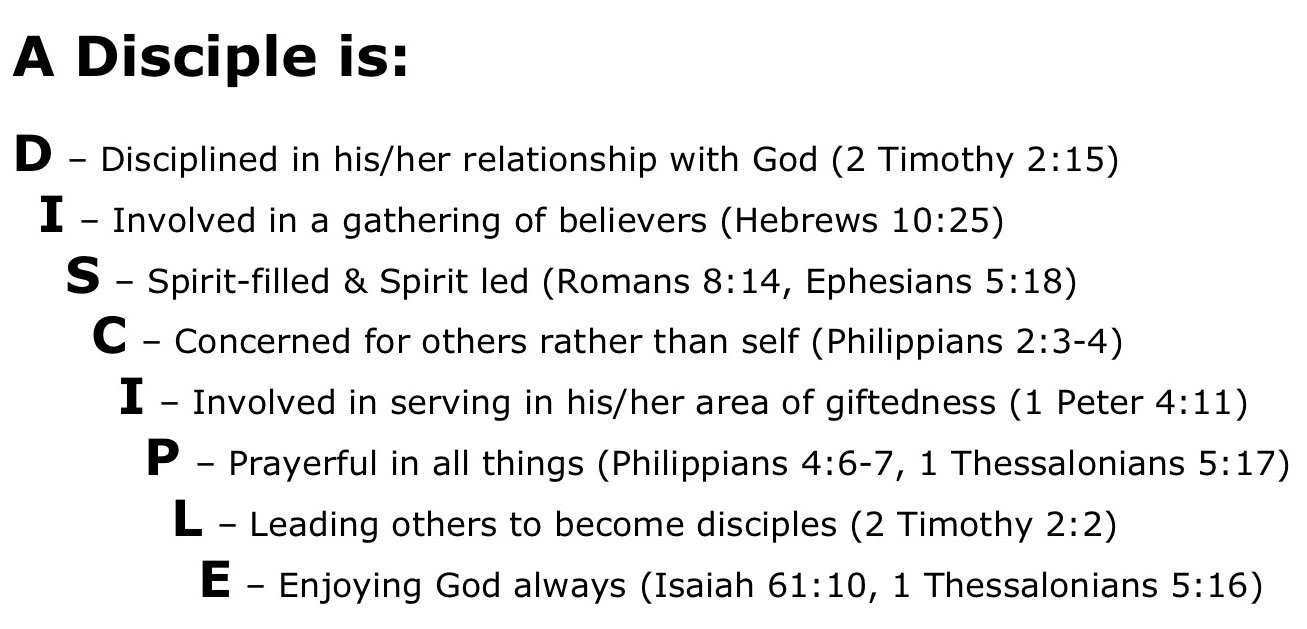
What is your definition of a disciple? What helpful tools and resources are you using to become and help others become effective disciples?


 Lane Corley