Category Archives: Church Planting

Your Church Can Grow This Summer!
Last year our small church actually grew by 30% between Memorial Day & the first day of school. Here’s what we did that helped us beat the summer slump. And it does not even include VBS!
1. Celebrate Summer

Memorial Day Outdoor Worship Gathering on the River in Madisonville.
There are at least four great opportunities already on the calendar to build in celebration over the summer: Memorial Day Weekend, Father’s Day, Fourth of July Weekend, & Back to School. Plan on doing something special & unique for each of these weekends. These four Sunday’s were the highest attended weeks of the summer for our church. Sure, some people went out of town, but we made each a special opportunity for people to invite unchurched family & friends & we reached out to each prospect with a special invite. The guests made up for the vacationers. Make the most of the holiday weekends!
2. Break the Routine
When summer comes around, everyone is thinking, “I need a break,” including your church’s teachers & volunteers. Structuring the calendar in such a way that gives some relief to hard working volunteers will help them stay enthused about their teams work all summer. It also builds in the expectation that volunteers will be out of town in such a way that momentum is not lost & relationships are not strained. Our kids ministry combined classes for special days several times & our holiday celebrations were planned in such a way that kids volunteers & setup crews had those weeks practically off.
3. Get Outside

4th of July Weekend Worship Gathering at an area State Park.
For Memorial Day & Fourth of July, we held our Worship Gatherings at some of our communities favorite outdoor venues. Every community has a park, picnic area, lake area, etc. where people like to gather & hang out. Incorporate cooking out, fishing, games, water slides, etc. & you’ve got a crowd. Share the gospel clearly & gather info from visitors. And depending on the location, you may can even maximize the hearing of the Gospel with people that show up not knowing that a church would be meeting there that day. Everybody loves being outside in Louisiana & in our case, outdoor worship gatherings have been a great tool for connecting new people to our church.
4. Connect New People
Of course, sustainable growth depends upon the systems you have to connect people to Christ, to one another, & to a mission greater than themselves. Plan for new people by continuing or starting a new comers class & by having special opportunities for connections with small groups throughout the summer. Also, keep in mind, if new families are relocating to your area, it will likely be during the summer. Make your gatherings accessible to new people in the community & plan on helping them feel welcomed & help them make meaningful connections. Our Connections Team prepares New Resident Welcome Baskets for people to give to new people moving into their neighborhoods throughout the summer.
Summer is a great time to grow things. Churches included. Celebrate. Have fun. Get outside. Get ready for new people. Expect God to bring an increase.
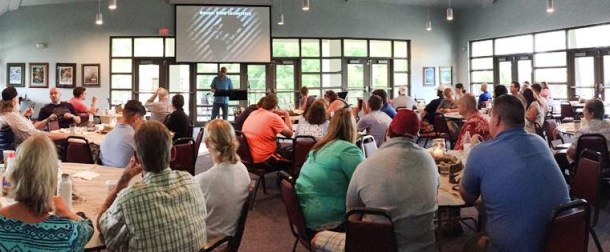
Father’s Day Pancake Breakfast. All you can eat pancakes right through the sermon! Yea!

Church Planting Update
 Louisiana Baptist Missions Support Committee met yesterday. The MSC allocates cooperative program & mission offering funds for the work of the Missions & Ministry Team that includes Church Planting, Disaster Relief, Compassion Ministry, & Missions Education. The committee’s actions this week:
- Allocated $398,000 in Church Planting & Compassion Ministry grants to 14 new ministries. $131,000 of the allocation to New Orleans. Including Revival Life in Houma – planter Dexter Gaspard, Immanuel Community Church in New Orleans – planter Matthew DeLaughter, Walker Community Ministries – Planter Joey Beeson, Crossroads Community Church – planter Larry Johnson, Christ Church Abbeville – planter Scott Guillory, Barker’s Corner Mission – planter Derek Kitterlin, The Way Church Livingston – planter Cameron Gober, Faith Church in Franklinton – planter Larry Lucas, Still Water Baptist Church New Orleans – planter Burnell Darnesberry, City of Lights Church – planter NaJee Johnson, Suburban West – Nicos Elzy, Touchstone Community Church – planter Herschel Moore.
- Allocated $125,000 in grants to five new churches acquiring first unit buildings. Including Philadelphia Baptist’s Alexandria campus – planter Clay Fuqua, Genesis Church in Walker – planter Jeff Smith, The Way Church in Livingston – planter Cameron Gober, Stillwater Church in Hammond – planter Lonnie Tucker, Fellowship Church’s South Ascension campus – planter Todd Blount.
Other reports shared at this week’s meetings:
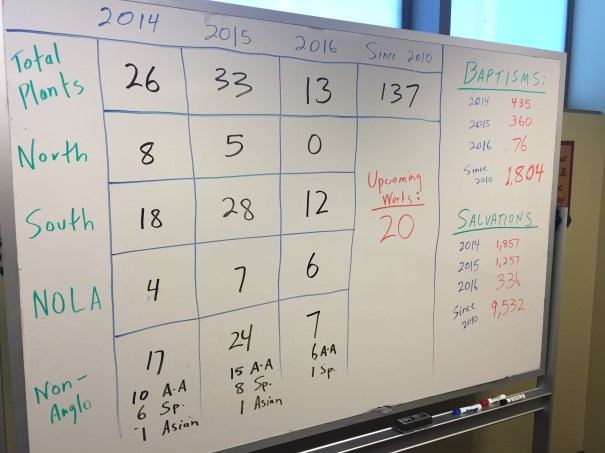
- 13 new churches planted so far in 2016. 6 in New Orleans. 7 Non-Anglo. All 13 in South Louisiana. 20 in development for 2016. 137 new churches planted since 2010.
- 76 baptisms, 336 new commitments to Christ reported Jan-Mar 2016 by church plants in Louisiana.
- Since 2010 – 1,804 baptisms & 9,532 new commitments to Christ. We’re approaching 2,000 baptisms & 10,000 new commitments to Christ this year.
- New Orleans – Since 2012 when Send New Orleans launched – 27 new churches started, 348 baptisms, 1,352 New Commitments to Christ. This month the Mission Support allocated for New Orleans will exceed $1 million since the 2012 launch.
- The President’s 2020 Commission identified the greatest needs for new churches in Louisiana among different people groups (40% of the population of Louisiana is non-anglo, but only 5% of our SBC churches in Louisiana were non-anglo), in South Louisiana (1,200 of our SBC churches in Louisiana are in North where only 1 million of our population is. 400 churches in south Louisiana where 3 million of our population is). Since 2010, 60% of our churches started have been non-anglo & 79% have been in South Louisiana.
- Church Plants receiving Cooperative Funding in Louisiana have increased from 39 in 2010 to 74 in 2016.
Grateful for the opportunity to be a part of Missions Support & Church Planting in the great state of Louisiana. Grateful for the generosity of Southern Baptist churches in Louisiana who contribute to the Cooperative Program, Georgia Barnette State Missions Offering, & Annie Armstrong Offering for North American Missions that makes the work of this team possible.

Why Portable Church? Advantages and Objections
Portable Church has MANY advantages. I’ve come to love being portable. Here’s why:
1. Energy
Energy can be directed outside the walls, because the walls are not ours. In portable situations, the church is usually not responsible for cleaning, managing accounts, & making repairs. We’re able to direct the skills of the people more to the needs of the community.
2. Affordability
The cost of buildings are growing exponentially. In many, not all, communities, being portable is better financially for new & transitioning churches. Often the cost of a building straps congregations with debt & too small a seating capacity for maximizing growth for the future.
3. Community Engagement
A Lifeway research study called The State of Church Planting showed that new churches that meet in public places experience 42%-49% greater attendance than others. Unchurched people are comfortable attending gatherings in theaters, gyms, banquet rooms, hotels. And the benefit to non-profit locations that churches can gather in is great. Churches we’ve planted have met in a Apartment Complex, Fire Station, YMCA, & Museum. Community agencies and organizations can greatly benefit from rent payed & the church can see that being there is an investment in the community.
4. Culture
Portable church allows for the ministry to be built on what is most important, especially in critical early years. When you are portable, people attend church due to relationships & mission. The building & space are less likely to become “tails that wag the dog.”
Common Objections:
-
Isn’t that a lot of work?
Yes. It takes work to setup. But that work involves people rubbing shoulders & elbows together weekly. In my experience setting up church on Sunday’s brings people together. In my opinion, one of the reasons portable churches meeting in public places have 42%-49% greater attendance is because of the work that requires mobilizing people every weekend. Relationships + Responsibility = a Reason to Return. Churches with few mobilization opportunities limit their capacity for growth. Portable church set up expands mobilization potential.
-
Doesn’t a building signify that you’re a real church?
Maybe so. But do you really want a building to define your church? Church should be defined by its disciples, their love for one another, & the churches ministry in the community. Studies & my own experience shows that portable church can enhance these things.
-
Won’t people get burned out?
People tend to get burned out in any situation. The work of the leader is to provide good systems, regular encouragement, & changes of pace to allow people to manage seasons of their lives. And portable churches can setup with great creativity & simplicity limiting the workload, but still involving greater numbers of people in the ministry of the church.
 Now, churches do reach a critical mass in attendance & finances where ownership & construction may make sense. And God often provides a building at the right time for the growth of His church. HOWEVER, there’s no need to be afraid of portable church. If your thinking about starting a church that may need to be portable or you’re thinking of staying portable, use these questions as a guide:
- Can I find an affordable, portable space that will help me direct energy outside the walls?
- Can I find an affordable, portable space that will help me with engaging community leaders & spheres of influence?
- Will portable church help establish the culture & vision of this new church for this community?
- Am I ready to establish teams & mobilize people?
Find some other great thoughts about Portable Church from Geoff Surratt in my earlier post On Church Buildings and Portable Church.

Church Planting Story: Hope Church of Waldheim
 Was back at Hope Church of Waldheim tonight for a men’s gathering. Heather & I moved to Covington in 2001, to be a part of starting a church in the community of Waldheim. So many great memories in this community. And so many hard lessons. Church planting in Waldheim brought me to the end of myself many times, as church planting will usually do. Wrote about the journey in the post Overheard as a North American Church Planter.
Timeline: Started in October 2001 as a Home Bible Study. Began weekly worship gatherings in October 2002. Worshipped in an unairconditioned Fire Station for 2 years. Moved into a former cafe/truck stop in 2005. Survived Hurricane Katrina in 2005. 55 baptisms in first five years. 1,000’s came on volunteer missions trips from Texas, Louisiana, Alabama, Kentucky, Mississippi, & South Carolina to serve this community through Hope Church between 2002 & 2008. Grateful to have been a small part of the story of this church that will hopefully be a light to the unchurched in the Waldheim community & beyond for generations to come.
Found an old partner presentation to share with the men’s group:

Sustainability and Church Planting
 Church planting is a risky endeavor that requires sacrifice, faith, & hard work. The goal should be to bring new people into the kingdom & to do it for years to come. Most church planters who start from scratch begin with support raised from denomination, other churches, & personal relationships. The church planter usually feels an internal clock ticking for the day when this support will begin to diminish. My denomination usually supplies 2-3 years of financial support. Sponsor churches will usually commit 3-5 years. Individual partners may stay on longer, but to be sustainable, the church plant is expected to & will have to make disciples who support the work of their church. A recent audit of failed church plants in my state, found that 50% of them just ran out of time before becoming financially self-sustainable. The outside support ran out before the disciples reached could carry the budget of the church. So how does a new church begin with the end in mind in relation to finances? Here are some helpful questions / exercises that a planter or planting team can work on to help count the cost & plant for financial self-sustainability:
1. If my vision is realized in 5 years, how much will it cost?
or a better question may be, How much will it cost annually to bring new people into the kingdom in this community? The work here is first to design a strategy that will actually reach the unchurched in the community, instead of just looking at what’s been successful in other places or by other people. Then, if the strategy & need is for the church to have things like full-time staff & a building of its own, go ahead & plan for those realities now. You will most likely need a budget of at least $120,000 per year to afford small doses of those two common realities.
2. Does this vision fit my context?
or, How long will it take to become financially self-sustainable in this particular community? or How many people will I need to reach to become financially self-sustainable in this community?
So this exercise is to look at economic realities in the community to begin to diagnose reasonable expectations of financial viability from within. In Louisiana, we’ve used a figure of $800 per year per person in average attendance that can be expected from the congregation as a way to project financial viability. So, average attendance, multiplied by $800 will usually put you in the ball park of what your annual budget will be. So if I will need $120,000 per year, divide that by $800 & that tells me that I’ll need to reach 150 people to be around financial self-sustainability. But the economic realities in some communities may not support that figure. For some, $400 per person per year may be more realistic. Talking to local pastors & looking at average incomes in the area will help with this exercise. We know all things are possible with God, but now you’re counting the cost of a potential church plant in this community. Questions are: Do I believe this can happen here? Am I willing to lead my family & people reached to get there? Do I need to be bi-vocational to start a church here?
3. How many years will I need financial support from the outside?
Outside support is great & needed, but most church plants will not be able to depend upon it beyond five years. These exercises may tell you that you will need to because of the realities on the ground. Plan for that by spending more time & energy on raising outside support. Developing partners that will be OK with long term sponsorship of your work. Or raise large amounts of capital on the front end for the new work. With more churches looking to support church planting directly, the good news is that this is possible today. But we also must be cognizant of the danger of getting top heavy – depending upon an amount of outside support that the congregation will never be able to sustain on its own. This scenario has meant for some plants, losing staff & making major course corrections in years 4 to 6, which could prove fatal to the work or put much pressure on the planter family or sending church.
4. How will I teach new people reached by the new church about Biblical Stewardship & Giving?
The sooner you begin discipling people & teaching them the principles of Biblical Stewardship the better. If you really do reach new people, you will have to lead them down the road to Biblical giving. Today, people are experiencing mountains of debt, high costs of living, & more taxes, so it may take longer than in previous generations. So don’t wait to start healthy financial systems in your new church that teach people to steward their money for the work of God’s kingdom.
5. How can I create a reproducible model that can produce disciples, leaders, & churches for years to come?
And one major consideration for the future of church planting is that new churches learn to create reproducible models that can plant churches that deliver the gospel to different communities for generations to come. If it costs you $2 million dollars over five years to launch a church that has reached 150 people, who are now strapped with debt on the new building that took hours of volunteer labor to build & seats 175 (not an uncommon scenario), it may be a tough sale when you start talking about doing it again. Making reproducibility a core value at the beginning will call for simplicity, creativity, & people based not funding based strategies. These things require more patience, but will lead to less stress & pressure for the church planter & plant in years 4 through 6.
What do reproducible models look like? Most of the time in the west, it’s about strategies that keep cost down. Scenarios like:
- Plants led by bi-vocational staff, at least initially.
- Keeping gatherings smaller, but adding locations to grow.
- Commitment to longer term portability may work in some communities.
- Starting a non-profit to raise money through grant writing & corporate donations for ministries to the communities.
I love the axiom, “Begin with the end in mind.” Jesus commended counting the cost (Luke 14:25-34). These questions may seem unspiritual, but are necessary part of planning for delivering the Gospel to generations in your given context.

“Reproducing Churches Stay Lean and Mean”
 Church Planters & Compassion Ministry leaders in the Greater Baton Rouge area are getting a treat this weekend, learning from Tulsa, OK, Church Planter Kujanga Jackson. Kujanga & his wife Kimberly planted New Beginnings Church in North Tulsa. NBC is the incredible story of how God birthed a Multi-Ethnic church near the spot of the largest race riots in US History. And NBC has in 10 years, planted 6 other churches & started a non-profit called TOUCH which reaches into 6 major schools & many low income multi-housing developments. The thing I love about this story is that NBC is in one of the poorest communities in Tulsa, but has found a way to be a self-sustaining AND multiplying church. Utilizing the non-religious non profit TOUCH for fund raising, for ministries, & employment of staff, the church doesn’t have to shoulder the financial load of ministries in a community with high unemployment & low incomes. Self-sustaining, reproducing, impacting the community. That’s what we desire of all our churches. Look forward to having Kujanga back in the future!
A few other big takeaways from our time with Kujanga:
- To be a reproducing church you must stay lean & mean. Each time New Beginnings reaches 120 in attendance, they know they are pregnant & begin preparing to send out.
- For transient, low income communities, link strategy to local schools.
- On Multi-Housing Ministry: What you use to draw’em is what you’ll have to use to keep’em.
- Counter entitlement thinking in communities by making them a part of the process, allowing them to participate in planning & implementing events & ministries in their communities.
- What is a Mature Multi-Housing Ministry? The residents involved in the process of making their community better. The church as a link for resources.

Breaking the 50 Barrier in Your Church

The vast majority of churches start out with less than 50 people. Actually, 70% of our current plants in Louisiana started below 50. 38% (or 618) of all Southern Baptist Churches in Louisiana reported attendance below 50 in 2018.
Having 50 people or less is not bad. In some communities, 50 is a big church. A church of 50 has some advantages. Less overhead. More community. 50 people can encourage one another and reach out in ways that bigger churches cannot.
Most pastors have the intention of their church growing beyond 50. Mostly because we are motivated to see more and more people saved and discipled for the glory of God. Also, if you are seeing to be a vocational minister and make a living as a clergyman, but 50 people is usually not enough to sustain a large personnel budget in a church.
50 can be a barrier that’s tough to get beyond. So how do we get beyond 50 people?
1. Pray for breakthrough opportunities!
Sometimes a breakthrough opportunity can happen in the life of a church. These are opportunities that open up that can only be explained as a work of God. A key meeting place for a church plant, a well-placed news story, a large financial contribution, a merger with another congregation. Pray regularly for God to open doors that man cannot open or explain.
These do not always = church growth, but they signal God is at work and will usually lead to fruitfulness and health (which have been known to lead to church growth).
2. Give away responsibility and authority
40-50 is a barrier often because 40-50 is about the number of people that one person can lead by himself. Unfortunately, many leaders are just not willing or able to let go of or share the reigns to let others lead with them.
To multiply, the leader must become a leader of leaders.
Fear of losing control. Fear of someone doing it better. Fear of someone messing up. And, “They’re just not ready yet!” I know. Every time I read the passage about Jesus sending out the 70, I have to stop myself from yelling, “They’re just not ready yet, Jesus!”
Sending the disciples out was part of Jesus’ strategy for getting them ready, and it will be so for your leaders as well. For the sake of your sanity, for the development of people, and the growth of church and kingdom, let go and send them into ministry and leadership.
3. Develop a 2nd and a 3rd group
40-50 is a barrier often because it’s a group that can fit in one big room. And sometimes we are too much in love with knowing everybody, having everybody together all the time, and having everybody listening to me (ouch!).
To move past 50 you need multiple groups, which means multiple leaders, which means more people owning the vision and growth of the church.
And starting multiple groups, whether its classes, teams, or whatever, helps get multiplication muscles moving for future growth.
4. Establish systems that lead people to Christ and His mission
How do people hear about your church? What do we want people to know and do once they attend? How do we want people to connect beyond just attendance? How will we help people move toward Christ? How do we help people become leaders?
These kinds of questions help us develop a step by step path for new people coming into the church. Today more than ever, connecting with Christ and His church is not something we can assume people know how to do. We have to lead them there. Systems help us do that.
5. Be on the lookout for speed bumps and dead ends.
Where are people getting hung up in their development as disciples? What is causing attendance to stagnate? What needs are going unmet? Some common speed bumps:
- Building & space issues. A full building is fun for us pastors, but it can put a lid on the growth of the ministry. Starting a second gathering or moving to a larger facility can keep the group growing. Rule of thumb: at 60% full, start making other arrangements and thinking about how you can create more space (2nd service, larger facility, etc.).
- Unity issues within the church. The radar of the world is up for hypocrisy and disunity among believers. Keep relationships straight in order to grow people and the church.
- Needs in the body that are going unmet. Watch for your Acts 6 moments. In Acts 6, the Hellenistic widows were being neglected, threatening unity and testimony. A ministry was started to meet the needs and keep the people and churches growing together.
What other issues or observations about breaking the 50 barrier would you add to my list?
One of my favorite church planting axioms is “In every apple there is an orchard.” God made every living thing in creation with the potential to make more. We’re all carrying seeds that can be planted to grow more of what God wants. For us, that’s disciples and churches. Do you see your church, no matter the size as a potential orchard to create more for God’s glory?

Taking a Mission Trip to Help a Church Plant? 7 Things You Need to Know
Church Plants and Volunteer Mission Teams, Part 2
Mission Trips can be powerful tools for the growth of individuals and churches. As a church planter, I consider every mission team a force multiplier, multiplying the impact of our church’s outreach in the community. Yesterday I wrote about five rules of thumb for church planters. Today, we turn to the sending church. Here are seven key things to know if your church is taking a trip to help a church plant:
1. It’s not about you.
Every Mission Trip should be about the people that will be served by your church. But sometimes when our expectations are unmet or we see things or are asked to do things out of our comfort zone, things turn inward. Train your team to expect to be uncomfortable and no matter what happens make the trip about the community, church, and people you’re serving. Love the military axiom that applies well to Mission Trip Preparation: “Get comfortable being uncomfortable.”
2. The Planter is caring for you PLUS trying to pastor a church.
The church planter is concerned about you, but he also has a job or two. He may need to make a hospital visit, prepare for Sunday’s sermon, lead a small group Bible Study, etc. As much as he may want it to be, his full-time job will not be to be at your beck and call. If you need that, explain that ahead of time so arrangements can be made.
3. The people at their church are probably new to this.
One of the most frequently asked questions from mission teams: “Where are the people from your church? Why aren’t they helping?” Well, most likely if it’s during the week, they’re at work. Just like you do not hang out at the church and help the pastor most of the time when you’re at home. Also, in most church plants, the people are new to faith and new to missions. The planter as disciple maker is moving them on a path toward engagement with faith and servanthood. Your presence will help as they see you taking a week or weekend to give of yourself. But don’t have unrealistic expectations and don’t be too critical if some of the people from the mission church seem immature in the faith. They probably are. And that actually means the church planter is doing a good job.
4. They love their community. Don’t trash it.
When you go on a mission trip, the community will be different from yours. There may be some things that seem strange to you. There may be some things that seem wrong to you. Hopefully, that’s why you’re there, to improve the community through the gospel and with your unselfish presence. Talking bad about what you see may put the planter on the defensive or hurt those you’re serving. Train your team to leave the community better than when you arrived through encouragement and servanthood.
5. Money is very tight. Bring some.
If you’re taking on projects that you know will cost a lot of money, consider footing the bill. Money is always tight for the church planter family and the new church. Ask them what they can afford to cover during the week ahead of time. Also, consider a love offering if they’ve provided housing for your team. Ask them if they took a day off work to help you around the community and consider covering that cost. And one of the best things your group could do for a lot of church plants is give the planter a date night with his wife.
6. Try to blend in.
If you made T-shirts for your team, wear them on your day off in the community or on the way home. Remember, it’s not about you. You are serving as an extension of the church plant. The church plant will be better off if after your mission trip, the community is saying, “That new church in the community served us” rather than “A big church from ____ came here and volunteered in our community.”
7. Commit 3-5 years.
The mission teams who have had the greatest impact on our community, new church, and family are those who make return trips. Return trips will allow your church to see the annual progress of the new church as they return each year. Anticipation will build naturally for each trip. A visit from the church planter to speak at your church could create a powerful relationship. You could even work it out with a church planter to help them develop one particular area of church life that your church is very strong in – i.e. VBS, Kids Ministry, Evangelism, etc. In that way, you’re reproducing yourself in another community with each trip.
I’m excited to see the huge swell of support for church plants and more churches taking in-country trips to help new churches. Use these 7 need-to-know things to train your team for maximum impact.
If you are a church planter or a church that has taken a trip, what else would you add to this list?

Our church plant, Bridge Church, got to help a church plant in San Antonio last summer.

Church Plants and Volunteer Mission Teams, Part 1
Mission Trips can be powerful tools for the growth of individuals and churches. As a church planter, I have considered every mission team as a force multiplier, multiplying the impact of our church’s outreach in the community. However, they can also be a drain on a church plant and/or planter if proper planning, communication, and strategy development haven’t gone into the trip.
In the next two posts, I want to talk about some tips for producing win-wins out of Mission Trips to help local church plants. Today, rules of thumb for Church Planters. Tomorrow, rules of thumb for churches going on a trip to help a church plant.
Five Rules of Thumb for Church Planters Working with Volunteer Mission Teams:
1. Invite Others to join you on your mission to reach that community.
If God has called you to plant a church, He’s most likely called others as well. He wants to call people from outside your context to join His mission of reaching your community. Start with churches that you have relationships with and invite them to consider supporting you through prayer, financially, OR by taking a mission trip to help you with outreach. There may be times when you help them, more than they help you. That’s part of having a kingdom view of your church plant’s place in history.
2. Ask for a Pre-Visit from a leader.
By far, the most productive mission teams always send an advance team to plan and prepare. That may look like a 1-2 person team several months before or a small team several days before the rest. As you’re planning for outside mission teams, always ask for an advance team of some kind to prepare the way. And the larger the group, the more necessary this will be.
3. Stay away from back-to-back groups. Unless you have Full-Time Staff.
As a church planter, time for the important work of rest and follow-up is always squeezed. You’ll need a week to recover and follow up properly between teams. Unless you have a full-time staff taking care of details. Then plan for at least 3-5 days between teams.
4. Set your calendar and strategy early.
Set your calendar early, so that when mission groups call, you know what times you have available and can receive teams and you know what you need to do to grow your church at this stage in history. This will save you from an exhausting spring or summer that leaves you feeling that you didn’t accomplish anything toward the planting of your church.
5. Plan for follow-up.
Part of a great mission trip experience for a church is seeing the impact they had on you and your mission. Send thank you notes, send pics of the trip or the results if they’ve promoted an event for you that they didn’t get to stay in town for. Send videos as you grow, so that they can feel like they’re a continued part. And invite them back.
Some of our best friends and partners in ministry are people who came on a mission trip to help our church plant. Some of them are now planting churches themselves. The investment in each other and the relationship built between the planter, plant, and church during mission trips is unique. Follow these rules of thumb for a great experience.
Tomorrow we’ll turn to some things churches taking a trip to help a church plant will need to remember to have the greatest impact.
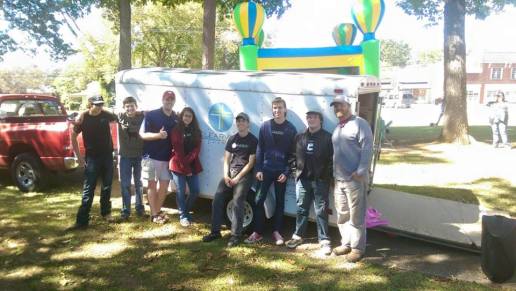
Mission team from Georgia that helped our church plant with Block parties during the summer of 2014.

Church Planting Update
>> With 88% of reports in, 121 new commitments to Christ, 24 baptisms reported by Louisiana Church Plants in January.
>> We added 2 new churches last month, bringing us to 9 for 2016. At least 3 more starting in April! Great start! Pray for Passion Church in Jennings, Planter Ryan Temple & Faith Church in Franklinton, Planter Larry Lucas.
Keep up with Church Planting among Louisiana Baptist by joining our Facebook Group.
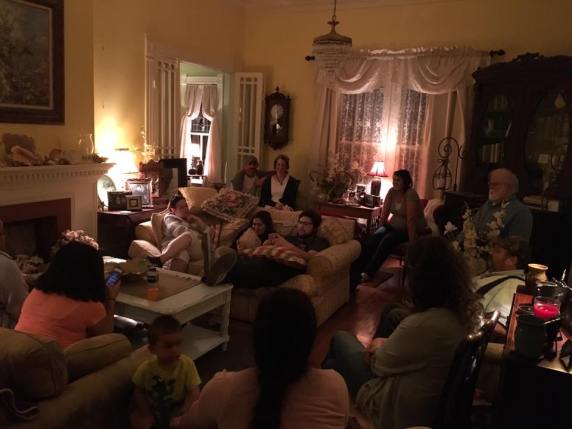
Pic of recent small group gathering with January start, Christ Church Abbeville, planter Scott Guillory.


 Lane Corley