Category Archives: Church Planting
Stillwater Making Waves through #ChurchPlanting and Multiplication
Every believer is a church planter.
 This is a lesson that I learned from Lonnie Tucker, pastor & church planter of Stillwater Baptist in Ponchatoula. And this is a lesson he’s teaching his congregation regularly. But it’s not just words to Stillwater. This year Stillwater has sent out three teams to start new churches in neighboring communities of Hammond, Slidell, & New Orleans. The result has been 118 professions of faith & 43 baptisms in 2014 & 301 professions of faith & 111 baptisms since 2012 when Stillwater Ponchatoula began receiving Cooperative Program funding. And another new church is planned in 2015. So one church plant has blossomed into five in a matter of 3 years! That’s the kind of rapid multiplication that will reach Louisiana & the world for Christ. Grateful for Lonnie Tucker & his team.

Believing for the Hard to Reach Areas: #ChurchPlanting in Avoyelles Parish

Before & after Life Point’s new Worship & Compassion Ministry Center was built in Mansura
Life Point Church in Avoyelles Parish is a favorite Louisiana church planting story of mine. Jacob Crawford started Life Point in 2010. They began receiving cooperative funding in 2012 and since then have baptized 104 in a traditionally hard to reach part of Louisiana. Life Point has grown from an average attendance of 65 in 2012 to 118 in 2013 to 165 this year. 75% growth since their first month of Cooperative Funding. Another remarkable thing about Life Point is that the congregation is 60% white & 40% African-American. That’s remarkable for almost any church in the South for one thing, but it’s also significant because it mirrors the racial makeup of the community. Life Point has used Compassion Ministry as a way to connect with people in the low income communities of Avoyelles, including thrift store, food distribution, Celebrate Recovery, Jail ministry & festival outreach. This year, construction was completed on a new Worship & Compassion Ministry Center in Mansura, LA. And now, as Life Point “rolls off” Cooperative Program funding, they are taking on the planting of a new church in the neighboring community of Plaucheville.
If anybody had said in 2010, that you could plant a church that would be 40% African-American & 60% white, & that church would grow to 200 in the heavily Roman Catholic, farming communities of low-income Avoyelles Parish, many would have doubted. But thank God Jacob & his team have kept believing in the power of the Gospel & today lives are being changed.
Connect with Life Point on Facebook. Get to know Jacob, especially if you’re planting in a rural area. And pray for Jacob & his team as they continue to plant seeds in Avoyelles Parish.
Listen to Jacob tell part of their story in his own words in these videos:

#ChurchPlanting Partnership Leading to Changed Lives in NE Hammond
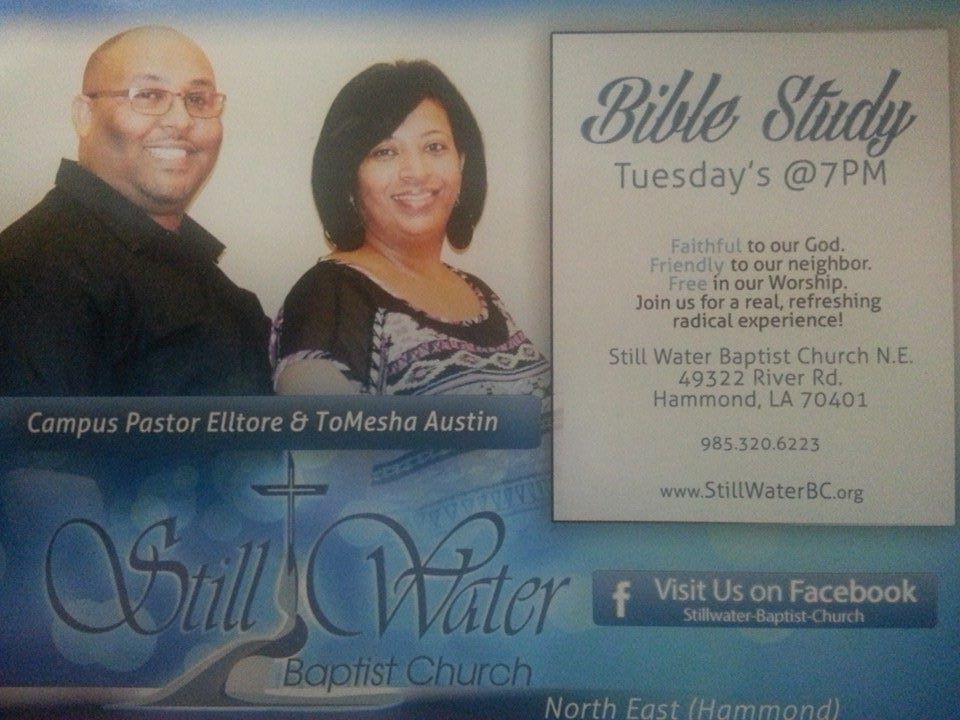
In the process of a self-assessment, Ebenezer Baptist Church in Hammond faced the fact that a sizable population of African Americans near their church was unreached & that they had been unable to reach them for years. That’s when the pastor, Kent Newell, called Lonnie Tucker, Pastor of predominantly African-American Stillwater Baptist Church in Ponchatoula. Together they saw that what was needed was a new congregation. Stillwater sent Elltore & Tomesha Austin to began ministering in the area & Ebenezer opened its doors for a Tuesday evening Bible Study. Six months later, 65+ gather for Worship & Bible Study & lives are being changed by the Gospel.
Grateful for this partnership that blossomed out of the needs of the community & desire for unreached people to have a gospel witness. One congregation SENT qualified leaders for the work. Another congregation WELCOMED a new congregation onto its campus. More Great Commission, Church Planting Partnerships like these needed! Grateful for Stillwater & Ebenezer!
5 Things You MUST Do the FIRST YEAR of a Church Plant
 There are different strategies & philosophies that go in to what you do in the Pre-Launch phase of a church plant. My purpose is not to give you another in this post, but to tell you what MUST happen along with the strategy you adopt so as not to derail success. I mentioned 5 Things you MUST do before you Plant a church here. Here’s my list of 5 Things for the Pre-Launch first phase of a church plant.
1. Build Your Network.
Ended here last time, start here this time. Your support network is your lifeline. As a entrepreneurial leader you should ALWAYS be building your network. But in the first year of a church plant your network must expand into the community. Meet with community political leaders, other pastors, school administrators, apartment complex managers, fire & police departments, business owners. Talk to as many people as possible to gather info, share about the church plant, find opportunities to serve & share the gospel. So many sound bites that instilled vision into our church plants came from these types of conversations in our first year.
2. Gather a __________.
Small Group? Yes! Core Group? Yes! Launch Team? Yes! I don’t care how many or what you call it, but GATHER! Somebody said there three keys to church planting: 1) GATHER, 2) GATHER, 3) GATHER. Whatever the strategy or philosophy, it must include gathering people together around the word of God & the mission of God. We started with two gatherings in each of our church plants. A Discovery Bible Study for seekers & pre-Christians & a Leadership Development Group that went through studies like Experiencing God & The Barnabas Factors. The two groups multiplied & played off of each other culminating in the launch of the new church. If you struggle with gathering people, then get somebody that doesn’t on your team, or expect slow growth, or consider a different role. Gatherings is essential!
3. Make it Sticky.
Our first church plant was in a community with hard soil. Gathering was difficult & slow. I had no experience or coach to help me read success or failure, so I invited a friend with experience planting in pioneer areas to come to a gathering. Afterward I ask him if I should quit & go do something else. He said, “If you quit it will be the stupidest decision you every make, because you can’t get people to sit down & shut up so that you can start & you can’t get people to quit talking & leave afterward so that you can lock up.” He was helping me see the relational stickiness of our gathered group. Several things that I’ve observed that help make new churches sticky:
- The Gospel. One of the great miracles of New Testament Christianity was the different people groups that were brought together & unified to make up the body of Christ. It’s still a miracle today. Gather around the Gospel & you can expect supernatural glue.
- Relationships. I love Ed Stetzer’s quip, “People are not looking for a friendly church, they’re looking for friends.” Don’t get organized & programatic too quickly (or at all if you can help it). Build in lots of time for getting to know people, being vulnerable, & caring for each others needs.
- Mission & Ministry. Tackle a huge project that everyone can get involved in. Get messy if possible. Celebrate what you did together that you could have not done separately. Mission & ministry create a story.
4. Establish clear lines of communication.
“Without communication, you travel alone” John Maxwell. You must develop a plan for how you’re going to communicate to at least six different groups of people: (1) Support network – including sponsor churches, denominational entities if applicable; (2) Prayer partners; (3) Core Group / Leadership Team; (4) the Unchurched Community; (5) Community Leaders; (6) Disciples in the making.
There has never been better tools available for communication than there are today. Some that I’ve found helpful:
- Mailchimp, Constant Contact, or Vertical Respons
- Facebook Groups – open & closed
- Facebook Page for the church
- Email – don’t neglect regular email b/c people are more apt to reply & create conversation
- Snail mail – never been easier & more affordable to do direct mail than it is today
- Personal notes – get some personalized stationary. The more personal the touch, the more personal the follow-up response should be
- Texting – many Church Management tools will have mass texting tools available
The cliches about communication are true! “You can’t over communicate!” “People are down on what they’re not up on.” And you’ve got a great story to tell, so plan on communicating with intentionality.
5. Start with Integrity.
Don’t wait to establish a framework for integrity in financial, personnel, & other matters of integrity. Don’t mix personal & church finances. Get a partnering church involved in oversight. Seek accountability. Establish job descriptions. In matters of integrity you can’t hope so. You must do all that you can to protect yourself & others from temptation & accusation. To get started:
- Open a separate checking account. A partner church might can do this for you at first, but get a separate place from which money can be received & spent.
- Use a Counting Sheet for donations. Helps keep track of cash & checks & records gifts for year end contribution statements.
- Get a Cloud based Church Management System. Popular ones are Fellowship One, The City, ACS, Church Community Builder. These are costly but worth it. You sponsor church may allow you to use theirs for awhile. Starting out from scratch they may be overkill. Our new church has used ChurchOfficeOnline.com. Designed with smaller churches in mind. Very functional. And not near as expensive or training intensive.
Design a strategy to reach your community & DON’T NEGLECT these 5 things. What else would you add to this list?
5 Things You MUST do BEFORE You Plant a Church
“I think I want to start a church one day, where do I start or what should I be doing now?” I get this question a couple of times of month & it’s awesome that so many are interested in church planting these days. Here’s my typical response:
 1. Confirm Your Calling.
You can’t just “think” you want to start a church, you need to KNOW that this is what you’re called & cut out by the Holy Spirit to do. The best way to confirm calling is to let others do it with you & for you. There are a variety of sources that offer Church Planting Assessments that start online & move to an interview where experienced church planters can help you confirm your make up & call to plant. Being disgruntled about the church(es) you’re currently attending can be part of a calling, BUT should not be the only part. Planters are shaped by God. Check out my post “You Might Be A Church Planter if…” to see some typical innate qualities of those who plant.
2. Confirm Your Spouse’s Calling.
Your spouse will not be the church planter, but she needs to have a sense of calling none the less, b/c so much of the early years of planting a church will encompass your home life. And your call to MARRIAGE, if you are a husband, will ALWAYS supersede your call to plant a church. If your wife is not on board, wait!
3. Deal with the Cracks in Your Character.
Church Planting can be like a pressure cooker. The stress & heat of the moments in the beginning of a new church will bring out whatever is in you, good & bad. So, if you’re struggling with addiction, anger, insecurity; church planting will most likely not help you in this struggle. Have a plan that includes accountability, rest, closeness to God, & emergency response by others as you feel pressure rising.
4. Get Equipped.
Read, attend church planting conferences, & seek out at least one good school of church planting or Basic Training. Listening to the podcast of a famous church planter is good, but it’s not the training you need to plant a church in a particular context. That planter is successful because of systems that are in place that you’ll never see just simply by listening to a podcast. Find a workshop type training in your area that will help you plan for evangelizing & discipleship in your context.
5. Build Your Network.
There are very few “self-made” church planters. To be successful you will need others. Start by seeking out Prayer Partners & do this as soon as possible. Start an E-Newsletter or send personal emails to everyone you know who MIGHT pray for you & be interested in what God’s doing in your life. Let them know what you’re praying about & seek their partnership in prayer. You’ll also need financial partners, on mission partners to be part of your core team, & a network of other planters/coaches/mentors who will advise you along the way.
So, you think you want to start a church?
- Are you called by God? or by disgruntlement? Desire for fame? or something else?
- Who is helping you confirm your calling?
- Is your spouse & family on board?
- Have you dealt with cracks in your character?
- Do you have a network?
- How many prayer partners do you have?
And one BIG honorable mention:
- Consider being part of a church planting team. Nothing prepares you for planting like experiencing it first hand as a team member. If you’re able, find a new church to become a member of for a year & get to know real life church planting. You can use this time to work on the 5 MUST’S. And maybe that church plant will be a big part of your growing network!
What would you add to this list?
Message me at Lane.Corley@LouisianaBaptists.org to get specific about confirming your calling or working on other parts of the MUST’s.
Gathering Strategy: “Draw them with love” #churchplanting #spurgeon
“Compassion magnetizes a man… A big heart is one of the main essentials to great usefulness… You may collect people for a time by some extraneous means, but unless they perceive that you love them, and that your heart goes out with desires for their good, they will soon weary of you.”
From a sermon by Charles Spurgeon entitled “Compassion On The Ignorant.” Check out the entire clip HERE.
Does My Community Need a New Church? The Right Questions & Key Indicators
 A common question I’m asked as a church planter and strategist: “Why do we need new churches when we have so many already?”
Stated in other, more direct ways:
- “We’ve got that area covered already, there’s no need for a new church.”
- “Planting a new church will make Pastors in the area feel unappreciated or like they’re not doing their job.”
- “Why plant a new church when my church needs so much help?”
- “Do we really need another ‘little’ church in this area?”
- “Won’t a new church just take resources from other churches.”
These can be legitimate concerns, when brought with a kingdom mind set, and these concerns should be addressed by strategists and planters in the planning process. I’d really like to work through each of these concerns individually at some point but now I’m asking, what are the right questions and the key indicators of the need for new churches or ministries?
- Is the community being transformed for the good or bad? Instead of starting by looking at ourselves (i.e. the existing churches in the community), maybe we should take a look at what’s happening in the lives of people in the area. Church planting should start with a desire to see the community transformed by the gospel. Is it happening as we need it to? Are we willing to admit that the task of transforming our community may be more than one church can handle? Are we committed to life change at all costs?
- Are there places where the Church is not? Flowing out of the first question, what do we find when we look at spheres of influence and places of engagement in the community? Are churches able and willing to engage the local schools, multi-housing complexes, business communities, correctional facilities, chat rooms, neighborhood associations, etc.?
- Are there population segments or people groups that are not being touched by the Gospel? Next, are there language, socioeconomic, or lifestyle groups, that are not being touched adequately by a consistent Gospel witness?
- What is God stirring up in and for this community? God is in the world reconciling people to Himself (2 Corinthians 5:17-21). What is He doing in this community in that regard? When our Father’s work includes stirring the heart of a church to multiply and send out its own to start a new church or launch a new campus or reach out to a population segment, we should not oppose what He is stirring. We can assess if this is a genuine call from God or a call to disgruntlement or if it is born out of divisiveness. We can also hold our planting teams accountable to be agents of transformation not division, focusing on where the church is not, and reaching out to unreached peoples.
Many Pastors, me included, tend to think about a new ministry or church through the lens of what it may cost us. What if we thought about it in terms of the great cost to those who may never hear the Gospel, or those who are going through life without the joy of a relationship with Christ, or those who are going through life’s challenges without a family of believers who can love and provide for them along the way? Can we look honestly at our communities and see the need and God’s activity if it’s there and then partner together to plant for God’s glory and the good of our communities?
Check out the Louisiana Engage Map to research demographic info, locations of current churches, church plants, & targets for new churches for communities across Louisiana.
Ethical Guidelines for Church Planters
 The Northshore Baptist Association has set some guidelines for church planting through the association that will help to focus church planting efforts on reaching the unchurched. Here’s a few of the statements within the guidelines:
- we will plant churches where there is the greatest need.
- our strategy will involve the use of church planting methods that are easily reproducible.
- Biblical Church planting is evangelism that results in a new church designed to develop new believers and not existing church members…
- our priority will be to develop new believers.
- we will seek to have a plan by which we can respond to any transfers who may desire to become involved with the new church plant.
Is this necessary? I think its a great move. With the rise of the nones, even in the south, & fewer & fewer people even considering church as a part of the solution for their lives, it’s so important that our church planting be done with intentionality & focused design on reaching unchurched people. We need to break our satisfaction on transfer growth & mimicking successful models & do the hard work of contextualized evangelism & evangelism in hard to reach areas. What we are learning is there is a lost population out there that’s beyond what worship style we practice & how clever our sermon series are. Listening, imagination, cultivation, & patience will be required to plant these kind of churches. And I appreciate the willingness of this association to define the kind of focused church planting through this set of guidelines.
Thoughts?
Dr. J.D. Payne first presented the idea for these guidelines. See his original doc here. I’ve mentioned his work in my post on The Great Transfer Growth Boogie Monster.
Successful? In Ministry?
 Success in ministry can be a tough thing to pin down. If you say success means a big church, then 82% of churches in American are unsuccessful because they have less than 100 people. And the lives of some of those with “big churches” are wrought with frustration & burnout & worse. Shawn Lovejoy’s book The Measure of our Success is a helpful tool to remind us about what really matters in ministry & church life. And the questions at the end of each chapter are a great way to recalibrate your current health as a leader & what you’re measuring in your ministry. Adding this one to my annual review list. Here’s a few of my favorite quotes.
- the greatest temptation that I face is substituting what I do for God, with who I am with God.
- If our attendance growth comes at the expense of our ability to disciple people, we have not been successful.
- Jesus didn’t say, “Go and grow large,” he said, “Go and make disciples.”
- Your responsibility is to be faithful. Not to be God.
- is your family on your schedule? You will schedule what’s important to you.
- We don’t use people to get tasks or ministry done; we use tasks and ministry to get people done
- TEAM: Together Everyone Accomplishes More
- The only way we can escape criticism is to say nothing, do nothing, & be nothing.
- Jesus experienced highs & lows. So will we.
- Do you trust God enough to take him at his word when he says resting every six days is best for you?
- Filling our auditoriums is good. Filling heaven is better.
- Christian community that is not reaching unchurched people is not Christian community; it’s consumerism.
- The Church is not the hope of the world. Jesus is the hope of the world. He has simply chosen to extend hope through his people, the church.
Here’s a few of the questions at the end of each chapter that I haven’t been able to forget:
- What would it look like for your church to measure more by the story than by the number? How could you express this shift in your church?
- Is there a specific courageous conversation you need to have or decision you need to make? If so, what do you need to do?
- What are some ways your church could heighten your capacity for making disciples?
- How do you think your church could make Jesus and his gospel more central to everything you are and do?
Pick up The Measure of Our Success for someone you know in ministry. We’ll be giving this book away at our Basic Trainings for Church Planters in Louisiana over the next year.

You Might Be a Church Planter if…
 Church planters are seen as a rare breed in the body of Christ, but I don’t think they’re as rare as we think. God still calls & empowers people for this important role. Many times they’re just not discovered or mobilized because we’re not looking to discover or mobilize them. Knowing church planters & being one, here’s an observational list that you may find true of yourself if you’re thinking you may be a fit for church planting. Not saying all of these have to be true, but they may be true.
1. You made a lot of visits to the ER growing up.
Church planters are risk takers at heart & this probably started early. The desire to jump off of, over, or go through any obstacle to the detriment of personal health is often a characteristic of pioneering church planters.
2. You can’t concentrate in church because of the kids you saw playing in the street on the way.
You’re heart will be with those who are NOT in church on Sunday’s. At times it may consume you to the point that you seem at odds with church leaders. God may put that discontent there if he’s leading you to those outside the camp. (See my post on Sending the apostles).
3. You think Chic-Fil-A would be a good place for a church.
If you find yourselves in different environments & believe that spiritual life could happen there you might be a church planter. The imagination of the church planter is usually full of ideas about creating environments to share the gospel. The new churches I have been involved in have met in apartment complex offices, a fire station, a former bar, a local gym, & a museum. Doesn’t make sense? Made perfect sense to me! And worshipping in Chic-Fil-A on Sunday is a dream of mine!
4. You hang out with the wrong kind of people for the right kind of reasons.
In college, I didn’t play intramural ball with my collegiate ministries intramural teams. I had a desire to use the skills I had to build relationships with non-Christians. The church planter will often be energized more by these relationships than relationships in Sunday School. But get ready…
5. Your Christian friends think your weird for that.
You may even be labeled by religious friends for hanging around sinners & disreputable characters. But seems like I saw someone in the Bible that had the same thing happen. Mark 2:13-17.
 6. You get a kick out of calluses on your hands.
Church planting is hard work. Gathering & motivating people can seem like pushing a rock up hill. Setting up church in non-traditional locations is not easy. If you are afraid of physical & emotional calluses & soreness then run the other way. Some go into church planting to avoid what they perceive as hard things in church leadership, but you’ll find many of the same things plus some in church planting. Make sure its a calling.
7. You’ve shared the gospel more times than you can remember.
Sharing the gospel must be a natural part of the church planters life & vocabulary. A church is a church because of the Gospel & the Gospel must be shared. The church planter must lead the way.
8. Friends call you with spiritual questions.
Leadership is innate & merely recognized by others. Do people see in you something that they want & need? Do people seek you out when there are questions about life & God? As a church planter you’ll probably be without title, position, & respect. Your character & ability to earn the respect of people because of leadership ability will be important.
9. You usually travel with a group.
You are more comfortable in a group & with a team, a posse. You will not be able to do this alone. Church planters must love people & believe that everyone is better off sticking together. Lone Ranger Church Planter is an oxymoron.
10. You daydream about solving big problems in the world.
North Korea, the crime ridden multi-housing complex down the street, the high school dropout problem, etc. These issues may cause you to stare off into the future & make list in your mind about how you would go about reaching people & changing the places with the greatest problems.
If this list still doesn’t talk you out of it, find out a little more about next steps here. And feel free to hit me up (lane.corley@lbc.org). I’d love to help you get started on the church planting journey. And there is a community that is needing God’s people to say yes and take the jump into multiplication!


 Lane Corley