Category Archives: Bridge Church
Gospel? Ain’t Nobody Got Time for That!
Though some churches are growing, we live in a day of declining church attendance. And beyond the pragmatistic solutions that we have to offer and conference about, we also must connect the dots to the reality that people are turning to other things for good news (substance, pleasure, people, false religions, etc.) and YEP, they’re saying to our Gospel, “Ain’t nobody got time for that!” Now, there are eternal consequences to this. Devastating. Eternal. Consequences. Why and how MUST be priorities for Christians and churches concerned about the Gospel, the Great Commission, the glory of God, the lives and souls of people.
In our Lenten study called The Explicit Gospel, our church is currently focusing on What is the Gospel? How do we make it part of everyday life? How do we share it in relevant ways to our friends? How do we allow the Gospel to influence how we do church? prepare for the future? etc.
There are good reasons to point to for the answer to the question, “Why are people turning to other things for Good News?” Why do p
1. It’s Spiritual. The Bible actually says that many people will not get it. Some people will never have time for that! That’s why Jesus often concluded truth statements with the phrase, “He who has ears to hear let him hear” (Matthew 11:15, Mark 4:9, Luke 8:8) knowing that some would not be able to comprehend the spiritual truth and respond to it. In the Parable of the Sower found in Matthew 13, Mark 4, and Luke 8, Jesus predicted that only one in four people that hear the word will respond with fruitfulness. The spiritual obstacles of Satan, suffering, and stuff can get in the way of us understanding and responding to the Gospel. See also 2 Corinthians 4:4.eople not have time for the Gospel of Jesus Christ? Here’s a few:
2. Compelling Counterfeits. Counterfeit Gospels scatter the landscape and many of them are compelling. A counterfeit gospel is anything that adds to or takes away from the Gospel or from Jesus’ work of defeating sin at the cross and death at the tomb. It’s + or – Jesus. Anything that we count on for hope, peace, salvation, security, significance outside of Jesus is a counterfeit. These can be substance, pleasure, possessions, people, or almost anything our heart goes after. It can also be something good. A compelling counterfeit can be found in church every Sunday with people who are trusting Jesus AND their religious activity to bring them salvation. The true Gospel is Jesus + or – nothing.
3. Failure to Communicate. We can’t blame ourselves for the Spiritual realities and counterfeits around us, but God put communication of the Gospel right on our to do list (Matthew 28:18-20, Acts 1:8, Romans 10:14-17). The Apostle Paul asks the obvious and challenging questions in Romans 10:14-15, “how can they hear about him unless someone tells them? And how will anyone go and tell them without being sent?” God’s plan for getting the Gospel to those around us is US. It’s our job to communicate it every way we can. We must be committed to telling, churches must be committed to sending. And we must be committed to living out the Gospel everyday. This includes applying the Gospel to our own lives as well. Our actions MUST line up with our message. Someone quipped about Christians, “Your actions speak so loudly that I can’t hear what you’re saying.” And “If it weren’t for Christians, there’d be more of us.” How are we communicating the Gospel must be a constant question?
Next, we’ll look at answers to the question, What is the Gospel? and What does it have to do with my everyday life?
Join Bridge Church on Sunday’s at the Lake Pontchartrain Basin Maritime Museum in Madisonville as we continue this series and together seek to live out the Gospel In Christ, On Mission, 4 Others.

What is Lent? The Season of the Cross
This week marks the beginning of a major religious celebration around the world called Lent. In our area it means FRIDAY’S ARE FOR SEAFOOD! What is Lent exactly? In Brief:
For Roman Catholics, the Eastern Orthodox Church, and other liturgical protestant denominations (those with a continuous history before AD 1500) Lent is the forty day period from Ash Wednesday to Holy Saturday. It is to be a season of soul-searching and repentance. It can be loosely traced to the early days of the church, but was certainly less formal (most scholars believe the time of fasting was two to three days and not forty) and of course much more spiritual. Lent, as we know it today, originated in the fourth century and has changed in practice throughout the years. In AD 325, the Council of Nicea discussed a forty day season of fasting and preparation for new converts to be baptized. In the seventh century, Gregory the Great moved the beginning of Lent from Sunday to Wednesday, now called Ash Wednesday. He is also credited with beginning the ceremony of marking foreheads with ashes, as a symbol of repentance taken from the Old Testament. The practice of fasting during Lent has become more relaxed over the centuries and in 1966, the Roman Catholic Church restricted fast days to Ash Wednesday and Good Friday.
Having moved to South Louisiana just 10 years ago, I have observed that Lent is practiced but not understood by many. Even many irreligious people will give up something of value (if you count chocolate, certain adult drinks, coffee, or some other modern convenience that doesn’t really affect a person’s way of life as valuable) and will abstain from meat on Friday. When asked the purpose behind this, the person will say, “I’m not sure,” or take a great guess that would fool everyone if they were playing the board game Balderdash. Herein lies the problem with modern spirituality – it’s long on activity and short on meaning and understanding.
Too often we use religious expression, such as Lent, as a means to fit in, to feel better about ourselves, but not to understand and conform to God’s desire for our lives. In many ways Lent illustrates our lack of understanding about God and His will for humanity. Many people give up for forty days what they know they shouldn’t be doing anyway. In the 2002 movie 40 Days and 40 Nights, a single man vows to stay celibate during Lent, but meets the girl of his dreams and regrets being unable to rebel against God’s commands concerning sexual purity (1 Thessalonians 4:3-8) and to “let the marriage bed be undefiled” (Hebrews 13:4) until Lent is over. As this movie illustrates, some people may see Lent as a window of time to be serious about their faith. I tend to believe God deserves and expects 365 days of devotion and obedience, not just forty.
A somber season of soul-searching and repentance, which includes fasting, is necessary for our generation. I don’t search my soul when I give up my favorite commodity but when I understand and get a glimpse of what God has done for me through Jesus Christ. His suffering, His sacrifice, and His love should make us forget modernity for awhile and focus ourselves on repentance and new life that Christ’s death and resurrection make possible.
So how should we view Lent? One 19th Century preacher called it “The Season of the Cross.” I like that. It’s the cross that is the centerpiece of our faith (1 Corinthians 15:3) and it’s the cross that we are called to carry (Luke 9:23). So, join me during the season of the cross and do more than just mark your calendar and do without some material luxury. Let’s increase our awareness of Christ’s love and His desire for our lives. We may find ourselves gaining more, spiritually, than we could ever give up in 40 days.
Our church will be going through The Explicit Gospel Series during this season. Pick up a book or devotional guide this Sunday.
Bridge Church West St Tammany Gathering is Moving! [Video]
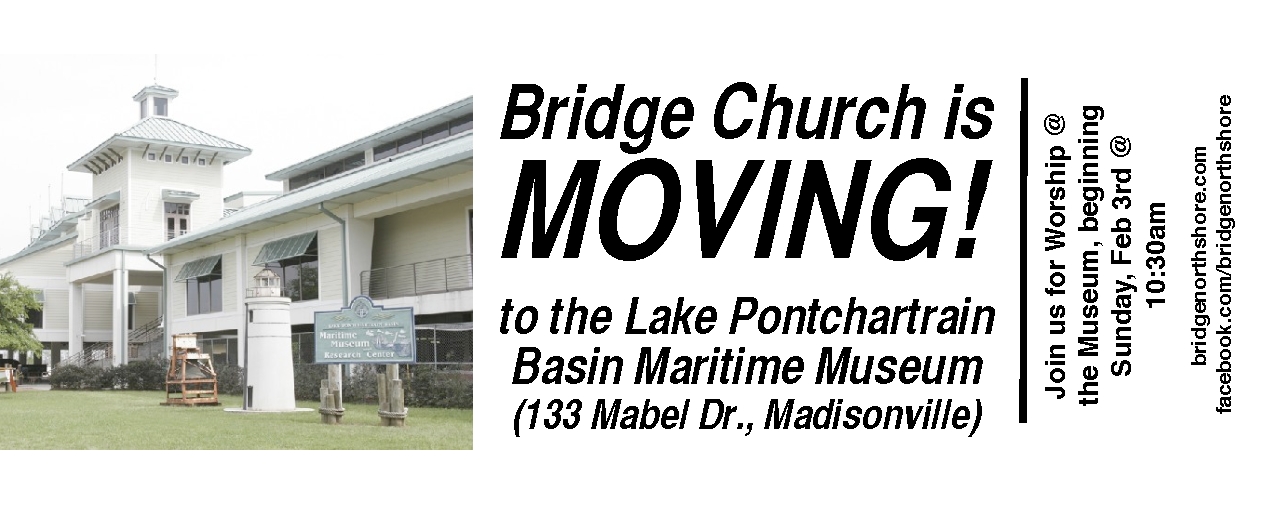
Beginning this weekend, February 3rd, Bridge Church will be gathering on Sunday’s 10:30am at the Lake Pontchartrain Basin Maritime Museum in Madisonville (Map It). Come early for coffee & donuts. More info about Bridge Church at BridgeNorthshore.com or Facebook.com/BridgeNorthshore.
“… when you pray… And when you fast” ~ Jesus, Matthew 6:5, 16
Jesus seemed to assume that prayer and fasting would be a part of the lives of his followers. He didn’t say “if” but “when.” With his assumptions we see again that spiritual disciplines were not just meant for the clergy, but for everyone. This month, Bridge Church will be participating with other churches in Louisiana in 21 Day’s Prayer and Fasting for Spiritual Awakening. With that in mind, here’s some basics on fasting from a few of my favorite books on the subject of prayer.
From Celebration of Discipline by Richard Foster:
- Fasting refers to abstaining from food for spiritual purposes. It’s not a hunger strike or a form of dieting. Biblical fasting always centers on spiritual purposes.
- Fasting must forever center on God. It must be God-initiated and God-ordained.
- More than any other discipline, fasting reveals the things that controls us. We cover up what is inside us with food and other good things, but in fasting these things surface.
- In Scripture the normal means of fasting involves abstaining from all food, solid or liquid, but not from water (Luke 4:2).
- Sometimes a partial fast is described. Like Daniel, “I ate no delicacies, no meat or wine entered my mouth” (Daniel 10:3).
Isaiah 58 is one of the best resources on fasting in the Bible. Tom Eliff in his great book, A Passion for Prayer shares an outline with us on improper and proper motivations for and the promised benefits of fasting:
Four Improper Reasons for Fasting:
- Fasting to get God’s attention (Isaiah 58:3a).
- Fasting w/o focusing on the Lord (Isaiah 58:3b).
- Fasting w/o humility of heart (Isaiah 58:4).
- Fasting for a brief external show of piety (Isaiah 58:5). Jesus spoke against this as well in Matthew 6:16-18.
Proper motivations for fasting (Isaiah 5:6-7):
- To bring spiritual liberation and freedom.
- To relieve heavy burdens.
- To increase our awareness of the needs of others.
God’s promised benefits for those who fast sincerely and seriously:
- Insight and understanding (v. 8)
- Physical well-being (v. 8)
- A deep sense of what is right (v.8)
- God’s presence to protect and provide (v. 8)
- A sense of immediate access to God (v. 9)
- Release from spiritual oppression (v. 10)
- Real-time guidance from God (v. 11)
- Satisfaction and joy during difficult times (v. 11)
- Increased strength to accomplish the Lord’s work (v. 11)
- Fruitfulness (v. 11)
- Recovering and restoring culture (v. 12)
- Rebuilding what was destroyed (v. 12)
Some Options for introducing fasting into your life:
As you consider fasting, before conducting an extended, lengthy complete or total fast from all food, consider your past health and conditioning and some of you may want to consult a doctor. Consider your work. If your work is rigorous then you need food for energy to give your best to your employer. A complete fast may not be for you at this point. Here are a few other options:
- One meal each day—The fast is not about only giving up food, but also includes praying during mealtime. Jesus said, “Could you not watch with me one hour?” (Matthew 26:40). It takes about an hour to prepare a meal or travel to a restaurant or get ready to eat. So this time is a perfect opportunity to pray. Those who work in hot exhausting jobs cannot fast completely because they need their strength and stamina for physical exertion. However, they can sacrifice one meal a day for the Lord.
- Two meals each day—Some people can pray for two hours each day, sacrificing two meals to the Lord.
- Eat only veggies—The Daniel Fast involves giving up meats, desserts and snacks, eating only the food that Daniel most likely ate. While the fast doesn’t give extra time to pray, it is a commitment of the heart that when joined with prayer, moves the heart of God.
- Give up television—Secular people might laugh at “fasting television” or “sacrificing television” but it is a commitment to God to place loyalty to Christ first above all else. This is a spiritual choice in response to Christ, who promises, “Seek first the kingdom of God and His righteousness, and all these things shall be added unto you” (Matthew 6:33).
- Give up sports—Giving up bowling league, golfing, fishing, jogging or other activity for a season (such as 40 days) to pray during that time is a choice. It places spiritual exercise above physical exercise.“Bodily exercise profits little, but godliness is profitable for all things” (1Timothy 4:8).
- Give up pleasure reading—Beyond what you must read for your work or preparing for teaching the Word of God, pleasure reading could be turned into prayer time. You could consider laying aside reading the daily newspaper too.
- Restrict mobile phone use and text messaging—While some of these communication devices are necessary, they are serious time robbers that could be placed aside for praying.
- Facebook and other social media—These activities can consume huge chunks of time. Part of a fast could be to cease social media and use the time for prayer and intercession.
- Other—There may be something that the Holy Spirit brings to mind that you could place aside for a season while you focus on more prayer.
The Daniel Food Fast
Also check out www.ultimatedanielfast.com & www.danielplan.com/ for info, recipes, & more.
The Daniel Food Fast is a very healthy way to eat. So health professionals will support this eating plan but might suggest a few modifications if you have health issues that need special attention. For example, pregnant and nursing mothers might get instructions to add fish, chicken and cheese into the Daniel Food Fast but otherwise stay the course. Diabetics may need to add more carbohydrates or include chicken and fish. Also, those who are especially active either through sports, bodybuilding or vocation may need to slightly alter the eating plan. I encourage you to check with your doctor . . . and by the way, being addicted to Snickers and Coke don’t count as a special need!
What is the Daniel Food Fast?
The Daniel Food Fast is a biblically based partial fast. It is a method of fasting that men, women and young people all over the world are using as they enter into the spiritual discipline of prayer and fasting.
There are two anchoring scriptures for the Daniel Food Fast. In Daniel 1, the Prophet ate only vegetables (that would have included fruits) and drank only water. So from these scriptures we get two of the guidelines for the fast:
1. Only fruits and vegetables
2. Only water for a beverage
Then in Daniel 10, we read that the Prophet ate no meat nor any precious breads or foods and he drank no wine for 21 days. So from this scripture, we get a third guideline:
3. No sweeteners and no breads
Another important guideline is drawn from Jewish fasting principles, where no leaven is used during the fast. So that’s why yeast, baking powder and the like are not allowed on the Daniel Food Fast.
Check out www.danielplan.com & www.ultimatedanielfast.com for more info, including recipes.
Other resources for your 21 Day’s of Prayer & Fasting:
Home for the Holidays: Maddie & Grady Jenkins
Maddie & Grady Jenkins lived in their Madisonville home for 50 of their 58 married years. Isaac’s surge sent over two feet of water into the house 
 and they’ve been displaced since that time. Several of our churches have been working on this project with the goal of getting them back in by Christmas. Here’s a list of things still to be done in case you, your church, or your personal network could help with this project over the next few weeks:
- Painting! Next week we’ll be ready for paint. The house will be open all week if anyone would like to volunteer some time.
- Floors! We are in need of someone to sand & refinish the floors. Anyone know how, enjoy, know someone, etc.?
- Trim & Doors! The trim will need to be painted white then installed. It will be ready to paint next week.
- Furniture still needed: Refrigerator. 36×68 inch.
We have at least three more elderly homeowners in Madisonville still to be done. Let me know if you’re up for a spring mission trip to SE Louisiana to help with one of these projects.
Christian, What are You’re Neighbors Saying About You?
“Conduct yourselves wisely toward outsiders, making the best use of the time” Colossians 4:5
This morning our church hit chapter 4 in our study of Colossians & reflected on how our CONDUCT relates to God’s mission. Our conduct is simply the way we live and this verse reminds us that the way we live can be a witness to the Gospel. So we must be mindful of others spiritual condition, be mindful of our attitude & behavior, & look for opportunities to serve others. People outside of the faith will be very important to true Christians, because our mission involves spreading the Christ-message to others (Matthew 28:18-20, Acts 1:8, Colossians 1:28-29).
A few weeks ago Thom Rainer shared some research on common comments non-Christians say about Christians that are instructive when considering our conduct & witness.
- Christians are against more things than they are for. “It just seems to me that Christians are mad at the world and mad at each other. They are so negative that they seem unhappy. I have no desire to be like them and stay upset all the time.”
- I would like to develop a friendship with a Christian. “I’m really interested in what they believe and how they carry out their beliefs. I wish I could find a Christian that would be willing to spend some time with me.”
- I would like to learn about the Bible from a Christian. “The Bible really fascinates me, but I don’t want to go to a stuffy and legalistic church to learn about it. I would be nice if a Christian invited me to study the Bible in his home or at a place like Starbucks.”
- I don’t see much difference in the way Christians live compared to others. “I really can’t tell what a Christian believes because he doesn’t seem much different than other people I know. The only exception would be Mormons. They really seem to take their beliefs seriously.”
- I wish I could learn to be a better husband, wife, dad, mom, etc., from a Christian.“My wife is threatening to divorce me, and I think she means it this time. My neighbor is a Christian, and he seems to have it together. I am swallowing my pride and asking him to help me.”
- Some Christians try to act like they have no problems. “Harriett works in my department. She is one of those Christians who seem to have a mask on. I would respect her more if she didn’t put on such an act. I know better.”
- I wish a Christian would take me to his or her church. “I really would like to visit a church, but I’m not particularly comfortable going by myself. What is weird is that I am 32-years old, and I’ve never had a Christian invite me to church in my entire life.”
Are there people in your community saying this about you? How could you change their perception? How could you engage them? Anything surprising? Are you ready to answer the questions of outsiders? If not, why?
Next time: Why CONDUCT is good, but not a complete witness toward others…
#FaithinAction Sunday Recap:
“not to be served, but to serve” Matthew 20:28 (NLT)
Our Faith in Action Sunday was wet, but we were able to serve several residents in the Madisonville area. Big thanks to those who were able to make it out for Bridge Church’s last official FIA of 2012. We were able to move two homeowners that suffered flooding from Isaac forward in their recovery. We also took care of a couple of remaining downed trees. And delivered “We Care” baskets & baked goods to 10 or so residents. We even had some visitors show up at 10:30am for our Worship Gathering & they jumped in & served as well. We also had an East St. Tammany congregation who are exploring starting their own Faith in Action Sunday join us for the experience.
I love Faith in Action Sunday b/c…
- it’s unscripted, like our lives & the lives of those we serve. Flexibility is required & makes stretching our faith & relying upon the power of Another possible.
- it reminds me of how many needs there are in my community. I drive by them everyday, seldom thinking about what’s on the other side of the fence or door.
- it reminds me that I can make a big difference. Things that are simple for me (changing a lock, fixing a shower head, cutting up a downed limb, believing that someone cares about my needs) are HUGE issues for someone else.
- it makes way for “along the way” relationships & discipleship. Serving & sharing with someone builds deeper relationships connections than just sitting beside them in a service.
- Playing w/power tools is just one of the cool things about Faith in Action Sunday.
- it adds something rich to the story of our lives. Jackson, our 10 year old, was telling the story at the bus stop this morning.
We fall short if putting our Faith in Action is just a date on the calendar. Jesus said he came “not to be served, but to serve” Matthew 20:28 (NLT). That’s the way of life for a true follower of Christ. So let’s keep looking for opportunities & courageously doing our part to follow Christ.
More info about Faith in Action Sunday here, including recap videos from previous FIA’s & answers to the question “why?”
Why Small Groups?
This video takes a look at some common excuses and reasons why Small Groups are an important part of life IN Christ. Christianity is about Relationships: with God and with others, around the open Bible, and around God’s mission. Small Groups are the best place for that to happen. Feel free to use. Jump into a small group ASAP. Email me (lane@bridgenorthshore.com) about some of the groups meeting at Bridge Church.
Faith in Action Needed
Dirt floors, no running water, the stench of open sewage, rats eating through the walls. This describes a home, not in a third world country, but in a wealthy suburban community in St. Tammany Parish. We found this family 3 years ago & I couldn’t believe the conditions they were living in. I told other people about it and they said, “I drive by that house all the time. I had no idea.” Over the past few years, Bridge Church, through Faith in Action has tried to improve their quality of life & be an encouragement to this family. This week, I’m excited for them, b/c they’re finally getting new floors thanks to Volunteers of America & on Sunday, during our quarterly Faith In Action Sunday we’ll be making other repairs to the home as well as cleaning up the yard. Still much left to do beyond new floors. They are still w/o running water to parts of the house & they have a lot of electrical problems.
Faith in Action Sunday is about not being content with just driving by. I don’t want to be a Drive By Disciple. Driving by the needs of the world on my way to church meetings. Through Faith in Action, we can bring Good News to neighborhoods in Tangible ways & keep the story of God’s provision & work spreading.
Every time there’s a 5th Sunday in a month we take that week and serve instead of soak. Check out some of the reasons why & videos from past FIA Sunday’s here. Check out some of our other projects for this FIA Weekend here. Also, suggest a project as you see the needs of your community.

Disabled sons bedroom.

Living room with new floor joists.

Back door. Porch repairs to be made Sunday.
Have You Been Squeezed Lately?
Each week us church goers, like sponges, sit and soak up great teaching and preaching from professional and highly trained clergy, high quality Bible Study materials and devotionals, praise and worship music that moves us to experience God, and many, like me, listen to more great teaching and preaching through podcasting and conferences. Here’s the question: What’s next for the SPONGE after it’s has soaked? It SOURS and becomes unusable. Almost nothing is more disgusting than a sour sponge. No one wants to pick it up, it stinks up the entire kitchen, and most of the time at our house we just throw them out.
As a Christian, I’ve had seasons of my life that can be described as SOUR. The sour Christian is sour toward others – nothing meets their standard, no sermon is good enough, they and their class or group or church are the only ones doing it right. No one wants to be around the sour Christian and he/she doesn’t really care to be around them. Being right matters more than being generous and graceful. (For a Biblical illustration of a Sour Christian see the story of the Prodigal Son in Luke 15:11-32 and watch for the older Brother).
What’s the remedy for keeping sponges from getting sour in the sink and in the church? A GOOD SQUEEZE. A good wringing out. With the sponge, by hand. But how is the Christian squeezed? Two ways:
1) Through Suffering. When I’ve lost a loved one, or experienced discouragement, or dealt with sickness, or faced financial struggles, or walked with others who’ve experienced these and worse, I have been squeezed. I have had to put to use all that I know about God and His word. That’s why God’s word tells us that there is great benefit to suffering. See James 1:2-4, Romans 5:3-5.
2) Through Serving. You don’t have to wait to be squeezed through suffering. Give yourself away and be emptied out through serving others. As we give ourselves away as Christians, we are allowing God to squeeze us and use what He’s placed in us for His good and glory. As we serve others, we experience more of God and the joy of being used by Him and He continually fills us.
What are you doing that squeezes you? Church leader, is your church providing opportunities for people to serve and give themselves away on behalf of others?
This weekend, my faith family will be squeezing ourselves out through Faith in Action Sunday. Every time there’s a 5th Sunday in a month we take that week and serve instead of soak. Check out some of the reasons why & videos from past FIA Sunday’s here. Check out some of our projects for this FIA Weekend here.
Everyone is invited. Come out and get squeezed with us.


 Lane Corley