Author Archives: Lane Corley
What is Lent Anyway?
This week marks the beginning of a major religious celebration around the world called Lent. In our area it means FRIDAY’S ARE FOR SEAFOOD! What is Lent exactly? In Brief:
For Roman Catholics, the Eastern Orthodox Church, and other liturgical protestant denominations (those with a continuous history before AD 1500) Lent is the forty day period from Ash Wednesday to Holy Saturday. It is to be a season of soul-searching and repentance. It can be loosely traced to the early days of the church, but was certainly less formal (most scholars believe the time of fasting was two to three days and not forty) and of course much more spiritual. Lent, as we know it today, originated in the fourth century and has changed in practice throughout the years. In AD 325, the Council of Nicea discussed a forty day season of fasting and preparation for new converts to be baptized. In the seventh century, Gregory the Great moved the beginning of Lent from Sunday to Wednesday, now called Ash Wednesday. He is also credited with beginning the ceremony of marking foreheads with ashes, as a symbol of repentance taken from the Old Testament. The practice of fasting during Lent has become more relaxed over the centuries and in 1966, the Roman Catholic Church restricted fast days to Ash Wednesday and Good Friday.
Having moved to South Louisiana just 10 years ago, I have observed that Lent is practiced but not understood by many. Even many irreligious people will give up something of value (if you count chocolate, certain adult drinks, coffee, or some other modern convenience that doesn’t really affect a person’s way of life as valuable) and will abstain from meat on Friday. When asked the purpose behind this, the person will say, “I’m not sure,” or take a great guess that would fool everyone if they were playing the board game Balderdash. Herein lies the problem with modern spirituality – it’s long on activity and short on meaning and understanding.
Too often we use religious expression, such as Lent, as a means to fit in, to feel better about ourselves, but not to understand and conform to God’s desire for our lives. In many ways Lent illustrates our lack of understanding about God and His will for humanity. Many people give up for forty days what they know they shouldn’t be doing anyway. In the 2002, movie 40 Days and 40 Nights, a single man vows to stay celibate during Lent, but meets the girl of his dreams and regrets being unable to rebel against God’s commands concerning sexual purity (1 Thessalonians 4:3-8) and to “let the marriage bed be undefiled” (Hebrews 13:4) until Lent is over. As this movie illustrates, some people may see Lent as a window of time to be serious about their faith. I tend to believe God deserves and expects 365 days of devotion and obedience, not just forty.
A somber season of soul-searching and repentance, which includes fasting, is necessary for our generation. I don’t search my soul when I give up my favorite commodity but when I understand and get a glimpse of what God has done for me through Jesus Christ. His suffering, His sacrifice, and His love should make us forget modernity for awhile and focus ourselves on repentance and new life that Christ’s death and resurrection make possible.
So how should we view Lent? One 19th Century preacher called it “The Season of the Cross.” I like that. It’s the cross that is the centerpiece of our faith (1 Corinthians 15:3) and it’s the cross that we are called to carry (Luke 9:23). So, join me during the season of the cross and do more than just mark your calendar and do without some material luxury. Let’s increase our awareness of Christ’s love and His desire for our lives. We may find ourselves gaining more, spiritually, than we could ever give up in 40 days.
Worth Reading: The Hole in Our Gospel by Richard Stearns
 Very challenging book that I will revisit often. Richard Stearns, President of World Vision, USA, paints a vivid picture of the major needs of the world and how making a difference is possible for every one of us. Today’s church needs to be reminded that we are saved for a mission and invited to join God on His mission in the world. The things I see God doing in scripture are giving radically (John 3:16), transforming people (2 Cor 5:17), AND caring for the needs of the poor and destitute (James 1:26-27). This book calls us back to that way of life. Stearns gives details of his very personal struggle with the Gospel, with having compassion for the least, with obeying God when that means inconvenience, pay cuts, and career changes. The Hole in Our Gospel will be helpful on the shelves of communicators, with many stories from the World Vision fields, statistics on the needs of the world, and quotes on the Christian life. Great book. Well worth reading. Here are a few of my favorite quotes and meaningful stats:
Northshore Seminary Extension starting Feb 23rd
Excited to announce that we will have an Extension of New Orleans Baptist Theological Seminary on the Northshore beginning this month. The classes will meet for now at the offices of the Northshore Baptist Associations at 11411 McLaughlin Lane in Hammond. On February 23rd there will be an orientation meeting. Below is a memo from our local “Dean” (my title for him), Randy Davis. He will teach the first class.
Dear Co-Laborer,
The Plans for our North Shore Seminary Extension Center are finalized. We have been approved by New Orleans Baptist Theological Seminary, so we are ready to get started.
We will have an orientation meeting on Tuesday, February 23, at 7:00 p.m. at the Clegg Missions and Ministry Center (11411 McLaughlin Lane, Hammond LA 70403). I will tell you about the costs, the textbook and where you can find it. We will discuss the class schedule. If you are interested in taking the class you need to be there for the meeting or get in touch with me and let me know. Once the class starts it will be very important that you not miss a class. We will meet once a week for two hours. This will last for 8 weeks.
One final bit of information you need. Each class is a one-hour class. The survey of the New Testament will be covered in three separate classes and each class will be for one hour of college credit. There is a one-time registration fee of $25.00 and each course will cost $100.00.
The best way to contact me is by email, randy@kudzuvine.org. I hope to see you at the orientation meeting.
Randy Davis
Let me or Dr. Davis know if you have any questions. The course work is part of the Certificate Program at New Orleans Seminary. One hour of college credit is earned with each course. This will be a great opportunity for those who have always wanted, but never had the opportunity for theological education, those who just want to stay sharp in a continuing Education kind of way, or for those who are mulling around with starting their theological training formerly. Hopefully, the program will grow and more courses can be offered in the future. Thanks to Randy and Dr. David Cranford for their work to get this program kicked off on the Northshore.
Small Things, Big Breakthroughs
 Planting a church I’ve learned to celebrate the small things. A big pile of them will often produce big breakthroughs. Last year we identified the needs of a large local trailer park and began doing whatever we could to serve the residents. That’s included delivering food to needy residents, cutting trees, pressure washing trailers, building handicap ramps, picking up trash, throwing block parties for kids, assisting park management with domestic issues, and a Christmas toy drive for kids in the park. We’ve built significant relationships, several residents have began a relationship with Christ, and tomorrow night we are launching a small group Bible Study in the park. Thanks God for opportunities and breakthroughs. Looking forward to more big breakthroughs in the lives of people.
Faith In Action Sunday UPDATE
“He gave Himself for us to redeem us from all lawlessness and to cleanse for Himself a special people, eager to do good works” Titus 2:14 (HCSB)
Enjoyed serving yesterday with my church. Several great projects knocked out during our first Faith in Action Sunday of 2010. Next FIA will be in May.

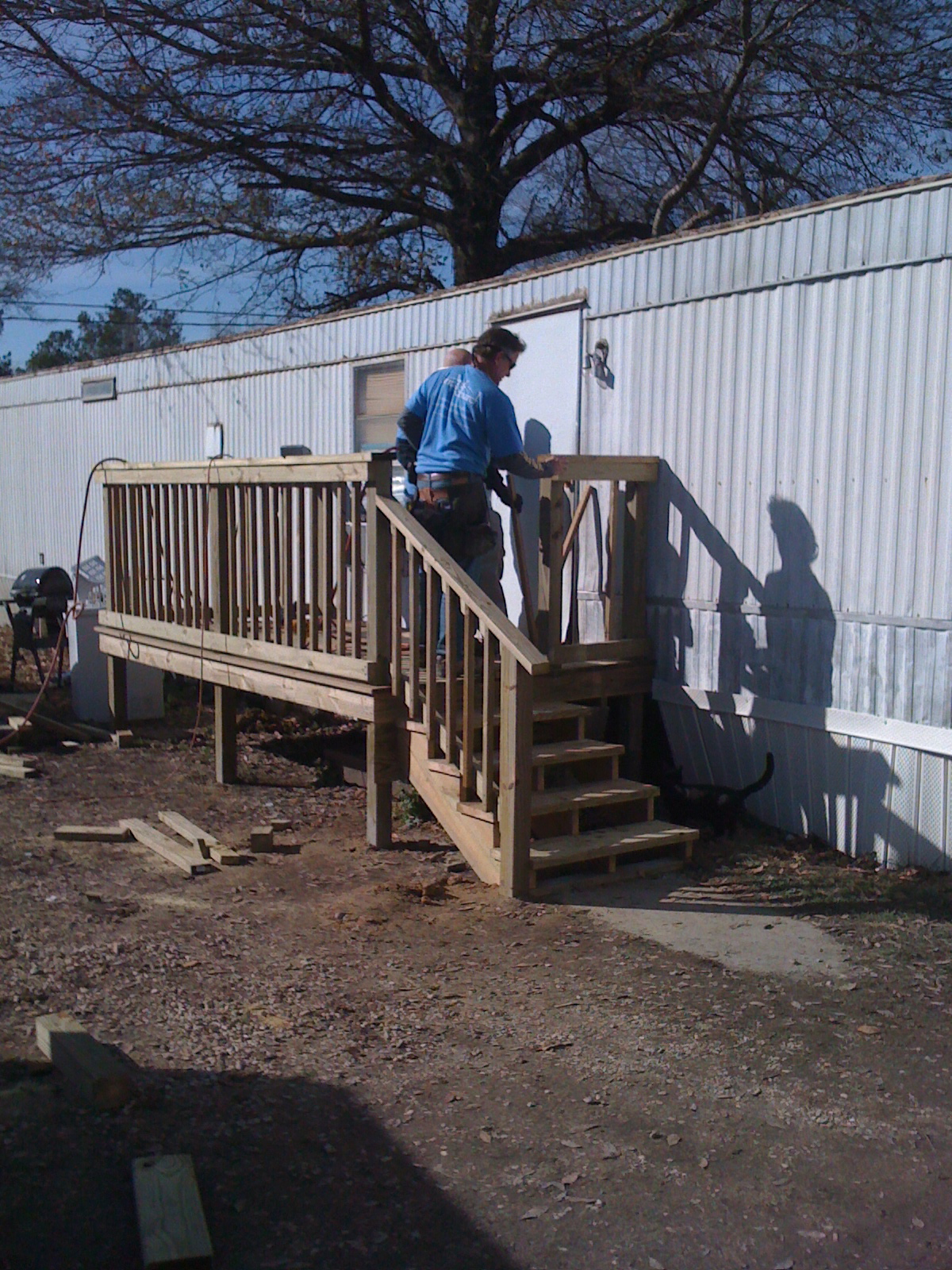
A value we’ve communicated at Bridge Church is Intentional Ministry. To act upon that we’ve began quarterly Faith in Action Sunday’s. That is, one Sunday per quarter, we have breakfast together, an abbreviated worship gathering and we head out to serve our community in practical ways. Why? Here’s a few reasons:
- To be intentional about the sending nature of the church.
- To make disciples who understand that the Christian life is about more than just attending worship services.
- To engage the real needs that we often never notice on our way to church.
- To build group cohesiveness as we accomplish big things together.
- Ministry and mission trips are proven ways to transform our worldviews.
- To demonstrate radical generosity that Jesus modeled for us in his life and death.
- To share the gospel outside the walls of the church.
- To bring about community transformation.
- To join God in fighting for the rights of the poor and down trodden.
- To create a culture of intentionality, going and sending, compassion and engagement, radical generosity, and sharing the Gospel.
Here are a few of our projects for this Sunday:
 A porch/ramp for the residents of this mobile home. Two of the three people living here have suffered multiple strokes. It’s a struggle to get in and out of their home. A porch and ramp are needed to improve their quality of life.

Clean up for the elderly resident of a local trailer park. His mode of transportation is a bike, so he is unable to haulaway debris. We’ll also be weatherizing this and other trailers.
Serving at an area Nursing Home. Our kids ministry will be bringing some joy to one of our largest Nursing Homes in the region by helping decorate for Valentine’s Day, serving lunch, and calling out Bingo numbers for the residents.
Practical, simple, inexpensive ways to make a difference in our community and in our vision for our community and world. Looking forward to the after affect of Intentional Ministry.
Ten Reasons Why Small Churches Tend To Stay Small
Loved these post (part 1, part 2) by Dr. Joe McKeever on Ten Reason Why Small Churches Tend to Stay Small.
Not that small in numbers is necessarily bad as Dr. Mckeever explains here:
By using the word “grow,” I do not mean numbers for numbers sake. I do not subscribe to the fallacy that bigness is good and small churches are failures. What I mean by “grow” is reaching people with the gospel of Jesus Christ. If you reach them and start new churches, your local church may not expand numerically, but it is most definitely “growing.” If you are located in a town that is losing population and your church manages to stay the same size, you’re probably “growing”
Health and growth and discipling are the real issues. Big and small churches can get stuck in the rut of doing church without spiritual fruit and reproduction of disciples. Dr. McKeever gives us some practical words on recognizing and climbing out of possible ruts and hindrances to health and growth. Here’s the ten:
- Wanting to stay small. “We like our church just the way it is.”
- A quick turnover of pastors.
- Domination by a few strong members. A “church boss” frustrates the pastors initiatives and controls his tendencies. Diotrephes in III John is a great example. He “loves to have the pre-eminence.”
- Not trusting the leaders. Micromanaging the churches every move, demanding to know every penny’s whereabouts and who squashed every bug.
- Inferiority complex. “We can’t do anything because we’re small. We don’t have the kind of money other churches have.”
- No plan. Going through the motions of all churches everywhere with no vision for reaching their specific community.
- Bad health. Always bickering, unable to make simple decisions, running the pastor off every two years. Romans 12 is a good place to start to get healthy.
- Lousy fellowship. A failure of the most basic kind – a failure to love.
- A state of neglect. Dying churches do not tend to their business. Problems fester and divisions go unaddressed.
- No prayer. Love this suggestion by Dr. McKeever:
“Want to give your congregation a little test, pastor? Next Sunday, call for your people to meet you at the altar for a time of prayer. Do not beg them or cajole them. Just announce it, then walk there yourself, kneel and begin praying. See if anyone joins you. Notice who comes and pay close attention to who does not.”
Much wisdom here. Hope you’ll read the whole article and think through how you can help move your church past these issues to health and growth or help stay away from them if you are healthy and growing.
Follow Joe everyday at his blog – www.joemckeever.com.
Faith in Action Sunday this Weekend!
A value we’ve communicated at Bridge Church is Intentional Ministry. To act upon that we’ve began quarterly Faith in Action Sunday’s. That is, one Sunday per quarter, we have breakfast together, an abbreviated worship gathering and we head out to serve our community in practical ways. Why? Here’s a few reasons:
- To be intentional about the sending nature of the church.
- To make disciples who understand that the Christian life is about more than just attending worship services.
- To engage the real needs that we often never notice on our way to church.
- To build group cohesiveness as we accomplish big things together.
- Ministry and mission trips are proven ways to transform our worldviews.
- To demonstrate radical generosity that Jesus modeled for us in his life and death.
- To share the gospel outside the walls of the church.
- To bring about community transformation.
- To join God in fighting for the rights of the poor and down trodden.
- To create a culture of intentionality, going and sending, compassion and engagement, radical generosity, and sharing the Gospel.
Here are a few of our projects for this Sunday:
A porch/ramp for the residents of this mobile home. Two of the three people living here have suffered multiple strokes. It’s a struggle to get in and out of their home. A porch and ramp are needed to improve their quality of life.
Clean up for the elderly resident of a local trailer park. His mode of transportation is a bike, so he is unable to haulaway debris. We’ll also be weatherizing this and other trailers.
Serving at an area Nursing Home. Our kids ministry will be bringing some joy to one of our largest Nursing Homes in the region by helping decorate for Valentine’s Day, serving lunch, and calling out Bingo numbers for the residents.
Practical, simple, inexpensive ways to make a difference in our community and in our vision for our community and world. Looking forward to the after affect of Intentional Ministry.
Matthew 25, Even Closer to Home
Reading Richard Stearns, the President of World Vision‘s book The Hole in our Gospel. Challenging story concerning God’s desire for us to engage the least. Talking about Matthew 25‘s call to tangible acts of obedience by Christ followers, Stearns gives this interesting paraphrase of verses 35-36.
“For I was hungry, while you had all you needed. I was thirsty, but you drank bottled water. I was a stranger, and you wanted me deported. I needed clothes, but you needed more clothes. I was sick, and you pointed out the behaviors that led to my sickness. I was in prison, and you said I was getting what I deserved.” Matthew 25:35-36 paraphrased by Richard Stearns.
How do you see the needs of others? Matthew 25:31-40 points us to the conclusion that “the righteous” are defined by Christ as those who acted in tangible ways on behalf of those in need. Not SO THAT righteousness can be gained (Galatians 2:16; Ephesians 2:8-9; Titus 3:5), but as evidence of His righteousness within (2 Corinthians 5:21). There are miriad opportunities that God will lead us to to give our food, drink, homes, clothes, concern, and love to others. Will we obey?
In Good Company

John the Baptists ate bugs!
If you find yourself pointing at your weaknesses and or your past mistakes as an excuse for not serving God or allowing him to shape your life, then think about some of the folks in the Bible that God used:
- Moses Stuttered
- David’s armor didn’t fit
- Timothy had ulcers
- Hosea’s wife was a prostitute
- Jacob was a liar
- David had an affair
- Solomon was too rich
- Jesus was too poor
- Abraham was too old
- David was too young
- Peter was a loud mouth
- Lazarus was dead
- Naomi was a widow
- Paul was a murderer
- So was Moses
- Jonah ran from God
- Miriam was a gossip
- Gideon doubted
- Jeremiah was depressed
- Elijah was burned out
- John the Baptist ate bugs
- Martha was a worry wart
- Mary was lazy
- Samson had long hair
- Noah got drunk
No one is out of God’s reach. Nothing you have done is too much for God’s grace. Jesus took all your sin on the cross. Get over your past and allow him to make you what you are not.
Church as a Connection Point
When thinking about the nature of the church, should we think of it as a destination or a connection point? Stated a little clearer: Is the church a resort or an airport? A resort is a destination or a place you go to relax, be refreshed, and be waited on. An airport is a place of connection or somewhere you are while waiting to GO. Reggie McNeal asked this question in his helpful book Missional Renaissance: Changing the Scorecard for the Church. Jason Dukes in his book Live Sent: You Are A Letter, likens the church to a Post Office, sending out letters written by God into the world. And of course an unsent letter is no good to anyone.
As I think about the New Testament church and the images of going and sending found there, I have to suggest that the church is not the destination for the believer. It’s a connection point to life in Christ, to the mission of Christ in the world, and to a life given away for the sake of others inside and outside the fellowship of believers.
Semantics? OK. But the implication for leaders and disciplers who devise strategy and plan ministry can be huge. Do you have a plan to send and release people into the community regularly and consistently? Do you reward people for their work done in Jesus’ name off campus or in unsponsored church activities? Is your discipling process producing Christians who are looking outward, engaging the unchurched, and actively giving themselves away as a way of life? The answer to these questions may suggest a mindset that makes the church either a connection point or the destination.
Jason Dukes says in Live Sent, “church culture has made discipleship about retention more than release.” While we must plan for assimilation and discipleship and life in the body, lets remember that God’s destination for His church is out there – see Matthew 28:18-20, Acts 1:8, 2 Corinthians 5:17-21.